
Share this post:
China Builds the World's Largest AI Virtual Film Studios
China is deploying AI powered virtual production at a scale no other country has attempted. A network of new facilities spanning Zhejiang, Jiangsu, and Chongqing provinces now offers filmmakers LED volumes, AI asset libraries, and automated workflows that compress months of location shooting into days of indoor production. The ambition behind these studios is what Chinese industry leaders call "grand realism," the pursuit of cinematic spectacle without the logistical and financial burden of physical sets.
The Deqing AI Virtual Film Base
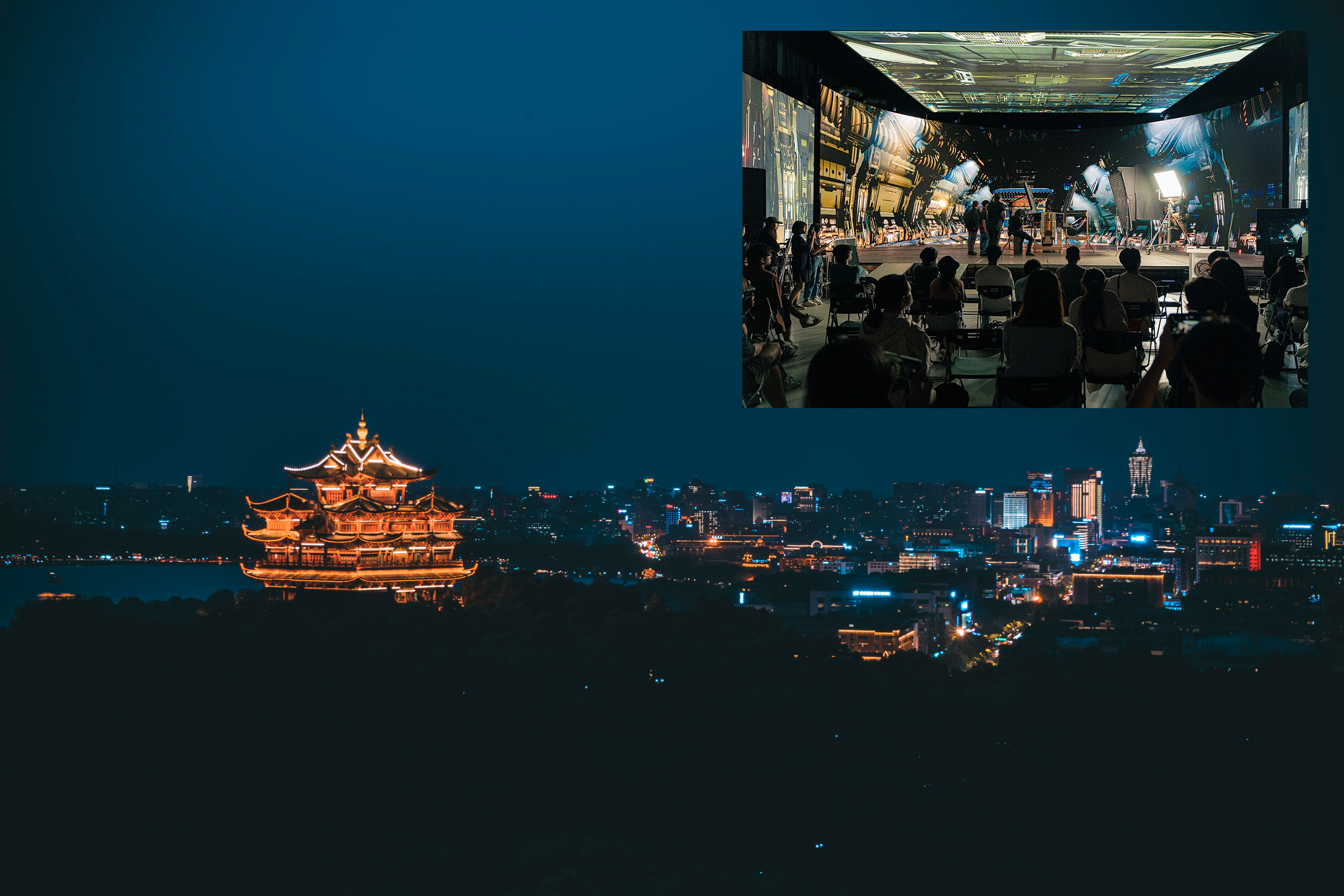
The flagship facility sits in Deqing, Zhejiang Province. Opened in July 2025 by Hangzhou based Versatile Media, the base spans 100,000 square meters and houses five LED virtual studios. Its centerpiece is a 270 degree curved LED screen measuring 50 meters in diameter and 12 meters in height, covering 1,700 square meters of display area with over 600 million pixels. According to both Absen (the LED hardware partner) and industry body AVIXA, it is the world's largest monolithic LED virtual production volume.
Niu Cong, project coordinator at Versatile Media, framed the economic logic plainly: "Shooting on location is difficult and expensive, especially for long periods. The virtual studio fulfills creative needs. That's why we bring a whole stadium indoors." The approach eliminates weather delays, travel logistics, and the single use nature of physical sets. "Now, virtual assets stay in digital libraries and can be reused," Niu added, pointing to a growing archive of environments that any production can license.
Since opening, the Deqing base has hosted more than 30 film and television projects. Nearly 10 companies have already signed production contracts for 2026, and 89 AI generated short drama projects are planned for the year ahead.
Yangzhou's Water Stage
In Yangzhou, Jiangsu Province, a complementary facility tackles one of cinema's most expensive challenges: water scenes. The studio can simulate over 200 wave types through computer controlled systems, generating waves up to three meters high across a 35 meter wide tank. The pool reaches 11 meters deep for underwater shooting sequences and can heat 32 degrees Celsius within 24 hours, allowing crews to film tropical ocean scenes in any season.
.jpg)
For a film industry that has historically relied on coastal location shoots or expensive tank facilities abroad, the Yangzhou studio offers a controlled alternative. Combined with LED backdrops that display ocean horizons or storm environments in real time, the facility allows directors to stage maritime sequences entirely indoors.
Chongqing's Digital Set Workshop
The Yongchuan Science and Technology Film Studio in Chongqing, operated by Dawa Imaging Technology, represents the most data driven approach in the network. Built in May 2023, it has scaled rapidly. In the first half of 2025 alone, the facility hosted 25 film and television productions and generated over 70 million yuan (approximately $9.7 million) in revenue, already exceeding its full year 2024 totals.
The studio runs at a 90% utilization rate, the highest of any virtual production facility in China according to iChongqing reporting. Its AI pipeline automatically matches scripts with stored digital assets and generates preliminary sequences, delivering efficiency gains of 60 to 70% compared to traditional pre production workflows. Overall, productions using the facility report 55% faster shooting timelines and up to 90% reduction in large scale set construction costs.
Director Bi Gan's film "Resurrection" provided an early proof point: the production completed over 30% of its footage using virtual production in a single month, reportedly saving 30 million yuan in staffing and logistics costs. It marked the first Chinese feature film to exceed that threshold of virtual production footage.
The Industrial Logic Behind "Grand Realism"
Wang Shu of the China Science Writers Association described the shift in stark terms: "The application of AI technology brings a revolution to the filmmaking workflow." The statement captures a broader consensus forming across China's entertainment sector. Rather than treating AI as an experimental tool, studios are building permanent infrastructure around it.
The trend extends beyond these three facilities. Tencent's Sun Zhonghuai predicted at a recent industry summit that roughly 30% of long form film and animation content will be significantly influenced by AI within two years, with concrete applications in concept design, previsualization, rotoscoping, and building digital sets for virtual production. Variety reported on his framing of AI as augmentation rather than replacement, though the workforce implications remain an active discussion.
At the academic level, Chen Xuguang of Peking University's Institute of Film, Television and Theatre envisions filmmaking evolving into "a lightweight, AI enhanced model" where small teams or individuals can drive full production workflows. Rao Shuguang, president of the China Film Critics Association, echoed the urgency: filmmakers must rapidly adopt AI technology or risk being surpassed by competitors who do. By June 2024, 230 million Chinese (16.4% of the population) were already using generative AI products, according to the China Internet Network Information Center.
What This Means for Global Production
China's virtual production buildout is not happening in isolation. Hollywood has its own LED volume ecosystem, from ILM's StageCraft (used on "The Mandalorian") to facilities operated by companies like Pixomondo and Dimension Studio. But the Chinese approach differs in scale and integration. The Deqing base alone, with its five studios and 100,000 square meter footprint, dwarfs most Western equivalents. More significantly, these facilities embed AI into the pipeline from script analysis to asset generation to final shooting, rather than treating virtual production and AI as separate capabilities.
For independent filmmakers and smaller studios, platforms like AI FILMS Studio offer access to AI video generation tools that mirror some of these capabilities at a fraction of the infrastructure cost. The ability to generate environments, match lighting, and produce preliminary sequences through AI is no longer exclusive to facilities that cost hundreds of millions to build.
The Chinese facilities documented by Xinhua also connect to a broader pattern at Hengdian World Studios, where AI powered micro drama production has already transformed the economics of short form content. Together, these developments suggest that AI virtual production is moving from experimental to industrial, and China is building the physical infrastructure to prove it.
Sources
Xinhua News Agency: "AI-powered virtual technologies elevate Chinese filmmaking via grand realism, efficiency" Published: February 22, 2026 https://english.news.cn/20260222/168a4ded7bc848fb9d42c7f764b95cf4/c.html
TV Technology: "Absen and Versatile Unveil World's Largest LED Virtual Production Volume" https://www.tvtechnology.com/news/absen-and-versatile-unveil-worlds-largest-led-virtual-production-volume
AVIXA: "Largest LED Virtual Production Volume Debuts in China" https://www.avixa.org/pro-av-trends/articles/largest-LED-virtual-production-volume
iChongqing: "Lights, Camera, AI: Chongqing Studio Sets National Record" Published: October 1, 2025 https://www.ichongqing.info/2025/10/01/lights-camera-ai-chongqing-studio-sets-national-record/
Variety: "AI Could Drive a Third of Film and Animation by 2026, Says Tencent's Sun Zhonghuai" https://variety.com/2025/film/festivals/ai-film-animation-2026-tencent-1236601955/
Asia News Network: "Artificial intelligence revolutionises the Chinese film industry" https://asianews.network/artificial-intelligence-revolutionises-the-chinese-film-industry/
Continue Reading
.jpg?w=3840)


Video & LipSync
- Video Generator
- Text to Video
- Image to Video
- Start-End Frame to Video
- Draw to Video
- Motion Control
- Video Enhancer
- Video Upscaler
- Video Extend
- Video to Video LipSync
- Audio to Video LipSync
- Image to Video LipSync
- Video FaceSwap
- Seedance 2.5
- WAN 3.0
- Seedance 2
- FLUX 3
- Minimax H3
- Vidu Q3 Pro
- Grok Imagine Video 1.5
- Gemini Omni
- Google Veo 3.1
- Kling 3.0 Pro
- Luma Ray 3.2
- LTX 2.3
- Happy Horse 1.1
- Kling 3.0 Motion
- ByteDance Upscaler
- InfiniteTalk
- InsightFace
Image & Edit
- AI Character
- AI Actor
- Art Generator
- Text to Image
- Image to Image
- LoRA Image to Image
- Draw to Edit
- Image LoRA Training
- Remove Background
- Image Enhancer
- MidJourney 8.0
- Krea 2
- OpenAI GPT Image 2.0
- Nano Banana Pro Ultra
- Nano Banana 2 Lite
- Nano Banana Pro
- Minimax Image
- Clarity Pro
- Z-Image Turbo LoRA
- Krea 2 Turbo LoRA
- Z-Image LoRA Trainer
- Qwen Image LoRA Trainer
- Background Erase Network 2 (BEN2)