

Skywork AI (Apache 2.0)
Share this post:
SkyReels V2 DF: Open Source Long Video Generation AI
A major limitation of standard Diffusion Transformer (DiT) video models is their fixed temporal window. Most open weights generate 5 second (81-frame or 97-frame) clips and cannot extend a continuous camera take to 15, 30, or 60 seconds without visible jump cuts. SkyReels V2 (developed by Skywork AI, documented in arXiv:2504.13074, and released under an Apache 2.0 license) bridges the gap between full sequence diffusion quality and autoregressive infinite length generation through a Diffusion Forcing (DF) architecture. Available in both a lightweight 1.3B parameter 540p checkpoint (Skywork/SkyReels-V2-DF-1.3B-540P) that runs inside 14.7 GB of VRAM and a flagship 14B parameter 720p model (Skywork/SkyReels-V2-DF-14B-720P), SkyReels V2 allows filmmakers to synthesize continuous 10 second to 30 second narrative takes, extend existing footage, and direct multi shot camera choreography.
Studio availability. SkyReels V2 is not available in AI FILMS Studio. This article covers a public research release. To generate video in the Studio, see the models listed on the text to video page.
Full Sequence Diffusion vs Diffusion Forcing for Long Takes
To understand why SkyReels V2 can extend shots indefinitely while standard DiT models hit a hard wall around 5 seconds, it helps to compare how video foundation models treat time and noise:
- Full Sequence Diffusion (
Sora / Wan 2.1 / HunyuanVideo). Every frame across the clip receives the exact same scalar noise level $\sigma_t$ at denoising step $t$. This uniform noise schedule produces strong global spatiotemporal coherence across 81 frames, but its memory cost scales quadratically with sequence length, and conditioning on clean past frames to extend a video creates a domain mismatch between clean context and noisy future latents. - Token Level Autoregressive Models (
VideoPoet / MAGVIT). Predict discrete visual tokens sequentially like a language model. They support variable length, but quantization losses degrade cinematic texture and accumulate temporal drift over long horizons. - Diffusion Forcing (
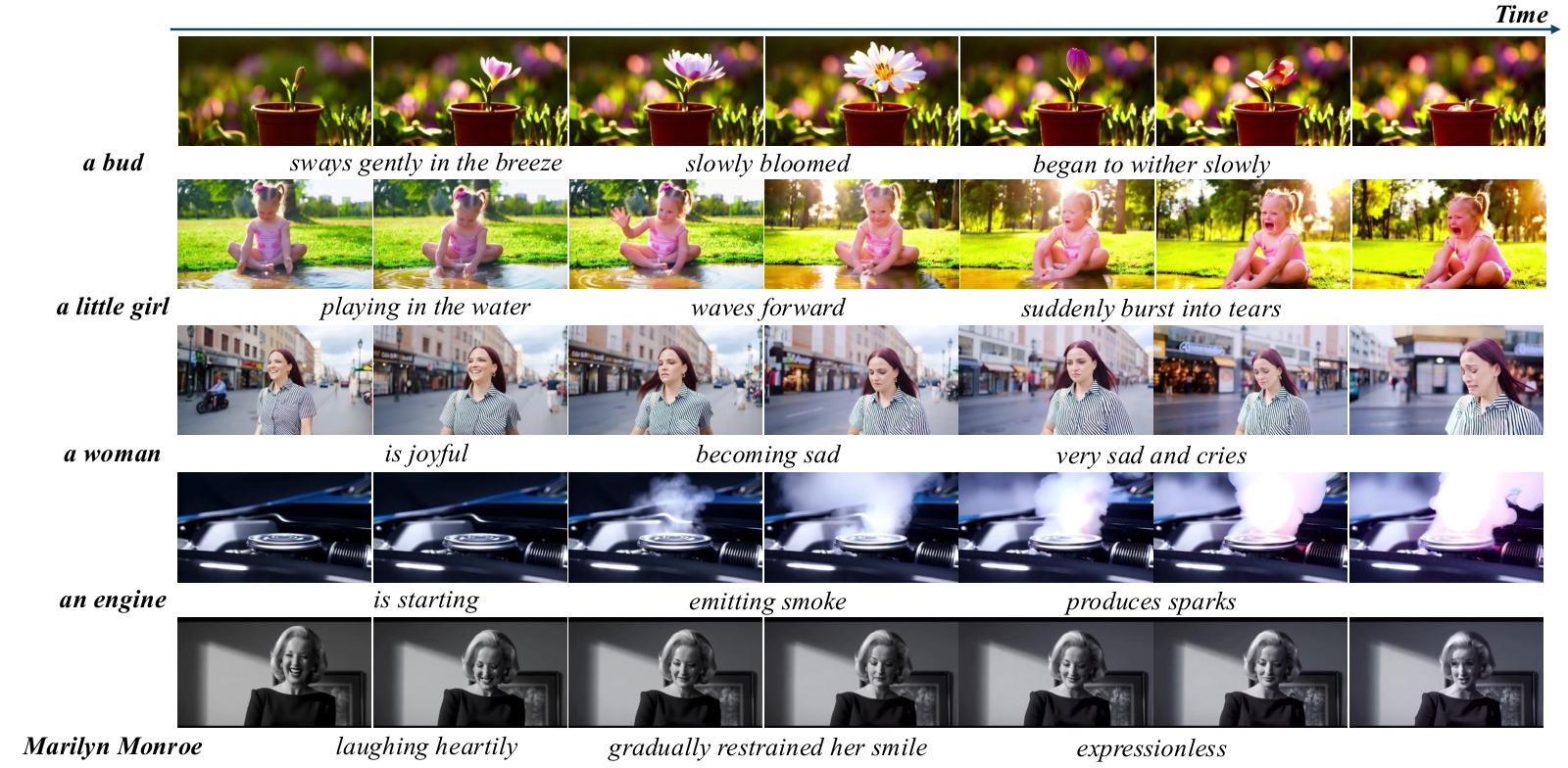
SkyReels V2 DF). Assigns an independent noise level $\sigma_{t, i} \in [0, 1]$ to each frame token or causal block $i$. During training, earlier frames in a window are corrupted with lower noise (or kept nearly clean) while later frames receive higher noise. At inference time, the model denoises a sliding window where clean or partially noised history frames directly condition the generation of future frames without architectural modification.
Cinematic character expression and lighting analyzed by SkyCaptioner-V1 in the SkyReels V2 pipeline. Source: Skywork AI (Apache 2.0).
Dynamic subject motion and camera framing sample from the SkyReels V2 repository. Source: Skywork AI (Apache 2.0).
Inside the SkyReels V2 Filmmaking Architecture
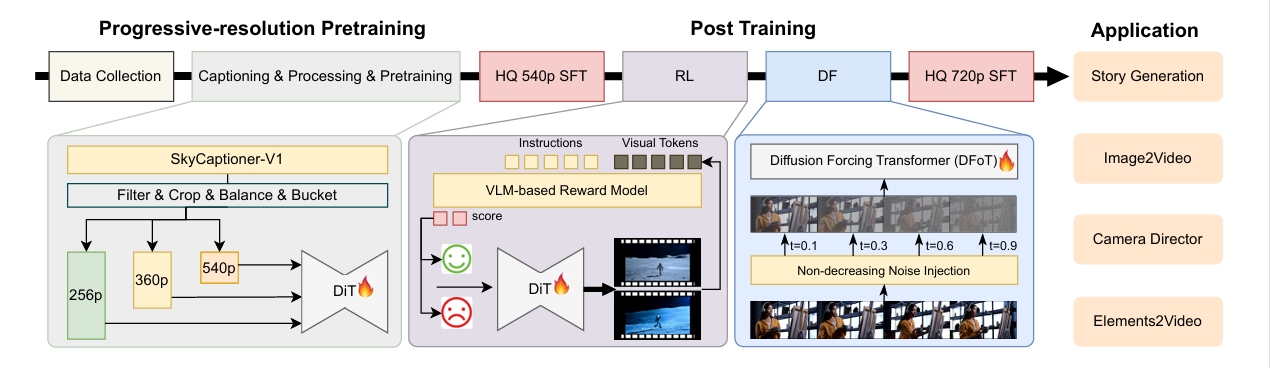
SkyReels V2 is designed specifically around film production grammar rather than generic web video clips. Its training pipeline integrates four specialized stages:
1. SkyCaptioner-V1: Structured Cinematic Data Annotation
Standard vision language captioners describe what is in a frame ("a person walking down a street") while ignoring how the director shot it. Skywork AI trained SkyCaptioner-V1 (Skywork/SkyCaptioner-V1) on curated film and television datasets annotated by professional cinematographers across four structural axes:
- Shot scale and framing (
extreme close-up,medium close-up,cowboy shot,wide establishing shot). - Camera angle and movement (
low-angle dolly in,handheld tracking shot,whip pan,crane up). - Lighting ratio and color temperature (
chiaroscuro side key,volumetric tungsten backlight,overcast diffused fill). - Actor micro expression and blocking (
subtle gaze shift left,tense jaw,slow turn toward camera).
Because the Diffusion Transformer is trained on these structured cinematic descriptions, filmmaker prompts using standard camera department terminology map directly to learned attention patterns.
2. Reinforcement Learning for Physical Motion Quality
Diffusion models trained purely with flow matching or MSE loss often struggle with limb articulation, gravity, and object permanence during rapid movement. SkyReels V2 applies a Direct Preference Optimization (DPO) reinforcement learning stage focused on motion coherence. By pairing human annotated and reward scored trajectories (preferred physical motion vs deformed or static motion), the post trained model reduces structural distortion during complex action scenes.
3. Non Decreasing Noise Schedules and Stabilization (addnoise_condition)
When extending a video to 257 frames (10+ seconds at 24fps) or 737 frames (30+ seconds), sliding window autoregression can still accumulate high frequency noise at block seams. SkyReels V2 introduces two inference controls that filmmakers can tune:
overlap_history(default: 17frames). Controls how many frames from the end of the previous causal block serve as conditioning context for the next block.addnoise_condition(default: 20). Injects a calibrated amount of Gaussian noise back into the clean conditioning history frames before denoising the next segment. Slightly re noising the overlap frames prevents high frequency error compounding and eliminates seam flicker across 30 second continuous takes.
For related breakthroughs in causal and block wise long video synthesis, explore our technical guides on Helios real-time long video generation, Self-Gradient Forcing long video extrapolation, and BlockVid minute-long video generation.
Hardware Requirements & Model Variants
Skywork AI released the SkyReels V2 family under the permissive Apache 2.0 license across both 1.3B and 14B parameter scales:
| Model Checkpoint | Resolution & FPS | Base / Extended Frames | Peak VRAM (with --offload) |
Key Capabilities |
|---|---|---|---|---|
Skywork/SkyReels-V2-DF-1.3B-540P |
960x540 (24 fps) |
97 base / 257 to 737+ extended |
14.7 GB VRAM (~5 GB weights) | Long form T2V, I2V, shot extension, start and end frame |
Skywork/SkyReels-V2-DF-14B-540P |
960x540 (24 fps) |
97 base / 257+ extended |
43.4 GB VRAM (or multi GPU USP) | High fidelity Diffusion Forcing long form video |
Skywork/SkyReels-V2-DF-14B-720P |
1280x720 (24 fps) |
121 base / 257+ extended |
51.2 GB VRAM (80 GB / 2x GPU USP) | Cinema grade 720p long take Diffusion Forcing |
Skywork/SkyCaptioner-V1 |
Video-to-Text MLLM | Video clip analyzer | 12.0 GB VRAM | Structured cinematic shot captioning |
Because SkyReels-V2-DF-1.3B-540P requires only 14.7 GB of VRAM when run with CPU offloading (--offload) and TeaCache (--teacache), any filmmaker with a 16 GB consumer GPU (such as an RTX 4060 Ti 16GB, RTX 4080, or RTX 4090) can generate 10 second to 30 second continuous shots locally.
Running SkyReels V2 DF 1.3B Locally on a 16 GB GPU
After cloning the official repository (SkyworkAI/SkyReels-V2) and installing its dependencies, you can synthesize a 30 second (737-frame at 24fps) continuous sequence using asynchronous sliding window Diffusion Forcing with the following command:
git clone https://github.com/SkyworkAI/SkyReels-V2
cd SkyReels-V2
pip install -r requirements.txt

# Generate a 30-second (737-frame) continuous shot on a single 16 GB+ GPU
python3 generate_video_df.py \
  --model_id Skywork/SkyReels-V2-DF-1.3B-540P \
  --resolution 540P \
  --ar_step 5 \
  --causal_block_size 5 \
  --base_num_frames 97 \
  --num_frames 737 \
  --overlap_history 17 \
  --addnoise_condition 20 \
  --prompt "A steady tracking shot following a detective walking through a foggy train station platform at night, warm practical streetlamps, 35mm anamorphic cinema lens." \
  --offload \
  --teacache \
  --use_ret_steps \
  --teacache_thresh 0.3
Setting --ar_step 5 and --causal_block_size 5 enables asynchronous Diffusion Forcing, allowing the 1.3B model to stream overlapping causal blocks up to 737 frames while keeping active memory under 15 GB. Because 540p (960x540) is half the spatial resolution of 1080p, pairing a SkyReels-V2-DF-1.3B-540P generation pass with a 2x or 4x video upscaler such as SeedVR2 or Real-ESRGAN Video produces a clean 1080p long take on consumer hardware.
Long Form and Multi Shot Filmmaking in AI FILMS Studio
While SkyReels V2 DF is an open source research release outside the hosted Studio catalog, filmmakers who need multi shot storytelling, extended takes, and camera trajectory control in the cloud can access production models directly on the Text to Video and Image to Video pages or inside the Video Generation Workspace:
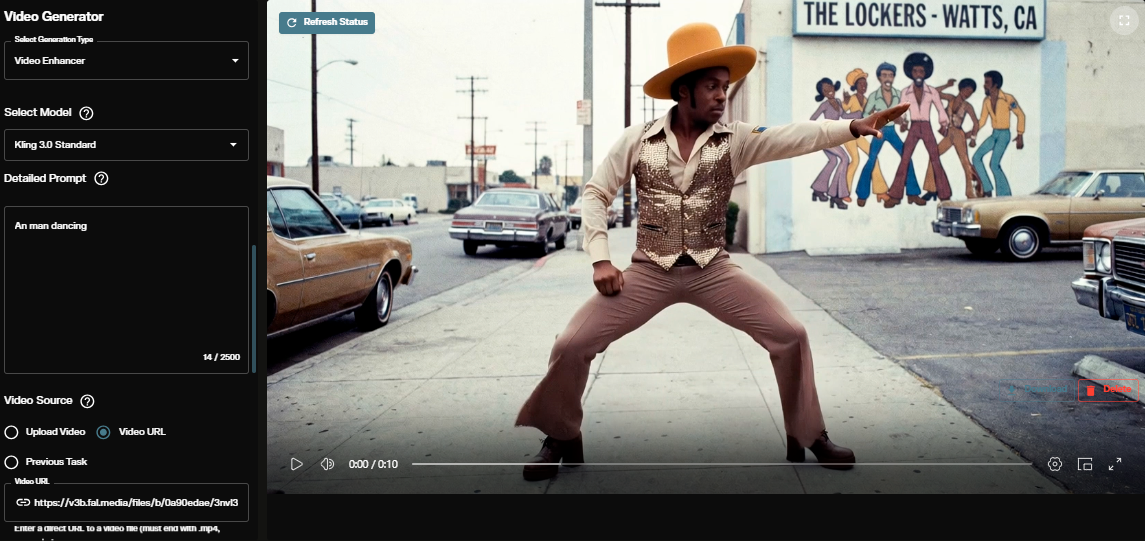
- Kling 3.0 Pro & Kling O3 Pro. Support native multi shot prompt choreography (
up to 15 secondsper pass with explicit shot by shot camera cuts and synchronized dialogue audio). - Sora 2 & Sora 2 Pro. Deliver extended duration text-to-video and image-to-video synthesis with coherent world physics across up to 20 second takes.
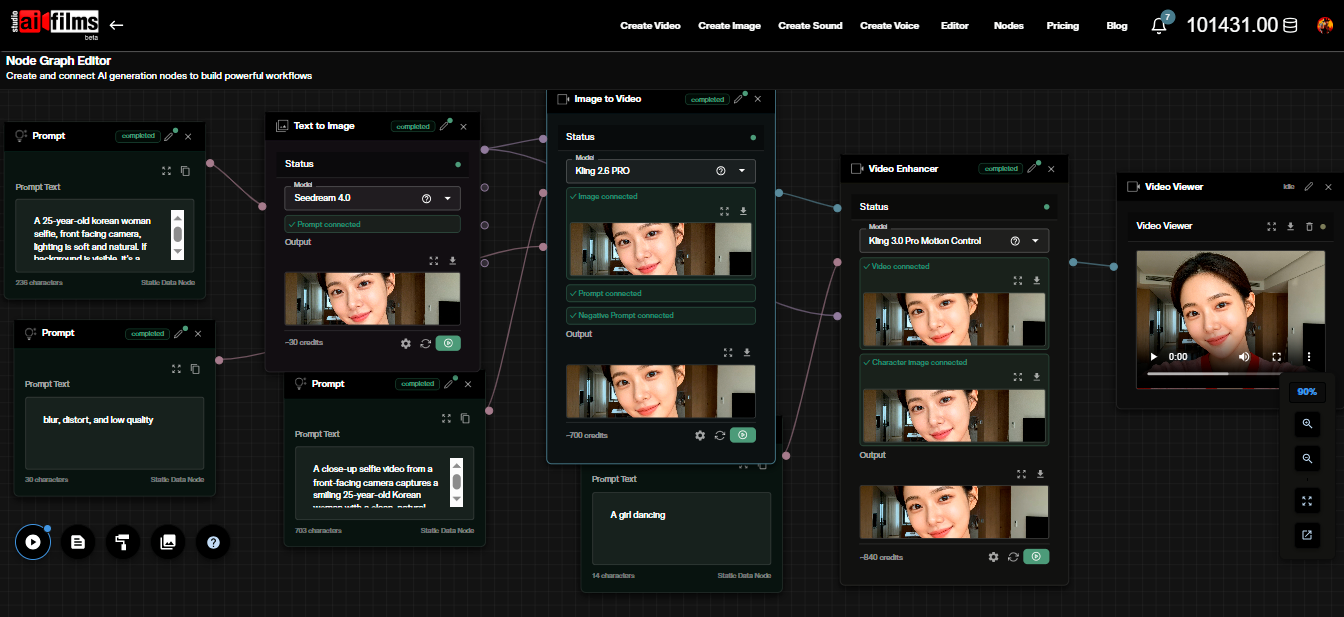
- Nodes Graph Editor Workflows. Inside the Nodes Graph Editor, you can build multi shot sequences by extracting the final frame of one video generation node, passing it into an image-to-video continuation node, and finishing the stitched sequence through a SeedVR2 Video Upscaler node for 1080p or 4K delivery.
Sources
SkyReels V2 Paper (arXiv:2504.13074) | SkyReels V2 GitHub (SkyworkAI/SkyReels-V2) | SkyReels-V2-DF-1.3B-540P Hugging Face | SkyCaptioner-V1 Hugging Face
Continue Reading


Video & LipSync
- Video Generator
- Text to Video
- Image to Video
- Start-End Frame to Video
- Draw to Video
- Motion Control
- Video Enhancer
- Video Upscaler
- Video Extend
- Video to Video LipSync
- Audio to Video LipSync
- Image to Video LipSync
- Video FaceSwap
- Seedance 2.5
- WAN 3.0
- Seedance 2
- FLUX 3
- Minimax H3
- Vidu Q3 Pro
- Grok Imagine Video 1.5
- Gemini Omni
- Google Veo 3.1
- Kling 3.0 Pro
- Luma Ray 3.2
- LTX 2.3
- Happy Horse 1.1
- Kling 3.0 Motion
- ByteDance Upscaler
- InfiniteTalk
- InsightFace
Image & Edit
- AI Character
- AI Actor
- Art Generator
- Text to Image
- Image to Image
- LoRA Image to Image
- Draw to Edit
- Image LoRA Training
- Remove Background
- Image Enhancer
- MidJourney 8.0
- Krea 2
- OpenAI GPT Image 2.0
- Nano Banana Pro Ultra
- Nano Banana 2 Lite
- Nano Banana Pro
- Minimax Image
- Clarity Pro
- Z-Image Turbo LoRA
- Krea 2 Turbo LoRA
- Z-Image LoRA Trainer
- Qwen Image LoRA Trainer
- Background Erase Network 2 (BEN2)