
Self Gradient Forcing: Native Long Video Extrapolation Without Retraining

Share this post:
Self Gradient Forcing: Native Long Video Extrapolation Without Retraining
A research team has released Self Gradient Forcing (SGF), a method that enables any pretrained autoregressive video model to generate video far beyond its training context length without modifying the model or running new training. The paper demonstrates continuous generation up to 240 seconds (four minutes) in both chunk and frame autoregressive modes.
Studio availability. Self Gradient Forcing is not available in AI FILMS Studio. This article covers a public research release. To generate video in the Studio, see the models listed on the text to video page.
The central finding is that long video generation from existing models does not require new architectures or extended training runs. It requires correcting the context that gets passed between generation steps using the model's own gradient signal.
The Context Gradient Gap
Autoregressive video models are trained on short clips. Each clip defines the context window the model learns to handle. At inference time, generating something longer means passing the model's own previous output as context for the next step.
That creates the problem the SGF paper names precisely: the context gradient gap. The gradient landscape the model was trained on corresponds to clean, short video contexts. Long generation pushes the context out of that distribution with every new step. The model has never seen its own long outputs as context, so quality degrades. Repetition sets in, coherence breaks down, scenes collapse into loops.
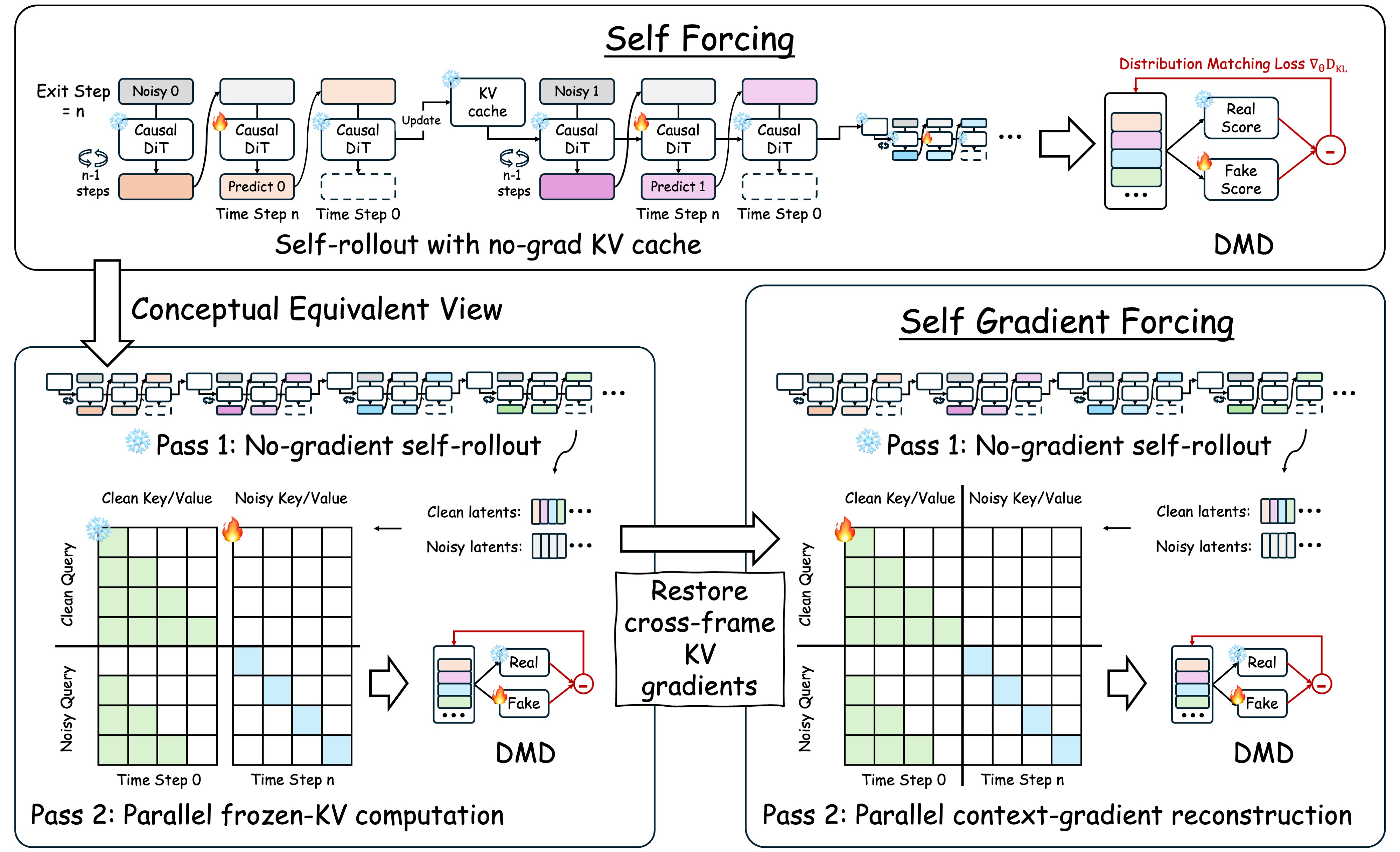
SGF pipeline overview. At each step, a gradient correction keeps the context aligned with the model's training distribution.
Existing approaches to this problem fall into two categories. One category retrains models on longer sequences. That requires compute, data, and time. The other category applies external consistency mechanisms: keyframe sampling, error banks, or regularization against drift. These reduce the symptom but do not address the cause.
SGF takes the second approach but uses the model's own gradient signal rather than external heuristics. It does not retrain anything. It corrects the context at each step based on what the model's own gradient indicates about where the context should have been if training had covered that length.
The "gap" the paper names is not just a description of degradation. It is a specific claim: there is a measurable difference between the gradient distribution at training time and at long inference time. SGF closes that gap at inference, step by step, using the model's own internal signal.
How the Correction Works
SGF operates on the context window passed between autoregressive steps. Before each generation step, it runs a brief gradient computation on the context using the model's own loss function. That computation produces a correction signal, which adjusts the context to align more closely with the gradient landscape the model was trained on.
The process runs in two passes per step. The first pass uses the current context to generate the next segment. The second pass applies the gradient correction to the context that was used, updating it for the following step.
This two pass structure means each step's context is slightly more aligned with the training distribution than it would have been without correction. Over hundreds of steps, across four minutes of continuous generation, those incremental corrections maintain coherence where uncorrected inference would have accumulated visible drift.
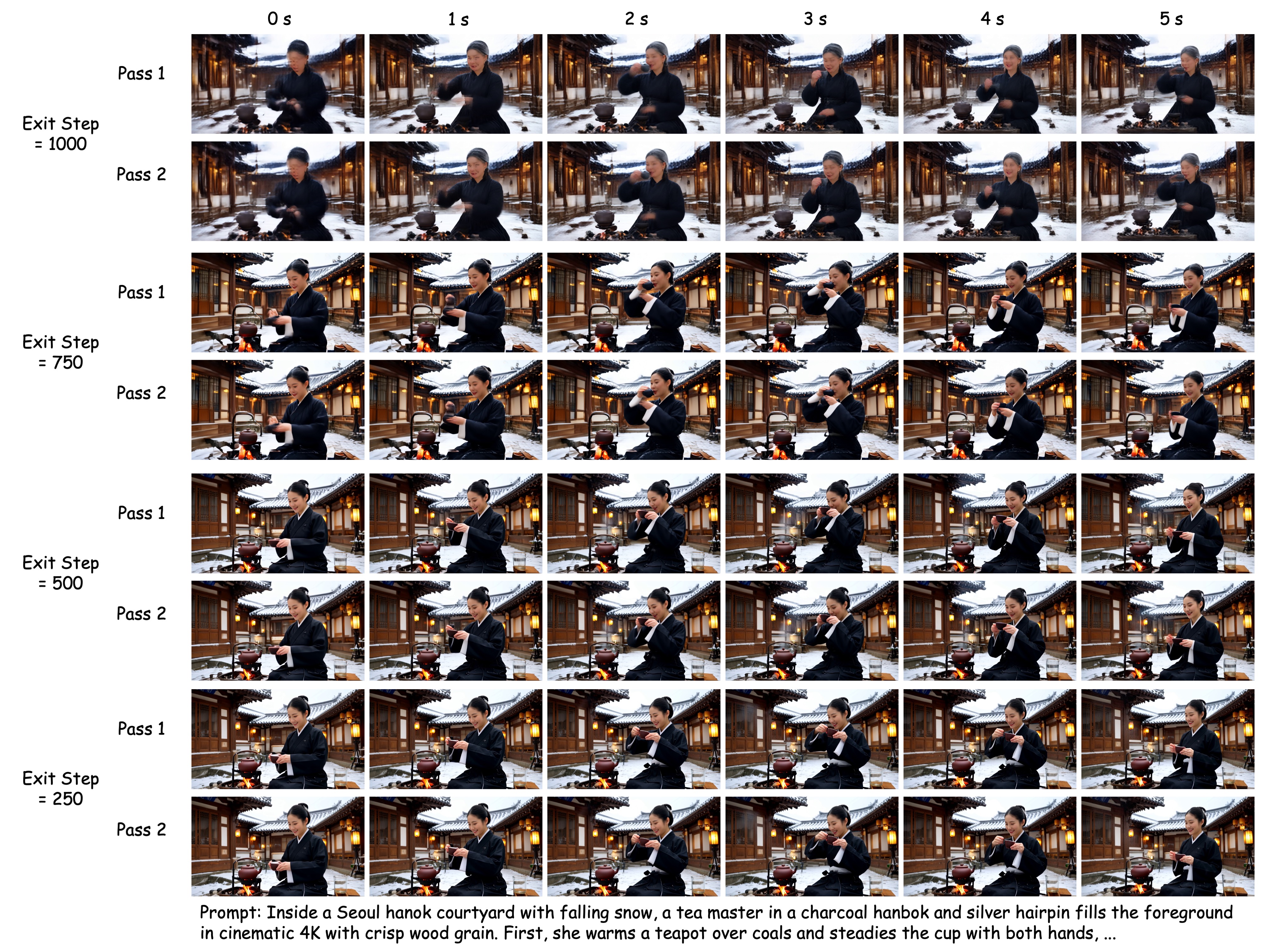
SGF's inference in two passes: generation, then gradient correction of the context for the next step.
The overhead from the gradient computation is not negligible, but the paper positions it as far cheaper than retraining. A practitioner who has a pretrained AR video model and wants to extend its output length does not need to collect new data, run new training, or change the model weights. They add the correction loop at inference.
Chunk Autoregressive Mode
In chunk autoregressive mode, SGF generates video in segments. Each segment conditions the next. The correction loop runs between segments, adjusting the segment context before the model uses it to seed generation of the following segment.
SGF chunk autoregressive generation example
Chunk autoregressive generation is the natural mode for video models trained to predict at the segment level. The model already knows how to continue from a short clip. SGF extends that capability to arbitrarily long sequences by correcting what gets passed as the conditioning clip at each step.
Frame Autoregressive Mode
Frame autoregressive mode generates one frame at a time, each conditioned on the accumulated frame history. The context gradient gap is sharper in this mode because the accumulated context grows with every single frame, pushing further from the training distribution at each step.
SGF frame autoregressive generation example
Frame autoregressive generation gives the model finer control over motion continuity but amplifies the drift problem because the context update is more frequent. SGF's gradient correction is applied at each frame step, so the correction overhead is higher in this mode than in chunk generation. The paper reports that it remains stable across both modes through the 240 second benchmark.
Results at Four Minutes
The paper's headline benchmark generates 240 seconds of continuous video in both modes. The four minute length puts SGF well above what most long video systems demonstrate: Helios targets one minute, BlockVid demonstrates similar durations, and most tools in production use cap out at 10 to 30 seconds.
SGF chunk mode: 240-second generation
SGF frame mode: 240-second generation
The comparison that matters most for practitioners is not length in isolation but coherence at length. The visual drift that makes long AR generation fail is not a matter of resolution or frame rate. It is a semantic collapse: scenes repeat, motion becomes cyclical, and the generated world loses any logic of continuity. The 240 second samples in the paper demonstrate that SGF suppresses that collapse across the full benchmark length.
What This Means for Video Production
The SGF result is significant primarily because it decouples generation length from model training. Existing AR video models trained on short clips are not discarded or replaced. Their length capability is extended at inference time, without modifying weights or collecting new data.
For practitioners and researchers already working with AR video models, this is a practical workflow extension. A model trained on segments of five seconds can produce four minutes of output by adding the SGF correction loop at inference. The extended duration video generation approach explored in LongCat required specialized architectural choices at training time. SGF achieves comparable duration as a post-hoc addition to existing models.
The requirement for additional gradient computation at each step means SGF's throughput is slower than uncorrected inference. The paper does not position it as a real time generation method. The target use case is offline generation where length and coherence matter more than speed. For applications like previs, storyboard generation, or long narrative video, those are the right priorities.
The gradient computation overhead scales with the context length being corrected. For very long generations approaching the four minute benchmark, the correction step at each inference pass becomes proportionally more significant.
Teams building production pipelines with SGF should benchmark inference time against their specific output length targets before committing to hardware configurations.
For shot-level temporal control within shorter generated clips, ShotPlan provides a complementary approach. ShotPlan extends Wan 14B with a planning token that places hard cuts at specified frame positions with 0.64 frame deviation accuracy, enabling multi shot sequences from a single generation pass. Where SGF addresses generation length, ShotPlan addresses shot structure within a clip.
Code and weights are available under the MIT license. The method is also architecture agnostic: any pretrained AR video model in chunk or frame autoregressive modes can adopt the SGF correction loop at inference without retraining, since the correction operates on the context window rather than on model internals.
Filmmakers exploring long AI video generation can access text-to-video and image-to-video tools at AI FILMS Studio.
Sources
arXiv: Self Gradient Forcing for Autoregressive Video Generation GitHub: zhuang2002/SelfGradientForcing Project Page: zhuang2002.github.io/SelfGradientForcing
Continue Reading


Video & LipSync
- Video Generator
- Text to Video
- Image to Video
- Start-End Frame to Video
- Draw to Video
- Motion Control
- Video Enhancer
- Video Upscaler
- Video Extend
- Video to Video LipSync
- Audio to Video LipSync
- Image to Video LipSync
- Video FaceSwap
- Seedance 2.5
- WAN 3.0
- Seedance 2
- FLUX 3
- Minimax H3
- Vidu Q3 Pro
- Grok Imagine Video 1.5
- Gemini Omni
- Google Veo 3.1
- Kling 3.0 Pro
- Luma Ray 3.2
- LTX 2.3
- Happy Horse 1.1
- Kling 3.0 Motion
- ByteDance Upscaler
- InfiniteTalk
- InsightFace
Image & Edit
- AI Character
- AI Actor
- Art Generator
- Text to Image
- Image to Image
- LoRA Image to Image
- Draw to Edit
- Image LoRA Training
- Remove Background
- Image Enhancer
- MidJourney 8.0
- Krea 2
- OpenAI GPT Image 2.0
- Nano Banana Pro Ultra
- Nano Banana 2 Lite
- Nano Banana Pro
- Minimax Image
- Clarity Pro
- Z-Image Turbo LoRA
- Krea 2 Turbo LoRA
- Z-Image LoRA Trainer
- Qwen Image LoRA Trainer
- Background Erase Network 2 (BEN2)