
Eli Roth Said He Drew 'Ice Cream Man's' Animated Sequences Himself. Then Dark Half Appeared in the Credits.

Share this post:
Eli Roth Said He Drew 'Ice Cream Man's' Animated Sequences Himself. Then Dark Half Appeared in the Credits.
Ice Cream Man opened August 7, 2026. Eli Roth directed it unrated, a return to the practical effects sensibility that defined Cabin Fever and Hostel. Press materials emphasized the physical craft: real locations, latex, rubber. When journalists asked about the animated cartoon sequences woven through the film, Roth said he drew them himself with an animation team. On August 5, two days before release, viewers found "Dark Half" in the credits. Dark Half is an AI VFX studio.
Roth issued a correction through Variety: "AI was used in a very small portion of a few scenes in the film. I misspoke."
What the Animated Sequences Are
The animated segments in Ice Cream Man are not incidental. They serve a structural purpose. One is a rubber hose cartoon in the Fleischer Studios style that hypnotizes child victims. The other is an origin flashback that explains how the villain became what he is. Both sequences are stylistically distinct from the live action footage, drawn in the visual language of 1920s animation.
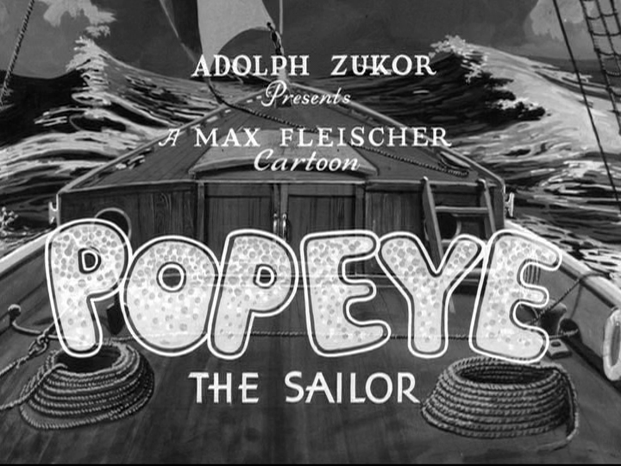
Fleischer Studios, Public domain, via Wikimedia Commons
The Fleischer Studios aesthetic, named for Max and Dave Fleischer who produced Betty Boop, Popeye, and the 1941 Superman cartoons, uses rounded forms, fluid motion, and exaggerated squash and stretch. It was the dominant American animation style before Disney's Snow White redefined the field in 1937. Recreating it convincingly requires either frame by frame hand animation or a process that can absorb and replicate the style.
Roth's choice to use this style for the hypnosis and origin sequences reflects a specific creative intention. A cartoon from another era carries a different kind of menace in a horror context than straightforward flashback footage would. The aesthetic distance is the point. Whether that distance works in the film is a question viewers will answer. The question that surfaced before the film even opened was who produced the animation and how.
Roth's First Statement and His Correction
Before the film released, Roth told press he drew the animated frames himself with an animation team. The framing placed the work inside the craft tradition he had described throughout the film's promotion. It was hands on, physical, made by people.
The credit listing changed that account. Dark Half is a generative AI VFX studio. Its appearance in Ice Cream Man's end credits made Roth's prior statement inaccurate. The correction came fast: "AI was used in a very small portion of a few scenes in the film. I misspoke."
The statement does not specify which scenes, how many shots, or what portion of the animated sequences used AI generation versus traditional methods. The word "misspoke" frames the original claim as a verbal error rather than a deliberate misdirection. Roth did not offer additional detail in the correction.
What the Dark Half Credit Means
Dark Half specializes in AI generated visual effects. Its credit in Ice Cream Man places AI generation inside at least part of the production pipeline for the animated sequences. The question the credit raises is how much of the animation was generated versus hand produced, and whether the Fleischer style was achieved through AI training on reference material or through traditional means supplemented by AI tools.
Roth's correction, that "AI was used in a very small portion of a few scenes," suggests limited use. The audience response treated the credit as confirmation of wider use. That is the dynamic credit disclosures regularly produce. A narrow acknowledgment lands as a broad one in the absence of specifics.
The end-of-Oak Street marketing campaign for Warner Bros., which also generated backlash when its AI production method became public, followed the same pattern: revealed through credit or credit-adjacent discovery, met with audience reaction that treated the disclosure as confirming more than the studio intended.
The Horror Community Reaction
The horror audience is not a uniform constituency on the question of practical effects, but it has a strong traditional center. Roth built his reputation in that center. Cabin Fever, Hostel, and their sequels used practical latex and location shooting as aesthetic commitments, not cost cutting measures. His filmography has been read as a defense of the physical against the digital.
Ice Cream Man leaned into that reading. An animated sequence using AI generation, disclosed only after the film was already in release, read to horror community members as a reversal of the film's stated ethos. Scream Magazine documented the backlash. The criticism was not that the sequences looked wrong. It was that the production method contradicted the framing Roth had established.
This is the part of the AI disclosure debate that is not primarily aesthetic. It is about alignment between what a filmmaker says a film is and what it actually contains.
Industry Context
The motion picture and sound recording industry lost 6,700 jobs in the twelve months through May 2026, according to Bureau of Labor Statistics data. That number shapes how audiences and critics read AI use in productions that could have supported traditional animation work.
An animation sequence in the Fleischer style, built by traditional animators, requires skilled labor. That includes character designers, inbetweeners, cleanup artists, ink and paint specialists, and their digital equivalents. Whether Dark Half's process displaced that labor or simply enabled a sequence that would not otherwise have existed is not addressed in any of Roth's statements. That gap is where much of the community reaction landed.
Roth joins a pattern that includes Martin Scorsese, whose use of AI face manipulation in Killers of the Flower Moon surfaced after release, and other filmmakers who applied AI tools in productions that had not foregrounded them publicly. Guillermo del Toro has publicly opposed AI in filmmaking. Roth's film now places him in a different category from del Toro, whatever the scale of the actual use.
The Disclosure Question
The gap between Roth's first statement and his correction is narrow in his framing and wider in its reception. Whether the use was "a very small portion of a few scenes" or something larger, the discrepancy between his earlier account and the credit listing is real.
The film industry does not have a standard disclosure requirement for AI generation. Studios decide what to say and when. The result is a recurring pattern: AI use surfaces through credits, or through production accounts that contradict marketing, and the correction arrives after audiences have already formed a view based on incomplete information.
What the Ice Cream Man sequence shows is that this pattern produces audience backlash in proportion to the distance between the stated and actual production method, not necessarily in proportion to the quantity of AI generated content. Roth's "very small portion" claim may be accurate. It was received as a defense of a larger practice.
The filmmakers who are building AI into productions from the start, without a gap between marketing and credits, are working in a different environment from the one Roth encountered. That environment is what AI video generation tools built for transparent, intentional production support. Filmmakers can explore those tools at AI FILMS Studio.
Sources
Variety | The Wrap | CartoonBrew | Scream Magazine | AV Club | Nerdbot
Continue Reading
.jpg?w=3840)


Video & LipSync
- Video Generator
- Text to Video
- Image to Video
- Start-End Frame to Video
- Draw to Video
- Motion Control
- Video Enhancer
- Video Upscaler
- Video Extend
- Video to Video LipSync
- Audio to Video LipSync
- Image to Video LipSync
- Video FaceSwap
- Seedance 2.5
- WAN 3.0
- Seedance 2
- FLUX 3
- Minimax H3
- Vidu Q3 Pro
- Grok Imagine Video 1.5
- Gemini Omni
- Google Veo 3.1
- Kling 3.0 Pro
- Luma Ray 3.2
- LTX 2.3
- Happy Horse 1.1
- Kling 3.0 Motion
- ByteDance Upscaler
- InfiniteTalk
- InsightFace
Image & Edit
- AI Character
- AI Actor
- Art Generator
- Text to Image
- Image to Image
- LoRA Image to Image
- Draw to Edit
- Image LoRA Training
- Remove Background
- Image Enhancer
- MidJourney 8.0
- Krea 2
- OpenAI GPT Image 2.0
- Nano Banana Pro Ultra
- Nano Banana 2 Lite
- Nano Banana Pro
- Minimax Image
- Clarity Pro
- Z-Image Turbo LoRA
- Krea 2 Turbo LoRA
- Z-Image LoRA Trainer
- Qwen Image LoRA Trainer
- Background Erase Network 2 (BEN2)