
Lingbot World: Open Source World Simulator for Commercial Use

Share this post:
Lingbot World: Open Source World Simulator for Commercial Use
On January 29, 2026, the same day Google opened its Genie 3 world model to Ultra subscribers, Ant Group released Lingbot World. An open source alternative built for commercial use. The Apache 2.0 licensed system generates interactive 3D environments from text and images, with precise camera control for cinematographic applications.
Studio availability. Lingbot World is not available in AI FILMS Studio. This article covers a public research release. To generate video in the Studio, see the models listed on the text to video page.
What is Lingbot World
Lingbot World is a world simulator that generates interactive, explorable environments. Developed by Ant LingBo Technology under Ant Group, the system processes image-to-video generation using camera pose inputs to control perspective and movement. The model achieves sub-1-second latency at 16 frames per second, maintaining consistency across sequences up to 961 frames, approximately one minute of footage.
The architecture builds on the Wan2.2 video generation framework, implementing Diffusion Transformer (DiT) models with Fully Sharded Data Parallel (FSDP) training. Released with code, pre trained models, and a technical paper (arXiv:2601.20540), Lingbot World operates under an Apache 2.0 license. This permits commercial deployment in content creation, game development, and robotics applications without subscription fees.
Open Source Alternative to Genie 3
Google DeepMind's Genie 3 requires a Google AI Ultra subscription, currently limited to users 18 and older in the United States. The service generates photorealistic environments at 24 frames per second with 720p resolution and several minutes of interaction time. Access costs $19.99 per month through the Ultra tier.
Lingbot World matches these technical specifications. 720p output, real time generation, minute level temporal consistency. The difference is accessibility. Anyone can download the model weights from HuggingFace or ModelScope, run inference on their own hardware, and integrate the system into commercial pipelines. No geographic restrictions, no age requirements, no recurring fees.
Both systems launched January 29, 2026. Genie 3 positions world models as consumer products behind paywalls. Lingbot World distributes the same capability as infrastructure that developers can modify and deploy freely.
Key Capabilities for Filmmakers
World simulators enable filmmakers to test shots, generate backgrounds, and prototype scenes before principal photography. Lingbot World's camera control system translates directly to cinematographic workflows.
Previsualization and Virtual Production
The Base (Cam) model accepts camera intrinsics and 4×4 transformation matrices in OpenCV format. Directors can specify focal length, sensor dimensions, and 3D camera positions with frame level precision. Real time generation allows iterating camera moves in seconds rather than rendering overnight.
Production teams can evaluate blocking, lighting angles, and lens choices in simulated environments. The system maintains geometric consistency across camera movements, avoiding the drift common in earlier video generation models. This stability supports shot sequence planning where multiple angles need to match the same space.
Background Plate Generation
LED volume workflows require consistent background plates that respond to camera movement. Lingbot World generates 720p sequences suitable for on set display systems. The camera pose control ensures parallax and perspective shift match physical camera tracking data.
Virtual production supervisors can pre generate environment libraries for different scenes, adjusting lighting conditions and atmospheric effects through text prompts. The 16 FPS output rate exceeds LED wall refresh requirements for static or slow moving backgrounds. For faster motion, the upcoming Fast variant will increase frame generation speed.
Concept Development
Art departments prototype environment concepts by feeding reference images and text descriptions to the model. The system handles realistic architectural spaces, scientific visualizations, and stylized cartoon aesthetics. Multiple visual treatments can be tested in minutes, accelerating the concept approval process.
Location scouts use world simulators to visualize potential shooting locations under different weather and lighting conditions. Instead of scheduling site visits for every time of day, teams generate variations computationally. This reduces travel costs and timeline pressure when evaluating location options.
Advanced Workflow: Image-to-Video Quality Enhancement
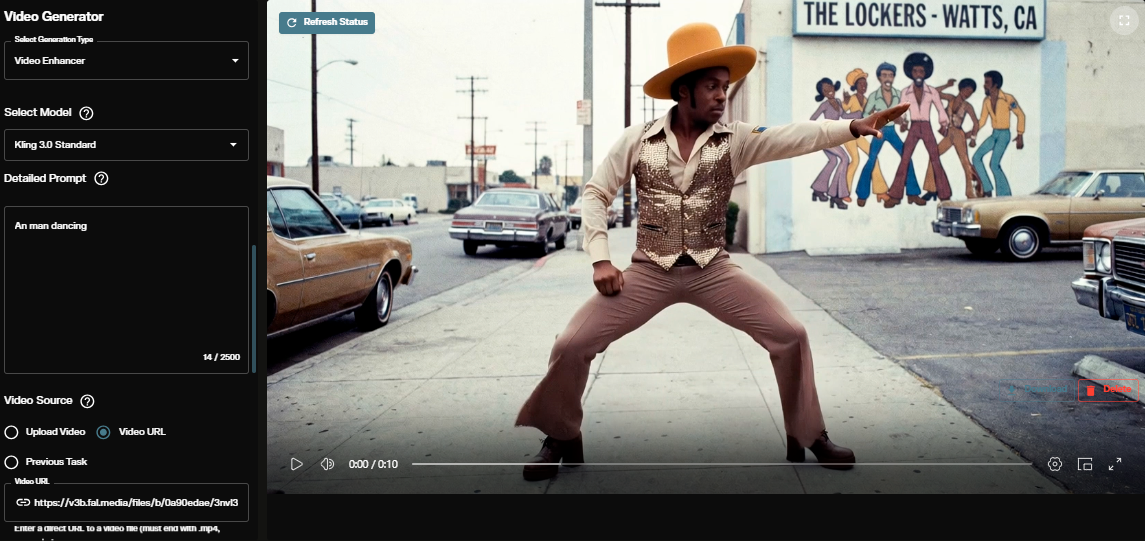
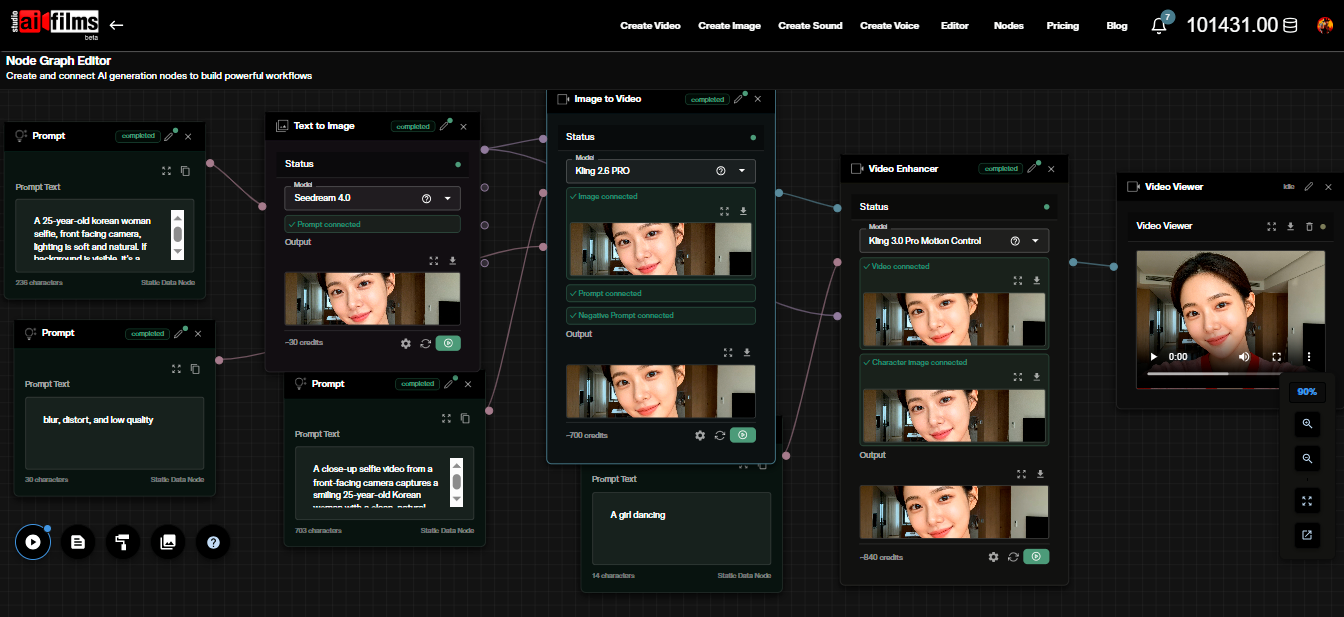
Combining still image generation with world simulation creates higher quality outputs. Generate the first frame using a dedicated image model like AI FILMS Studio's image generator, then feed that frame to Lingbot World as the starting point for video generation.
This two step process separates aesthetic control from motion synthesis. The initial image establishes composition, lighting, and visual style with the precision of state of the art image models. Lingbot World then extends that single frame into a temporally consistent sequence while maintaining the established visual quality.
Recording camera actions in the world model creates repeatable camera moves. Teams can program complex dolly shots or crane movements once, then apply those motion profiles across different environments. This workflow supports systematic scene creation where multiple takes require identical camera choreography.
Technical Specifications
Lingbot World ships three model variants, with two currently in development. The Base (Cam) version available now handles camera pose inputs at 480p and 720p resolution.
| Model Variant | Control Input | Resolution | FPS | Max Duration | Status |
|---|---|---|---|---|---|
| Base (Cam) | Camera poses | 480P, 720P | 16 | 961 frames (~60s) | Available |
| Base (Act) | Action vectors | TBD | TBD | TBD | Coming soon |
| Fast | TBD | TBD | TBD | TBD | Coming soon |
The system requires camera intrinsics formatted as [fx, fy, cx, cy] and 4×4 transformation matrices following OpenCV conventions. Inference runs on 8 GPUs using Fully Sharded Data Parallel and DeepSpeed Ulysses optimizations for long video generation. Teams with sufficient CUDA memory can reduce GPU requirements through optimization.
Key performance characteristics:
- Latency: Sub-1-second response time per generation request
- Consistency: Minute level temporal coherence with long term memory
- Resolution: 480p and 720p output, with 720p recommended for production use
- Frame generation: Adjustable via frame_num parameter, up to 961 frames at 16 FPS
- Architecture: DiT (Diffusion Transformer) with FSDP training on Wan2.2 framework
Getting Started
Installation requires PyTorch 2.4.0 or later and Flash Attention for optimized inference:
git clone https://github.com/robbyant/lingbot-world.git
cd lingbot-world
pip install -r requirements.txt
pip install flash-attn --no-build-isolation
Model weights download from HuggingFace or ModelScope using their respective CLI tools. The Base (Cam) checkpoint weighs approximately 37GB in safetensors format. Full documentation and inference examples are available in the GitHub repository.
Implications for AI Filmmaking
Open source world models change production economics. Instead of subscription costs scaling with team size and project duration, infrastructure expenses become one time hardware investments. Studios running Lingbot World on owned GPUs pay no marginal costs per generated frame.
The Apache 2.0 license permits modifications and derivative works. Production pipelines can integrate world simulation directly into existing toolchains, custom tuning models for specific aesthetic requirements or performance profiles. This flexibility doesn't exist with API based services where capabilities and costs are fixed by the provider.
Filmmakers comparing world simulators should evaluate HunyuanWorld's WorldPlay model, which emphasizes 24 FPS real time interaction, and HunyuanWorld Mirror for 3D scene completion from single images. InSpatio-World takes a distinct approach: it anchors a world to an existing reference video rather than generating from scratch, enabling temporal scrubbing and spatial roaming within real captured footage. MosaicMem takes yet another angle, lifting video patches to 3D and reproducing them at target viewpoints to combine geometric precision with full motion generation across 2 minute sequences. NVIDIA's Lyra 2.0, also Apache 2.0 licensed, adds anti forgetting and anti drifting mechanisms for long horizon scene exploration and exports directly to NVIDIA Isaac Sim for robotics simulation. NVIDIA's SANA-WM, released in May 2026, takes a different path by generating 60-second 720p clips with 6-DoF camera trajectory adherence on a single GPU, delivering 36 times higher throughput than prior open source baselines under Apache 2.0. AlayaWorld, released in July 2026, adds a text prompt driven interaction layer on top of long horizon consistency, enabling filmmakers to trigger scene events within a generated world without losing environment coherence, also under Apache 2.0. Each system optimizes different tradeoffs between speed, consistency, and control granularity. Lingbot World's camera pose inputs make it particularly relevant for cinematographic applications requiring precise shot specification.
Ant Group, the same organization behind Lingbot World, released LingBot-Video in July 2026. That model focuses on text-to-video and image-to-video generation rather than interactive world simulation, and leads all open source models on the RBench leaderboard with a score of 0.620 under Apache 2.0.
Alibaba's AMAP CV Lab released a comparable system in July 2026: ABot-World-0, a 5B model using Wan2.2-TI2V with LongForcing training for long horizon scene stability. It runs at 720P on a single RTX 5090 and uses an action based navigation model rather than explicit camera pose inputs, under Apache 2.0.
The technology builds on advances in physics-informed video generation, where models learn physical constraints that improve motion realism. As world simulators incorporate these physics priors, generated environments will better match how real spaces respond to camera movement and lighting changes.
Teams exploring world simulation workflows can combine these models with traditional video generation systems through AI FILMS Studio, creating hybrid pipelines that use specialized tools for different production stages.
Sources
Lingbot World Technical Report Robbyant Team Released: January 29, 2026 arXiv:2601.20540
Lingbot World GitHub Repository https://github.com/Robbyant/lingbot-world
Lingbot World Base (Cam) Model HuggingFace: robbyant/lingbot-world-base-cam ModelScope: Robbyant/lingbot-world-base-cam
Project Page https://technology.robbyant.com/lingbot-world
Genie 3: A new frontier for world models Google DeepMind Published: January 29, 2026 https://deepmind.google/blog/genie-3-a-new-frontier-for-world-models/
Project Genie: AI world model now available for Ultra users Google Blog Published: January 29, 2026 https://blog.google/innovation-and-ai/models-and-research/google-deepmind/project-genie/
Continue Reading
.jpg?w=3840)


Video & LipSync
- Video Generator
- Text to Video
- Image to Video
- Start-End Frame to Video
- Draw to Video
- Motion Control
- Video Enhancer
- Video Upscaler
- Video to Video LipSync
- Audio to Video LipSync
- Image to Video LipSync
- Video FaceSwap
- Seedance 2.5
- WAN 3.0
- Seedance 2
- FLUX 3
- Minimax H3
- Vidu Q3 Pro
- Grok Imagine Video 1.5
- Gemini Omni
- Google Veo 3.1
- Kling 3.0 Pro
- Luma Ray 3.2
- LTX 2.3
- Happy Horse 1.1
- Kling 3.0 Motion
- ByteDance Upscaler
- InfiniteTalk
- InsightFace
Image & Edit
- AI Character
- AI Actor
- Art Generator
- Text to Image
- Image to Image
- LoRA Image to Image
- Draw to Edit
- Image LoRA Training
- Remove Background
- Image Enhancer
- MidJourney 8.0
- Krea 2
- OpenAI GPT Image 2.0
- Nano Banana Pro Ultra
- Nano Banana 2 Lite
- Nano Banana Pro
- Minimax Image
- Clarity Pro
- Z-Image Turbo LoRA
- Krea 2 Turbo LoRA
- Z-Image LoRA Trainer
- Qwen Image LoRA Trainer
- Background Erase Network 2 (BEN2)