
Lumos-Nexus: Reasoning-Driven Video Generation with Physical World Understanding

Share this post:
Lumos-Nexus: Reasoning-Driven Video Generation with Physical World Understanding
Lumos-Nexus is a video generation framework from Alibaba DAMO Academy, Zhejiang University, and five other research institutions that adds explicit reasoning about physical dynamics, causal behavior, and spatial interactions to the generation process. The paper, submitted to arXiv on May 31, 2026, introduces both the model and VR-Bench, a new benchmark for evaluating whether video generation systems can translate inferred intent into coherent, physically plausible output.
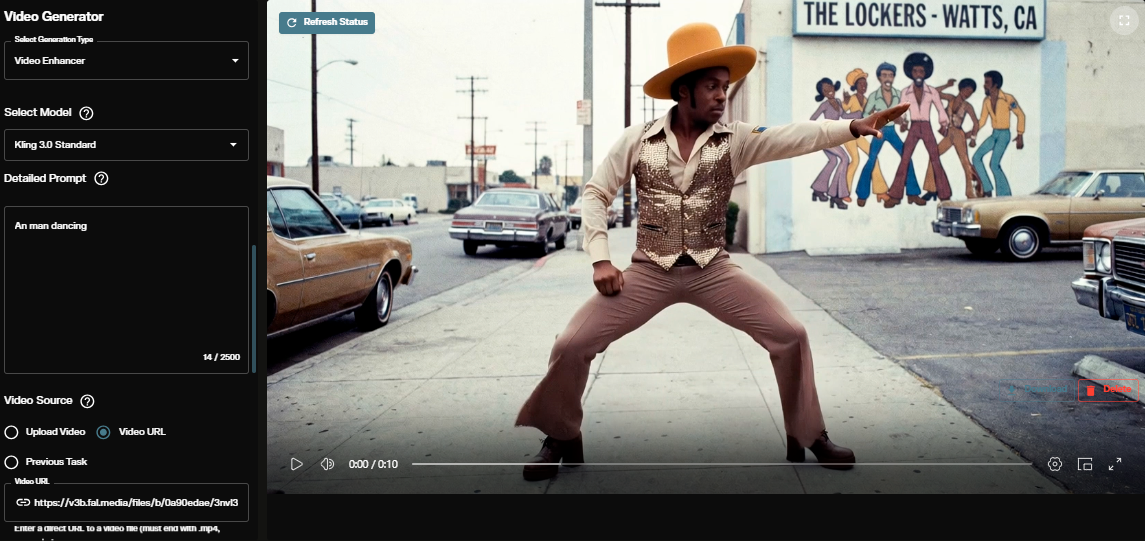
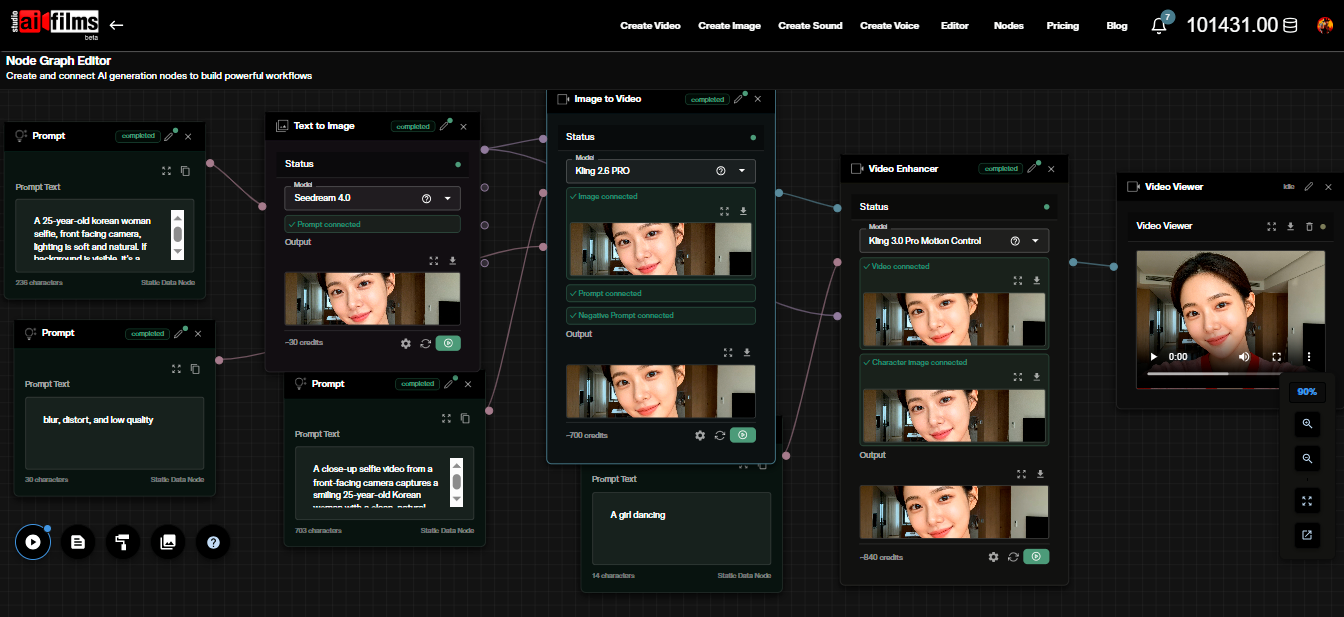
Studio availability. Lumos-Nexus is not available in AI FILMS Studio. This article covers a public research release. To generate video in the Studio, see the models listed on the text to video page.
Lumos-Nexus overview, reasoning driven unified video generation
Why Physical Reasoning Matters for Video Generation
A video generation model can produce footage of a glass falling off a table that looks visually plausible. Without physical reasoning, that footage may show the glass falling in the wrong direction, decelerating before impact, or bouncing through the floor. The model generates shapes and textures correctly because it has seen enough falling objects; it does not model the actual physics of falling.
This gap matters most in production contexts where physical accuracy is a creative requirement, not an aesthetic preference. A scene involving character interaction with objects, fluid motion, structural collapse, or contact dynamics cannot be approximated by a model that interpolates visual appearances. It requires a system that understands why things move the way they do.
Lumos-Nexus targets that gap directly. The framework separates reasoning about physical dynamics from the generation of visual output, connecting them through an architecture that transfers the model's inferences about cause and effect into the generated video frames.
What Lumos-Nexus Does
Standard video generation models produce visually coherent output but frequently fail when a prompt requires understanding of causality, material behavior, or physical consequence. A ball prompt generates a ball; a prompt about a ball rolling off a table and bouncing on a floor requires a model to reason about gravity, surface properties, and motion continuity. Lumos-Nexus targets that second class of generation tasks.
The framework uses a two stage approach: a lightweight generator during training learns to connect reasoning capability with semantic control, then at inference a Unified Progressive Frequency Bridging mechanism transfers generation to a higher capacity pretrained model. The bridging operates in a shared latent space, refining from coarse layout to fine visual detail progressively. This lets the framework avoid training the large final generator from scratch while still using its full capacity at output time.
How the Bridging Architecture Works
The two stage architecture solves a practical training problem. Training a large video generation model with physical reasoning from scratch requires enormous compute and data resources. The Lumos-Nexus approach avoids that cost by keeping the large pretrained model fixed.
The lightweight generator, which is small enough to train efficiently, learns to connect reasoning signals with generation control signals. At inference time, the Unified Progressive Frequency Bridging mechanism translates those control signals into the latent space of the larger model, which then generates the final output. The bridging operates progressively: it first establishes coarse spatial layout, then progressively refines motion trajectories and surface details.
The practical consequence is that the system can use any pretrained generation model as its output engine, which means improvements in base models automatically improve Lumos-Nexus output without retraining the reasoning component.
VR-Bench: Evaluating Reasoning in Generation
Most video generation benchmarks measure motion smoothness or prompt fidelity. VR-Bench, introduced alongside Lumos-Nexus, asks whether a model can generate video that reflects inferred understanding of why things happen, not just what is described.
The benchmark has three evaluation categories. High-Level Physical World Reasoning tests whether the model correctly handles physical dynamics and material interactions, such as objects falling, colliding, or deforming. High-Level Commonsense Reasoning tests causal, cultural, and abstract behavioral understanding. Embodied Physical Reasoning tests motion coherence and grounded physical interactions between agents and environments.
VR-Bench: physical world reasoning, dynamic interaction sample
VR-Bench: physical world reasoning, environmental transition sample
The paper reports substantial improvements in visual realism and temporal coherence on VBench over prior baselines, alongside strong performance on VR-Bench. The benchmark itself is included in the GitHub repository as a standalone evaluation tool under Lumos-Nexus/vr_bench_eval/.
VR-Bench: The Three Categories in Detail
Physical World Reasoning is the most concrete of the three categories. The evaluation uses prompts that require the model to generate physically correct interactions: a heavy object dropped on a light one, a liquid poured into a container, a structure under load. The model either generates the physically correct outcome or it does not. Scoring is based on whether the output matches the inferred causal chain.
Commonsense Reasoning is harder to evaluate because it involves cultural and social inferences rather than deterministic physical laws. A scene at a birthday party follows behavioral conventions that are not derived from physics; the model needs to know that candles get blown out, that people clap, that the birthday person cuts the cake. VR-Bench tests these scenarios as a distinct category because they require a different type of world knowledge from physical dynamics.
Embodied Physical Reasoning targets agent-environment interaction directly. It asks whether a subject's body moves in a way that is consistent with the surface it is standing on, the weight it is carrying, and the effort required by the action being performed. This is the category that separates systems producing physically plausible character animation from systems that generate convincing-looking motion without modeling the forces involved.
Commonsense Reasoning as a Production Tool
The Commonsense Reasoning category of VR-Bench is the least technically defined of the three, which makes it the hardest to train for and the most valuable for production applications. A model that handles commonsense correctly generates video where character behavior matches what audiences expect from the social and cultural context of the scene.
A character at a restaurant who orders food and then has it arrive without paying, a meeting scene where no one sits down, a party where no one interacts with the food or drinks: all of these are physically possible but commonsense failures that an audience would notice immediately. Models that fail on commonsense produce video that is technically plausible but feels wrong in ways that are hard to articulate.
Embodied Physical Reasoning
The embodied reasoning category is the most directly relevant to character driven filmmaking. It tests whether the model can generate video where a subject interacts with its environment in a physically grounded way: contact forces, weight distribution, and reaction to surfaces. This is the category that separates systems that look physically plausible from systems that actually model the causal chain between an agent's movement and its environment.
VR-Bench: embodied physical reasoning sample
Why Video Generation Benchmarks Have Missed Physical Reasoning
Standard video generation benchmarks like VBench and EvalCrafter were designed when the primary research problem was visual quality: does the output look right? They measure smoothness, prompt fidelity, aesthetic coherence, and subject consistency. None of them ask whether a falling object falls at the right speed.
This worked as a benchmark framework when generation quality was the limiting factor. As generation quality improved, the remaining failure modes shifted toward semantic and physical accuracy. A model can now produce visually polished video of a ball rolling off a table while getting the physics completely wrong. VBench would score that output highly. VR-Bench would score it poorly.
By releasing VR-Bench alongside Lumos-Nexus, the authors give the field an evaluation tool that can be used independently of the generation framework they introduce. Researchers working on other physical reasoning approaches can use VR-Bench to evaluate their work against the same benchmark, which provides a common evaluation framework the field previously lacked.
The Research Collaboration
The lead authors are Jiazheng Xing and Hangjie Yuan from DAMO Academy, Alibaba, and Yong Liu from Zhejiang University. Additional authors come from Hupan Lab, the National University of Singapore, HKUST, Fudan University, and Tsinghua University.
The seven-institution collaboration reflects the structure of large AI research projects in 2026. No single institution has the combination of compute access, annotation labor, and domain expertise needed to evaluate physical reasoning in video generation across all three of VR-Bench's categories. The Singaporean and Hong Kong affiliations bring hardware and annotation infrastructure; the mainland Chinese university affiliations bring deep learning expertise; the Alibaba DAMO Academy affiliation brings production deployment context.
Where Lumos-Nexus Fits Alongside Physical AI Systems
NVIDIA Cosmos 3 and Lumos-Nexus are both research systems targeting physical plausibility in video generation, but from opposite directions. Cosmos 3 starts with world foundation modeling: it trains on synthetic and real video data to build a general model of physical environments that produces physics-accurate output as a byproduct of its training data. Lumos-Nexus starts with reasoning architecture: it builds an explicit inference module that reasons about causality, then connects that module to a pretrained generation system.
The practical difference shows in their intended uses. Cosmos 3 is designed to generate training data for robotics and physical AI, where it produces physically accurate synthetic video at scale. Lumos-Nexus is designed for prompt-driven generation where the prompt specifies a causal scenario that a generation model would otherwise handle incorrectly. Both solve the physical plausibility problem, but the CC BY-SA license on Lumos-Nexus and the OpenMDW1.1 license on Cosmos 3 have different commercial implications for productions that want to deploy them at scale.
The Progressive Frequency Bridging Mechanism in Detail
The Unified Progressive Frequency Bridging mechanism is the component that connects the lightweight reasoning-capable generator to the larger pretrained generation model. "Progressive frequency" refers to working from low frequency (coarse spatial structure) to high frequency (fine detail and texture) progressively, rather than generating everything simultaneously.
The mechanism first establishes where objects are and how they relate to each other in the scene. It then refines motion trajectories within that spatial layout. Finally it adds surface detail and texture. This order matters because physical reasoning operates most reliably at the spatial layout level: whether an object is above or below another, whether a subject is in contact with a surface. By establishing those relationships first and then adding detail on top of them, the mechanism reduces the chance that high frequency detail decisions contradict the physical layout the reasoning component established.
License and Availability
The code is in the GitHub repository at alibaba-damo-academy/Lumos-Custom, which includes a dedicated Lumos-Nexus folder. The project is released under a CC BY-SA 4.0 license, which permits commercial use with attribution and requires that derivative works carry the same license. The arXiv paper is at 2605.31603. The project page with full video results is at jiazheng-xing.github.io/nexus-lumos-home/.
VR-Bench is included in the repository as a standalone evaluation tool at Lumos-Nexus/vr_bench_eval/, allowing researchers to use the benchmark independent of the Lumos-Nexus generation framework. This makes it possible for other physical reasoning approaches to be evaluated on the same benchmark without adopting the Lumos-Nexus architecture, which encourages the broader research community to engage with physical reasoning evaluation rather than treating VR-Bench as proprietary to one framework.
For video generation that combines visual quality with physical reasoning, Lumos-Nexus sits in a different design space from pure generation models like those available in the AI FILMS Studio workspace. The generation workspace covers prompting for visual output; Lumos-Nexus targets scenarios where the generation needs to be semantically grounded in what things physically do.
Sources
Continue Reading
.jpg?w=3840)


Video & LipSync
- Video Generator
- Text to Video
- Image to Video
- Start-End Frame to Video
- Draw to Video
- Motion Control
- Video Enhancer
- Video Upscaler
- Video Extend
- Video to Video LipSync
- Audio to Video LipSync
- Image to Video LipSync
- Video FaceSwap
- Seedance 2.5
- WAN 3.0
- Seedance 2
- FLUX 3
- Minimax H3
- Vidu Q3 Pro
- Grok Imagine Video 1.5
- Gemini Omni
- Google Veo 3.1
- Kling 3.0 Pro
- Luma Ray 3.2
- LTX 2.3
- Happy Horse 1.1
- Kling 3.0 Motion
- ByteDance Upscaler
- InfiniteTalk
- InsightFace
Image & Edit
- AI Character
- AI Actor
- Art Generator
- Text to Image
- Image to Image
- LoRA Image to Image
- Draw to Edit
- Image LoRA Training
- Remove Background
- Image Enhancer
- MidJourney 8.0
- Krea 2
- OpenAI GPT Image 2.0
- Nano Banana Pro Ultra
- Nano Banana 2 Lite
- Nano Banana Pro
- Minimax Image
- Clarity Pro
- Z-Image Turbo LoRA
- Krea 2 Turbo LoRA
- Z-Image LoRA Trainer
- Qwen Image LoRA Trainer
- Background Erase Network 2 (BEN2)