EditorNodesPricingBlog

MIT AI Film Festival (Boston AI Week, Oct 3, 2025)

September 24, 2025
Updated: June 30, 2026
MIT AI Film Festival (Boston AI Week, Oct 3, 2025)

Share this post:

MIT AI Film Festival | Boston AI Week, October 3, 2025

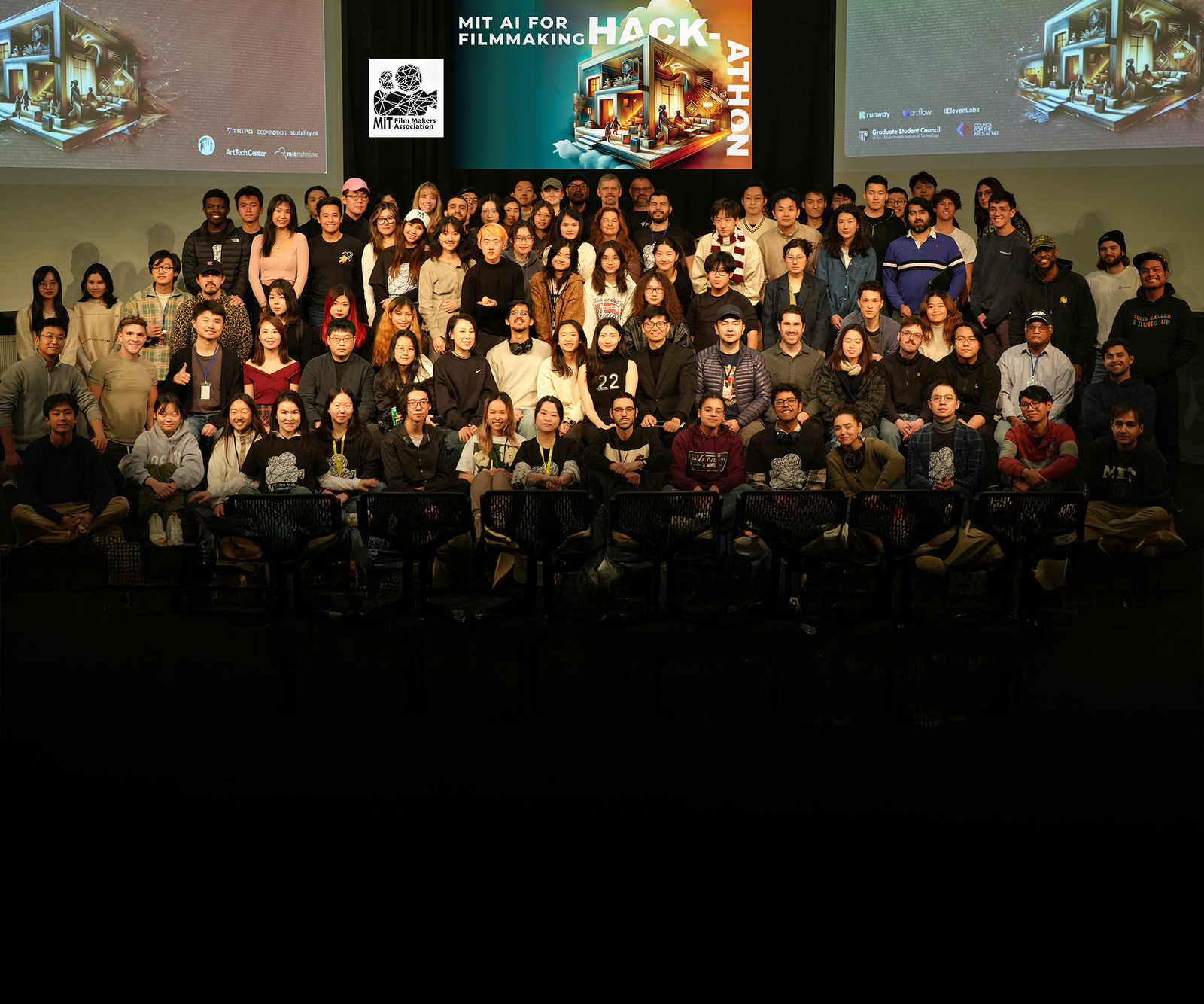
MIT's AI Film Hack team hosted an evening AI Film Festival on October 3, 2025 in Cambridge as part of Boston AI Week. The format combined finished film screenings with working panel discussions, putting audiences in the same room with the filmmakers who made the work and the engineers who built the tools behind it.

Roughly 200 attendees came from the MIT research community, the Boston startup and creative tech scene, and the regional film community. The mix produced conversations that would not have happened in a purely academic or purely industry setting.

The event was not structured as a general networking mixer with a reel playing in the background. Filmmakers presented completed projects, then participated in panels that went into the specific processes, decisions, and failures behind each piece. For attendees, that format meant concrete takeaways rather than generic inspiration.

MIT AI Film Festival at Boston AI Week October 2025 screening and panel event
MIT AI Film Hack

Evening Schedule

  • 5:30 to 6:00 pm: Check in and networking
  • 6:00 to 6:40 pm: AI film screening Part I
  • 6:40 to 7:00 pm: Opening remarks
  • 7:00 to 8:30 pm: Panels: AI Creators: The New Avant Garde, AI Agent and Future Tools, World Making and World Model
  • 8:30 to 8:45 pm: Closing remarks and group photos
  • 8:45 to 9:30 pm: AI film screening Part II and networking

The structure of screening, panel discussion, then second screening was intentional. The first block set the audience's visual reference point, the panels addressed process and tools, and the second screening let attendees watch with fresh context from the discussions. That sequencing made the technical conversations more grounded and the films easier to evaluate critically.

What the Panels Covered

The three panel sessions addressed different aspects of the AI filmmaking pipeline. AI Creators: The New Avant Garde focused on who is making AI films and why, with a specific angle on the creative decisions and authorial choices that distinguish strong AI work from generated content that lacks a point of view.

AI Agent and Future Tools went into the pipeline side. The conversation covered how to structure a production workflow that uses multiple AI tools in sequence, how to manage reproducibility when you need to revisit a shot, and how emerging agentic tools are beginning to handle multi step production tasks without constant manual intervention.

World Making and World Model addressed the most technically forward looking area. World models and spatial generation approaches are changing what is possible in virtual production, previsualization, and environments that need to be consistent across many shots and sequences. This panel was particularly relevant for teams working on projects that require a coherent fictional world rather than isolated generated images.

Why These Panel Topics Matter for Production

The agentic tools panel is the most practically urgent of the three for working production teams. Tools that can chain together generation, evaluation, and revision steps without a human manually managing each transition are already beginning to appear in professional contexts, and understanding how to structure a pipeline around them is a practical skill.

The panel discussion included specific examples of agentic workflows that teams had tested in production contexts, including automated quality review passes that flagged inconsistent frames, shot matching tools that evaluated visual consistency across a sequence, and prompt refinement loops that iterated on outputs until they met a defined quality threshold.

The world model panel addresses a question that becomes important when AI generation moves from single shots to sequences and then to entire scenes. Keeping a consistent environment across twenty minutes of screen time requires spatial memory and coherent state that single image or video generation tools do not provide. World models are the component that will eventually close that gap.

For the creative identity panel, the underlying question is what distinguishes a film made with AI tools from a film generated by AI. The answer depends on the director's choices about what to direct, what to accept, and what to override. Those choices are where authorship lives, and that is what the panel was designed to make visible.

The Next Generation Track

The festival included a Next Generation track focused on student and emerging creator work. This track provided a brief, a deadline, and a public screening, which is often the missing infrastructure that converts an experiment into a finished piece.

For students and educators, the value of the Next Generation track is not only the screening opportunity. It is the process of completing something to a specific standard by a specific date. Working toward an external deadline with a defined format requirement produces different results than working in open-ended exploration.

The track also served as a talent identification mechanism for mentors and production companies in the audience. Early stage work that shows authorial voice and technical fluency, even at modest production scale, is exactly what experienced practitioners look for when building teams for more ambitious projects.

Several participants in Next Generation tracks at events like this have gone on to direct work for commercial clients and to build ongoing relationships with production companies they met at the events. The public screening is the entry point. The conversations afterward are where the professional relationships form.

What Filmmakers Could Take Away

The format of the MIT AI Film Festival was designed to convert watching into learning. Seeing how other teams handled specific problems, whether it was maintaining visual consistency across a three minute film or generating a specific kind of motion that matched a scene's emotional register, gave attendees a concrete map of what was achievable at the current state of the tools.

For teams that attended with work in progress, the feedback loop was more specific. Hearing how an audience responded to finished work that wrestled with similar challenges provided more useful information than any general discussion of AI capabilities.

The networking structure between the two screening blocks was designed to facilitate introductions between filmmakers and the people who could help them. Those connections are often the most durable outcome of events like this, more so than any single technical insight from a panel.

For filmmakers who could not attend, the event's YouTube channel published selected panel discussions and recaps that captured the key points from each session. Those recordings are the most accessible entry point for anyone who wants the substance of the conversations without the networking component. The official pages list where archived recordings are available alongside the full agenda.

Boston AI Week Context

Boston AI Week in 2025 gathered multiple events across the MIT campus and the broader Cambridge area. The Film Festival was one of several events that brought the AI research community into conversation with practitioners from film and other creative fields.

That context mattered because the most useful conversations at events like this often happen across disciplines. A researcher presenting a new motion model has a different frame of reference than a director who has been trying to get consistent human movement out of current tools for six months. When those two people are in the same room watching the same film, the exchange of perspectives is more direct than at a pure research conference or a pure industry event.

For the AI filmmaking ecosystem, events at research institutions like MIT play a specific role. They surface work that has not yet been picked up by trade press, introduce tools that are closer to the research frontier than commercial releases, and provide a setting where speculative conversations about what comes next are grounded in actual systems and results rather than product marketing.

The academic setting also brings a different standard of technical explanation. Researchers at MIT are accustomed to defending their methods with detail, and that expectation carries into event panels. Audience questions tend to be more specific, and the answers are held to a higher standard of precision than at commercial events. For practitioners who have hit the limits of what documentation and tutorials can explain, that depth is valuable.

What Made This Different from a Standard Demo Event

The screening format distinguished the MIT AI Film Festival from most AI meetups, which present tools rather than finished work. At a tool demo, the audience evaluates what a system can generate under ideal conditions. At a film screening, the audience evaluates whether a completed work holds attention, communicates something, and earns its runtime.

Those are different questions, and they produce different conversations. Teams presenting at the MIT festival had to have made creative decisions, not just technical ones. Which sequences to keep, which to cut, how to pace the narrative, where to use silence. Those choices are visible in a finished film in a way they are not in a demo reel.

The panels then made those decisions explicit. A filmmaker who has completed a short film has a specific answer to the question of what the tools could and could not do, because they had to solve specific problems, not hypothetical ones. That specificity is what made the panel content useful rather than generic.

What Worked and What Did Not

Conversations from the event touched on several patterns that appeared across different production approaches. Consistency across longer sequences was the most commonly cited limitation. Most current tools handle single shots or short clips well, but maintaining a coherent visual language across a three or four minute film required significant editorial discipline and, in many cases, substantial retouching or reshooting passes.

Motion coherence for character action, particularly anything involving hands, objects, or precise physical interaction, remained one of the harder problems. Filmmakers who worked around this by designing their stories around camera language, performance timing, and editing rather than relying on the AI to handle complex action found their results more reliable.

The tools that produced the strongest results in the screened work were used to establish environment, atmosphere, and visual language rather than to generate narrative action. The human craft layer was most visible in the editing, pacing, and story choices rather than in individual generated frames.

Takeaways for Teams Planning Future Work

The practical conclusion from the MIT festival, based on what was screened and discussed, is that the strongest AI films in 2025 were built around the tools' strengths rather than against their limitations. Teams that designed their stories for the tools got better results than teams that tried to generate outputs the tools were not yet capable of delivering reliably.

Designing for the tools means understanding, before writing, what kinds of environments, motions, and visual requirements current generation systems handle consistently. A short film set in a visually specific static environment with minimal character interaction is buildable at high quality with current tools. A short film requiring consistent crowd scenes, complex physical interactions, and precise lip sync is not, and teams that discovered this partway through production had harder experiences.

The most useful pre production step for AI films in 2025, based on the experiences shared at the event, was a two to three day test production before committing to a script. The test production produces a one minute proof-of-concept in the intended style and surfaces the specific limitations that the full production will need to design around. Teams that ran this test before writing their final scripts adjusted their stories to match what was actually buildable.

The event's most useful function may have been normalizing that awareness of boundaries as a creative discipline rather than a limitation. The filmmakers who talked through their choices without embarrassment about what they avoided demonstrated that creative constraint is a standard part of the craft, not a failure of ambition.

Other AI Film Events in the Same Period

For a family friendly AI film screening in the same fall period, the Red Rocks AI Film Festival ran October 9 in St. George, Utah, with both in person and livestream options.

On the competitive awards side, Frame Forward AI Film Festival announced its 2026 finalists for national theatrical release, representing the more established festival circuit for AI short films. The combination of research-aligned events like the MIT festival and public-facing events like Red Rocks reflects the breadth of what the AI filmmaking community had developed by late 2025.

Together, these events mark a shift in how the AI filmmaking community presents its work. The focus is moving from demonstrating capabilities to demonstrating finished films. That shift reflects a maturing community, one where the question of whether AI can produce a watchable film has been answered and the new question is whether AI films can hold an audience and say something worth hearing. That shift is a sign of maturity. It means the conversation is less about what the tools can theoretically do and more about what filmmakers have actually made with them, and what the audience thinks of the result. The AI FILMS Studio video workspace is a platform for filmmakers building work for this circuit, with access to the latest text-to-video and image-to-video models.


Sources

MIT AI Film Hack: mitaifilmhack.com Agenda: mitaifilmhack.com/agenda Rules: mitaifilmhack.com/rules Next Generation track: mitaifilmhack.com/the-next-generation-track