
SANA-Streaming: Real-Time Video Editing at 24 FPS on a Single Consumer GPU

Share this post:
SANA-Streaming: Real-Time Video Editing at 24 FPS on a Single Consumer GPU
NVIDIA released a project page and arXiv paper on May 28, 2026 for SANA-Streaming, a streaming video editing system that applies stylistic and appearance edits to video at 24 end-to-end frames per second on a single RTX 5090 at 1280×704 resolution. The paper describes a Hybrid Diffusion Transformer architecture optimized for consumer GPU hardware.
Studio availability. SANA-Streaming is not available in AI FILMS Studio. This article covers a public research release. To generate video in the Studio, see the models listed on the text to video page.
SANA-Streaming teaser, real time video editing at 24 FPS on a single RTX 5090
What It Does
SANA-Streaming takes a video stream as input and applies text-guided appearance or style edits to each frame continuously, producing edited output without stopping for batch processing.
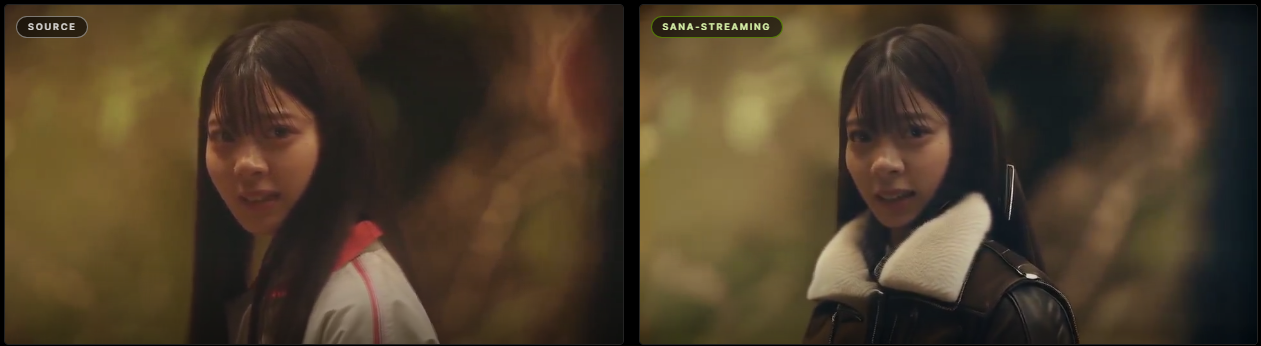
The supported edit types demonstrated in the paper include: style transfer (changing the visual aesthetic of the video to match a text-described style), object transformation (changing the appearance or type of an object in the scene), background replacement (replacing the environment while preserving subject motion), and subject appearance editing (altering how a person or character looks while maintaining motion continuity). These are the four categories of edit most frequently needed in production workflows, covering the full range from purely aesthetic changes to structural visual changes. The system is designed for applications where latency matters: live broadcasting, interactive production, and on set monitoring workflows where a director wants to preview how a scene reads with different visual treatments before committing to them in post.
The DiT core of the system runs at 58 FPS on the same hardware. The gap between the core speed and the 24 FPS end to end figure reflects the overhead added by preprocessing, the encoding and decoding pipeline, and the system codesign components.
What "End-to-End" Means in the 24 FPS Figure
The "end-to-end" qualifier in the 24 FPS benchmark is important. An end-to-end measurement includes every step in the pipeline from input frame to edited output frame: preprocessing the input, running the model forward pass, decoding the output, and rendering it to display. A model-only benchmark would exclude preprocessing and rendering, which would produce a higher number that does not reflect what a user actually experiences.
SANA-Streaming's 24 FPS end-to-end figure is the rate at which edited output frames arrive at the display. The DiT core runs at 58 FPS, but the full pipeline processes one frame roughly every 42 milliseconds rather than every 17 milliseconds. For a 24 FPS video stream, one frame every 42 milliseconds is sufficient to keep up without dropping frames. For a 30 FPS stream, the current end-to-end speed would produce visible dropped frames. The system is calibrated for cinematic frame rates, not broadcast frame rates.
The Latency Problem in Video Editing
Standard AI video editing in 2026 operates in batch mode. A filmmaker submits a video clip, the system processes it over seconds to minutes depending on length and complexity, and returns the edited result. For a single clip in a workflow that requires no interactive feedback, that latency is acceptable. For any workflow where the editor needs to see a result and immediately respond with a different instruction, it is too slow.
The use cases that require low latency are not niche. A director on set reviewing how a location will look under a different visual treatment needs a response in seconds, not minutes. A broadcast producer applying a real time style filter to live footage has no opportunity for batch processing. An interactive installation that responds to viewer input with video style changes cannot queue clips for later processing.
SANA-Streaming addresses this class of applications by keeping the editing loop below the threshold of noticeable latency. At 24 FPS, the output keeps up with standard video frame rates, which means there is no visible gap between the input and the edited output.
Three Technical Components
The paper describes three core contributions.
Hybrid Diffusion Transformer. Standard linear attention is efficient but misses fine local detail. SANA-Streaming introduces softmax attention in a subset of the transformer blocks while keeping linear attention in the rest. This gives the model stronger local spatial modeling without abandoning the efficiency of the linear architecture used in earlier SANA releases.
SANA-Streaming architecture. Source: NVIDIA NVLabs
Cycle-Reverse Regularization. Training a video editing model typically requires large collections of paired videos: an original and an edited version of the same content. SANA-Streaming introduces Cycle-Reverse Regularization, a flow matching strategy that enforces semantic consistency without needing those paired training datasets. The model learns to preserve the underlying structure of the input while applying the requested edits.
System Codesign. The third contribution targets hardware specifically. The system uses fused GDN kernels and mixed precision quantization designed for NVIDIA's Blackwell GPU architecture (RTX 5090 series). This is the layer that converts what would be a powerful research model into something that runs at usable speeds on a single GPU rather than a cluster.
Cycle-Reverse Regularization Explained
Training paired video datasets is expensive. Producing an original video and an edited version of the same clip, with the same content under different visual treatments, requires either real production shoots or prior AI editing passes, both of which cost time and compute.
Cycle-Reverse Regularization works differently. The model learns that applying an edit and then reversing it should return the video to its original state. That constraint is a form of self supervision that does not require paired datasets created in advance. The model learns semantic consistency from its own forward and reverse operations.
The practical consequence is that SANA-Streaming can be trained on unpaired video data, which is abundant. The training pipeline does not require a specialized dataset of original-edited pairs, which would have limited what visual transformations the system could learn.
Performance
The benchmark figure from the paper: 24 end to end FPS at 1280×704 resolution on a single RTX 5090. The DiT core alone reaches 58 FPS at the same resolution on the same hardware. The paper reports improvements in temporal coherence over existing methods, though side by side comparisons are available on the project page rather than in numerical table form in the abstract.
The model was trained using 32 NVIDIA H100 GPUs. The paper is authored by Yuyang Zhao, Yicheng Pan, Qiyuan He, Jincheng Yu, Junsong Chen, Tian Ye, Haozhe Liu, Enze Xie, and Song Han.
Temporal coherence is the metric that matters most for practical use. A video editing system that produces quality edits on individual frames but shows visible flicker or inconsistency between frames is not usable in production. The improvements in temporal coherence that SANA-Streaming reports address the specific failure mode that has made earlier streaming editing attempts impractical.

SANA-Streaming editing results across different text prompts. Source: NVIDIA NVLabs
Production Workflow Applications
The on-set monitoring application is the most immediate for film production. A director who can see how a scene will read after a color treatment or a style change, while the scene is still being shot, can make decisions in production that currently require waiting for post. That compression of the feedback loop changes how the production schedule works: fewer pickups, fewer reshoots, more confidence in the original shooting day.
For broadcast, the 24 FPS real time capability means live visual treatment is practical without dedicated hardware processing pipelines. A sports broadcast applying a consistent visual style across multiple camera feeds could use SANA-Streaming as part of the live production chain once the code is released.
The SANA Research Lineage
SANA-Streaming is the fourth model in the NVLabs SANA research line. SANA 1.0 and 2.0 focused on high resolution image generation with efficient linear attention architectures. SANA-Video extended those architectures into video generation, producing high resolution output for generation from text prompts. SANA-WM pushed further, generating continuous video at 720p for up to 60 seconds. Each release from the SANA line has addressed a different bottleneck: image quality, video generation, long form world modeling, and now real time editing.
SANA-Streaming addresses a different problem. The earlier models all work in batch mode: you submit a prompt, the model generates output, you receive the result. Streaming rewires the architecture around continuous input processing rather than one-shot generation. The Hybrid DiT architecture is a direct consequence of that redesign: softmax attention in selected blocks improves local spatial consistency for the frame-to-frame fidelity that editing requires, which batch generation models do not need in the same way.
The Hardware Gap Between Research and Deployment
SANA-Streaming's RTX 5090 requirement is the current boundary between research capability and broad deployment. The RTX 5090, NVIDIA's consumer Blackwell GPU, has an MSRP in the range of $2,000. That places it well above the RTX 3090 or 4090 that most independent filmmakers and small studios currently use for AI work.
Fused GDN kernels and mixed precision quantization, the system codesign components, are specific to Blackwell architecture. Running SANA-Streaming on an older RTX would require either lower resolution output, reduced frame rate, or software changes to adapt the kernel implementations. NVIDIA's open source release of the code, once available, will allow the community to test both. The more significant deployment path for this technology is likely through cloud APIs rather than local installations, where production studios can access RTX 5090 class compute without owning the hardware.
What "Streaming" Means as a System Design Choice
Streaming video editing is architecturally distinct from batch video generation in a way that goes beyond speed. A batch model processes a fixed input and returns a fixed output. A streaming model must maintain state between frames: each output frame depends on the previous output frame, not just the current input frame. That dependency is what produces temporal coherence, and it is also what makes the architecture substantially harder to build.
The Cycle-Reverse Regularization approach addresses one dimension of this: training the model to maintain semantic consistency across edits without paired training data. The system codesign component addresses the other: making the stateful computation fast enough to run in real time on hardware that production practitioners actually have. The 24 FPS end-to-end figure is the result of both constraints being solved simultaneously on the same RTX 5090 platform.
License and Availability
The project page and arXiv paper are live. Code release is listed as "coming soon" in the NVLabs/Sana GitHub repository, where SANA-Streaming appears on the project's planned releases list. When released, the code is expected to fall under the Apache 2.0 license that governs the parent NVLabs/Sana repository, which permits commercial use.
SANA-Streaming extends a line of NVIDIA open source video models that includes SANA-Video, a high resolution video generation model, and SANA-WM, a world model for minute-scale 720p generation. The streaming model addresses a different problem: real time editing of existing video rather than generation from scratch.
How Real-Time Editing Changes the Production Decision Point
The shift from batch to real time editing is not only a speed improvement. It moves the decision point. A director using a batch editing system makes decisions about what to request before seeing the result, then evaluates the output afterward, then formulates the next request. That cycle runs at the speed of processing time.
Real-time editing collapses that cycle. The director sees the output as they adjust the instruction. The feedback loop becomes exploratory rather than iterative: adjustments can be made continuously, and the result of each adjustment is immediately visible. This changes how decisions about visual treatment get made, since it becomes possible to test hypotheses about what a scene should look like in the same mental bandwidth as viewing the scene, rather than in a separate editing session.
Filmmakers who want to work with AI video generation and editing tools can access them in AI FILMS Studio now.
Sources
Continue Reading
.jpg?w=3840)


Video & LipSync
- Video Generator
- Text to Video
- Image to Video
- Start-End Frame to Video
- Draw to Video
- Motion Control
- Video Enhancer
- Video Upscaler
- Video Extend
- Video to Video LipSync
- Audio to Video LipSync
- Image to Video LipSync
- Video FaceSwap
- Seedance 2.5
- WAN 3.0
- Seedance 2
- FLUX 3
- Minimax H3
- Vidu Q3 Pro
- Grok Imagine Video 1.5
- Gemini Omni
- Google Veo 3.1
- Kling 3.0 Pro
- Luma Ray 3.2
- LTX 2.3
- Happy Horse 1.1
- Kling 3.0 Motion
- ByteDance Upscaler
- InfiniteTalk
- InsightFace
Image & Edit
- AI Character
- AI Actor
- Art Generator
- Text to Image
- Image to Image
- LoRA Image to Image
- Draw to Edit
- Image LoRA Training
- Remove Background
- Image Enhancer
- MidJourney 8.0
- Krea 2
- OpenAI GPT Image 2.0
- Nano Banana Pro Ultra
- Nano Banana 2 Lite
- Nano Banana Pro
- Minimax Image
- Clarity Pro
- Z-Image Turbo LoRA
- Krea 2 Turbo LoRA
- Z-Image LoRA Trainer
- Qwen Image LoRA Trainer
- Background Erase Network 2 (BEN2)