EditorNodesPricingBlog

Analyzing the Rise of AI in Filmmaking: A Shift from Theme to Tool

October 10, 2025
Updated: July 12, 2026
Analyzing the Rise of AI in Filmmaking: A Shift from Theme to Tool

Share this post:

Analyzing the Rise of AI in Filmmaking: A Shift from Theme to Tool
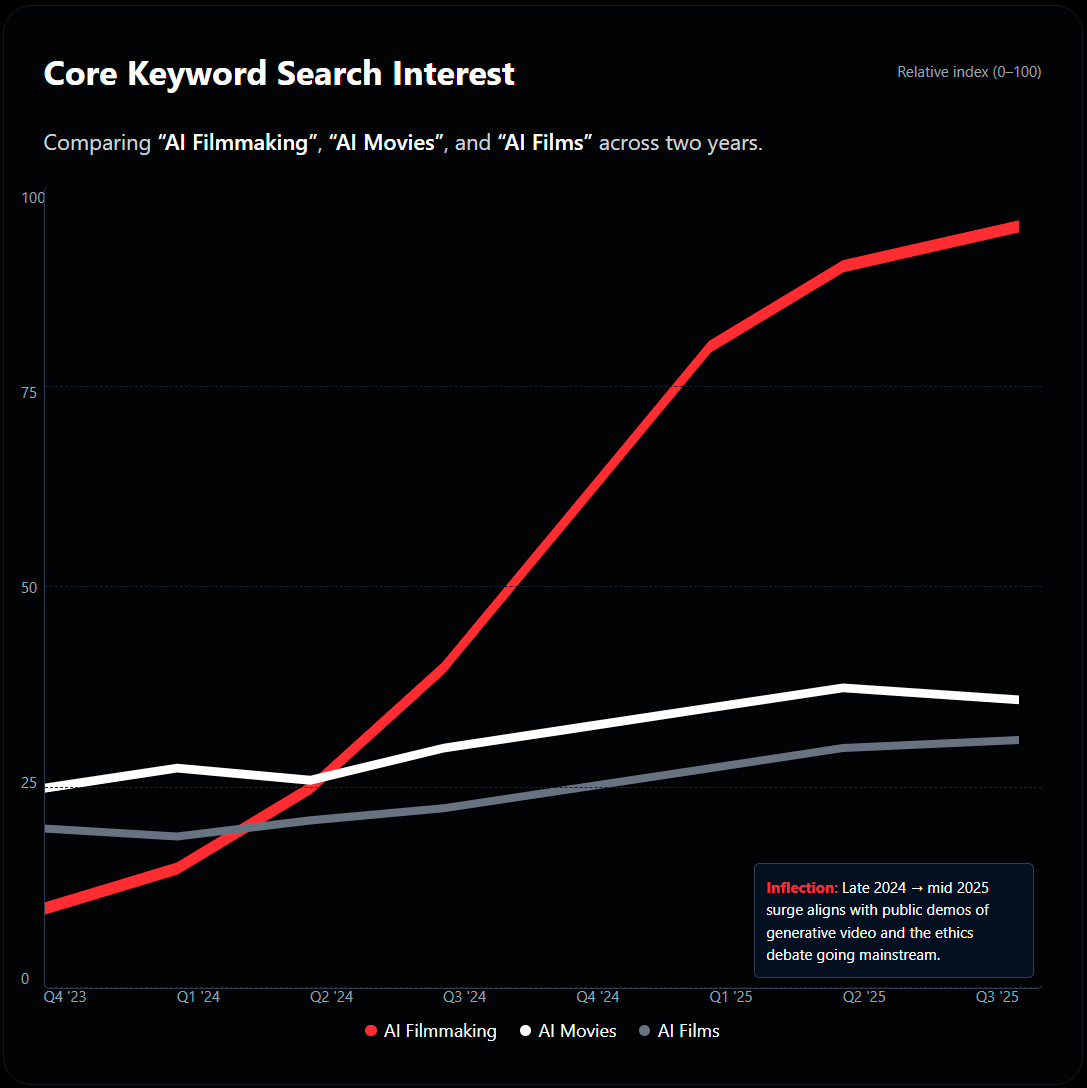
Google Trends data covering October 2023 through October 2025 shows that AI in filmmaking has moved from a science fiction trope into an active production tool category. The clearest signal is a divergence in search behavior: passive consumer interest in AI themed movies held flat, while searches for AI filmmaking techniques grew at an accelerating rate.

Title card reading The Rise of AI in Filmmaking, Google Trends October 2023 to October 2025

Public interest shifted from AI as a narrative theme to AI as a production tool across the two-year period. Source: Google Trends analysis.

The two year period is significant because it spans the 2023 WGA and SAG-AFTRA strikes, the commercial releases of the first consumer-accessible generative video tools, and the Cannes 2025 and 2026 cycles where AI filmmaking became an open industry debate. Each event left a measurable footprint in the search data.

This analysis examines the primary keyword clusters, the breakout queries that grew fastest, and the geographic patterns that identify where adoption is moving from interest to practice.

A Fundamental Shift in Search Intent

The most significant finding from the two-year dataset is the gap that opened between "AI Filmmaking" and "AI Movies" as search terms. "AI Movies", which captures consumer interest in films featuring AI as a plot device, grew at a steady, near-linear rate across the period. "AI Filmmaking" grew at a steeper curve, particularly from late 2024 onward, and by October 2025 was generating substantially higher relative search volume.

The intent behind these two queries is different. Searches for "AI Movies" come from audiences looking for titles to watch. Searches for "AI Filmmaking" come from practitioners looking to understand or use the technology. The divergence indicates that a creator-side audience for AI filmmaking tools grew faster than the general audience for AI themed content.

Video Generation Is the Primary Driver

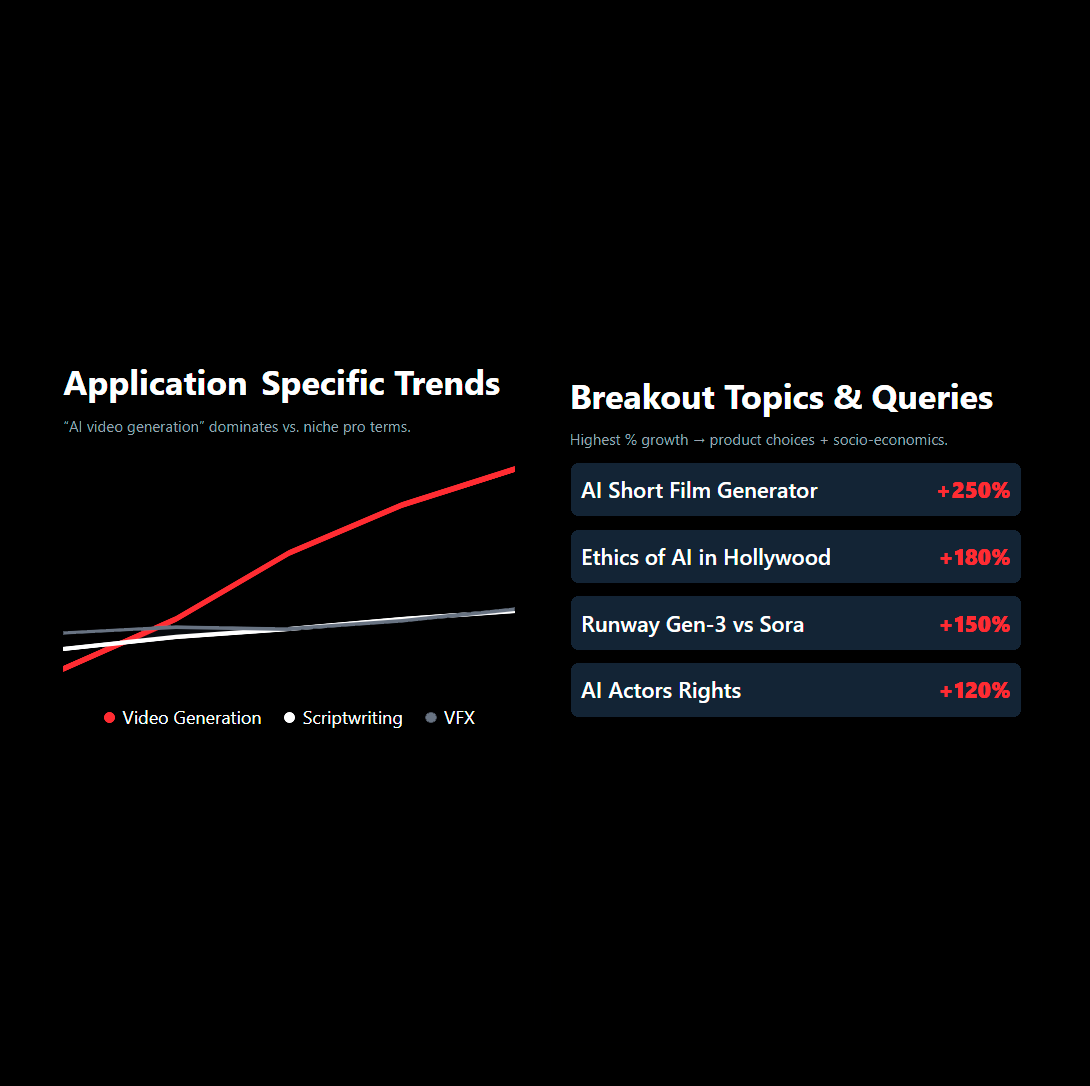
Breaking search interest down by application, "AI video generation" produced more search volume growth than any other category in the filmmaking cluster. Terms like "AI scriptwriting" and "AI VFX" grew during the same period but at slower rates. The reason is accessibility.

Video generation tools that output viewable footage from a text prompt have a visible result in seconds. A scriptwriting tool requires a workflow context to evaluate its output. The immediacy of video generation, and the fact that results can be shared instantly, drove both public demonstrations and creator adoption at a pace that other application categories did not match.

The search volume for "AI short film generator" rose sharply during this period, indicating that interest moved from learning about the technology to using it for specific creative projects. That shift from exploration to application is the primary story in the two-year dataset.

Two charts showing video generation leading application trends and AI Short Film Generator appearing as a breakout query

Video generation dominates application interest. Breakout queries show movement toward specific tool evaluation and socioeconomic concerns. Source: Google Trends analysis.

Breakout Queries: What the Fastest-Growing Searches Reveal

Breakout queries show the highest percentage growth rather than the highest absolute volume. They identify topics moving from niche to mainstream. Two categories drove the fastest growth in the filmmaking cluster.

The first category is product evaluation. Searches like "Runway Gen-3 vs Sora" grew substantially, indicating that users had moved past general awareness of AI video tools and were actively comparing specific products for their own workflows. The search query "AI short film generator" also fell into this category, reflecting a user intent of creating rather than observing.

The second category is labor and ethics. Searches for "Ethics of AI in Hollywood" and "AI Actors Rights" grew significantly from mid-2023 onward. The 2023 WGA and SAG-AFTRA strikes were the trigger: AI use rights were a central negotiating point in both agreements, which pushed the topic from industry news to mainstream search behavior. Questions about job displacement, intellectual property, and performer likeness rights all appeared as distinct growing query clusters.

The Tool Comparison Pattern in Detail

Product comparison searches in the AI filmmaking category follow a specific progression. First, searches establish that a tool exists. Then, searches compare it to a competing product. Finally, searches look for tutorials, use cases, and integration guidance. The appearance of "Runway Gen-3 vs Sora" as a breakout query represents the second stage: a user base that has already decided to use one of these tools and is choosing between them.

That pattern repeated across multiple tool comparisons during the two-year period. Each time a new video generation model was publicly released, a burst of comparison searches followed within days. The queries were specific, naming exact model versions, which indicates a creator audience rather than a general interest audience. General audiences search for "AI movies." Practitioners search for model version comparisons.

Geographic Detail: India and South Korea

India's position in the top five search interest markets for AI filmmaking reflects two factors. Indian film production volumes are among the highest in the world, which creates a large base of professional practitioners who would search for production tools. The country also has an active technology sector with direct exposure to AI tool development, which accelerates awareness of new releases. Bollywood and the regional language industries account for thousands of productions annually, and the competitive pressure to reduce production costs makes AI adoption a business-level priority.

South Korea's presence reflects a different dynamic. The country's animation and live-action industries have built export markets in Asia, Europe, and North America. Manhwa adaptations and original Korean drama series have established a pipeline for content production at scale. Korean studios are evaluating AI tools for visual development, post-production, and the early development of AI assisted animation pipelines that could reduce per-episode costs for series production.

Global Interest Follows Industry Hubs

A chart showing top regions by search interest for AI filmmaking: United States, United Kingdom, Canada, India, and South Korea

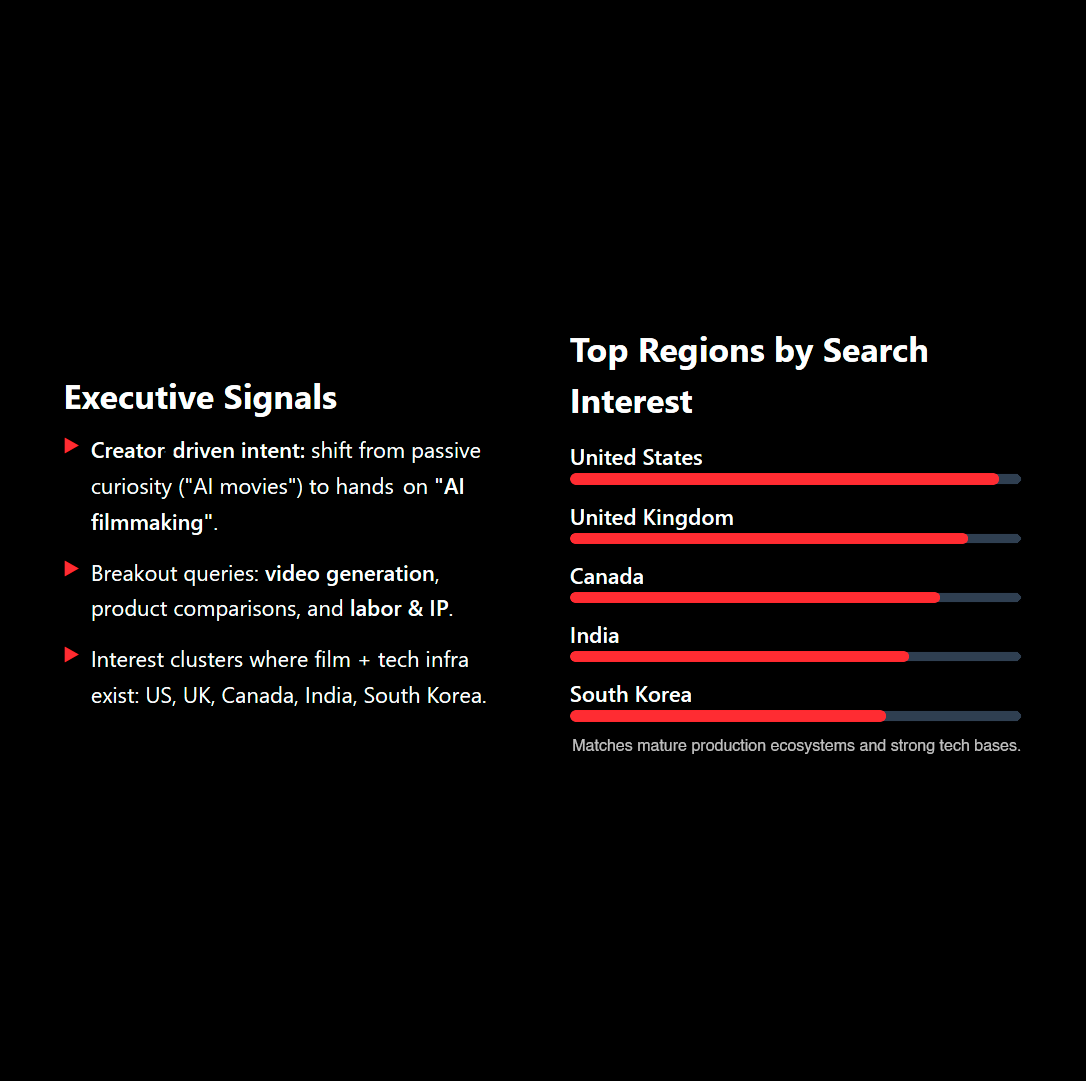
Search interest is highest in markets with mature production infrastructure and established technology bases. Source: Google Trends analysis.

The United States, United Kingdom, Canada, India, and South Korea lead the geographic distribution. These five markets share two characteristics: established film and television production infrastructure, and direct exposure to AI tool development through technology industry concentration.

Countries without both of those factors appear further down the ranking regardless of population size. The combination of production professionals who have immediate use cases for AI tools, and technology sectors that follow new model releases closely, produces the search volume concentration visible in the data.

Post-Guild Deal Ethical Query Pattern

The ethics search cluster grew sharply during the 2023 strike period and remained elevated after both guilds ratified agreements. The queries shifted in character after the agreements were reached: pre-ratification searches centered on "will AI replace actors" and "AI and writers strike", while post-ratification searches moved toward "AI actors consent", "AI script copyright", and "SAG-AFTRA AI rules". The second wave indicates a user base that accepted AI's presence in production and moved to understanding the specific terms under which it operates.

The same pattern occurred after the 2026 guild renewals. Within 30 days of the SAG-AFTRA 2026 agreement, queries around digital replica consent and performer AI licensing saw increases. The policy outcomes created new information needs for practitioners who wanted to use AI tools in compliance with the new agreements.

From Query to Tool Adoption

Search interest is a leading indicator of adoption, not a direct measure of it. A spike in searches for "AI video generation" tells you that awareness is growing. It does not tell you how many productions are actually using the tools, at what scale, or at what quality tier.

The gap between search interest and production adoption is real. Productions that use AI tools frequently do not disclose that use publicly, as Deadline documented in its June 2026 analysis of AI production credit practices. That means the production adoption rate is likely higher than public disclosure would suggest, but search volume cannot resolve the discrepancy. Google Trends is a reliable proxy for professional awareness and practitioner intent. Actual adoption data requires production surveys or guild reporting, neither of which is currently public at scale.

Search Volume as a Production Forecasting Tool

The practitioner-led growth in "AI Filmmaking" queries has historically preceded production adoption by six to twelve months. When interest in a specific tool category spikes in search data, productions using those tools appear in guild reports and distribution announcements within a year. That lag reflects the time between a practitioner discovering a tool and finishing a production that used it.

The implication is that the search volume data from 2024-2025 predicts what will show up in production data in 2025-2026. The sharp rise in "AI short film generator" searches from late 2024 should produce a visible uptick in AI assisted short films entering festival circuits in 2025 and 2026. Festival programming data from Sundance, Tribeca, and SXSW over those two years can be used to test whether the search to production lag holds at this particular stage of the adoption curve.

What the Data Misses

Google Trends reflects search behavior on Google. China, which has one of the most active AI filmmaking development environments in the world, uses Baidu as its primary search engine. MiniMax Hub, Kling AI, and Hailuo Video are all Chinese AI video tools with substantial production use, but their search footprint is largely invisible in Google Trends data. The geographic distribution showing India and South Korea in the top five would look different if Baidu Trends data were included alongside Google's.

Japan is similarly underrepresented relative to its AI animation development activity, where local search engines and closed platform networks handle much of the practitioner research. The Google Trends data is a reliable picture of Western and English-language market dynamics. It is not a complete picture of global AI filmmaking adoption.

The Cannes 2026 Effect on Search Volume

The Cannes Film Festival has historically driven brief spikes in entertainment industry search queries. Cannes 2026 produced a measurable spike in AI filmmaking queries specifically, driven by the festival's ban on AI in Official Competition, Peter Jackson's "just a special effect" remarks at his masterclass, and the volume of press coverage describing AI as having "come out of the closet" at the Marché. Those three news events concentrated over ten days generated more AI filmmaking search volume than any comparable period in the dataset.

The spike pattern is different from the sustained growth in "AI Filmmaking" as a category. The Cannes spike was driven by news-motivated searches and returned to baseline within two weeks. The sustained growth curve reflects practitioner adoption behavior rather than audience reaction to headlines. Both are present in the data and need to be read as distinct signals.

What the Trajectory Suggests

The divergence between "AI Filmmaking" and "AI Movies" search interest will continue widening as generation tools improve and pricing drops. Each generation of tool lowers the barrier to production-quality output, which expands the creator audience that produces practitioner level search behavior.

The ethics and labor query cluster will grow more specific over time. General questions about AI and jobs are already giving way to precise questions about specific contractual provisions, consent requirements, and copyright frameworks. That shift indicates a user base moving from opposition or anxiety to engagement with the regulatory and commercial details.

As specific models and tools attract practitioner audiences, the search volume patterns become more granular. "AI short film generator" as a broad query will give way to model specific searches as practitioners develop preferences for specific tools and techniques. Search volume for model names directly, rather than generic category terms, is the sign that a technology has moved from early adoption to mainstream professional use. That transition was visible in the 2024-2025 data and will be more pronounced in 2026-2027.

The ethics and labor query cluster will continue evolving as the 2026 guild agreements move into their first enforcement and renewal cycles. Search patterns that currently show practitioners asking how AI affects their rights will shift toward questions about specific provisions and precedents, reflecting a user base that has moved from concern to navigation of a specific regulatory reality.

For filmmakers who want to move from search interest to active production, AI FILMS Studio provides access to the text-to-video and image-to-video models driving the adoption trends the data shows. For a look at how guild agreements are shaping AI use on professional productions, see Hollywood's 25 most influential AI figures.


Sources

Google Trends | Deadline | Variety | The Hollywood Reporter