Fremantle's Andrea Scrosati: AI is lowering barriers for talent

Share this post:
Fremantle's Andrea Scrosati: AI is lowering barriers for talent
Andrea Scrosati, Group COO of Fremantle, said at the Toronto International Film Festival that AI tools "will permit a new generation of talent to emerge" by removing barriers to entry. Speaking in September 2025, Scrosati framed the development as a fundamental shift in how the creative industry identifies and develops new voices, not as a marginal efficiency gain.
His comments carried institutional weight. Fremantle is one of the largest independent television production and distribution companies globally, with operations across more than 30 countries and credits including The Price Is Right, American Idol, Family Feud, and Neighbours. When its Group COO says AI changes who can enter the creative industry, that statement reflects a company that has already begun building infrastructure around that assumption.
The statement also arrived at a moment when the production industry was navigating competing narratives about AI. Some voices in the industry framed AI generation tools primarily as threats to existing creative labor. Scrosati's framing from a major production company was notably different: AI as expansion of the creative talent base rather than as replacement of existing participants. That framing has strategic implications for how Fremantle positions itself in markets and in relationships with new creators.
What Scrosati Said
Scrosati described AI tools as capable of removing barriers to entry for a new generation of creators. His full formulation was that these tools "will permit a new generation of talent to emerge." The directional claim is about access, not automation.
He paired that statement with a firm position on intellectual property. Scrosati said content protection is "fundamental," signaling that Fremantle's embrace of AI access does not translate to loosened rights standards. The two positions are not in contradiction. Lower barriers to creation increase the supply of content, which makes IP protection more important rather than less.
The Toronto setting is relevant context. TIFF is where distributors, producers, and rights holders gather to evaluate talent and close deals. Scrosati's remarks addressed exactly the audience that decides which new voices get access to distribution, development funds, and production partnerships.
Speaking about AI access to buyers and distributors at TIFF rather than to a technology audience signals that Scrosati was making a market argument rather than a technology one. The claim is not that AI tools are impressive; it is that they change who buyers will be evaluating at the next TIFF and in the development slates that follow. That is a commercial argument calibrated for the commercial audience in the room.
What Imaginae Studios Represents
In April 2025, Fremantle launched Imaginae Studios, an AI focused production label built to develop and deploy AI driven production tools and services for Fremantle's in house creatives. The label operates across the Fremantle group.
Imaginae Studios is not a standalone startup; it is Fremantle infrastructure. Tools developed there will be available to Fremantle's production teams across markets, not just to a single pilot project or a competitive accelerator cohort.
The April 2025 launch, five months before Scrosati's TIFF remarks, suggests the remarks reflect work already underway rather than aspirational positioning. Fremantle had already built the operational vehicle for AI production before Scrosati described the talent access implications publicly.
The Imaginae name is also notable. A label built specifically for AI production tools sits alongside Fremantle's conventional development and production infrastructure rather than replacing it. That parallel structure suggests Fremantle is treating AI production as a distinct capability requiring dedicated resources, not as an enhancement to existing workflows that can be absorbed by current teams without structural change.
Whether Imaginae Studios develops into a significant revenue line or remains primarily a tooling resource for Fremantle's own productions is a question that subsequent years will answer. What the launch confirmed is that Fremantle's operational response to AI production tools is institutional rather than experimental.
Both approaches, the production tools infrastructure and the talent access framing Scrosati described at TIFF, are consistent with a company that expects AI generation to be a defining factor in content development over the next decade rather than a short cycle trend.
The Talent Pipeline Argument
Scrosati's claim about lowering barriers maps to a specific production reality. Pitching a television series has historically required either institutional access, such as a production company relationship or an agency, or enough budget to produce proof of concept materials independently. AI tools change the second part of that equation.
A creator who can prototype a pilot teaser, a visual lookbook, or an animatic using AI generation tools has a pitch artifact that previously required a production budget or an industry sponsor to produce. That capability shift expands the pool of people who can demonstrate their creative vision to a buyer.
The global dimension is also significant. Fremantle's operations across more than 30 countries mean Scrosati is describing a talent access shift that applies across markets where the traditional gatekeeping infrastructure of agents, development deals, and physical film schools has been thinner. In those markets, AI tools compress the advantage that creators in established industry hubs have historically held.
Independent creators outside major markets who previously could only pitch through text and static images can now produce video lookbooks, character exploration, and tone references that communicate a project's potential more concretely to international buyers.
That said, the access shift is only part of the equation. Buyers evaluating more pitches still apply the same quality and commercial viability standards. A creator who uses AI tools to produce a higher volume of lower quality pitches does not benefit from the access expansion. The advantage goes to creators who use the tools to produce materials that communicate a strong and original creative vision clearly. The bar for quality does not lower because the tools do; if anything, the baseline rises as more creators use them.
Distribution and Format Testing
Faster prototyping enables more format testing across regions and platforms. A development team that can generate localized visual concepts, test different tonal approaches, and produce multiple format variants in days rather than months changes how international development decisions get made.
For a company like Fremantle with operations across 30 plus markets, that format testing advantage is material. Content that travels internationally tends to have visual and tonal qualities that translate across cultural contexts. Testing those qualities in early development, rather than after full production budgets are committed, is a risk management approach that AI tools make financially viable for the first time.
The distribution implication extends to independent creators as well. An international buyer evaluating a pitch from an unfamiliar creator has historically had limited material to assess. A creator who can produce a localized visual proof of concept for the buyer's specific market removes a significant part of that uncertainty. Scrosati's talent access argument partly depends on independent creators having the tools to do exactly this.
Streaming platform requirements add another dimension to this dynamic. Platforms that acquire content for specific regional markets have delivery specifications and genre preferences that vary by territory. A creator who understands those specifications and can produce concept materials tailored to them is better positioned for acquisition conversations than one who cannot.
The Rights Infrastructure Question
Scrosati's content protection statement is the practical counterweight to the access claim. More creators using AI tools to produce content means more content with complex provenance questions. What models were used, what training data informed those models, and what rights attach to the generated output are questions that buyers will ask before acquiring or developing AI generated work.
Studios and distributors evaluating AI generated content need defensible answers to those questions. Fremantle's emphasis on content protection as fundamental signals that the company is building rights verification into its AI workflows rather than treating it as a downstream issue to solve at delivery.
The practical requirements for producers working with AI tools include verifying training data sources and model licenses before generating content intended for distribution, securing likeness, voice, and music rights independently of the generation pipeline, and locking usage boundaries around any model that carries a community license with scale or territory restrictions.
Development Speed and the Greenlight Loop
One direct production implication of AI tools is the compression of the development timeline between a creative idea and a buyer's evaluation of it. Scripts can move to visual form faster through animatics, storyboards, or AI generated previs. That faster path means more iterations before significant budget is committed.
For producers, that changes the economics of development. A creative idea that might previously have required three months to develop to a pitchable state can now reach a comparable pitch artifact in days. The cost per iteration drops, which means more ideas can be tested before a greenlight decision.
Scrosati's framing suggests Fremantle sees this acceleration as a net positive for the industry. Faster feedback loops on more ideas, from a broader pool of creators, increases the probability of finding formats and concepts with genuine market appeal before large production budgets are deployed.
The greenlight loop compression also changes the risk profile of development investment. When a pilot presentation can be produced in days, the cost of testing a concept that does not land with buyers is measurably lower. That lower cost per test makes it economically viable to develop and test more concepts rather than betting development resources heavily on a small number of projects.
For studios with large development slates, that risk profile change has structural implications. A development model that tests many ideas quickly and invests heavily only in the ones that generate buyer interest is different from a model that invests in a smaller number of ideas over longer development timelines. Fremantle's infrastructure investment in Imaginae Studios suggests they are moving toward the former model.
Cost Profile and Human Oversight
AI tools do not eliminate production budgets; they shift where money is spent. The shift is from labor intensive manual production work toward supervision, quality control, and rights clearance as the primary human contributions.
Producers planning AI augmented productions should account for that shift rather than treating AI generation as a straight cost reduction. The generation cost may be lower, but the oversight cost, including the people who review outputs, verify rights, and maintain quality standards, represents a new budget category rather than a saving on an existing one.
Fremantle's positioning through Imaginae Studios and Scrosati's TIFF remarks suggests the company expects AI production to require trained human supervision throughout the pipeline. Automated generation that runs without rights verification is a liability; supervised generation with documented provenance is a production asset.
The QA implications deserve specific attention. Productions that use AI for visual generation need a rights and safety checkpoint before content moves to marketing or distribution. AI generated content that includes uncleared likenesses, music, or reference material that does not survive rights verification is a delivery problem, not a generation problem. Building that checkpoint into the workflow at the point before marketing handoff is more efficient than discovering the issue at delivery.
For budgeting purposes, producers should plan for one hour of human quality review per deliverable, not just per generation session. A session that produces fifty frames may require meaningful review time to identify the frames that meet quality and rights standards for delivery. That review time is production cost, and it should appear in the budget rather than being absorbed informally.
The producers who will get the most from the talent access shift Scrosati described are those who build this oversight infrastructure early, when the productions are small enough to learn on, rather than when a large production depends on systems that have never been stress tested.
Upskilling and the Production Room
Scrosati's framing implies that the production room of the near future combines established showrunners with people who are native to AI tools. That combination captures the creative and editorial judgment that experience provides alongside the generation and iteration speed that AI tool proficiency provides.
That pairing is not automatic. Studios and production companies that want to benefit from AI generation need to build the internal capacity to supervise AI outputs with production judgment, not just adopt the tools and assume the result will match broadcast quality. The supervision gap is where most early AI production failures occur.
Fremantle's Imaginae Studios presumably addresses this for Fremantle's own productions. Independent producers without that resource need to build equivalent capacity through hiring, training, or partnerships with people who have both production experience and AI tool expertise.
For individual producers without a studio infrastructure, the practical upskilling path involves learning to evaluate AI generated outputs against broadcast quality standards before any buyer review. That evaluation skill is as important as the generation skill itself.
The combination Scrosati implicitly describes, experienced editorial judgment alongside AI tool fluency, is not common yet. People who develop both are positioned well in a market that is building demand for exactly that combination. Fremantle's Imaginae Studios is in part a bet that those people can be developed internally and that the combination of institutional knowledge and AI tool competency produces better outputs than either alone.
For independent producers, the equivalent is the combination of understanding what buyers want, what makes good television, and how to direct a generation tool toward that standard. The AI tool does not replace editorial judgment; it responds to it. Producers who invest in developing their editorial judgment alongside their AI tool competency will produce better materials than those who invest only in one or the other.
What This Means for Independent Producers
The message from Scrosati is directionally positive for independent creators but comes with specific practical requirements. Access to AI generation tools does not automatically translate to access to distribution or development deals. What it does is lower the bar for producing demonstration materials that can initiate those conversations.
Independent producers who want to benefit from this shift need to invest in the rights and documentation infrastructure that buyers like Fremantle will require. That means building a rights checklist into AI generation workflows from the first project, not as a compliance step added at the end. It also means being prepared to show buyers the documentation of how content was produced, not just the output itself.
The format testing implication is also worth tracking. Faster prototyping enables more format testing across regions. AI tools make it possible to generate localized pilots and trailer versions quickly, with human editors curating final cuts. For Fremantle, which operates across 30 plus markets, that format testing capability is a direct competitive advantage in identifying which content travels internationally.
Independent producers who take Scrosati's comments at face value should also be realistic about the competitive dynamics that follow. If AI tools lower the barrier to entry across the entire industry simultaneously, the number of pitches buyers receive increases even as individual pitches become cheaper to produce. The competitive advantage goes to creators who combine AI tool fluency with a clear creative voice and production execution capability, not to those who adopt the tools without developing the judgment to use them well.
The producers who benefit most from this shift will be those who use AI tools to free creative time and budget for the elements of a production that require human judgment, relationship, and execution. The generation work becomes faster; the creative and editorial decisions that determine whether a project is worth making remain as demanding as they have always been.
The rights documentation requirement is also worth treating as a competitive advantage rather than as a compliance burden. A producer who arrives at a buyer conversation with a project that has clean documentation, verified model licenses, and a production plan that addresses AI content standards is distinguishing themselves from the field rather than just meeting a baseline. That documentation is part of the pitch, not just part of the paperwork.
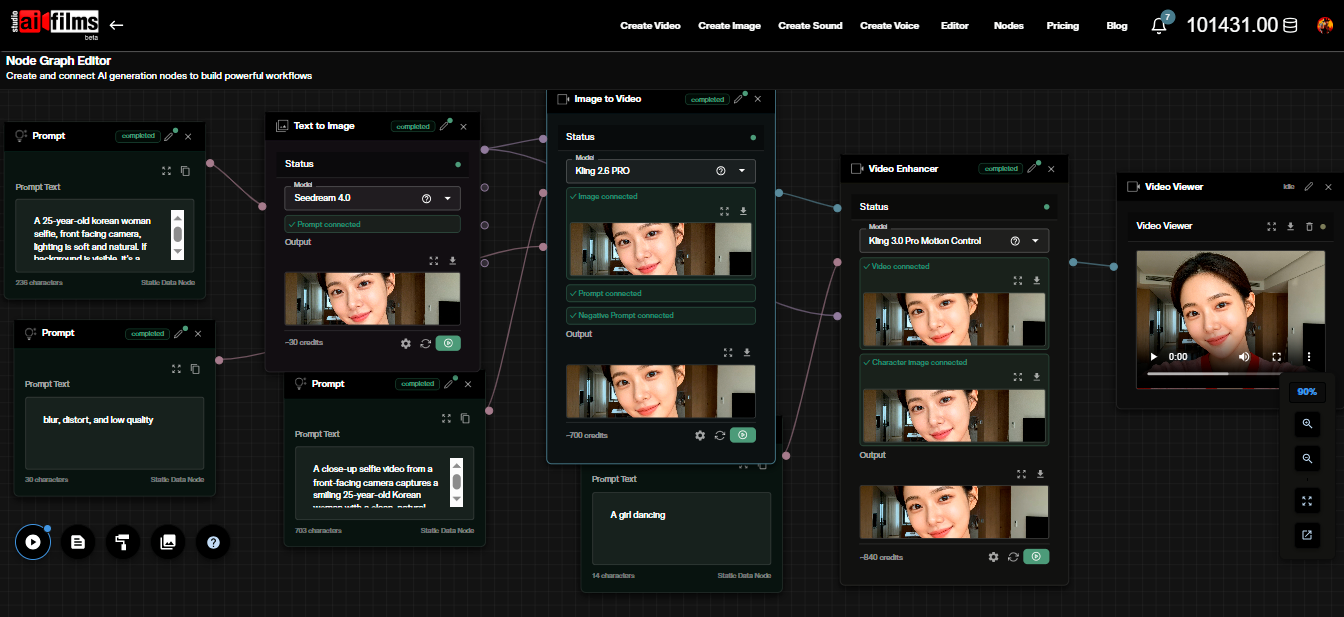
For independent filmmakers building AI production workflows without a studio relationship, the AI FILMS Studio video workspace provides access to text-to-video and image-to-video generation with commercial licensing handled at the platform level.
Sources
Deadline | Yahoo Entertainment | Screen International | Variety
Continue Reading
Video & LipSync
- Video Generator
- Text to Video
- Image to Video
- Start-End Frame to Video
- Draw to Video
- Motion Control
- Video Enhancer
- Video Upscaler
- Video to Video LipSync
- Audio to Video LipSync
- Image to Video LipSync
- Video FaceSwap
- Seedance 2
- Vidu Q3 Pro
- Google Veo 3.1
- Kling 3.0 Pro
- LTX 2.3
- Happy Horse 1.1
- Kling 3.0 Motion
- ByteDance Upscaler
- InfiniteTalk
- InsightFace