
Cannes 2026: AI Vendors Dominate the Marché as Competition Banned Their Films
.png?w=3840&q=90)
Share this post:
Cannes 2026: AI Vendors Dominate the Marché as Competition Banned Their Films
The 79th Cannes Film Festival banned generative AI films from Palme d'Or eligibility. In the same building during the same two weeks, the Marché du Film ran more than 20 AI sessions in its final four days alone, with over 100 AI companies represented on the market floor. The two parts of the festival were operating on opposite assumptions about where the industry is going.
Cannes 2026 is the moment AI filmmaking became a commercial market category even as the festival's artistic gatekeepers tried to exclude it.
The Contradiction at the Center of the Festival
The competition jury banned AI generated work from consideration for the Palme d'Or. That decision played out in the Lumière theatre while the Marché hosted its most technology dense programming in the event's history. The first Creator Economy Summit ran alongside AI vendor sessions, a new programming category that did not exist in prior years.
Screen Daily named "AI moves in" as one of seven defining talking points of the 2026 festival. The Hollywood Reporter called it "AI crashes the party." Both framings describe the same fact: the market no longer treats AI production as an experiment or a niche. It treated it as a segment.
The Creator Economy Summit, which ran during the market's opening days, drew producers and digital content creators together for the first time in the Marché's official programming. The session structure acknowledged a shift in who makes content and how it reaches audiences, a shift that AI tools are accelerating in both directions.
US Studios Retreated. European Buyers Moved In.
The most consequential business story at Cannes 2026 was the absence of traditional US studio distributors. Major American studios were largely not competing for acquisitions, leaving the floor open to European buyers and streaming platforms.
Mubi dominated the acquisition landscape overall, extending its position as the leading buyer of prestige festival titles. A24 made the single most notable deal of the Marché: acquiring "Club Kid" for $17 million. IndieWire described the acquisition environment as a geopolitical shift, with European buyers filling the vacuum US distributors left behind.
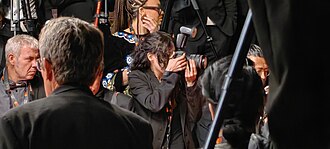
Runawaymo / WikiPortraits, via Wikimedia Commons
The [cultural mood on the Croisette](/blog/cannes-2026-ai-acceptance-hollywood-stayed-home) reflected the same realignment. Hollywood was not present at the festival in its traditional capacity, and the directors and producers who were there were not waiting for its return.
Mubi's dominance at acquisitions is not accidental. The platform has built its identity around exactly the kind of international auteur cinema that wins at Cannes, and its buyer relationships with European and South American production companies give it first access to the films that come out of the competition. The A24 deal for "Club Kid" at $17 million was the largest single acquisition announced during the market.
The Meta Partnership and AI's Official Status
Meta signed a multiyear official partnership with the Festival de Cannes during the 2026 edition, a first for the festival with a major AI technology company. The partnership covers both the festival and the Marché, giving Meta a formal presence in official programming and communications.
The partnership's timing, announced while the competition banned AI generated films from Palme eligibility, produced a visible tension. The festival's artistic arm and its commercial arm were signaling opposite things about AI in the same week. Fremaux addressed the contradiction by distinguishing between the festival's values (standing with artists) and the market's function (connecting buyers with product). Both can coexist in the same building.
Meta AI tools were used in Steven Soderbergh's documentary "John Lennon: The Last Interview," a competition selection, meaning AI was not categorically absent from the competition even as the festival officially restricted it. Soderbergh's film used Meta's AI for specific technical tasks rather than character generation, which kept it within the festival's rules.
What Shifted in Filmmaker Sentiment
The Wrap described the 2026 Marché as a moment when filmmaker attitudes toward AI shifted from panic to "cautious curiosity." The phrasing captures something real: panic implies AI arriving uninvited. Cautious curiosity implies a decision being made.
At the Marché's AI for Talent Summit, held May 15-16 ahead of the festival, the organizers had predicted this shift. The summit drew practitioners rather than critics. The Marché's final four days converted that practitioner interest into active vendor sessions with buyers in the room.
The 100+ AI companies on the Marché floor represented a range of production tools: visual effects platforms, voice generation services, script analysis tools, distribution prediction models, and localization systems. The spread across every stage of the production pipeline confirmed that AI's presence in the market was not a single technology vertical but a general category of services targeting every part of the industry's workflow.
AI Films Were Shopped Alongside Conventional Ones
The Marché did not create a separate track for AI produced titles. Buyers encountered AI films and conventionally produced films in the same sales meetings, the same screening slots, and the same acquisition conversations. Doug Liman's Bitcoin, Casey Affleck and Pete Davidson's AI feature, had a "steady stream of curious buyers" at the Majestic Hotel according to Deadline.
The ban in competition and the vendor presence in the market produced a structural split that has no precedent in the festival's history. Competition rewards craft by human artists. The market rewards product that buyers can sell. At Cannes 2026, those two functions reached sharply different conclusions about AI.
Whether that split resolves at Cannes 2027 will depend on whether any of the titles shopped as AI productions in 2026 return with distribution data showing commercial viability. No major AI production from this Marché has announced a release date.
The AI for Talent Summit Before the Festival
The Marché's AI programming did not begin when the festival opened. The AI for Talent Summit ran May 15 and 16, ahead of the main festival, with sessions focused on how AI tools change what creative talent can produce independently. The summit drew practitioners and executives who had traveled specifically for the event, establishing the AI track before the main Marché floor even opened.
By the time the festival began, the groundwork for the AI program was already set. Vendors who attended the summit had already scheduled meetings with buyers. The Marché's final four days concentrated those conversations into formal sessions, but the relationships behind them had been built during the summit's summit run before the festival.
The 100 AI Companies Across the Pipeline
The 100+ AI companies represented at the Marché covered every stage of the production and distribution pipeline. Vendors offering script analysis tools shared floor space with visual effects platforms, voice generation services, distribution prediction models, and localization systems.
That spread is significant. Previous years' AI presence at the Marché was concentrated in visual effects and post production. The 2026 edition had AI vendors in development, production, post, distribution, and marketing simultaneously. A filmmaker could walk the Marché floor in 2026 and find AI tools targeting every decision point in a film's commercial life. That had not been true at any previous Cannes market.
Doug Liman's Bitcoin at the Majestic
Deadline reported that Casey Affleck and Pete Davidson's AI feature Bitcoin, directed by Doug Liman, attracted a "steady stream of curious buyers" at the Majestic Hotel during the market. The film's acquisition conversations were ongoing during the festival.
Bitcoin was the most prominent AI integrated feature being shopped at the 2026 Marché and represented the clearest test case for whether buyers would treat AI productions as commercial inventory. Curious buyers is not the same as completed deals: as of the market's close, no acquisition announcement had been made. But sustained buyer traffic at the Majestic over multiple days established that the film was generating genuine acquisition interest, not just diplomatic attention.
What the Absence of US Studios Means
The retreat of major US studio distributors from Cannes 2026 acquisitions left a specific gap. Studios with acquisition budgets had been the backstop for second and third tier prestige titles that European buyers did not take. Without that backstop, European distributors had to make faster decisions on a wider range of titles or let films go without distribution deals.
For AI productions being shopped at the Marché, the studio absence removed the most likely source of skepticism. Studios acquiring titles through their US distribution arms have institutional pressures to avoid reputational controversy, including the controversy that AI attribution in major release titles would generate in 2026. European buyers operating in different regulatory and audience environments faced less of that constraint.
The Meta Partnership's Meaning
Meta's multiyear official partnership with the Festival de Cannes was announced during the 2026 edition, a first for a major AI technology company. The partnership covers both the festival and the Marché, giving Meta a formal presence in official programming and communications.
The timing, announced while the competition banned AI generated films from Palme eligibility, produced a visible tension. The festival's artistic arm and its commercial arm were signaling opposite things about AI in the same week. The Meta partnership is the clearest evidence that Cannes as an institution is not aligned with the competition's restrictive position. It is an institution willing to formalize a commercial relationship with the sector's largest AI platform at the same time its competition jury refused to evaluate AI films.
What Buyers Actually Heard About AI Films
The AI companies presenting at the 2026 Marché addressed buyers differently than in previous years. The pitch in prior years was potential: AI tools that could produce content at lower cost, eventually. The 2026 pitch was product: finished films, completed series pilots, and demonstrated workflows producers could integrate immediately.
Buyers were evaluating AI content the same way they evaluate any other category, asking about audience demographics, distribution rights, marketing costs, and windowing strategy. The conversations were commercial, not primarily technical.
What MIFA 2027 Will Look Like
Every major film market reacts to the programming that generated the most attendee traffic the previous year. The Marché's 20+ AI sessions and 100+ company floor presence in 2026 will be the reference point for MIFA programming decisions in 2027.
Whether those sessions generated acquisition deals or primarily conversations will determine how much the 2027 edition expands the AI track. The Bitcoin conversations at the Majestic are the clearest data point: if that film announces distribution in Q3 2026, the 2027 Marché AI track will be larger.
Who Attended the Creator Economy Summit
The Creator Economy Summit ran during the Marché's opening days and combined film industry buyers with digital content creators for the first time in the official Marché program. Previous Marché programming had maintained the distinction between the film industry and the broader digital content economy.
The 2026 summit acknowledged that AI tools have reduced the production cost gap between film productions and creator economy content. A creator with AI tools can produce short form video at a quality level that now requires distribution decisions from the same buyers who previously only evaluated theatrical and streaming feature content.
The AI for Talent Summit Before the Festival
The AI for Talent Summit ran May 15 and 16, before the main festival opened, drawing practitioners and executives for sessions on how AI tools change independent creative production. Vendors who attended arrived at the Marché with established buyer relationships rather than starting cold.
By the time the festival began, the AI community attending Cannes had already been in session for two days. The Marché's concentration of AI sessions in its final four days was a continuation of conversations that had begun before the festival started.
Distribution Data from the Marché
Mubi dominated the 2026 acquisition landscape, extending its position as the leading buyer of prestige festival titles. A24 made the single most notable deal: acquiring "Club Kid" for $17 million. IndieWire described the acquisition environment as a geopolitical shift, with European buyers filling the vacuum US distributors left behind.
The absence of major US studio distributors from the acquisition market changed what European buyers were competing for. Without studio buyers as backstop acquirers, every title that screened without a deal had fewer distribution options. European buyers had to make faster decisions or let titles go unacquired.
What Comes After the Marché
No major AI production from the 2026 Marché had announced a release date as of the festival's close. The AI films that generated attention at the market will test their commercial viability in distribution conversations that continue past the festival calendar.
The Marché's function is to initiate those conversations, not to close them. Films that attract serious buyer attention at Cannes typically reach distribution agreements in the weeks and months after the festival. The AI productions shopped in May 2026 will either produce announcements in Q3 2026 or confirm that buyer curiosity and commercial acquisition are not the same thing.
The next major industry gathering to address AI in distribution after Cannes was Locarno Pro 2026, where 1,000+ industry professionals debated algorithms and acquisition data in August. The response to the Locarno Pro opening panel confirmed that the Marché's cautious curiosity had not resolved into confidence by the time the summer festival circuit concluded.
Filmmakers building their next project can access the same generation tools now reaching the Marché at AI FILMS Studio.
Sources
Screen Daily | The Hollywood Reporter | Variety | The Wrap | IndieWire
Continue Reading
.jpg?w=3840)


Video & LipSync
- Video Generator
- Text to Video
- Image to Video
- Start-End Frame to Video
- Draw to Video
- Motion Control
- Video Enhancer
- Video Upscaler
- Video Extend
- Video to Video LipSync
- Audio to Video LipSync
- Image to Video LipSync
- Video FaceSwap
- Seedance 2.5
- WAN 3.0
- Seedance 2
- FLUX 3
- Minimax H3
- Vidu Q3 Pro
- Grok Imagine Video 1.5
- Gemini Omni
- Google Veo 3.1
- Kling 3.0 Pro
- Luma Ray 3.2
- LTX 2.3
- Happy Horse 1.1
- Kling 3.0 Motion
- ByteDance Upscaler
- InfiniteTalk
- InsightFace
Image & Edit
- AI Character
- AI Actor
- Art Generator
- Text to Image
- Image to Image
- LoRA Image to Image
- Draw to Edit
- Image LoRA Training
- Remove Background
- Image Enhancer
- MidJourney 8.0
- Krea 2
- OpenAI GPT Image 2.0
- Nano Banana Pro Ultra
- Nano Banana 2 Lite
- Nano Banana Pro
- Minimax Image
- Clarity Pro
- Z-Image Turbo LoRA
- Krea 2 Turbo LoRA
- Z-Image LoRA Trainer
- Qwen Image LoRA Trainer
- Background Erase Network 2 (BEN2)