
Critterz: The First Commercial AI Integrated Animated Feature

Share this post:
Critterz: The First Commercial AI Integrated Animated Feature
Critterz is the first commercial animated feature with AI integrated throughout its entire production pipeline. Directed by Nik Kleverov of Native Foreign and produced by Chad Nelson, the film arrived at the 2026 Cannes Marché du Film with AGC Studios holding worldwide distribution rights and a budget of approximately $30 million, a fraction of what a conventionally produced animated feature costs.
Traditional studio animation typically runs between $100 million and $200 million. Critterz is a direct test of whether a film built around a dedicated AI production tool can close that gap without losing mainstream commercial appeal.
The Woven Tool and the amersia Pipeline
The production AI on Critterz is Woven, built by amersia, an AI native production company formed specifically for this kind of work by Vertigo Films and Federation Studios. Woven is not a general purpose AI video tool. It was built as an integrated pipeline for animated feature production, designed to sit inside the existing workflow of a film crew rather than replace it.
Director Nik Kleverov described the philosophy directly: "Woven is built around human-led creativity. AI should remove friction, not replace judgment." The film is described by its producers as human led and AI assisted, not fully AI generated. Animators, directors, and writers make the creative decisions; the Woven pipeline handles specific production tasks across the workflow.
What Woven AI Does Across the Production Pipeline
Amersia has not published a complete technical specification of what Woven does at each production stage. Based on Cannes press coverage and producer statements, Woven handles tasks across the pipeline rather than replacing a single department. In animation, that typically means character rigging and movement assistance, background generation, lighting consistency across scenes, and rendering acceleration.
The integrated pipeline model distinguishes Woven from tools that address one specific production task. A production using Woven for character animation, background generation, and rendering simultaneously benefits from shared data representations across those stages, which reduces the consistency problems that arise when separate tools generate assets that must later be composited together. The cost reduction compared to traditional animation reflects both the lower labor hours required for AI-assisted tasks and the reduced iteration time when style changes propagate through a shared system.
Amersia as a Production Company
Amersia was formed as a joint venture between Vertigo Films and Federation Studios, two production companies with track records in international commercial film and television. The joint venture structure reflects a common pattern in AI film infrastructure: companies with existing production relationships and industry access forming dedicated entities to develop proprietary AI production tools.
Vertigo Films' catalog includes StreetDance, The Football Factory, and several international co-productions. Federation Studios has a broader slate including international drama series and feature films. Neither company is primarily an animation studio. Amersia represents their shared bet that AI tools can make animated feature production accessible to production companies without traditional animation infrastructure.
Nik Kleverov and Native Foreign
Nik Kleverov directs from Native Foreign, a production and creative company with a background in commercial work, music videos, and short form branded content. That background is common among directors being chosen for AI integrated features: experience in high-volume visual content production, where working quickly with reference materials and iterating across visual styles is standard practice.
Kleverov's commercial directing background means he has worked with AI image and video tools in advertising contexts before the Critterz production. Directors from advertising and music video backgrounds have adapted more quickly to AI integrated pipelines than directors whose primary experience is in long form drama or traditional animation, where the workflow assumptions are different.
The Paddington Writers and Guild Alignment
The screenplay is written by James Lamont, Jon Foster, and Tom Butterworth, the team behind Paddington in Peru. That credential is not incidental. It establishes that the film is written by WGA covered writers with a proven track record in mainstream family animation. The Paddington franchise has grossed over $500 million worldwide across two films.
AGC Chairman and CEO Stuart Ford confirmed the guild alignment as a selling point for buyers: "AI can integrate into production without replacing artistry, becoming a tool for exploration rather than substitution." AGC acquired worldwide distribution rights ahead of the Cannes market, making Critterz the first AI integrated animated feature with a major international distributor attached before completing production.
Why the Paddington Writers Matter to Investors
Attaching established writers to an AI integrated production serves a specific function beyond creative quality. WGA writers with commercial track records provide investors with evidence that the project is not an experiment in AI filmmaking but a conventional commercial production that uses AI as a production tool.
The Paddington franchise's $500 million gross gives investors a comparable success case. Critterz does not need to match that number to justify its budget. It needs to perform well enough relative to its $30 million cost to demonstrate that AI integrated animation can produce commercially viable family content. With the Paddington writers attached, the screenplay risk is reduced to a level that makes the production's AI integration the primary variable being tested.
.jpg)
Photo by Zhifei Zhou on Unsplash
AGC Studios' distribution commitment before production completion signals that the film's commercial positioning was clear enough to secure international rights without waiting for footage. That is an unusual position for an animated feature using an unproven production pipeline, and it reflects both the strength of the creative team and the market appetite for AI integrated content at this budget level.
Chad Nelson and the OpenAI Connection
Producer Chad Nelson works as a creative strategist at OpenAI and created the original 2023 viral short that Critterz is based on, using OpenAI's creative tools. The feature film's production tool is Woven, not Sora or any OpenAI product. The connection to OpenAI runs through the producer, not through the production pipeline.
That distinction matters because OpenAI's Hollywood strategy has centered on Sora as its primary creative tool for filmmakers. Critterz uses a production specific pipeline built by a different company, which means its outcome is a data point for Woven and amersia independently of whatever OpenAI's video generation achieves. The Disney and OpenAI Sora deal, which collapsed after Sora's service disruption, shows how fragile those relationships can be when built around a single vendor's tool.
AGC Studios' Distribution Role
AGC Studios has positioned itself as a buyer for high-concept productions that carry production technology risk alongside conventional creative risk. Its catalog includes films where the production approach, not just the script and cast, was part of the investment thesis.
Acquiring worldwide distribution rights for Critterz ahead of production completion means AGC is betting on both the Woven pipeline's ability to deliver a watchable family animated feature and on the market's readiness to see an AI integrated animated film in theatrical release. The Q1 2027 target release date gives the production approximately eight months from the Cannes announcement to complete the film and position it for the post holiday family theatrical window.
AI Animation's Cost Range in 2026
The AI animated feature landscape in 2026 covers a striking range. Dreams of Violets, which secured its world premiere at Tribeca, was made for $2,000 by a single director in exile using API credits. Critterz targets $30 million with a named distributor and a professional crew. Traditional studio animation sits at $100 million to $200 million.
Those numbers tell a story about what AI integration actually does to the cost structure of animation. The $2,000 film achieves budget compression by eliminating almost every conventional production input except the director's time. The $30 million film achieves compression by replacing specific high-cost labor categories with AI assistance while retaining professional writers, a director with commercial experience, and a distribution partner with international reach. The two approaches are not comparable production models. They represent different bets about what the audience for AI animated content will accept.
Vertigo Films and Federation Studios as Backers
Vertigo Films has a catalog that includes StreetDance, The Football Factory, and international co-productions developed over two decades. Federation Studios is a newer entity with a background in international drama and film. The joint venture that created amersia brought both companies' production relationships and market access to the AI animation project without either having to develop AI production infrastructure independently.
That structure reflects a broader pattern in how AI production infrastructure is being built. Companies with production expertise form joint ventures or subsidiaries to develop AI tools rather than building them in-house from scratch. The tool development risk is shared between the venture partners, while the production relationships and market access that make the tool commercially viable stay within the established companies. Amersia is simultaneously a tool developer and a production company, which gives Woven a production laboratory that proprietary tools from pure technology companies do not have.
Guild Alignment in Practice for AI Animation
The guild alignment claim for Critterz covers the screenplay writers (WGA members), the director (who works under DGA jurisdiction), and the production crew. The Woven AI pipeline handles specific production tasks but does not generate the narrative content or direct the performances. Those roles remain with guild-covered personnel, which is the foundation of the guild alignment argument.
The more complex question is how animation guild coverage applies to the specific tasks Woven handles. Traditional animation is covered by the International Alliance of Theatrical Stage Employees and similar craft unions. If Woven replaces specific animation roles, those workers' jurisdictional claims are not addressed by the SAG-AFTRA, WGA, or DGA agreements. AGC's statement that the production "integrates AI without replacing artistry" describes the intent but not the specific crew composition.
What Family Animation Requires That AI Must Match
Family animated features face specific audience expectations that distinguish them from other animation formats. The target audience includes both children and the adults accompanying them, which means the emotional content, character expressiveness, and humor need to work across a wide age range simultaneously. Pixar's films, which set the standard the market is measured against, achieve this through character animation that conveys nuance of feeling at a level that even adult audiences respond to.
The Woven pipeline's ability to produce character animation that meets that standard is the critical unknown in Critterz's commercial positioning. AI generated animation for background environments and secondary action is a different challenge than AI generated character performance for lead roles. The Paddington writers' involvement addresses the emotional intelligence of the screenplay. Whether Woven can produce character animation that delivers that screenplay's emotional beats is a question the completed film will answer.
The Q1 2027 Target and What It Requires
The Q1 2027 theatrical release target means Critterz needs to complete production, post-production, and distribution setup in approximately eight months from the Cannes 2026 announcement. For a traditionally produced animated feature, that timeline would be impossible at any budget level. It is the Woven pipeline's ability to compress those stages that makes the target plausible.
If Woven can deliver animation output that requires less iterative refinement than traditional animation, and if the integrated pipeline approach reduces the back-and-forth between departments that slows traditional production, Q1 2027 is achievable. If the pipeline has limitations that require more manual intervention than the Cannes announcement suggested, the release date will slip. The timeline itself is a test of the pipeline's claims.
The Broader AI Animation Field in 2026
Critterz is not the only AI-integrated animation project in development in 2026. Several smaller studios and individual directors are developing shorter-form AI animated content for streaming platforms. The distinction Critterz is trying to establish is the combination of theatrical distribution, a named distributor, established writers, and a $30 million budget.
That combination positions Critterz as the commercial viability test for AI animated features at a scale and with a distribution model that streaming-only AI animation projects do not attempt. If it works, the argument it makes to the market is not that AI animation is possible but that AI animation is theatrically viable at a price point that unlocks projects traditional animation economics would not support. That is a more commercially significant claim than any streaming-only AI animated project can make in 2026.
The Cannes 2026 market run gave Critterz international visibility before the film was complete, which is standard practice for productions with strong distribution and creative attachments but is less common for AI-integrated projects of any kind. The decision to take the film to market in its development phase reflects AGC's confidence that the creative and distribution package was strong enough to generate buyer interest ahead of footage. That confidence, from a distributor with deep buyer relationships, is itself a data point about how the industry's perception of AI animation has shifted.
What a $30 Million Benchmark Means
The budget comparison is the most commercially significant fact about Critterz. If the film reaches its targeted Q1 2027 release and performs at even a modest level for a family animated feature, it will have demonstrated that the $100-200 million cost floor of traditional studio animation is a tooling constraint, not a storytelling requirement.
No previous animated feature has publicly documented the full integration of an AI production tool across the entire pipeline with a named budget and a named distributor. The combination of Woven, AGC, the Paddington writers, and the $30 million figure creates a benchmark that future productions will be measured against.
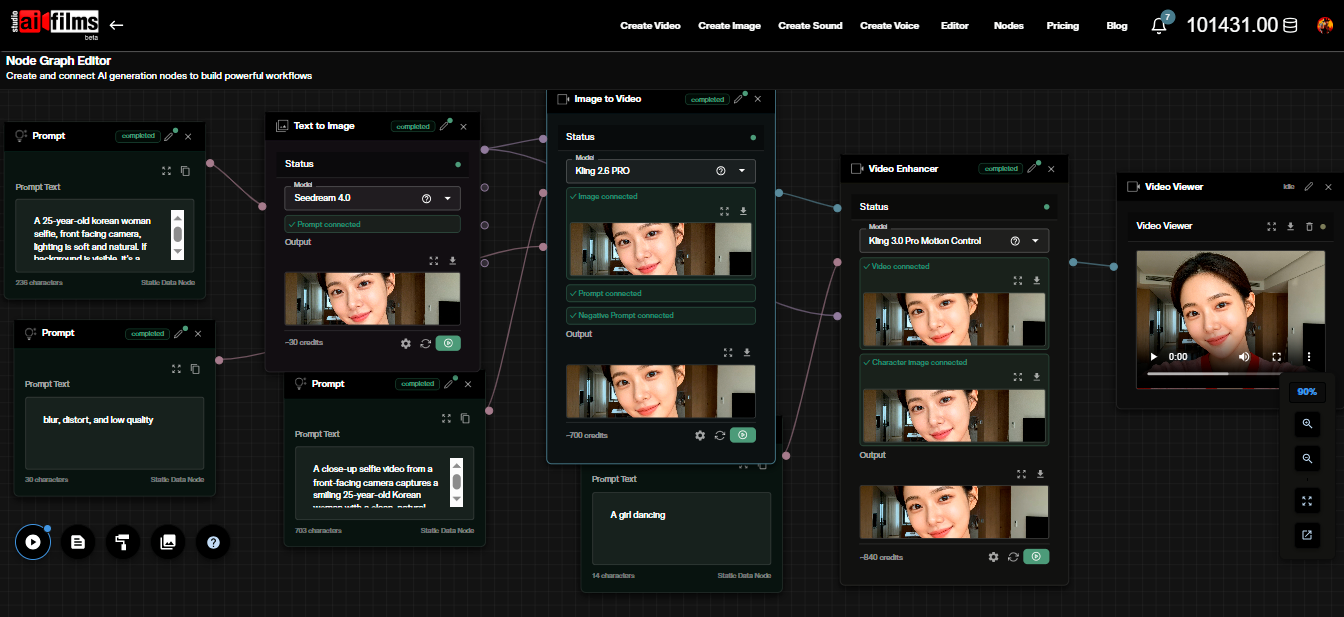
Filmmakers building animation workflows at any scale can access AI generation tools through AI FILMS Studio.
The same week Critterz was announced, Dreams of Violets secured its world premiere at Tribeca, made for $2,000 in a London flat by a director who had no physical access to the country the film depicts.
The two films together demonstrate the full cost range of AI animated production in 2026. One required a professional crew, a major distributor, guild covered writers, and a budget comparable to a mid-range live action feature. The other required none of those things. Both made it to major festivals in the same month.
Another milestone came in July 2026. YouTube creator Gossip Goblin secured theatrical distribution for 'Gods Don't Give Gifts', an anthology of four AI films opening in several hundred U.S. locations on October 30, produced with Fable Studio.
The producers and distributors evaluating Critterz at Cannes were not measuring it against Dreams of Violets. They were measuring it against traditional animated features at $100-200 million. The film's commercial argument is that the AI animated feature category can produce mainstream theatrical product, not just proof of concept shorts for festival audiences. The Q1 2027 release will be the first direct test of that argument against a paying theatrical audience.
No prior AI animated feature has carried AGC-level international distribution and a named theatrical release date into production. That combination is what makes Critterz the category's benchmark rather than another experiment.
Sources
Deadline | Screen Daily | Variety | The Hollywood Reporter
Continue Reading
.jpg?w=3840)


Video & LipSync
- Video Generator
- Text to Video
- Image to Video
- Start-End Frame to Video
- Draw to Video
- Motion Control
- Video Enhancer
- Video Upscaler
- Video Extend
- Video to Video LipSync
- Audio to Video LipSync
- Image to Video LipSync
- Video FaceSwap
- Seedance 2.5
- WAN 3.0
- Seedance 2
- FLUX 3
- Minimax H3
- Vidu Q3 Pro
- Grok Imagine Video 1.5
- Gemini Omni
- Google Veo 3.1
- Kling 3.0 Pro
- Luma Ray 3.2
- LTX 2.3
- Happy Horse 1.1
- Kling 3.0 Motion
- ByteDance Upscaler
- InfiniteTalk
- InsightFace
Image & Edit
- AI Character
- AI Actor
- Art Generator
- Text to Image
- Image to Image
- LoRA Image to Image
- Draw to Edit
- Image LoRA Training
- Remove Background
- Image Enhancer
- MidJourney 8.0
- Krea 2
- OpenAI GPT Image 2.0
- Nano Banana Pro Ultra
- Nano Banana 2 Lite
- Nano Banana Pro
- Minimax Image
- Clarity Pro
- Z-Image Turbo LoRA
- Krea 2 Turbo LoRA
- Z-Image LoRA Trainer
- Qwen Image LoRA Trainer
- Background Erase Network 2 (BEN2)