
'Dreams of Violets' Becomes the First Fully AI Generated Feature in Tribeca's Official Lineup

POS78, CC BY 4.0, via Wikimedia Commons
Share this post:
'Dreams of Violets' Becomes the First Fully AI Generated Feature in Tribeca's Official Lineup
A feature film running 75 minutes, made for approximately $2,000 in a London flat, will have its world premiere on June 10 at the Tribeca Film Festival, entering the official lineup as the first fully AI generated narrative feature accepted into a major festival's main program.
Directed by Ash and Pooya Koosha, tech entrepreneur brothers and first time filmmakers, "Dreams of Violets" depicts a fictional dramatization of the January 2026 Iranian civilian massacre, in which death tolls exceeded 7,000. No actors, sets, or cameras were used at any point in production.
Made From Exile, With No Access to Iran
.jpg)
Greg2600, CC BY-SA 2.0, via Wikimedia Commons
Ash Koosha made the film while living outside Iran, with no physical access to the country, its locations, or its people. "I am one person, in exile, with no access to Iran, no access to the locations, no access to the people", Koosha told trade press. Every image and every person depicted in the film was generated by AI tools working from journalistic reports, photographs, and eyewitness accounts.
The production relied on five AI systems. Kling AI handled video generation, producing the visual sequences that form the film's primary narrative content. Anthropic's Claude served as a language and script editing tool, refining dialogue and structural decisions without generating visual material. Google Gemini handled research and initial imagery generation for reference frames. Google Nanobanana provided additional imagery for specific sequences. Fountain 0's proprietary technology managed blocking accuracy and frame consistency across scenes, maintaining spatial continuity between generated shots.
The Five Systems and What They Did
Each system's role was distinct. Kling AI was responsible for all final video output: every scene the audience watches is Kling generated. Claude operated entirely at the script level, functioning as an editing partner for the directors rather than a visual tool. Gemini and Nanobanana produced reference imagery that informed prompts rather than output that appeared in the final cut. Fountain 0's technology addressed the frame consistency problem that affects all AI video productions: ensuring that a character's appearance, position, and spatial relationship to other elements stays coherent across cuts.
No cameras were used. Every human face in the film was generated. Every location, every crowd, every piece of footage depicting events in Kashmar in January 2026 came from AI systems trained on journalistic photographs, eyewitness accounts, and the directors' specific prompts.
Ninety Days and $2,000
The three month production timeline is as significant as the $2,000 budget. A conventional documentary covering events in a country where the filmmaker has no physical access would require years of development, multiple fixers, significant travel expenditure, and distribution negotiations running in parallel with production. Koosha compressed all of that into a single working period in a London flat.
The $2,000 figure covers API costs, compute fees, and the software subscriptions required to run five AI systems in parallel over 90 days. It does not include Koosha's own labor, which was substantial. The comparison he drew to conventional documentary production is not about labor hours but about infrastructure costs. The physical and logistical requirements that have historically determined who can and cannot make a feature film are simply absent from this production model.
Ash and Pooya Koosha founded Claigrid, a cloud AI personalization company, with former NBC Cable president Tom Rogers serving as executive chairman. The entire feature was completed in approximately three months.
Tribeca's 25th Anniversary Official Selection
Tribeca Film Festival founder Jane Rosenthal cited both the film's subject and its method of production as reasons for the selection. "At this time in history when both artificial intelligence and Iran are central to global conversation, this film offers audiences a rare and intimate perspective", Rosenthal said.
The festival runs June 3 through 14 in New York City, marking its 25th anniversary edition. The 2026 program includes 118 features, among them 103 world premieres, and the "Dreams of Violets" premiere is scheduled for June 10 at the AMC Flat Iron Theatre in Manhattan.
Previous fully AI generated features have screened in festival marketplace sections and sidebar programs, where any project can pay for a slot. An official lineup selection is decided entirely by the programming team, making this the first time a major festival has placed a fully AI generated feature in its curated program.
What the Programming Team Decided
Rosenthal's statement was careful. She cited the subject matter, Iran, as a reason for the selection alongside the production method. That framing was deliberate: it avoided positioning the selection purely as an AI achievement, which would have reduced a film about a civilian massacre to a technology demonstration. The film's subject was doing work that the AI story alone could not.
Festival programming teams applying that same logic in future cycles will face a structural decision about AI features that Tribeca has now navigated once. The precedent Rosenthal established is that AI production method is neither a qualification nor a disqualification on its own. The selection depends on whether the work merits inclusion on artistic and journalistic grounds.
An Ethical Question Built Into the Film
Ash Koosha has not deflected the moral complexity of the project. He acknowledged that using AI to film the deaths of real people raises difficult questions. The film reconstructs an event that Koosha, living in exile, had no physical means to document.
The Kling AI video generation tools used in "Dreams of Violets" were also at the center of a filmmaker initiative that brought multiple AI projects to the Cannes Film Festival earlier this month. Details on that program and the verified production data from three directors are in the Kling AI filmmaker initiative coverage.
Context: The Range of AI Features in 2026
The $2,000 budget of "Dreams of Violets" sits at the absolute floor of the AI feature range. At the opposite end, the Cannes 2026 Marché du Film hosted Bitcoin: Killing Satoshi, Doug Liman's production with a $70 million budget and a full cast, which replaced every location with generated environments but used traditional crews and on-set direction for all performances.
The same week "Dreams of Violets" secured its Tribeca premiere, Critterz, a commercial AI animated feature with a $30 million budget and distribution from AGC Studios, was announced with the Paddington franchise writers attached. The two projects represent opposite ends of the AI filmmaking range: one made for $2,000 by a single director in exile, the other a fully financed commercial production.
Tribeca 2026 also selected a prestige documentary about AI's origins, executive produced by Barbara Broccoli and featuring Nobel laureates Geoffrey Hinton and Demis Hassabis, programming AI as both a filmmaking tool and a subject in the same festival. For a full picture of AI programming at the 25th Tribeca Festival, including the Asteria animated short ChikaBOOM! and the industry panels, see the Tribeca 2026 AI overview.
The Film's Subject and AI's Role in Documenting It
The January 2026 events in Kashmar produced limited visual documentation because of Iranian government information controls. Eyewitness footage that circulated on social media was fragmentary, often showing locations and crowds rather than the specific events at the center of the incident. Photojournalists and documentary crews could not access the affected areas.
That documentation gap is exactly the conditions Koosha argues AI generation can address. The film does not claim to be a record of what cameras saw. It uses AI to construct a plausible visual account of events that no camera documented, based on testimony and reporting. The ethical distinction between a camera crew filming a massacre and an AI system generating images based on survivor accounts is significant, and Koosha has acknowledged it directly.
Whether that approach produces work with documentary value or merely illustrates the limits of AI as a journalism substitute is a question the film's Tribeca screening will put to audiences and critics. Tribeca's decision to program it in the official lineup rather than a sidebar treats the question as worth posing at that level of visibility.
Fountain 0 and the Production Infrastructure
Fountain 0, the production company behind "Dreams of Violets", describes itself as building infrastructure for AI native filmmaking. The company's proprietary blocking and frame accuracy technology is not a publicly available tool. Its role in the production was to solve a specific problem that affects all AI video productions at feature length: maintaining visual consistency across hundreds of generated shots that were not created in a single session.
AI video models generate outputs stochastically. Two prompts that are nearly identical can produce outputs with significantly different framing, character positioning, and lighting. At the short film level, this inconsistency can be managed editorially. At 75 minutes, it compounds. Fountain 0's technology addresses this by establishing spatial and visual anchors across shot generations, reducing the manual correction work required in editorial.
The production company's involvement means the $2,000 budget figure requires a footnote. That figure appears to cover Ash Koosha's direct API and subscription costs. Fountain 0's contribution, its technology and presumably production support from its team, may not be included in the $2,000 number. Koosha's public statements have not clarified whether Fountain 0 provided services at cost, as an investment, or as an in-kind contribution to a project it wanted to use as a showcase.
The January 2026 Event and Its Documentation
The film depicts a specific historical event: a civilian massacre in Kashmar, Iran in January 2026, with a reported death toll exceeding 7,000. That event received limited Western media coverage compared to its scale, partly because of information restrictions from Iranian authorities and partly because the global news cycle was dominated by other stories in that period.
Koosha's access to source material for the film came through diaspora networks, journalistic accounts that circulated outside mainstream Western outlets, and his own ongoing connections to information flows from inside Iran. The AI systems he used were tools for translating that source material into images and motion. The creative and journalistic choices about what to depict and how to frame it were his.
What the Tribeca Selection Means for Other Festivals
The Tribeca decision creates a precedent that other major festivals will now have to address explicitly. TIFF, Locarno, Telluride, and Venice have not published formal positions on fully AI generated features in their official lineups. "Dreams of Violets" gives programmers at those festivals a concrete reference point: a film accepted into a major festival's official program, on the basis of artistic and journalistic merit, using AI as its entire production method.
The likely near term response from programming committees will be on a case by case basis rather than formal policy. Festivals have historically avoided blanket rules about production technology, preferring to evaluate individual films. The question programmers will face is whether to treat AI generation as a technical method, like digital photography or handheld shooting, or as something that changes the fundamental evaluation criteria.
Ash Koosha's Previous Work
Ash Koosha is not a filmmaker who came to the medium without established credentials. He is an Iranian electronic musician and AI music pioneer who has been working at the intersection of AI and creative production since 2016. His music project Yona, which uses AI to generate real-time vocal performances, predates the current wave of generative AI tools by several years.
That background is relevant to how "Dreams of Violets" was made. Koosha understood AI generation as a production medium before he applied it to film. The three month timeline and $2,000 budget were possible partly because he was not learning AI generation tools while making the film. He was applying experience from years of using them for music to a new visual context.
Claigrid and the Production Company Context
Ash and Pooya Koosha founded Claigrid as a cloud AI personalization company before turning to film production. Tom Rogers, former president of NBC Cable, serves as executive chairman. That corporate structure gave "Dreams of Violets" an institutional context that most first films by unknown directors lack: a company with operational infrastructure, an executive with major media industry experience, and a stated interest in AI as a production medium.
The involvement of a former NBC Cable executive as chairman of the production company is not incidental. Rogers' presence signals that the project was positioned for serious industry engagement from the start, not as a personal experiment. Tribeca programmers reviewing the submission were evaluating a work backed by a company with media industry credentials alongside an experimental production method.
What the $2,000 Figure Includes and Excludes
The $2,000 budget figure has been cited widely without the clarification Koosha's public statements provide. It covers API costs, subscription fees for the five AI systems used in production, and compute charges over the three month production period. It does not include the time Koosha invested as director, researcher, and primary creative decision-maker.
Fountain 0's contribution, the frame consistency technology and associated production support, is also not reflected in the $2,000 number based on available public statements. Whether Fountain 0 provided services at cost, at no cost as a production showcase, or under a revenue-sharing arrangement has not been disclosed. For filmmakers trying to replicate the production model, those unstated inputs are part of the real cost structure.
Koosha's public statements have framed the $2,000 budget as evidence of AI's democratizing effect on filmmaking. That framing is accurate for the direct compute costs. It is less accurate as a description of the total resources that made the production possible: a co-director with AI music production experience since 2016, a production company with proprietary frame consistency technology, and an executive chairman with decades of major media industry connections. Both framings are true simultaneously. The compute costs really are $2,000. The supporting infrastructure really is not.
The practical question for independent filmmakers evaluating the "Dreams of Violets" model is which of those inputs they can replicate and which they cannot.
Koosha followed up in July 2026 with Odysseus: The Fall, a 135 minute fully AI generated adaptation of Homer's epic, budgeted at mid five figures and timed to coincide with Christopher Nolan's $250 million version opening the same week.
Venice hosts its own dedicated AI film competition, the Reply AI Film Festival, which drew 2,181 entries for its 2026 edition.
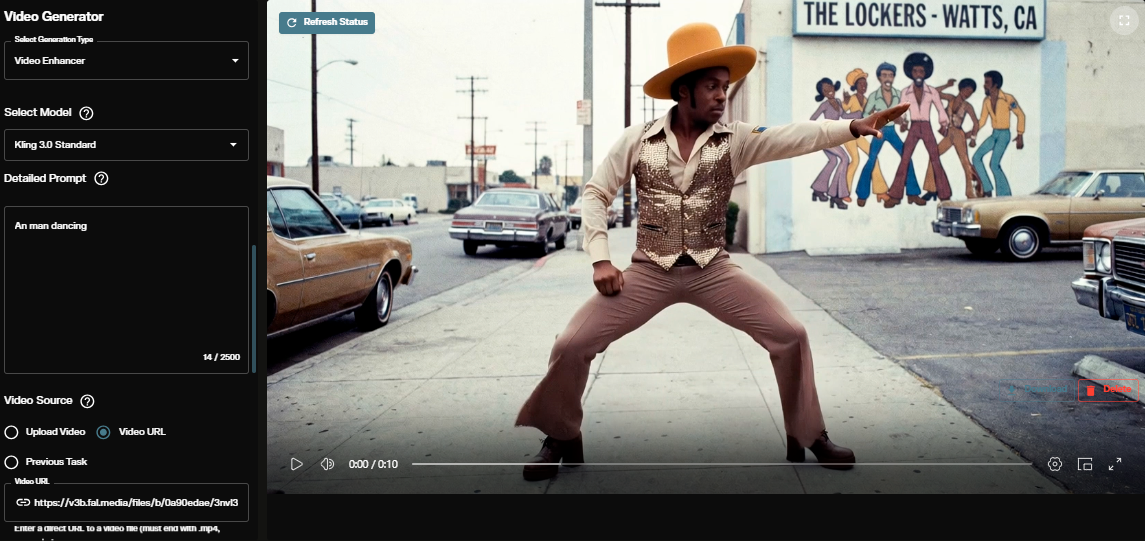
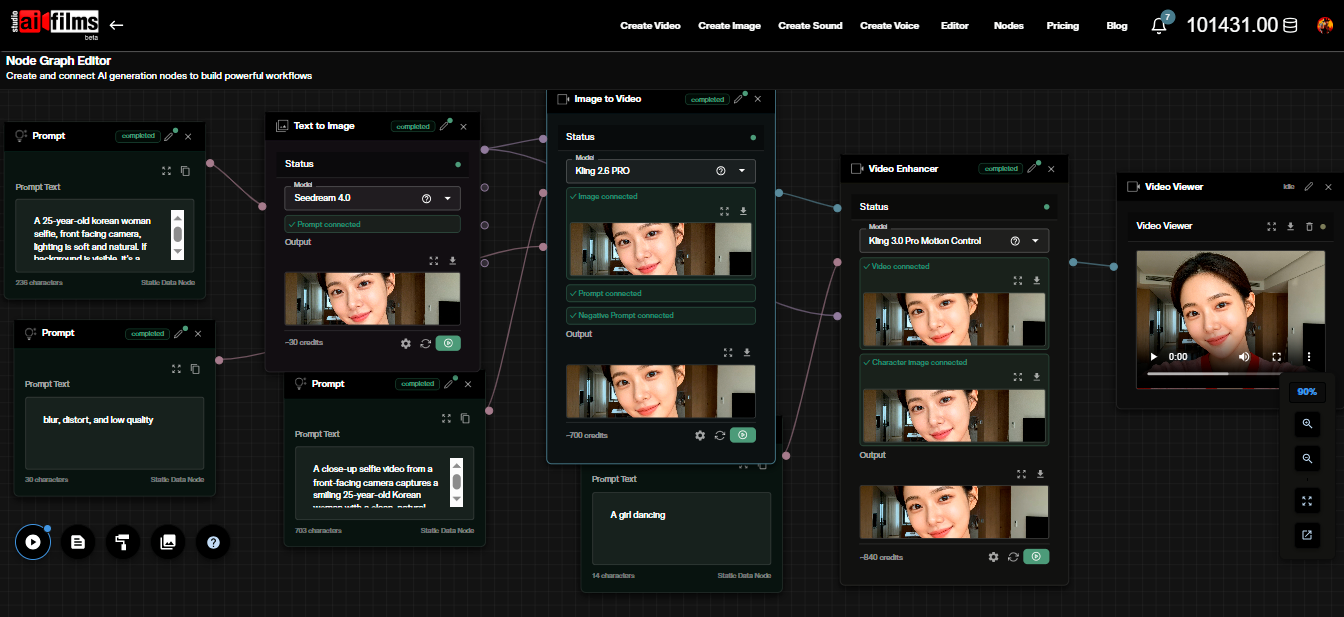
Filmmakers who want to work with AI video generation tools can access them through the AI FILMS Studio video workspace.
Sources
Deadline | Variety | The Hollywood Reporter | IndieWire | Cineuropa | Tribeca Film Festival
Continue Reading
.jpg?w=3840)


.jpg)
Video & LipSync
- Video Generator
- Text to Video
- Image to Video
- Start-End Frame to Video
- Draw to Video
- Motion Control
- Video Enhancer
- Video Upscaler
- Video Extend
- Video to Video LipSync
- Audio to Video LipSync
- Image to Video LipSync
- Video FaceSwap
- Seedance 2.5
- WAN 3.0
- Seedance 2
- FLUX 3
- Minimax H3
- Vidu Q3 Pro
- Grok Imagine Video 1.5
- Gemini Omni
- Google Veo 3.1
- Kling 3.0 Pro
- Luma Ray 3.2
- LTX 2.3
- Happy Horse 1.1
- Kling 3.0 Motion
- ByteDance Upscaler
- InfiniteTalk
- InsightFace
Image & Edit
- AI Character
- AI Actor
- Art Generator
- Text to Image
- Image to Image
- LoRA Image to Image
- Draw to Edit
- Image LoRA Training
- Remove Background
- Image Enhancer
- MidJourney 8.0
- Krea 2
- OpenAI GPT Image 2.0
- Nano Banana Pro Ultra
- Nano Banana 2 Lite
- Nano Banana Pro
- Minimax Image
- Clarity Pro
- Z-Image Turbo LoRA
- Krea 2 Turbo LoRA
- Z-Image LoRA Trainer
- Qwen Image LoRA Trainer
- Background Erase Network 2 (BEN2)