
Share this post:
Is Hollywood Hiding How Much AI It Really Uses?
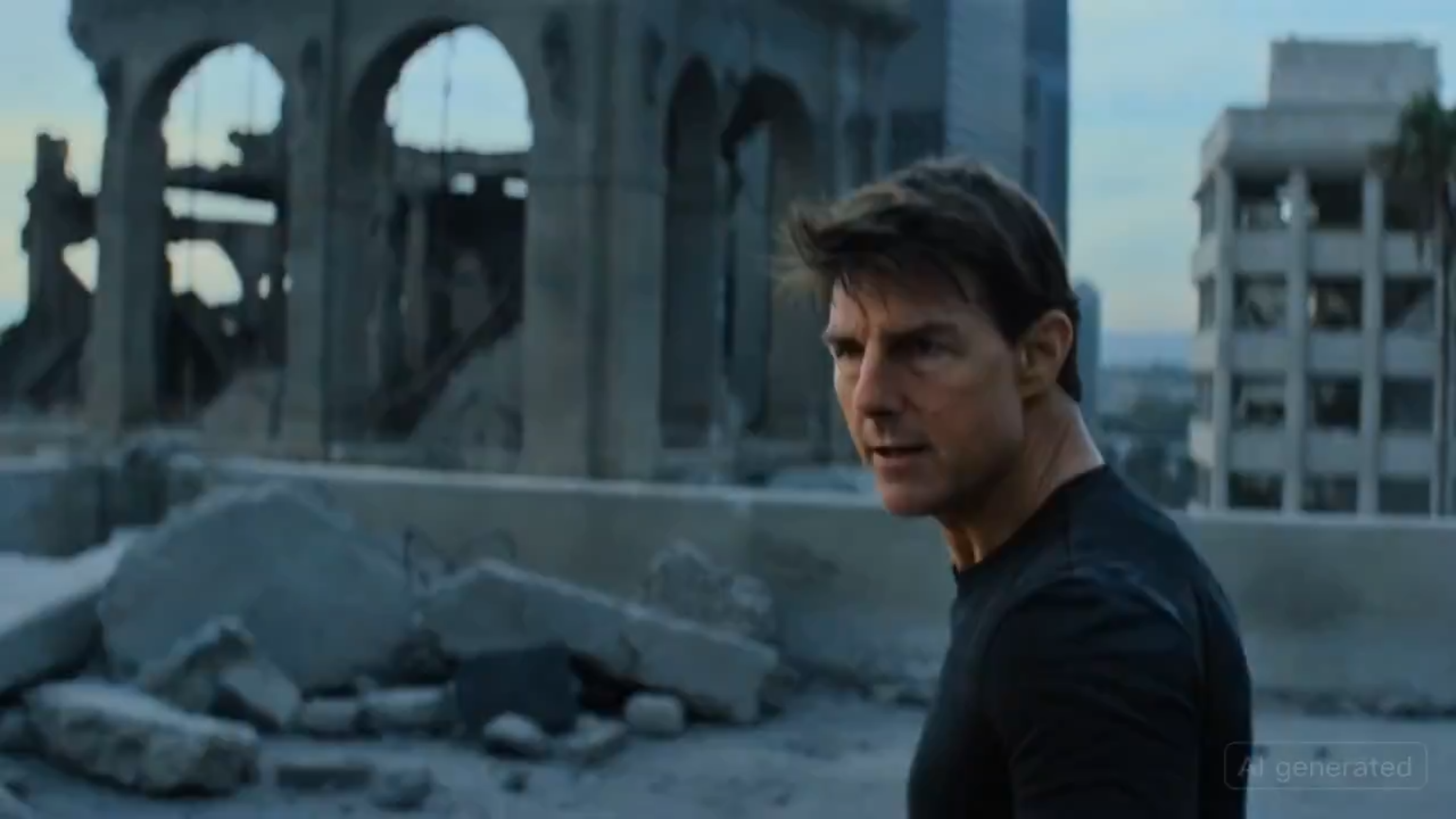
"Everyone's lying just a little bit." That was Janice Min, CEO of Ankler Media and former editor of The Hollywood Reporter, speaking candidly about the entertainment industry's relationship with artificial intelligence. Her assessment goes further than vague suspicion. She says studios use AI more than they publicly admit, that every Best Picture nominee at the most recent Academy Awards used AI somewhere in its production process, and that the Academy itself operates a "don't ask, don't tell" policy on the matter. That characterization found partial institutional backing when Academy CEO Bill Kramer acknowledged a significant lack of consensus across the Academy's 17 branches in a March 2026 Guardian interview, days before the 98th ceremony.
The Cases That Slipped Through
A handful of disclosures have reached the public, though typically only after press scrutiny or audience backlash forced them out.
Marvel's Disney+ series Secret Invasion used AI to generate its opening title sequence through visual effects studio Method Studios. Director Ali Selim confirmed the decision only after journalists reported on it. The acknowledgment came buried in trade coverage rather than in any production statement. No prominent disclosure appeared in trailers or promotional materials. The incident followed a pattern that has since repeated: AI is used in a contained, technical area, then quietly credited in small print if at all, and acknowledged publicly only when the question is asked directly.
The Brutalist offered a second case. Director Brady Corbet confirmed, after the film's awards campaign was well underway, that the production had employed Respeecher's voice conversion technology to refine Hungarian pronunciation for Adrien Brody and Felicity Jones. Respeecher's approach involved mapping a native Hungarian speaker's pronunciation onto Brody's original on-set recording, preserving the emotional delivery while correcting specific vowels and consonants. Director Dávid Jancsó, a native Hungarian speaker himself, reportedly required that his family back home detect no pronunciation errors in the final cut. Traditional ADR could not preserve the energy of the original performance, so the production turned to AI.
Respeecher describes this as enhancement, not replacement, and the technical distinction is real. But the film's marketing said nothing about it. The detail became public through journalism, not studio disclosure. A similar situation arose with Emilia Pérez, where reports emerged that AI voice cloning was used to help Karla Sofía Gascón hit certain musical notes. The audience learned about it through press coverage, not from the production.
The AI That Never Gets Named
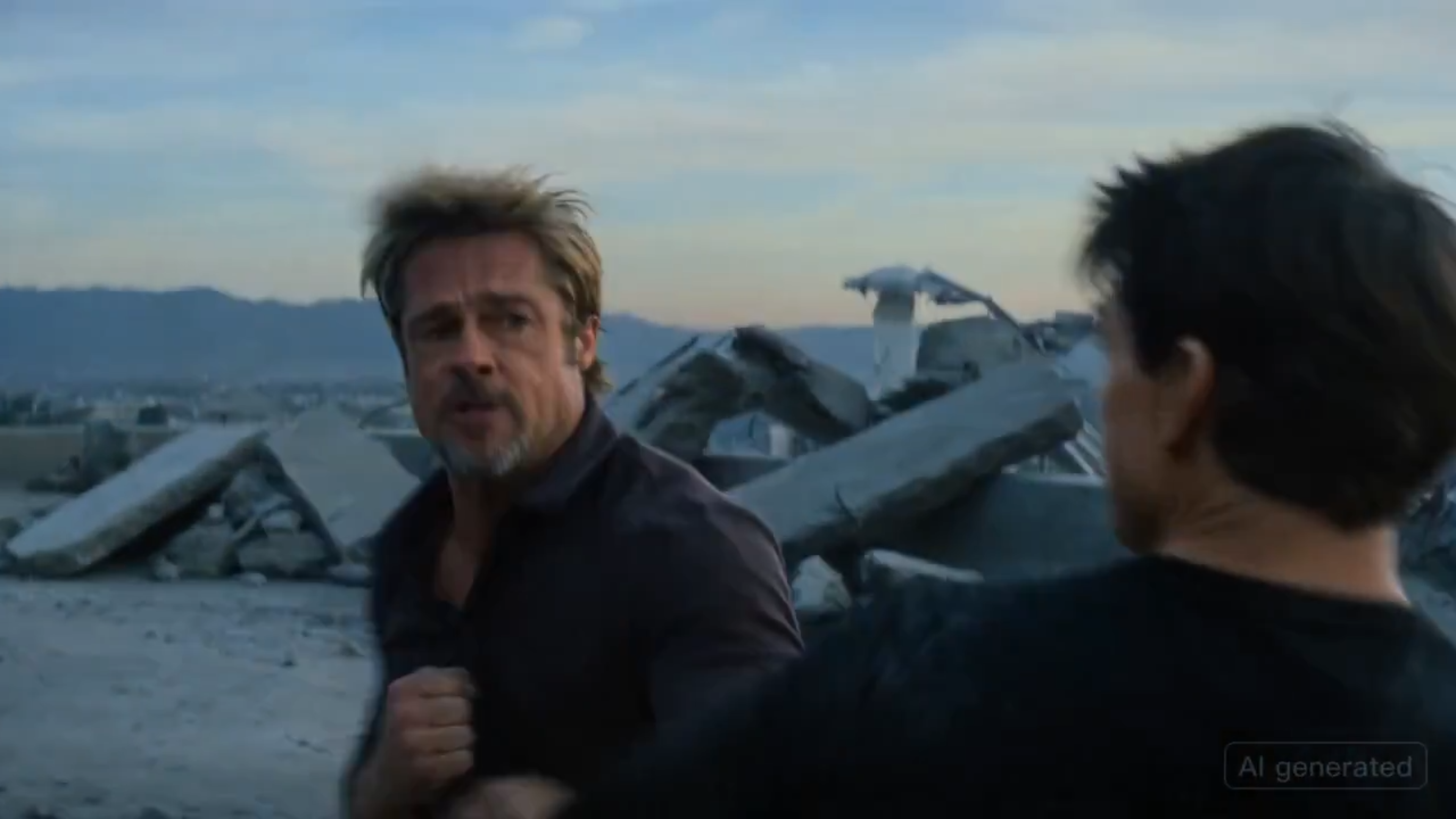
The examples above represent the visible surface of a much larger operation. The bulk of AI use in Hollywood happens in post production, where it rarely earns a credit line and almost never surfaces in public communication.
AI tools are already standard for rotoscoping, background cleanup, and visual effects work on major studio films. Filmmaker Erik Weaver at USC described using Runway AI for roughly 12 shots in a recent short: tasks that would have required a team working three to four months were completed in a few hours. Everything Everywhere All at Once used Runway for rotoscoping in a climactic scene, enabling a VFX team of just seven artists to complete complex effects work at a pace that would otherwise have been impossible for a production of that scale.
Lionsgate has gone further than any other major studio in making its AI investment official. The studio announced a partnership with Runway to build a custom generative AI model trained exclusively on its own film and TV library, sidestepping copyright liability concerns while positioning itself to deploy AI tools across future productions. Disney has created a dedicated business unit to examine AI and augmented reality integration across its divisions. Neither announcement specified which current or upcoming projects would draw on these internal capabilities.
Industry analysts project that AI automation could reduce VFX workforces by 80 percent or more once the technology reaches cinema grade resolution. Runway currently produces key frames at 720p. By late 2025, some experts predicted output would reach 2K. Deadpool & Wolverine alone credited 231 digital artists from Industrial Light & Magic, with hundreds more from additional vendors. That pool of specialized labor represents exactly what studios see as automatable.
What the Numbers Say About Jobs
The financial incentive for studios to deploy AI without public disclosure is considerable. A 2024 study found that 204,000 entertainment jobs had been adversely affected by AI over three years. Analysts projected that 21 percent of US film, television, and animation jobs would be consolidated, replaced, or eliminated by 2026. Computer graphic artists saw a 12 percent employment decline in 2024, followed by a 33 percent drop in 2025. Concept artists at art outsourcing companies have seen roughly half their colleagues laid off.
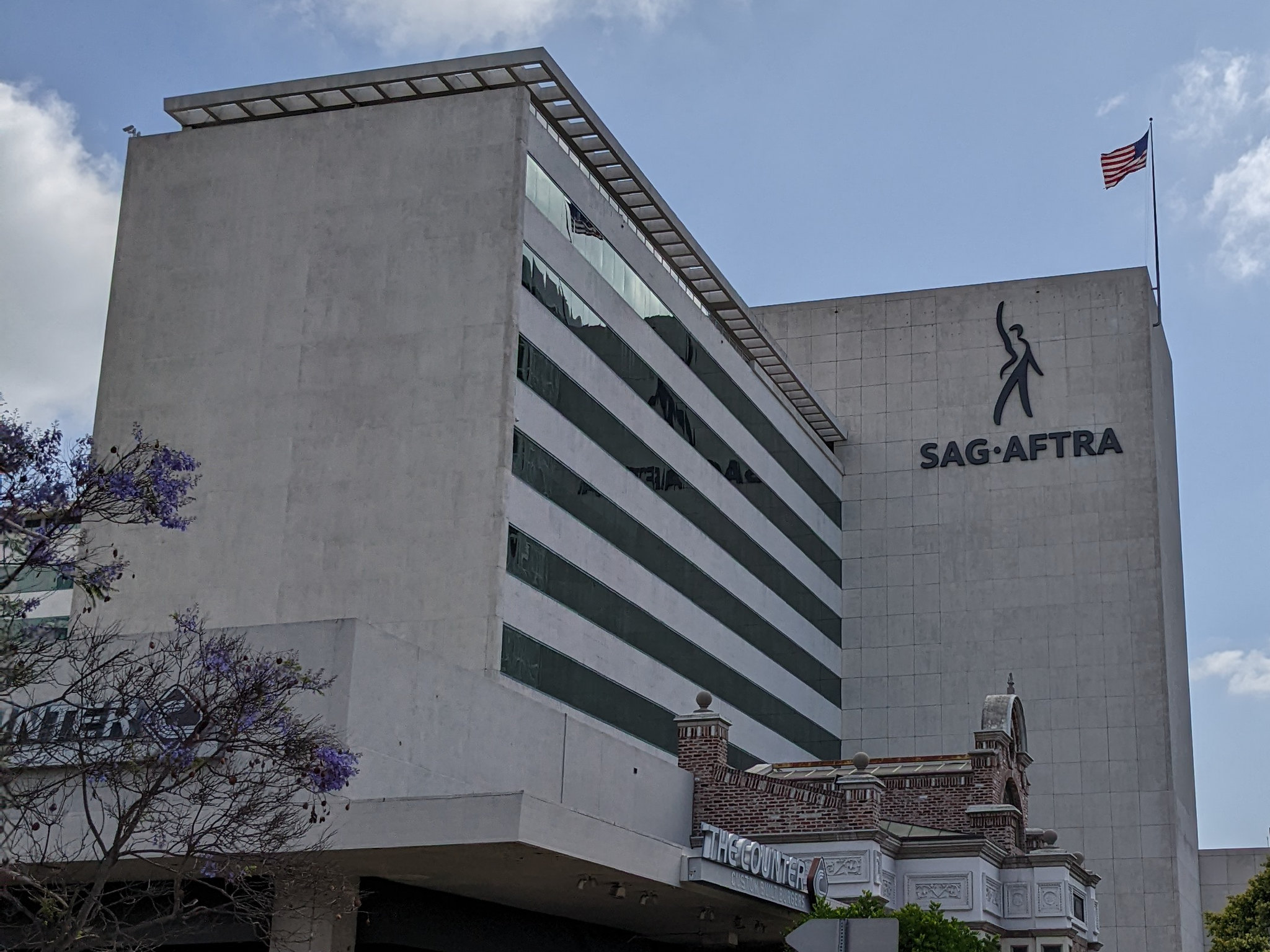
SAG-AFTRA spent the better part of two years negotiating contractual guardrails around digital replicas, background scanning, and automated writing tools. Those negotiations only became necessary because studios were already experimenting with AI against actors' interests. Hollywood talent agent Ryan Hayden described the culture bluntly: "A lot of people want plausible deniability right now." The union's AI bargaining timeline documents in detail how studios pushed back against disclosure requirements at every stage of negotiations.
Why Studios Stay Quiet
The logic behind under-disclosure is not difficult to understand. Audiences show growing familiarity with AI tools and are more accepting of their use when it is disclosed upfront, according to Hub Entertainment Research. That finding cuts both ways. Even if audiences are more forgiving when told about AI in advance, studios still face an awards season branding problem. The mythology of prestige film depends entirely on human artistry and exceptional individual performance. An Oscar campaign built around the claim that an actor's accent was refined by machine learning is a harder sell than one premised on craft and preparation alone.
The McKinsey Global Institute has modeled how generative AI could automate large portions of scripting, pre-visualization, post production, and marketing in film and television, with cost savings projected across the entire pipeline. Studios have a direct financial incentive to adopt these tools as aggressively as contracts allow, and to stay quiet about that adoption where contracts do not yet require disclosure. Producer Michael Shamberg and other insiders argue the industry should stop hiding and instead lead AI filmmaking with a proactive strategy. Janice Min put it plainly: "I dare you to find a screenwriter who is staring at a blank page and not talking to Claude or ChatGPT at the same time." A Hollywood Reporter investigation from April 2026 confirmed the pattern extends all the way down the ladder: entry-level assistants are among the most active daily AI users, running script coverage and development research through AI tools while keeping quiet about it.
Regulation Stops at the Studio Door
Legislators in two states have moved to address AI transparency, but both efforts contain significant carve-outs for the entertainment industry.
California's proposed AB 412, the AI Copyright Transparency Act, would require AI developers to document all copyrighted works used in training data, with penalties of $1,000 per violation per day. The bill has stalled in the state Senate and is currently paused as a two-year measure.
New York's AI disclosure law, effective June 9, 2026, requires clear labeling when synthetic performers appear in advertisements. The law explicitly exempts motion pictures, television programs, and streaming content. That exemption is not an oversight. It reflects the practical limits of legislation when an industry has a strong interest in maintaining flexibility around how it describes its own production methods.
What Real Transparency Looks Like
Respeecher's handling of The Brutalist situation, whatever one thinks of the underlying creative choice, offers a template for what honest disclosure could look like in practice. The company published a detailed technical case study explaining the voice conversion process, the collaboration with the director, the consent procedures, and the precise limits of what AI changed and what it preserved. That level of specificity is not the industry norm.
Most AI use in Hollywood never earns a credit line. It moves through post production workflows, localization pipelines, and development tools without public acknowledgment. For more on AI's expanding role in global production infrastructure, see our coverage of China's AI virtual production studios.
The question Min and others are raising is whether audiences, the labor force, and the awards bodies are operating with an accurate picture of what modern film production actually is. Based on available evidence, the answer is no.
A parallel market answer is emerging. Certification platforms like Not By AI and the MindStar Standard are issuing AI free logos as a third party alternative to studio self-reporting, giving audiences a verified signal that the work they are watching was made without generative AI.
Steven Spielberg is a notable exception to the secrecy pattern. At SXSW 2026, he stated publicly that he has never used AI in any of his films. The audience applause that followed signals how rare that kind of directness has become.
Sources
Janice Min / Ankler Media: "Hollywood Is Lying to Everyone About How Much AI It Is Using" https://awesomeagents.ai/news/hollywood-lying-about-ai-usage-studios/
Deadline: "Secret Invasion AI Opening Credits Backlash" https://deadline.com/2023/06/secret-invasion-opening-credits-ai-backlash-marvel-mcu-disney-1235421667/
Respeecher: "The Brutalist AI Controversy Explained" https://www.respeecher.com/blog/brutalist-ai-controversy-explained/
The Wrap: "The AI Wave Is Coming for VFX Production Labor" https://www.thewrap.com/ai-vfx-production-labor/
Hub Entertainment Research / NewscastStudio: "Hub Study Finds Growing Comfort with AI Tools, But Disclosure Remains Key for Viewers" https://www.newscaststudio.com/2026/01/14/hub-study-finds-growing-comfort-with-ai-tools-but-disclosure-remains-key-for-viewers/
SAG-AFTRA: AI Bargaining & Policy Timeline https://www.sagaftra.org/contracts-industry-resources/member-resources/artificial-intelligence/sag-aftra-ai-bargaining-and
Continue Reading


Video & LipSync
- Video Generator
- Text to Video
- Image to Video
- Start-End Frame to Video
- Draw to Video
- Motion Control
- Video Enhancer
- Video Upscaler
- Video Extend
- Video to Video LipSync
- Audio to Video LipSync
- Image to Video LipSync
- Video FaceSwap
- Seedance 2.5
- WAN 3.0
- Seedance 2
- FLUX 3
- Minimax H3
- Vidu Q3 Pro
- Grok Imagine Video 1.5
- Gemini Omni
- Google Veo 3.1
- Kling 3.0 Pro
- Luma Ray 3.2
- LTX 2.3
- Happy Horse 1.1
- Kling 3.0 Motion
- ByteDance Upscaler
- InfiniteTalk
- InsightFace
Image & Edit
- AI Character
- AI Actor
- Art Generator
- Text to Image
- Image to Image
- LoRA Image to Image
- Draw to Edit
- Image LoRA Training
- Remove Background
- Image Enhancer
- MidJourney 8.0
- Krea 2
- OpenAI GPT Image 2.0
- Nano Banana Pro Ultra
- Nano Banana 2 Lite
- Nano Banana Pro
- Minimax Image
- Clarity Pro
- Z-Image Turbo LoRA
- Krea 2 Turbo LoRA
- Z-Image LoRA Trainer
- Qwen Image LoRA Trainer
- Background Erase Network 2 (BEN2)