

AI FILMS architecture diagram built from Jeveration (arXiv:2611.24738) Apache 2.0 specs
Share this post:
Jeveration: Open Source Single Pass Image AI
Diffusion and flow matching image generators refine noise across 4 to 50 iterative neural passes before a single storyboard frame appears. Jeveration (linlinlinlinsdada/Jeveration, arXiv:2611.24738), released on November 18, 2026 under the Apache 2.0 license, takes a radically different approach called System One generation. Using a frozen Qwen3.5-4B vision language backbone with rank 256 LoRA adapters, Jeveration emits a complete 512x512 image as one joint decision in a single forward pass with zero denoising loop. You can test this open source model free in your browser below with zero login.
Studio availability. Try the public Hugging Face demo below; Jeveration is not part of a paid AI FILMS Studio plan (use FLUX.2 Pro Text to Image in the image workspace for example instead).
Try Jeveration Live
Test single forward pass text-to-image, edge or depth guided synthesis, colorization, style transfer, and dense indoor prediction in the public Hugging Face Space below.
Architecture and Technical Design
Jeveration demonstrates that a frozen autoregressive vision language model can synthesize images without iterative diffusion or slow token by token raster scanning. The core weight file (jeveration.pt, 4.0 GB) packages rank 256 LoRA adapters on Qwen3.5-4B, learnable decision token inputs, an image prediction head, and three dense prediction heads.
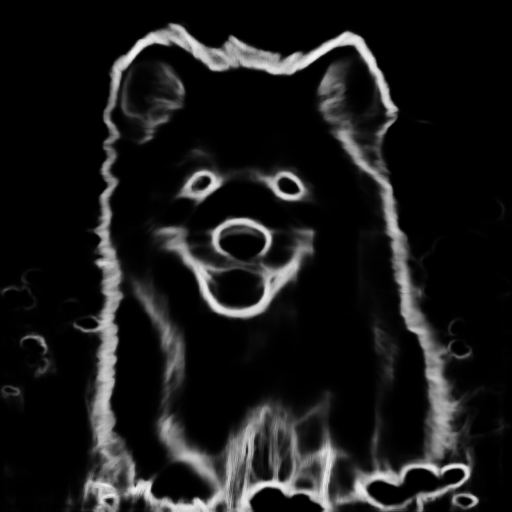
HED edge map input from Jeveration Space, Apache 2.0
During a single forward pass, the model predicts compact visual latents that feed into a fine tuned TA-TiTok 512 decoder (decoder512.pt, 1.2 GB) for text-to-image synthesis. For image-to-image tasks, a gated source branch decoder (source_decoder512.pt, 1.3 GB) fuses structural details from the input photo so edges and silhouettes stay locked.
One checkpoint covers text-to-image, six trained image-to-image workflows (hed, depth, colorize, anime, ghibli, and watercolor), and dense indoor prediction outputting 13 class segmentation, metric depth in meters, and surface normals simultaneously.
Because Jeveration skips iterative sampling entirely, latency scales like a single LLM prefill step rather than a multi step UNet or DiT loop. That makes it an attractive building block for real time storyboard sketching, live edge to frame concept exploration, and rapid colorization tests.
Depth guided rendering lets pre vis artists block out rough geometry in Blender or pull a depth pass from a reference still, then render fresh 512x512 lighting and texture ideas in one pass. Three companion models load automatically on first run: Qwen/Qwen3.5-4B, the turkeyju/tokenizer_tatitok_bl128_vq tokenizer, and a CLIP ViT-L/14-336 text tower.
Artists should note two scope boundaries documented by the authors. Outputs are fixed at 512x512 with English prompts, and the dense prediction heads were trained on indoor 4:3 NYUv2 scenes.
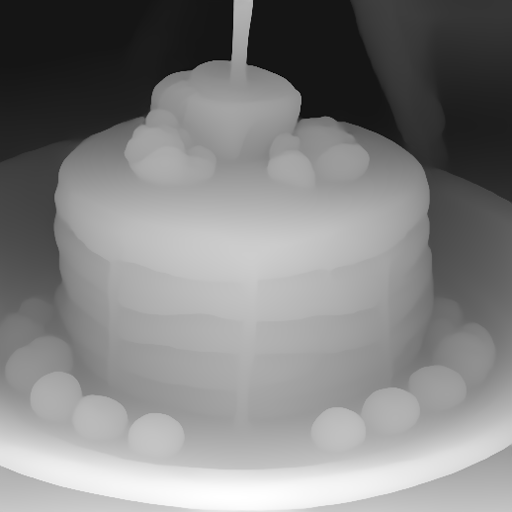
Depth map input from Jeveration Space, Apache 2.0
Hardware, VRAM, and License Matrix
| Component File | File Size | Typical Total VRAM | Inference Steps | License | Intended Use |
|---|---|---|---|---|---|
jeveration.pt |
4.0 GB | ~12 to 16 GB (with Qwen3.5-4B) | 1 forward pass | Apache 2.0 | Core adapters, image and dense heads |
decoder512.pt |
1.2 GB | Included above | 1 pass decode | Apache 2.0 | 512x512 text-to-image decoding |
source_decoder512.pt |
1.3 GB | Included above | 1 pass decode | Apache 2.0 | Gated image-to-image decoding |
Runtime dependencies (Qwen3.5-4B, TA-TiTok, CLIP) |
Downloaded on first run | Shared GPU footprint | 1 forward pass | Respective upstream licenses | Backbone, tokenizer, and text tower |
The Jeveration weights and repository code ship under Apache 2.0, while downloaded runtime dependencies retain their original upstream licenses.
Parameter Reference
| Parameter / Mode | Accepted Values | Practical Filmmaking Role |
|---|---|---|
text_to_image(prompts, gen) |
List of English strings | Single pass 512x512 storyboard concepts |
image_to_image(img, "hed", cap) |
Edge map + caption | Converts rough line art or storyboards to shaded frames |
image_to_image(img, "depth", cap) |
Depth map + caption | Turns 3D clay renders into textured lighting studies |
image_to_image(img, "colorize") |
Grayscale input | Rapid archival footage or black and white colorization tests |
| Style modes | "anime", "ghibli", "watercolor" |
Instant look development palettes from live plates |
dense_predict(room) |
RGB indoor frame | Returns seg, metric depth, and normal arrays in one pass |
Local Python and CLI Setup
Jeveration uses native PyTorch state dictionaries loaded with weights_only=True via its official repository rather than Diffusers.
git clone https://github.com/Carol-lyh/Jeveration && cd Jeveration
pip install -r requirements.txt
hf download linlinlinlinsdada/Jeveration --local-dir weights
import numpy as np
from PIL import Image
from jeveration import JeverationPipeline
from jeveration.images import load_square, to_gray

pipe = JeverationPipeline(
    "weights/jeveration.pt",
    decoder="weights/decoder512.pt",
    source_decoder="weights/source_decoder512.pt",
)

# Single pass text-to-image
images = pipe.text_to_image(
    ["A lone pine tree on a small island in a calm lake at dawn."],
    pipe.generator(0),
)
Image.fromarray(images[0]).save("dawn_lake.png")

# Structure guided HED edge to image
edges = load_square("examples/hed_puppy.png")
out = pipe.image_to_image(
    edges[None],
    "hed",
    ["A white Samoyed puppy in a field of yellow flowers at golden hour."],
    generator=pipe.generator(0),
)
Image.fromarray(out[0]).save("puppy_hed.png")

# Dense indoor prediction (segmentation, depth, normals)
room = np.asarray(Image.open("examples/room_1.png").convert("RGB"))
pred = pipe.dense_predict(room[None])
Filmmaker Production Playbook
- Treat Jeveration as a rapid ideation engine, then upscale hero picks. Because native outputs are 512x512, generate dozens of composition and palette variations in seconds, then send chosen frames to PrunaAI P-Image-OSS or SeedVR Image Upscaler in AI FILMS Studio for 2K and 4K finishing.
- Turn rough 3D blockouts into look dev boards with
depthmode. Export quick Z depth previews from your layout scene and let Jeveration paint multiple lighting directions in one forward pass before committing to slow path tracing. - Test archival colorization quickly. Use
colorizemode to audition natural skin tones and wardrobe hues on monochrome documentary scans before manual grading in DaVinci Resolve. - Keep dense prediction focused on interior set design. Since the dense heads trained on NYUv2 indoor rooms, use
dense_predicton interior location scouts and switch to Apple Depth Pro 2 for exterior landscapes and moving video sequences.
Related Reading
- PrunaAI P-Image-OSS: Open Source 8-Step Image Editing
- BRIA FIBO 2.0 Edit: Open Source JSON Image Editing
- Apple Depth Pro 2: Open Source Metric Depth for VFX
- Explore cloud image models on the AI Text to Image Generator page.


Sources
Continue Reading


Video & LipSync
- Video Generator
- Text to Video
- Image to Video
- Start-End Frame to Video
- Draw to Video
- Motion Control
- Video Enhancer
- Video Upscaler
- Video Extend
- Video to Video LipSync
- Audio to Video LipSync
- Image to Video LipSync
- Video FaceSwap
- Seedance 2.5
- WAN 3.0
- Seedance 2
- FLUX 3
- Minimax H3
- Vidu Q3 Pro
- Grok Imagine Video 1.5
- Gemini Omni
- Google Veo 3.1
- Kling 3.0 Pro
- Luma Ray 3.2
- LTX 2.3
- Happy Horse 1.1
- Kling 3.0 Motion
- ByteDance Upscaler
- InfiniteTalk
- InsightFace
Image & Edit
- AI Character
- AI Actor
- Art Generator
- Text to Image
- Image to Image
- LoRA Image to Image
- Draw to Edit
- Image LoRA Training
- Remove Background
- Image Enhancer
- MidJourney 8.0
- Krea 2
- OpenAI GPT Image 2.0
- Nano Banana Pro Ultra
- Nano Banana 2 Lite
- Nano Banana Pro
- Minimax Image
- Clarity Pro
- Z-Image Turbo LoRA
- Krea 2 Turbo LoRA
- Z-Image LoRA Trainer
- Qwen Image LoRA Trainer
- Background Erase Network 2 (BEN2)