

Liquid AI LFM3-Audio-2B architecture diagram
Share this post:
LFM3-Audio-2B: Open Source Speech & Dubbing AI
Post production sound teams often juggle separate local models for transcription, international subtitle translation, acoustic event tagging, and scratch voiceover synthesis. LiquidAI LFM3-Audio-2B (LiquidAI/LFM3-Audio-2B), updated in November 2026 with over 18,500 downloads, packs all four capabilities into a single 2 billion parameter open weights checkpoint built to run on laptops and edge GPUs. With a 32K token context window, causal 16 kHz audio encoding, and 24 kHz LiquidCodec streaming speech output, LFM3-Audio-2B handles transcription, translation, and speech synthesis across 18 languages. You can test this open source model free in your browser below with zero login.
Studio availability. Try the public Hugging Face demo below; LFM3-Audio-2B is not part of a paid AI FILMS Studio plan (use MiniMax Speech 2.8 HD Text to Speech in the audio workspace for example instead).
Try LFM3-Audio-2B Live
Record a spoken clip or upload a dialogue file in the public Hugging Face Space below to test multilingual ASR, speech translation, audio reasoning, and 24 kHz voice synthesis.
Architecture and Technical Design
LFM3-Audio-2B combines the compact LFM3 hybrid backbone with a custom causal audio encoder (16 kHz input) and LiquidCodec audio tokenizer (24 kHz output), replacing the earlier LFM2.5-Audio front end for cleaner prosody and lower latency.
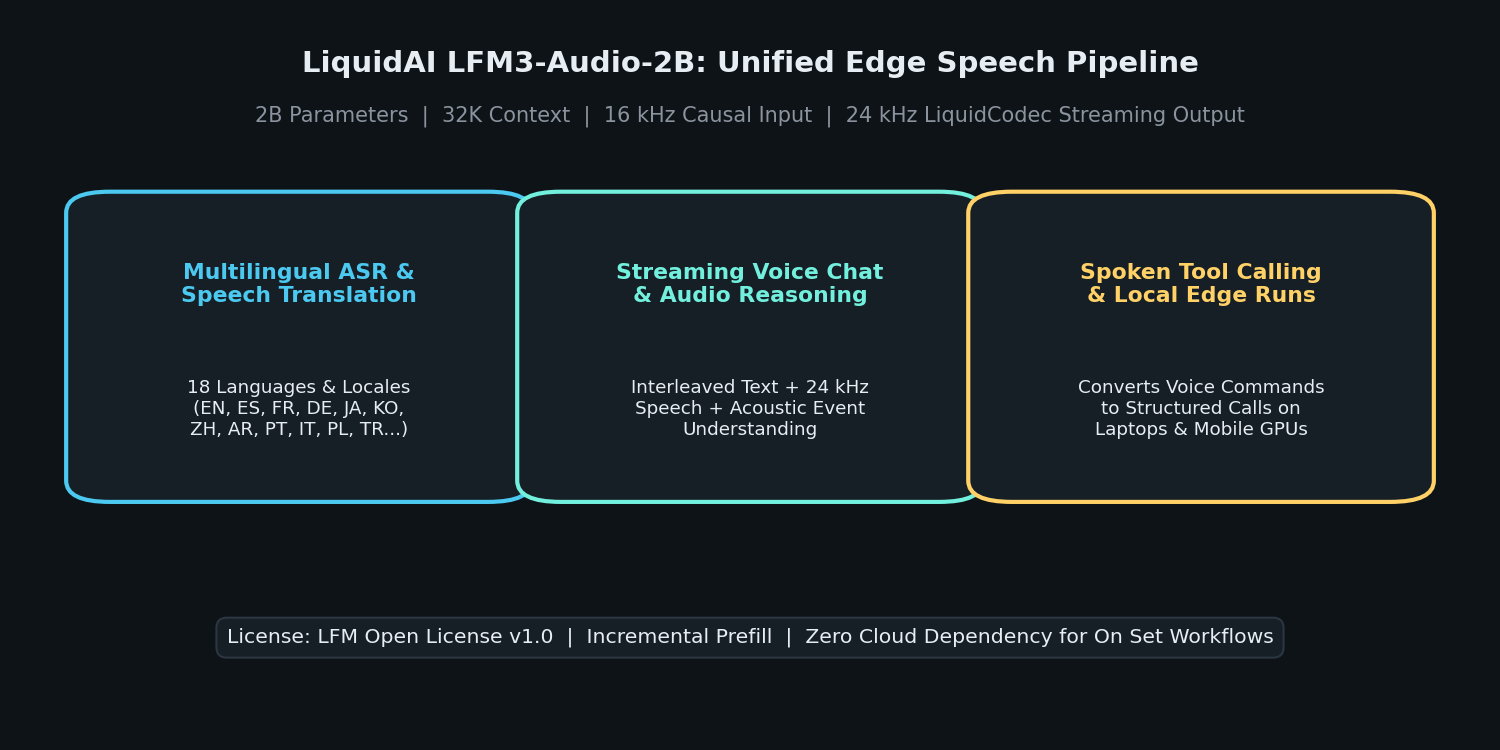
LFM3-Audio-2B modality overview built from Liquid AI model specifications
Because both the audio encoder and prefill path are causal, the model processes incoming speech incrementally and streams 24 kHz audio tokens back alongside synchronized text tokens. It accepts text or audio inputs and outputs text, speech, or interleaved text and speech.
Language coverage spans 18 languages and locales: Arabic, Danish, German, Greek, British English, American English, Finnish, French, Hebrew, Italian, Japanese, Korean, Dutch, Polish, Portuguese, Spanish, Swedish, Turkish, and Chinese. Beyond dialogue, the model performs acoustic event reasoning, answering questions about background sounds and ambient cues inside field recordings.
At 2B total parameters, LFM3-Audio-2B fits comfortably on consumer laptops without requiring data center GPUs. It also supports spoken tool calling, converting verbal editor commands into structured JSON actions for local workflow automation.
Hardware, VRAM, and License Matrix
| Deployment Option | Precision / Format | Typical Memory | Audio I/O Spec | License | Intended Use |
|---|---|---|---|---|---|
LiquidAI/LFM3-Audio-2B (BF16) |
Transformers / Safetensors | ~5 to 6 GB VRAM | 16 kHz in / 24 kHz out | LFM Open License v1.0 | Local ASR, dubbing prep, TTS |
| Quantized Edge / Laptop Builds | 8 bit / 4 bit | ~2.5 to 4 GB RAM/VRAM | Streaming causal audio | LFM Open License v1.0 | On set field logging and offline script notes |
| Server Batch Pipeline | BF16 CUDA | ~8 GB VRAM | 32K context window | LFM Open License v1.0 | Automated dailies transcription & tagging |
Review the LFM Open License v1.0 file in the official Hugging Face repository for commercial deployment thresholds and attribution terms.
Parameter Reference
| Specification | Value | Production Significance |
|---|---|---|
| Total Parameters | 2B |
Runs fast locally on laptops and 8 GB GPUs |
| Context Length | 32K tokens |
Handles long documentary interviews or multi page scene transcripts |
| Input Sample Rate | 16 kHz |
Standard broadcast and field recorder speech input |
| Output Sample Rate | 24 kHz (LiquidCodec) |
Crisp scratch voiceover and multilingual temp dubbing |
| Streaming Mode | Causal + incremental prefill | Low latency interactive voice chat and live logging |
Local Python and CLI Setup
Install the liquid-audio and transformers packages to run local speech transcription, translation, or interleaved text and audio generation with LiquidAI/LFM3-Audio-2B.
pip install -U torch torchaudio transformers accelerate
hf download LiquidAI/LFM3-Audio-2B --local-dir ./models/LFM3-Audio-2B
import torch
from transformers import AutoModelForCausalLM, AutoProcessor

model_id = "LiquidAI/LFM3-Audio-2B"
processor = AutoProcessor.from_pretrained(model_id, trust_remote_code=True)
model = AutoModelForCausalLM.from_pretrained(
    model_id,
    torch_dtype=torch.bfloat16,
    device_map="auto",
    trust_remote_code=True,
)

# Inspect processor methods for ASR, translation, and 24 kHz LiquidCodec TTS
print("Loaded LFM3-Audio-2B on", model.device)
Check the official Liquid AI documentation for the latest liquid-audio streaming wrapper and quantized GGUF / ONNX edge runtimes.
Filmmaker Production Playbook
- Log international documentary dailies completely offline. Load LFM3-Audio-2B on a location laptop to transcribe interviews across 18 languages, translate key quotes into English for the editor, and tag background sound events inside the same 32K context window.
- Generate fast multilingual temp dubs for festival rough cuts. Before booking foreign language voice actors, translate English scratch dialogue and synthesize 24 kHz timing guides in Spanish, French, Japanese, or Korean to check subtitle pacing and lip sync rhythm.
- Pair with dedicated voice cloning for final character voices. Use LFM3-Audio-2B for lightweight translation and audio QA, then render final character voice tracks with Fun-CosyVoice 3.0 or MiniMax Speech 2.8 HD Text to Speech in AI FILMS Studio.
- Keep knowledge queries grounded in scripts. Because LFM3-Audio-2B is a compact 2B edge model, feed your actual scene transcript into its 32K context rather than asking open ended trivia questions.
Related Reading
- Fun-CosyVoice 3.0: Open Source Multilingual Voice AI
- Hunyuan AuK: Open Source Speech & Dialogue Editing AI
- Haru-4B: Open Source Full Duplex Speech Dialogue AI
- Explore cloud video and dialogue workflows on the AI Text to Video Generator page.


Sources
Continue Reading


Video & LipSync
- Video Generator
- Text to Video
- Image to Video
- Start-End Frame to Video
- Draw to Video
- Motion Control
- Video Enhancer
- Video Upscaler
- Video Extend
- Video to Video LipSync
- Audio to Video LipSync
- Image to Video LipSync
- Video FaceSwap
- Seedance 2.5
- WAN 3.0
- Seedance 2
- FLUX 3
- Minimax H3
- Vidu Q3 Pro
- Grok Imagine Video 1.5
- Gemini Omni
- Google Veo 3.1
- Kling 3.0 Pro
- Luma Ray 3.2
- LTX 2.3
- Happy Horse 1.1
- Kling 3.0 Motion
- ByteDance Upscaler
- InfiniteTalk
- InsightFace
Image & Edit
- AI Character
- AI Actor
- Art Generator
- Text to Image
- Image to Image
- LoRA Image to Image
- Draw to Edit
- Image LoRA Training
- Remove Background
- Image Enhancer
- MidJourney 8.0
- Krea 2
- OpenAI GPT Image 2.0
- Nano Banana Pro Ultra
- Nano Banana 2 Lite
- Nano Banana Pro
- Minimax Image
- Clarity Pro
- Z-Image Turbo LoRA
- Krea 2 Turbo LoRA
- Z-Image LoRA Trainer
- Qwen Image LoRA Trainer
- Background Erase Network 2 (BEN2)