

AI FILMS technical diagram from Beidouqixing MiniMax-H3 FlashGen 4 step VSD schedule
Share this post:
MiniMax-H3 FlashGen: Open Source 4 Step Video Audio
Joint video and audio diffusion models normally require 30 to 50 denoising steps per take, making interactive shot exploration slow on local hardware. MiniMax-H3 FlashGen (Beidouqixing/minimax-h3-4step-lora-flashgen), released under the Apache 2.0 license, compresses MiniMax-H3 text-to-video plus synchronized audio (T2VA) down to 4 inference steps at 1344x768 resolution for 5.2 second clips. Built with data free Variational Score Distillation (VSD) and zero adversarial GAN loss, the rank 64 LoRA merges cleanly into base MiniMax-H3 weights for fast serving. You can test this open source model free in your browser below with zero login.
Studio availability. Try the public Hugging Face demo below; MiniMax-H3 FlashGen is not part of a paid AI FILMS Studio plan (use MiniMax H3 Text to Video in the video workspace for example instead).
Try MiniMax-H3 FlashGen Live
Enter a scene prompt with ambient sound or dialogue cues in the public Hugging Face Space below to test 4 step joint video and audio generation directly in your browser.
Architecture and Technical Design
FlashGen applies data free distribution matching distillation (VSD) to the base MiniMax-H3 teacher without requiring a curated video dataset or fragile GAN discriminators. Training targets every core linear projection inside the joint audio video transformer blocks at LoRA rank 64 in BF16 precision (minimax_h3_4step_lora_flashgen_v1.0_768p_bf16.safetensors).
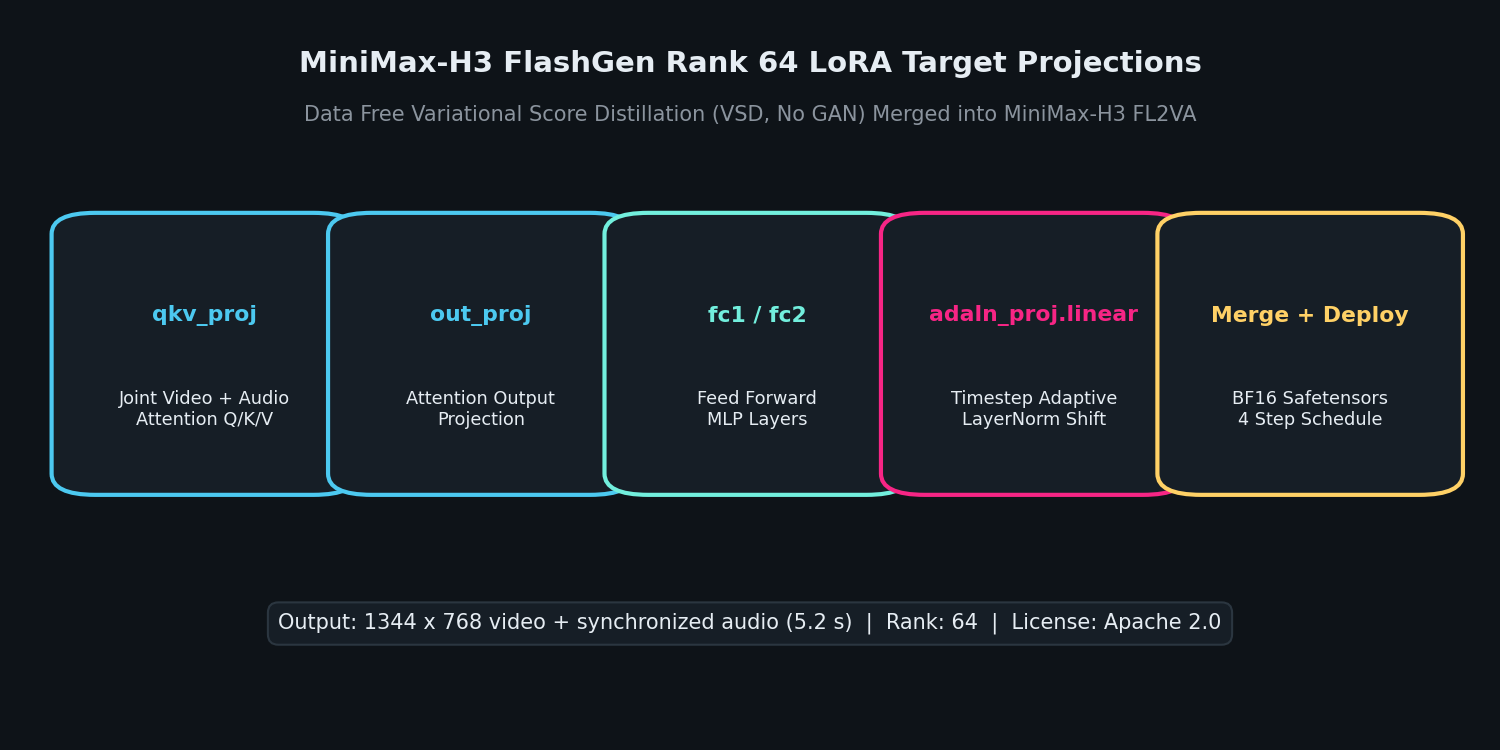
FlashGen rank 64 LoRA target projection map built from FlashGen model specs, Apache 2.0
Specifically, the adapter attaches to qkv_proj, out_proj, fc1, fc2, and adaln_proj.linear. Adapting the timestep conditioning layer (adaln_proj.linear) is critical for 4 step schedules because it lets the student network jump across wide noise intervals without losing motion coherence or audio synchronization.
Instead of loading the LoRA dynamically at runtime, the official release ships merge_lora_ckpt.py to fuse the adapter permanently into the base FL2VA weights and write the exact 4 step base_schedule array ([1.0, 0.7, 0.4, 0.15, 0.0]) directly into the checkpoint config.
Once merged, the checkpoint serves out of the box through vLLM-Omni on NVIDIA GPUs or MindIE-SD on Ascend NPUs with zero runtime LoRA overhead. Because the audio stream is distilled alongside the video latents, footsteps, weather ambience, and camera pans stay synchronized even at 4 steps.
Hardware, VRAM, and License Matrix
| Deployment Option | Precision / Format | Typical VRAM | Inference Steps | License | Intended Use |
|---|---|---|---|---|---|
Merged FlashGen + MiniMaxAI/MiniMax-H3 (BF16) |
Merged BF16 Safetensors | ~32 to 48 GB | 4 steps | Apache 2.0 (LoRA) + MiniMax-H3 Base | Fast 768p T2VA generation |
| Quantized FP8 / INT8 + FlashGen | FP8 / INT8 | ~16 to 24 GB | 4 steps | Apache 2.0 (LoRA) + MiniMax-H3 Base | Local workstation previz |
| vLLM-Omni / MindIE-SD Server | Merged BF16 | 1x A100 / H100 / Ascend NPU | 4 steps | Apache 2.0 (LoRA) | Multi user studio serving |
The FlashGen LoRA and merge script carry an Apache 2.0 license, while the underlying MiniMaxAI/MiniMax-H3 base checkpoint remains subject to MiniMax's open weights license.
Parameter Reference
| Parameter | Required Value | Role in 4 Step Generation |
|---|---|---|
num_inference_steps |
4 |
Exact distilled student step budget |
base_schedule |
[1.0, 0.7, 0.4, 0.15, 0.0] |
Injected during merge; controls noise jump spacing |
| Target resolution | 1344 x 768 |
Native widescreen 16:9 distillation resolution |
| Clip duration | 5.2 seconds |
Optimal synchronized audio video length |
| LoRA rank | 64 |
High capacity distillation across attention and AdaLN |
Local Python and CLI Setup
Download the base MiniMaxAI/MiniMax-H3 weights and the FlashGen repository, then fuse the adapter and inject base_schedule before serving with vllm-omni or MindIE-SD.
pip install -U huggingface_hub torch safetensors
hf download MiniMaxAI/MiniMax-H3 --local-dir ./models/MiniMax-H3
hf download Beidouqixing/minimax-h3-4step-lora-flashgen --local-dir ./flashgen

python ./flashgen/merge_lora_ckpt.py \
  ./models/MiniMax-H3/FL2VA \
  ./flashgen/minimax_h3_4step_lora_flashgen_v1.0_768p_bf16.safetensors \
  ./models/minimax-h3-4step-flashgen

export MODEL=./models/minimax-h3-4step-flashgen/FL2VA
Filmmaker Production Playbook
- Use FlashGen for rapid sound and blocking look dev. Generating 5.2 second 1344x768 clips in 4 steps lets directors audition ten camera angles and soundscapes in the time a standard 40 step schedule renders one take.
- Write explicit acoustic cues into the prompt. Because FlashGen distills joint
T2VAweights, describe foley details such as rain on glass, distant siren hum, or gravel footsteps alongside lens framing so the audio track anchors the cut. - Do not override
base_schedulewith generic linear sigmas. The[1.0, 0.7, 0.4, 0.15, 0.0]schedule matches the exact noise points trained during VSD. Using a default uniform schedule causes soft edges and muddy transients. - Compare 2 step, 4 step, and 8 step H3 distillations. If you need extreme preview speed without a VAE decoder, inspect pi-H3 2 step audio video generation. If you want extra temporal detail on complex crowd motion, compare FlashGen against FastH3-Omni 8 step audio video AI.
Related Reading
- pi-H3: Open Source 2-Step Audio Video Generation
- FastH3-Omni: Open Source 8 Step Audio Video AI
- SANA-Video 2.0 5B: Open Source 4 Step 720p Video
- Explore cloud video models on the AI Text to Video Generator page.


Sources
Continue Reading


Video & LipSync
- Video Generator
- Text to Video
- Image to Video
- Start-End Frame to Video
- Draw to Video
- Motion Control
- Video Enhancer
- Video Upscaler
- Video Extend
- Video to Video LipSync
- Audio to Video LipSync
- Image to Video LipSync
- Video FaceSwap
- Seedance 2.5
- WAN 3.0
- Seedance 2
- FLUX 3
- Minimax H3
- Vidu Q3 Pro
- Grok Imagine Video 1.5
- Gemini Omni
- Google Veo 3.1
- Kling 3.0 Pro
- Luma Ray 3.2
- LTX 2.3
- Happy Horse 1.1
- Kling 3.0 Motion
- ByteDance Upscaler
- InfiniteTalk
- InsightFace
Image & Edit
- AI Character
- AI Actor
- Art Generator
- Text to Image
- Image to Image
- LoRA Image to Image
- Draw to Edit
- Image LoRA Training
- Remove Background
- Image Enhancer
- MidJourney 8.0
- Krea 2
- OpenAI GPT Image 2.0
- Nano Banana Pro Ultra
- Nano Banana 2 Lite
- Nano Banana Pro
- Minimax Image
- Clarity Pro
- Z-Image Turbo LoRA
- Krea 2 Turbo LoRA
- Z-Image LoRA Trainer
- Qwen Image LoRA Trainer
- Background Erase Network 2 (BEN2)