
Netflix Recreates Gene Wilder's Voice With AI for 'Wonka's The Golden Ticket'

Share this post:
Netflix Recreates Gene Wilder's Voice With AI for "Wonka's The Golden Ticket"
Netflix used AI to recreate Gene Wilder's 1971 voice as Willy Wonka for a new unscripted competition series. The streamer obtained permission from Wilder's estate before building the project, a detail that separates it from most posthumous AI voice controversies in Hollywood.
The trailer for "Wonka's The Golden Ticket" dropped June 30, 2026, and immediately drew sharp reactions on social media. The series itself premieres September 23, with a two part finale closing out the season on September 30.
A Competition Series Built Around Wilder's Wonka
"Wonka's The Golden Ticket" is a nine part unscripted competition series produced by Netflix and Eureka Productions. Twelve contestants, each holding a golden ticket and a partner of their choosing, compete through challenges inspired by the 1971 film and Roald Dahl's original novel.
Rusty Goffe, who played one of the Oompa Loompas in the original "Willy Wonka & the Chocolate Factory," reprises his role for the new series. His return links the production directly back to the source film rather than treating it as a standalone reboot.
Wilder's AI recreated voice functions as the narrator and guide throughout the competition, giving Wonka's character an active role in the series beyond a licensing premise. The production treats the 1971 film not as a visual reference but as the structural engine, using its characters, spirit, and now its lead actor's voice to anchor the format.
The nine episodes span roughly one week of broadcast time, from the September 23 premiere to the two part finale on September 30. That compressed schedule positions the series as an event rather than a standard streaming drop, more like a game show finale week than a binge release.
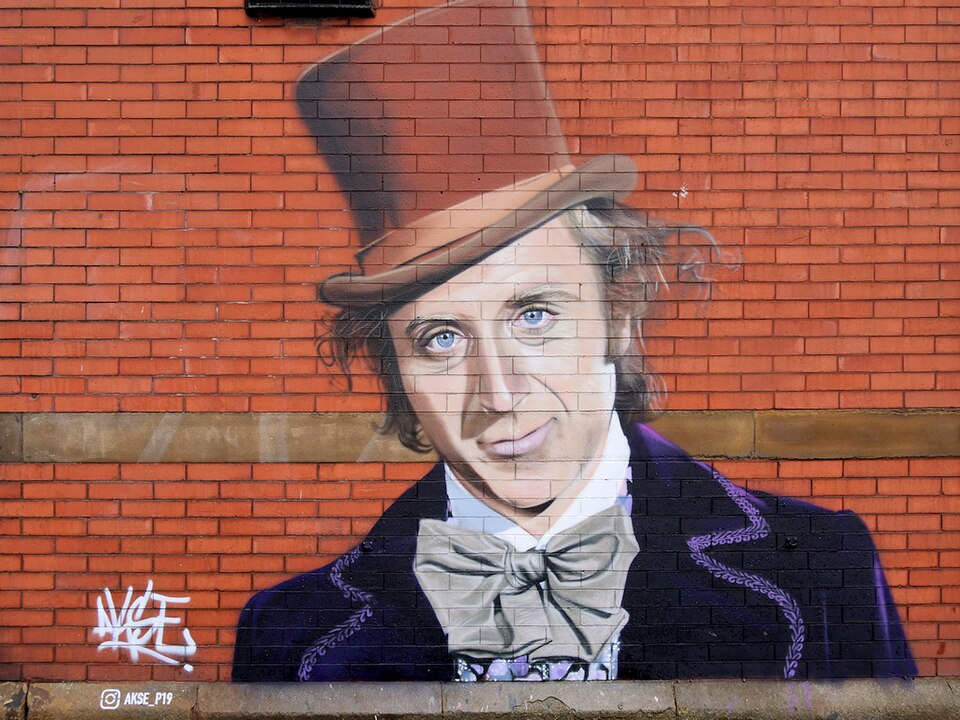
Willy Wonka in his Felt Hat by David Dixon, CC BY-SA 2.0, via Wikimedia Commons
Wilder's felt hatted Wonka has remained a fixture of popular culture for more than five decades, appearing in street art, fan tributes, and merchandise long after the 1971 film's release. Netflix's new series leans directly into that legacy rather than introducing a new visual interpretation of the character.
That cultural staying power is precisely what made Wilder's estate willing to authorize the AI voice work. Karen B. Wilder's public statement made the estate's rationale explicit: the project celebrates the warmth Wilder brought to the role and introduces it to a new generation.
ElevenLabs and the Estate's Blessing
Netflix partnered with AI voice company ElevenLabs to recreate Wilder's voice for the series, using archival audio from the original film as the basis for the synthetic narration. The voice guides contestants through the competition's challenges in character as Wonka.
Karen B. Wilder, Gene Wilder's wife, gave the project her blessing on behalf of his estate. "Gene had a remarkable ability to bring humor, wonder and heart into people's lives, and that connection has endured for generations," she said. She added: "We are delighted that Wonka's The Golden Ticket celebrates the warmth and imagination that he brought to the role, introducing that magic to a new generation while honoring the fans who have cherished it for decades."
The estate's involvement goes beyond a standard licensing agreement. Karen B. Wilder has been the primary steward of Gene Wilder's creative legacy since his death in August 2016, and her public statement positions the AI project as an extension of that stewardship rather than a commercial exploitation of his image.
ElevenLabs built the voice model from archival recordings sourced from the 1971 film. The company has not disclosed the specific volume of training audio used, but Wilder's performance in the original film is extensive, giving ElevenLabs a substantial sample to work from compared to performers with shorter filmographies.
A Pattern of Consent Based AI Voice Licensing
ElevenLabs has built a track record of estate sanctioned posthumous and legacy voice work ahead of the Wilder project. The company previously recreated Michael Caine's voice for a 13 hour audiobook of Homer's The Odyssey, produced with Caine's direct approval through its Iconic Marketplace licensing platform, which pays rights holders each time a licensed voice is used commercially.
That same marketplace structure underpins ElevenLabs' broader Hollywood push, valued at $11 billion with $330 million in annual recurring revenue as of January 2026. The company has used it to resurrect James Earl Jones' voice for Darth Vader in Fortnite, done "in close consultation with Jones' family," and has built estate partnerships with John Wayne, Laurence Olivier, and Judy Garland in addition to Stan Lee's estate. ElevenLabs positions licensed, compensated voice recreation as its primary strategy for entering Hollywood production.
Matthew McConaughey, an ElevenLabs investor, has taken a parallel route by filing trademark applications covering his own voice and likeness, a legal complement to the same consent based philosophy. Caine and McConaughey are both living actors who licensed their own voices directly. The Wilder deal extends that same framework to an estate acting on behalf of a performer who can no longer give consent in person.
The range of ElevenLabs' estate and talent partnerships now spans performers from multiple eras and consent situations:
| Performer | Status | Authorized By | Project |
|---|---|---|---|
| Michael Caine | Living | The performer directly | The Odyssey audiobook |
| Matthew McConaughey | Living | The performer directly | Newsletter narration, investor |
| James Earl Jones | Deceased (2022) | Jones' family | Darth Vader in Fortnite |
| Gene Wilder | Deceased (2016) | Karen B. Wilder (estate) | Wonka's The Golden Ticket |
| John Wayne, Judy Garland, Laurence Olivier | Deceased | Respective estates | Iconic Marketplace catalog |
Netflix and the Roald Dahl Catalog
Netflix acquired the Roald Dahl Story Company in 2023, making it the rights holder for the underlying Charlie and the Chocolate Factory intellectual property. The acquisition gave Netflix ownership of the Dahl literary catalog, the characters in it, and the associated merchandising and licensing rights.
That context changes how the Wilder voice project should be read. The series is part of a broader IP consolidation strategy in which Netflix has brought the Dahl underlying rights together with the most recognizable screen iteration of the characters. Wilder's Wonka is the version that most audiences associate with the story, and his estate's participation directly serves that consolidation.
The Roald Dahl Story Company acquisition also means Netflix controls both what the characters do and how they look and sound across the catalog. The Wilder estate providing voice authorization effectively closes the loop on a character that Netflix now owns in almost every other dimension.
Karen B. Wilder's willingness to participate publicly, including through a statement that specifically frames the project as honoring Wilder's legacy, signals that the estate sees alignment with Netflix's handling of the underlying IP rather than a conflict with it. That estate buy-in is not a given: other actor estates have declined similar arrangements even when underlying rights holders have proceeded with AI based projects.
The alignment also affects how the project is positioned in the press. An estate that gives a willing public endorsement rather than merely signing a consent form creates a very different story around the announcement than one that authorizes quietly. The Karen B. Wilder statement is the most prominent public defense of the project available, and Netflix has leaned on it as the primary counter to social media criticism.
A Fully Posthumous Test Case
Gene Wilder died in August 2016, a decade before "Wonka's The Golden Ticket" was announced. That distinction sets the project apart from ElevenLabs' prior Hollywood work, where Caine and McConaughey each personally approved how their voices would be used. Here, the estate, represented by Karen B. Wilder, is the sole party authorizing the recreation.
The arrangement places Netflix and ElevenLabs closer to the James Earl Jones Fortnite partnership, where the actor's family rather than the actor himself authorized the AI work. Whether audiences treat estate authorized posthumous voice work the same as living actor licensing is, in part, what the Wilder project will test once the series premieres in September.
The Jones family authorized a voice that Jones himself had previously sanctioned for digital continuation before his death. The Wilder situation is structurally different. No documented record exists of Wilder expressing a preference about AI voice use, which places Karen B. Wilder's judgment at the center of a decision that the performer himself cannot ratify.
That structural difference will matter to policymakers evaluating how California's AB 1836 functions in practice. The law requires estate consent; it does not require that the performer anticipated or pre-authorized AI use. Karen B. Wilder's judgment is legally sufficient under that framework. Whether it is sufficient in the broader cultural sense is a question the September premiere will begin to answer.
What California Law Requires
California's AB 1836, signed in September 2024 and effective January 1, 2025, prohibits studios from using digital replicas of deceased performers in entertainment products without written consent from their estate. Netflix and ElevenLabs structured the Wilder project with that statutory requirement as the baseline, not merely as an ethical position.
The law applies to performances in audiovisual works, which covers a competition series. Karen B. Wilder's written authorization satisfies the statute's core consent requirement. California's statute also prohibits using a deceased performer's digital replica to portray them in ways the performer would have found objectionable, a provision that the estate's explicit public endorsement directly addresses.
SAG-AFTRA's agreements cover living members' voices and likenesses, not estates of deceased performers who were not active guild members at the time of production. The union has called for broader posthumous protection standards, but the Wilder project does not fall under any active guild enforcement mechanism. The applicable legal framework is California property law.
The estate authorization also provides protection against a California right of publicity claim. California's celebrity rights law extends posthumous right of publicity protection for 70 years after a performer's death. Wilder died in 2016, meaning that right does not expire until 2086. Without the estate's written consent, any commercial use of his voice in a California production would expose Netflix to a right of publicity lawsuit.
Congress is also moving toward federal posthumous digital replica protections. The NO FAKES Act, introduced in 2023 and reintroduced in 2025, would create a federal private right of action against using a person's name, voice, or likeness in AI generated audio or video content without consent. As of mid-2026, the bill has not passed, but the legislative discussion signals that posthumous voice recreation will face federal scrutiny regardless of whether California's state framework is deemed sufficient.
The Wilder project's legal structuring, with explicit estate authorization, a technology partner bound by consent terms, and a production by a major streamer subject to California jurisdiction, makes it one of the better documented examples of how a compliant posthumous AI voice project can be assembled under current law.
The Backlash and What It Tests
Despite the estate's involvement, the trailer drew immediate criticism on social media over the use of AI to approximate a deceased actor's voice. Several outlets framed the reaction as part of a broader pattern of audience discomfort with AI generated performances, regardless of who has consented.
The consent and compensation model resolves the legal and ethical question of who can authorize a posthumous AI voice recreation. It does not resolve the separate audience question of whether people want to hear a dead performer speak in new contexts, even with family approval. Those are different objections, and the Wilder project will generate data on both simultaneously.
The project functions as a real time test of whether estate authorized, compensated AI voice work changes audience reception compared to unauthorized voice cloning. Unlike deepfake controversies built on scraped or unlicensed audio, the Wilder recreation carries the explicit backing of the people legally responsible for his likeness, a distinction that may matter more to regulators and guilds than to social media reaction in the short term.
Netflix will draw its own conclusions from the September premiere. If the series performs well and the trailer backlash does not carry into viewership, the industry will read that as confirmation that legal authorization is sufficient to carry a posthumous AI voice project through to audiences. The Wilder project is the clearest test of that proposition the industry has run so far.
The response also opens a gap between what regulators and guilds will tolerate and what audiences will accept without friction. Those are not the same threshold, and the distance between them is what studios making similar decisions after September will be watching closely.
Posthumous AI voice work involving estate consent, California compliance, and a transparent technology partner represents the most defensible version of this category of production. What the Wilder trailer reaction suggests is that even the most defensible version generates immediate pushback, which means the industry has not yet found the format or framing that makes posthumous AI voice work feel acceptable rather than merely legal.
A Reference Point for the Industry
The Wilder project's architecture, estate authorized, California compliant, paired with ElevenLabs' consent based Iconic Marketplace, will function as a reference point the next time a studio announces a posthumous AI voice recreation. If the series performs well and the backlash stays contained to the pre-premiere period, that architecture becomes the industry's working standard for doing this with maximum legal and reputational cover.
ElevenLabs has already built active relationships with the estates of John Wayne, Judy Garland, and Laurence Olivier. Adding Gene Wilder reinforces that the Iconic Marketplace model extends to performers who were working before the AI era and left no explicit record of their preferences on the technology.
The three months between the trailer's release and the September premiere give the estate and Netflix time to observe public reaction and adjust their communications approach. Estate authorization of posthumous AI voice work does not require silence after the announcement. That window is part of what the project will teach the industry about how to sequence disclosure and promotion.
ElevenLabs' voice synthesis tools are available for independent creators in the AI FILMS Studio voice workspace, where filmmakers can work with licensed AI voices for narration and character projects.
Sources
Deadline | The Hollywood Reporter | Variety | The Wrap | Yahoo Entertainment | Just Jared | ScreenRant
Continue Reading
.jpg?w=3840)


Video & LipSync
- Video Generator
- Text to Video
- Image to Video
- Start-End Frame to Video
- Draw to Video
- Motion Control
- Video Enhancer
- Video Upscaler
- Video Extend
- Video to Video LipSync
- Audio to Video LipSync
- Image to Video LipSync
- Video FaceSwap
- Seedance 2.5
- WAN 3.0
- Seedance 2
- FLUX 3
- Minimax H3
- Vidu Q3 Pro
- Grok Imagine Video 1.5
- Gemini Omni
- Google Veo 3.1
- Kling 3.0 Pro
- Luma Ray 3.2
- LTX 2.3
- Happy Horse 1.1
- Kling 3.0 Motion
- ByteDance Upscaler
- InfiniteTalk
- InsightFace
Image & Edit
- AI Character
- AI Actor
- Art Generator
- Text to Image
- Image to Image
- LoRA Image to Image
- Draw to Edit
- Image LoRA Training
- Remove Background
- Image Enhancer
- MidJourney 8.0
- Krea 2
- OpenAI GPT Image 2.0
- Nano Banana Pro Ultra
- Nano Banana 2 Lite
- Nano Banana Pro
- Minimax Image
- Clarity Pro
- Z-Image Turbo LoRA
- Krea 2 Turbo LoRA
- Z-Image LoRA Trainer
- Qwen Image LoRA Trainer
- Background Erase Network 2 (BEN2)