
NVIDIA UniRelight: AI Video Relighting for Filmmakers
Share this post:
NVIDIA UniRelight: AI Video Relighting for Filmmakers
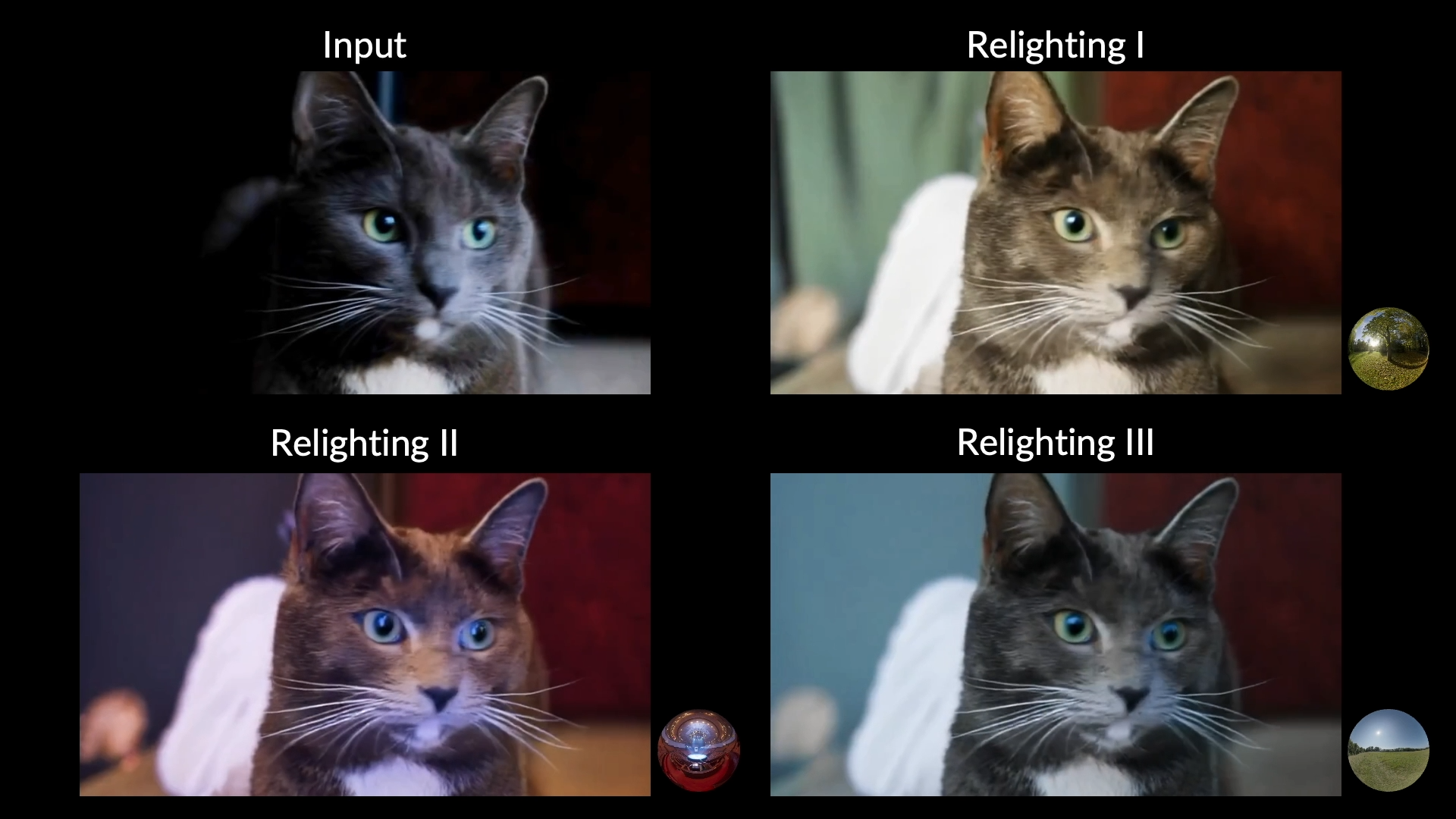
NVIDIA's Toronto AI Lab published UniRelight, a system that changes lighting conditions in existing videos while preserving scene geometry, material properties, and temporal consistency. The work was accepted at NeurIPS 2025 and builds on NVIDIA's Cosmos World Foundation Models. The research is led by Kai He and Ruofan Liang at NVIDIA, the University of Toronto, and the Vector Institute.
Studio availability. UniRelight is not available in AI FILMS Studio. This article covers a public research release. To generate video in the Studio, see the models listed on the text to video page.
UniRelight, NVIDIA Toronto AI Lab
Why Relighting Existing Footage Is Difficult
Standard relighting pipelines treat albedo estimation and lighting synthesis as separate steps. The disconnect produces artifacts where shadows, specular highlights, and material responses in one frame disagree with the next, breaking temporal coherence across the clip.
Failure modes of isolated relighting approaches
Complex surfaces compound the problem. Glass, transparent objects, and anisotropic materials produce lighting responses that conventional decomposition methods cannot model accurately, because the physical assumptions built into most approaches break down at those surface types.
Why Separating Albedo From Lighting Fails
Standard relighting pipelines assume a clean physical model: separate the scene into albedo, the base color of materials, and lighting, then simulate new lighting on the albedo. That assumption breaks in practice because natural materials, including wet surfaces, skin, fabric, and complex metals, do not decompose cleanly into those two components. Any estimation error in the albedo bleeds into the lighting synthesis, and the error propagates in the opposite direction too.
The disconnect between consecutive frames is a persistent problem. Albedo estimation is typically done per frame, not across the sequence. If the estimate shifts slightly between frames, the synthesized lighting shifts with it, producing flicker or gradual drift in the relit output that did not exist in the original footage. That flicker is what makes prior relighting approaches impractical for broadcast or theatrical output.
UniRelight addresses both problems simultaneously by making the albedo and relit output constrain each other in the same forward pass. Errors in one direction are partially corrected by the other, the resulting albedo is more stable across frames, and that stability is why the temporal coherence in the relit output improves compared to sequential approaches.
Joint Decomposition and Synthesis
UniRelight addresses the separation problem by predicting the relit video output and an albedo map simultaneously in a single forward pass. Each prediction constrains the other, giving the model a structural prior that single task approaches lack.
Joint estimation: simultaneous albedo and relit output prediction
The architecture uses a finetuned DiT video diffusion model with a VAE encoder and decoder for the latent space. Target lighting is supplied as environment maps (HDRI), whose features are concatenated with video latents at inference time. Training combines synthetic multi illumination datasets with automatically labeled real world video footage, covering the range of materials and conditions the model encounters in practice.
The Training Data Strategy
UniRelight trains on a combination of synthetic multi illumination datasets and automatically labeled real world footage. The synthetic data provides controlled conditions where the ground truth albedo and lighting are known, letting the model learn the relationship between scene decomposition and relighting quality. The real world footage prevents the model from understanding only synthetic material properties.
Automatic labeling of real world footage with pseudo ground truth removes the need for manual annotation at scale. The automatic labeling process uses existing computer vision methods to estimate albedo and scene geometry, then filters for cases where those estimates are reliable enough to serve as training targets.
The combination of synthetic and real world training is what allows UniRelight to generalize to footage it has never seen. A model trained only on synthetic data would perform well on surfaces that match its training distribution and poorly on the complex material properties encountered in professional production footage.
HDRI Environment Maps as Lighting Control
UniRelight takes target lighting as HDRI environment maps. An environment map encodes the full sphere of incoming light at a scene point, capturing both the direction and intensity of all light sources in the environment. This is the same representation used in standard VFX and compositing pipelines, which means existing HDRI libraries can be used directly.
The map is ingested as features concatenated with video latents at inference time, rather than applied as a post processing correction. That integration method keeps the lighting influence consistent across the diffusion process. The lighting is embedded into the generation itself, not layered on afterward.
Filmmakers who want to match footage from one location to the lighting of another can capture an HDRI map at the target location and apply it to the existing footage. The approach also works in reverse: footage shot at a location with poor light can be relit to match a different environment map without returning to set.
What the Model Produces
UniRelight handles specular highlights on metallic and polished surfaces, glass and transparent objects, and anisotropic materials that respond differently based on viewing and lighting angles. All outputs remain consistent from frame to frame throughout the video sequence.
Dramatic lighting changes are within scope: switching from daylight to nighttime conditions, hard directional sources, and colored environments. The authors report that UniRelight outperforms DiffusionRenderer on standard benchmarks for intrinsic decomposition and relighting quality. For commercial video generation workflows without research restrictions, AI FILMS Studio provides a licensed suite of tools.
What Filmmakers Can Apply UniRelight To
Post production relighting addresses a recurring class of production problem. Location shoots where weather or time of day changed between setups produce footage with inconsistent light that cannot be matched without relighting. Interior scenes where the lighting design was altered between takes for coverage leave the editor with footage that does not cut together cleanly. UniRelight provides a path to correct both.
The gallery examples in the research paper cover outdoor environments at different times of day, interior scenes with point sources and ambient combinations, and reflective surfaces including metallic objects and glass. All three represent real production scenarios rather than controlled demonstrations.
The specular highlight handling is where the practical gap between UniRelight and earlier relighting approaches is widest. Correcting specular highlights on metallic surfaces, car paint, polished floors, and jewelry requires accurate material modeling that surface normal estimation alone cannot provide. UniRelight's joint decomposition produces a more accurate material model, which is why its specular results outperform single task approaches on the benchmark.
Gallery
Availability and License
UniRelight's code is on GitHub at nv-tlabs/UniRelight and model weights are published on Hugging Face. The project is released under the NVIDIA OneWay Noncommercial License. Commercial deployment is not permitted. Use is restricted to research and academic purposes.
This release follows the same noncommercial model as other NVIDIA NVLabs projects. NVIDIA LongLive, the lab's real time interactive video generation system, and NVIDIA SANA Video, an efficient long form text-to-video model, both ship under the same terms. NVIDIA Lyra 2.0, from the Spatial Intelligence Lab, takes the opposite approach with an Apache 2.0 license that permits commercial deployment.
The Noncommercial License in Context
The NVIDIA OneWay Noncommercial License permits research and academic use but restricts commercial deployment. That places UniRelight in the same category as many NVIDIA research releases from the Toronto AI Lab. It is available to study, to reproduce in academic work, and to build on for non commercial research, but not to integrate into commercial production tools or charge clients for outputs produced with it.
This license structure is consistent with how NVIDIA treats work that is close to commercial products the company sells or plans to sell. A video relighting capability of this quality is directly relevant to NVIDIA's professional media and entertainment hardware market. Releasing it as non commercial research gives the academic community access to the method while preserving the commercial option for NVIDIA's own products or future licensing agreements.
For filmmakers who need commercial relighting capabilities today, the InterPositive acquisition Netflix completed in March 2026 signals where the market for this class of tool is heading. The technical approach, AI models applied to existing footage for lighting correction, is what InterPositive built commercially. UniRelight is the open research version of the same problem solved at research quality.
Sources
arXiv: UniRelight: Learning Joint Decomposition and Synthesis for Video Relighting
GitHub: nv-tlabs/UniRelight
Project Page: research.nvidia.com/labs/toronto-ai/UniRelight
Continue Reading
.jpg?w=3840)


Video & LipSync
- Video Generator
- Text to Video
- Image to Video
- Start-End Frame to Video
- Draw to Video
- Motion Control
- Video Enhancer
- Video Upscaler
- Video Extend
- Video to Video LipSync
- Audio to Video LipSync
- Image to Video LipSync
- Video FaceSwap
- Seedance 2.5
- WAN 3.0
- Seedance 2
- FLUX 3
- Minimax H3
- Vidu Q3 Pro
- Grok Imagine Video 1.5
- Gemini Omni
- Google Veo 3.1
- Kling 3.0 Pro
- Luma Ray 3.2
- LTX 2.3
- Happy Horse 1.1
- Kling 3.0 Motion
- ByteDance Upscaler
- InfiniteTalk
- InsightFace
Image & Edit
- AI Character
- AI Actor
- Art Generator
- Text to Image
- Image to Image
- LoRA Image to Image
- Draw to Edit
- Image LoRA Training
- Remove Background
- Image Enhancer
- MidJourney 8.0
- Krea 2
- OpenAI GPT Image 2.0
- Nano Banana Pro Ultra
- Nano Banana 2 Lite
- Nano Banana Pro
- Minimax Image
- Clarity Pro
- Z-Image Turbo LoRA
- Krea 2 Turbo LoRA
- Z-Image LoRA Trainer
- Qwen Image LoRA Trainer
- Background Erase Network 2 (BEN2)