
ShotPlan: Cinematic Multi Shot Video with Frame Accurate Shot Timing, Apache 2.0

Share this post:
ShotPlan: Cinematic Multi Shot Video with Frame Accurate Shot Timing, Apache 2.0
TeleAI and Harbin Institute of Technology have released ShotPlan, a method for generating cinematic multi shot videos with frame accurate hard cuts, soft cross fades, and temporally localized camera moves. The model adds a single learnable planning token to the Wan 14B generation backbone and produces shot sequences with a measured transition deviation of 0.64 frames, down from 2.71 frames for the previous best open model. It is released under Apache 2.0.
Studio availability. ShotPlan is not available in AI FILMS Studio. This article covers a public research release. To generate video in the Studio, see the models listed on the text to video page.
The Planning Token: One Embedding per Transition
ShotPlan's core innovation is architecturally simple. For each transition event in a planned video, the model introduces a single learnable embedding, the planning token, that is concatenated with the visual tokens fed to the generation backbone. No new modules are added to the Wan 14B model. No architectural changes are required. The planning token tells the model when a shot transition should occur and what type it should be.
The timing precision comes from a new positional encoding technique called Fractional Temporal RoPE, or FRoPE. Standard temporal RoPE assigns integer latent time coordinates to video frames. FRoPE assigns fractional coordinates to each planning token, giving the model frame level positional information that integer indexing cannot provide. This fractional coordinate is what allows the model to place a hard cut at frame 18 rather than approximately near frame 18.
The approach is designed to be base model agnostic. The planning token and FRoPE mechanism do not depend on any Wan architecture specifically. The authors demonstrate ShotPlan on Wan 14B, but the method can in principle be applied to other transformer based video generation models.
Shot Timing Accuracy: 0.64 Frames Against Baselines
The paper evaluates transition timing accuracy by measuring how many frames off a generated cut lands from its specified target frame. ShotPlan achieves a mean deviation of 0.64 frames. MultiShotMaster, the prior best open source baseline, achieves 1.12 frames. HoloCine achieves 2.71 frames. ShotPlan's 0.64 frame deviation is 1.75 times more precise than MultiShotMaster and 4.2 times more precise than HoloCine.
At 81 frames per generated clip at 832×480 resolution, a 0.64 frame deviation means the model places cuts within less than one percent of the total video length from their target positions. For a generated three shot sequence, that precision is what separates a cut that looks intentionally placed from one that appears to have drifted during generation.
The model also reports a narrative coherence score of 0.88, a character consistency score of 0.46, and a scene consistency score of 0.37 on its benchmark. Narrative coherence is the highest of the three, which is consistent with what training on 13,000 curated multi shot clips from real cinema would produce. Story progression across shots remains strong even when individual character or background elements are not perfectly locked between cuts.
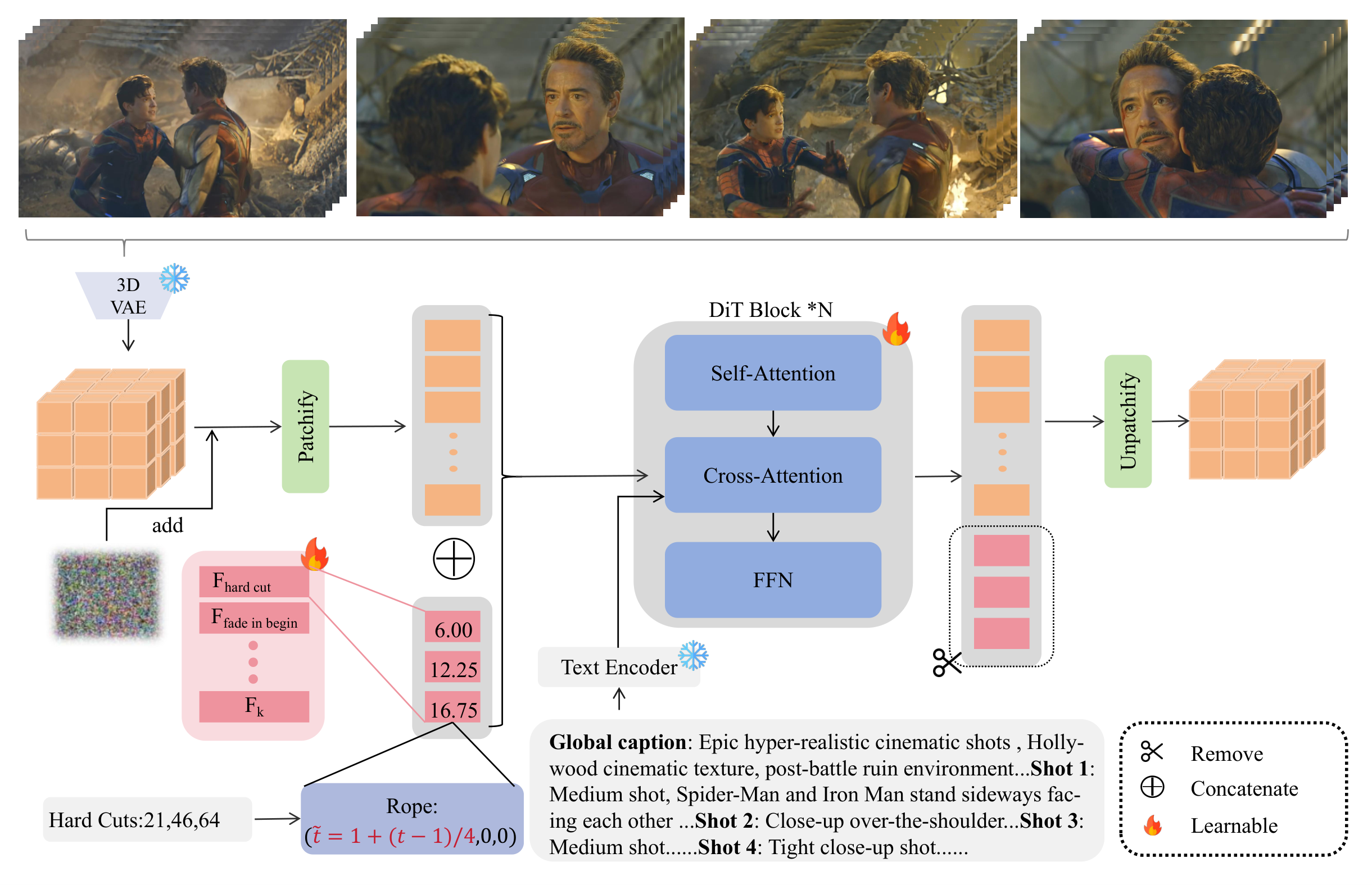
Overview figure from arXiv:2607.17675 (Su Guo, Guangce Liu et al. / TeleAI, Harbin Institute of Technology)
The ShotPlan system takes a single text prompt with per shot captions as input. Each caption describes the content of one shot in the sequence. A filmmaker specifies when each shot should begin by designating the target frame for each transition, and the model generates the entire video as one continuous output with cuts placed at those frames.
The Wan 14B backbone handles the visual generation quality. The planning token layer handles the temporal structure. Separating those two responsibilities is what allows the model to achieve both generation quality and timing precision without requiring a purpose built multi shot architecture from scratch.
Hard Cuts: Multi Shot Character and Scene Sequences
The following videos demonstrate ShotPlan generating three shot sequences with hard cuts at specified frame positions. Each sequence is produced from a single prompt with per shot captions. The model generates all shots in a single pass, not as separately generated clips joined in post.
Three shot sequence, cuts at frames 18, 40, 63
Three shot sequence, cuts at frames 23, 44, 62
Urban scene, cuts at frames 19, 41, 63
Three shot sequence, cuts at frames 20, 40, 63
Soft Cross Fades and Localized Camera Moves
ShotPlan extends beyond hard cuts to two additional transition types. Soft transitions use dedicated fade in and fade out planning tokens to generate cross fades between shots. Temporally localized camera moves apply camera motion (circle, zoom, dolly, truck) starting at a specified frame within an otherwise continuous shot, without requiring a cut.
Soft cross fade transition between shots
Camera control uses the same planning token mechanism as cut placement. A circle right camera move starting at frame 25, for example, is specified as a planning token with a fractional temporal coordinate at that frame. The camera move begins precisely at the specified position within the clip rather than drifting in based on the text prompt.
Localized camera: circle move starting at frame 25
Localized camera: pull back starting at frame 40
Hard cuts, soft cross fades, and localized camera moves can all be combined in a single generation pass. A video can include a hard cut at frame 20, a cross fade at frame 45, and a camera move starting at frame 60, all specified as planning tokens in the same prompt.
Training Data and Output Specifications
The model was trained on 13,000 curated multi shot clips sourced from real cinema and other video content. The curation focuses on clips with clearly identifiable shot transitions and consistent narrative progression across cuts. That relatively compact training set produces the 0.88 narrative coherence score, suggesting that quality of training data matters more than volume for this specific capability.
Output videos are generated at 832×480 resolution with 81 frames per clip. At standard frame rates, that is approximately three seconds of video per generation. A three shot sequence fits within that 81 frame window with meaningful shot lengths at each cut point. The team has not published a specification for extending the output window, though the base model's context can in principle accommodate longer sequences.
The authors are Su Guo and Guangce Liu (equal contributions), Haosen Yang, Jiepeng Wang, Cong Liu, Junqi Liu, Haibin Huang, Hongxun Yao, Chi Zhang, and Xuelong Li. The paper, "ShotPlan: Cinematic Video Generation with Learnable Planning Token," was posted to arXiv on July 21, 2026.
Available Now: Weights, Code, and Dataset
The ShotPlan weights are available on HuggingFace as Pensioner/ShotPlan-Wan2.2-T2V-A14B-HighNoise. The code is on GitHub at Pensioner-11/ShotPlan. A curated training dataset is also available on HuggingFace as Pensioner/shotplan for researchers who want to fine tune the approach or train on a different base model.
The Apache 2.0 license covers commercial use without royalties. ShotPlan can be integrated into production video generation workflows without restrictions on deployment or distribution.
GroundShot, published the same month, pairs naturally with ShotPlan. Once timing is locked, GroundShot keeps characters and objects visually consistent across every cut without retraining the base model.
This extends the capabilities available in AI FILMS Studio's video workspace alongside other Wan-based models. Related open source work on long video generation using Wan 14B is covered in Self Gradient Forcing, and motion-driven video generation on the same base model is covered in Wan-Dancer-14B.
Update (August 19, 2026): Shot planning at generation time and storyboard authoring before the shoot are separate problems. SAGE covers the second one, and released the first public screenplay to storyboard dataset alongside it. Full story here.
Sources
arXiv: ShotPlan: Cinematic Video Generation with Learnable Planning Token GitHub: Pensioner-11/ShotPlan Hugging Face: Pensioner/ShotPlan-Wan2.2-T2V-A14B-HighNoise Project Page: pensioner-11.github.io/ShotPlan
Continue Reading


Video & LipSync
- Video Generator
- Text to Video
- Image to Video
- Start-End Frame to Video
- Draw to Video
- Motion Control
- Video Enhancer
- Video Upscaler
- Video Extend
- Video to Video LipSync
- Audio to Video LipSync
- Image to Video LipSync
- Video FaceSwap
- Seedance 2.5
- WAN 3.0
- Seedance 2
- FLUX 3
- Minimax H3
- Vidu Q3 Pro
- Grok Imagine Video 1.5
- Gemini Omni
- Google Veo 3.1
- Kling 3.0 Pro
- Luma Ray 3.2
- LTX 2.3
- Happy Horse 1.1
- Kling 3.0 Motion
- ByteDance Upscaler
- InfiniteTalk
- InsightFace
Image & Edit
- AI Character
- AI Actor
- Art Generator
- Text to Image
- Image to Image
- LoRA Image to Image
- Draw to Edit
- Image LoRA Training
- Remove Background
- Image Enhancer
- MidJourney 8.0
- Krea 2
- OpenAI GPT Image 2.0
- Nano Banana Pro Ultra
- Nano Banana 2 Lite
- Nano Banana Pro
- Minimax Image
- Clarity Pro
- Z-Image Turbo LoRA
- Krea 2 Turbo LoRA
- Z-Image LoRA Trainer
- Qwen Image LoRA Trainer
- Background Erase Network 2 (BEN2)