
Sora 2 and Runway Gen-4 Solve AI Video's Biggest Problem
Share this post:
Sora 2 and Runway Gen-4 Solve AI Video's Biggest Problem
Sundance Film Festival 2026 marked a turning point for AI video generation. Multiple production ready shorts premiered using OpenAI Sora 2 and Runway Gen-4, tools that have effectively solved the temporal consistency problem that plagued earlier models. The "jitter" that made AI generated video unusable for professional work has been eliminated through technical advances showcased this week.
Studio availability, updated 2026-09-15. Sora 2 was previously available in AI FILMS Studio. It is no longer available. Runway Gen-4 is not available in the Studio. To generate video in the Studio, see the models listed on the text to video page.
The Jitter Problem Explained
Temporal consistency refers to how objects and motion remain stable across sequential video frames. Earlier AI video models from 2024-2025 suffered from what the industry called "jitter," where generated elements would morph, flicker, or behave inconsistently from one frame to the next.

This technical limitation prevented professional adoption. A character's face might shift slightly between frames. Background objects would drift or warp. Physics based motion like falling objects or water flow appeared artificial. The result was video that signaled its AI origin immediately, making it unsuitable for anything beyond proof of concept demonstrations.
The Technical Breakthrough
According to Towards AI's January 2026 analysis, the shift comes from integrating neural radiance fields (NeRFs) and Gaussian splatting within video diffusion models. This represents a fundamental change in how AI systems understand and generate video content.
Previous models predicted pixels based on probabilistic patterns learned from training data. The new approach incorporates 3D geometric understanding of scenes. Instead of guessing what the next frame should look like based on statistical patterns, these models now understand spatial relationships, object permanence, and physical constraints.
This technical foundation enables what both OpenAI and Runway describe as "physics informed world understanding." The models now simulate gravity, collision detection, and momentum, producing motion that adheres to physical laws rather than just appearing visually plausible.
OpenAI Sora 2 Capabilities
OpenAI's January 2026 update introduced character cameos, allowing persistent character embeddings across different scenes. This addresses one of the most requested features from filmmakers seeking narrative continuity.
The system now supports up to 25-second clips with synchronized audio, a substantial increase from the 6-second limitation of 2024 models. This duration enables complete scene coverage rather than just snippets requiring extensive editing.
The character consistency feature works by embedding specific facial features, body proportions, and movement patterns into the model's generation process. Directors can maintain the same protagonist across multiple shots without the morphing that characterized earlier attempts.
Runway Gen-4 Advances
Runway's December 2025 release specifically markets infinite character consistency as a core capability. According to their research documentation, Gen-4 achieves this through improved temporal attention mechanisms that track object identity across the entire clip duration.

The physics informed world understanding component simulates real world constraints. When generating a scene with falling objects, the system calculates trajectories based on gravity. Water flows according to fluid dynamics principles. Cloth drapes and folds realistically on character models.
This physical accuracy eliminates the uncanny valley effect that made previous AI video immediately recognizable. Professional cinematographers report that Gen-4 output can pass for traditional CGI in many contexts, marking a threshold for commercial viability.
Industry Response: The Panic-Opportunity Paradox
The Wrap and National Research Group's "2026 In The Frame" report documents what they term "The AI Wars," describing the industry's simultaneous fear and adoption of these capabilities.
McKinsey's January 23 analysis provides specific economic data. The cost to produce studio-grade visual effects has dropped by approximately 70% using these tools. This creates opportunity for independent creators while threatening traditional VFX roles.
The report identifies different stakeholder positions. Major studios are adopting an integrationist approach, incorporating AI tools into existing pipelines. Independent directors view the technology as democratizing access to production quality previously requiring substantial budgets. Labor organizations including SAG-AFTRA and WGA maintain defensive positions, advocating for protections against replacement.
The paradox appears in the data. Entry level VFX positions face displacement risk. Simultaneously, the number of filmmakers capable of producing broadcast quality content has increased substantially. The market expands while certain job categories contract.
Sundance 2026 Evidence
This week's festival provided real world validation of the technical claims. Multiple shorts in the "GenAI" category demonstrated extended narrative sequences with consistent characters, believable physics, and synchronized dialogue.
Directors reported using these tools for pre-visualization that evolved into final output. What began as planning aids became production assets when the generated quality met broadcast standards. This workflow shift represents a practical application of the technological advances.
The festival's programming choices reflect industry acceptance. Unlike previous years where AI generated content appeared in experimental categories, 2026 selections integrated these tools alongside traditional production methods without special designation.
Implications for Creators
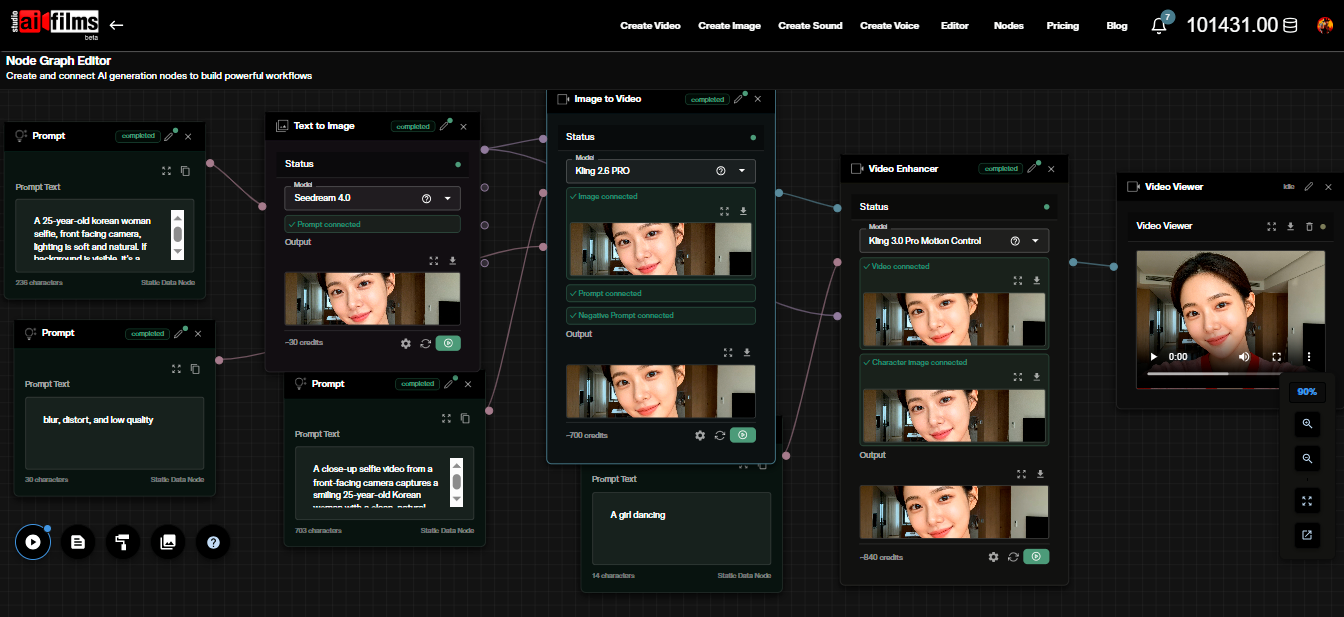
For filmmakers, these advances remove technical barriers that previously required specialized knowledge or expensive service providers. Creators can now generate complex visual effects sequences using AI FILMS Studio without understanding the underlying mathematics of neural radiance fields or Gaussian splatting.
The 70% cost reduction documented by McKinsey translates to specific production scenarios. A sequence requiring $50,000 in traditional VFX can now be executed for approximately $15,000 using AI assisted workflows. This changes budget allocation for independent productions, enabling allocation of saved resources to other production values.
The character consistency capabilities enable serialized storytelling at scales previously prohibitive. Maintaining visual continuity across episodes no longer requires maintaining access to specific performers or locations. Creators can develop narrative projects with technical consistency guarantees.
The Technical Foundation
The integration of NeRFs and Gaussian splatting represents more than incremental improvement. These approaches fundamentally change how AI systems model visual information.
Neural radiance fields create volumetric representations of scenes rather than flat image predictions. The system understands depth, occlusion, and spatial relationships. When generating motion, this spatial awareness prevents the morphing and drift that characterized earlier models.
Gaussian splatting provides efficient rendering of these 3D representations. The technique represents scenes as collections of 3D Gaussians with specific properties for position, color, and opacity. This allows rapid generation while maintaining geometric consistency.
The combination enables real time understanding of scene geometry during video generation. The model knows what should remain stable across frames because it understands the underlying 3D structure rather than just predicting pixel patterns.
Industry Adoption Patterns
The shift from "making things" to "choosing things" described in the NRG report reflects how decision-making has changed. Studios now select between AI generated options rather than commissioning traditional production for every visual need.
This creates new roles focused on AI direction, prompt engineering, and output curation. These positions require different skill sets than traditional VFX work, emphasizing creative judgment over technical execution.
The economic pressure for adoption comes from competitive dynamics. As McKinsey documents, productions using AI assisted workflows can deliver comparable quality at substantially reduced cost. This creates market pressure for broader adoption regardless of individual preferences.
Conclusion
The elimination of temporal jitter in Sora 2 and Runway Gen-4 marks a technical threshold for AI video generation. The integration of neural radiance fields and Gaussian splatting solves problems that made earlier models unsuitable for professional use.
Sundance 2026 provided real world demonstration of these capabilities in narrative contexts. The industry response reflects both opportunity and concern as production economics shift and new workflows emerge.
For creators, these tools represent access to capabilities previously requiring substantial resources. The technical foundation enables reliable results, removing the experimental uncertainty that characterized earlier AI video tools.
For analysis of how AI is affecting industry decision-making more broadly, see our coverage of Hollywood's shift toward Decision Intelligence.
Sources
Marketing AI Institute: "OpenAI Sora 2 Product Roadmap"
https://www.marketingaiinstitute.com/blog/sora-2-product-roadmap
Runway ML: "Introducing Runway Gen-4"
https://runwayml.com/research/introducing-runway-gen-4
Towards AI: "The Cognitive Substrate Shift: Understanding AI's 2026 Inflection Point," January 2026
https://towardsai.net/p/machine-learning/the-cognitive-substrate-shift-understanding-ais-2026-inflection-point
McKinsey & Company: "What AI could mean for film and TV production and the industry's future," January 23, 2026
Authors: Jamie Vickers, Marc Brodherson, Alec Wrubel, Cléophée Bernard
https://www.mckinsey.com/industries/technology-media-and-telecommunications/our-insights/what-ai-could-mean-for-film-and-tv-production-and-the-industrys-future
The Wrap / National Research Group: "2026 In The Frame: Hollywood's AI Hype Hit Reality in 2025, Next Year It All Moves Faster"
https://www.thewrap.com/industry-news/tech/hollywoods-ai-hype-hit-reality-in-2025-next-year-it-all-moves-faster/
Continue Reading
.jpg?w=3840)


Video & LipSync
- Video Generator
- Text to Video
- Image to Video
- Start-End Frame to Video
- Draw to Video
- Motion Control
- Video Enhancer
- Video Upscaler
- Video Extend
- Video to Video LipSync
- Audio to Video LipSync
- Image to Video LipSync
- Video FaceSwap
- Seedance 2.5
- WAN 3.0
- Seedance 2
- FLUX 3
- Minimax H3
- Vidu Q3 Pro
- Grok Imagine Video 1.5
- Gemini Omni
- Google Veo 3.1
- Kling 3.0 Pro
- Luma Ray 3.2
- LTX 2.3
- Happy Horse 1.1
- Kling 3.0 Motion
- ByteDance Upscaler
- InfiniteTalk
- InsightFace
Image & Edit
- AI Character
- AI Actor
- Art Generator
- Text to Image
- Image to Image
- LoRA Image to Image
- Draw to Edit
- Image LoRA Training
- Remove Background
- Image Enhancer
- MidJourney 8.0
- Krea 2
- OpenAI GPT Image 2.0
- Nano Banana Pro Ultra
- Nano Banana 2 Lite
- Nano Banana Pro
- Minimax Image
- Clarity Pro
- Z-Image Turbo LoRA
- Krea 2 Turbo LoRA
- Z-Image LoRA Trainer
- Qwen Image LoRA Trainer
- Background Erase Network 2 (BEN2)