UAE launches $1M AI Film Award (Dubai, Jan 2026)

Share this post:
$1M AI Film Award | what matters
Dubai launched a global AI short film competition with a one million dollar grand prize, organized by the UAE Government Media Office with the 1 Billion Followers Summit and in partnership with Google Gemini. At its announcement in September 2025, it was the largest prize offered specifically for AI assisted filmmaking anywhere in the world.
The competition drew 3,500 submissions from teams in over 60 countries. A Tunisian filmmaker working largely alone won the prize, demonstrating that the competition's scale did not select for large production teams.
The brief was clear and demanding. Deliver a polished 7 to 10 minute short where the majority of the creative work comes from Gemini powered systems: Veo for video, Imagen for stills and design elements, and Flow for orchestrating multi step generation workflows. The goal was a watchable film for a public audience at the January 2026 summit, not a tech demo.
Key Dates
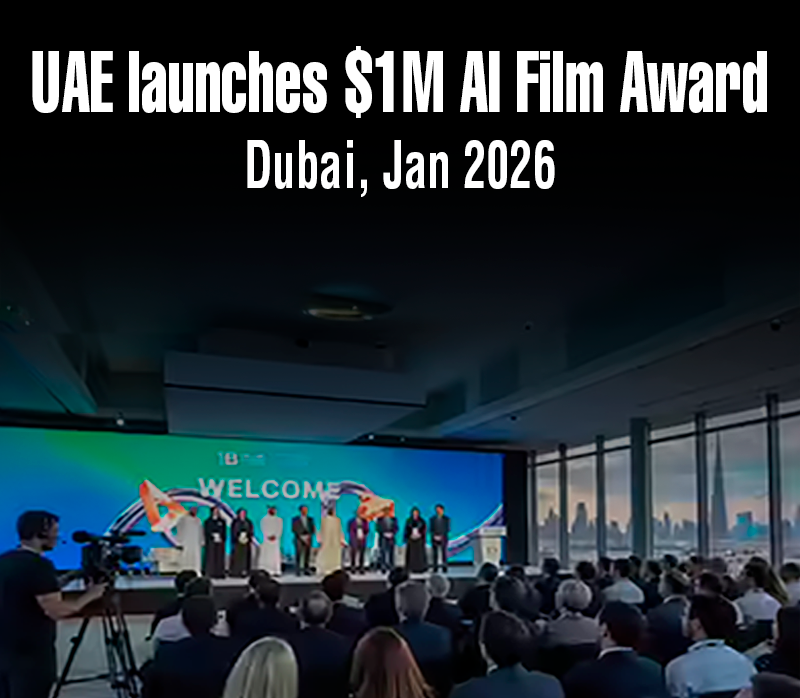
Submissions opened on 23 September 2025 with a final deadline on 20 November. A Top 10 shortlist was announced on 5 December, followed by public voting from 10 to 15 December. The Top 5 films premiered on 10 January 2026 in Dubai, with the winner revealed on 11 January at the summit.
The timeline compressed what would normally be a multi month production cycle into under two months. Teams that had an established Gemini workflow before the submission window opened had a significant advantage over those who had to build the pipeline and produce the film simultaneously.
The public voting component between shortlist and winner added an audience dimension that most AI film competitions had not included. The winner needed to succeed with a general audience, not only with a technical or industry jury. That distinction shaped what kinds of stories and what production values the competition rewarded.
For international teams, the November 20 deadline meant submitting during a period that included holiday travel and production commitments for many professional filmmakers. Teams that treated the competition as a primary project during October and November, rather than fitting it around other work, had a significant advantage in production time and iteration cycles.
The submission flow required an unlisted YouTube link for the finished film plus a completed entry form on the official site. Confirming that the unlisted link was accessible to the review panel before the deadline closed was a step that several teams reportedly missed, resulting in disqualified submissions. Check delivery requirements at least 48 hours before any competition deadline.
The Gemini Tool Stack
The competition required at least 70 percent of the creative generation to come from Gemini powered tools. In practice, most competitive teams used all three primary tools in combination.
Veo handled primary video sequences. As Google's text-to-video and image-to-video model, Veo was the component most responsible for the moving image content of the film. Teams working with Veo at this stage of its development reported that shot selection, precise prompting, and iterative refinement mattered more than any single generation technique. The model needed clear direction and benefited from a library of tested prompt formulations before production began.
Imagen provided stills, design elements, and reference images for Veo's image-to-video mode. For productions that anchored their video generation in strong static image references, Imagen's instruction following and style consistency were directly relevant to the quality of the final video output. Flow connected these tools in sequence, allowing teams to build generation pipelines that moved from text prompt through image reference through video output in a reproducible way.
Building a Competition Pipeline
Teams that competed successfully described similar pipeline structures. A core visual language was established first, using Imagen to generate a set of key images that represented the film's intended aesthetic. Those images then served as style and character references throughout the production, keeping visual identity consistent across independently generated clips.
Shot selection happened before generation, not after. The most efficient teams storyboarded their films conventionally, identified which shots required the longest generation and iteration cycles, and started those first rather than generating linearly through the script. This front loaded the hardest production problems into the early phase when there was still time to adjust the story around limitations.
Music and sound design were handled in parallel with video generation rather than added at the end. Teams that finished their video edits and then began sound had less time to get the audio right than teams that tracked music against rough cuts throughout the process.
Rights, Consent, and Disclosure Requirements
The competition required that all submitted work be original and that teams had the rights to all elements included in their films. For AI generated content, the rights chain includes the prompts, any reference images used as inputs, any music in the soundtrack, and any real-world elements depicted in the content.
Google's terms of service for Gemini tools specify what uses of generated content are permitted and what attribution is required. Reading those terms before building a competition workflow is a basic step that many teams skipped and then discovered at the submission stage. The competition rules also required disclosure that AI tools were used, which is now a standard requirement in AI film competition submissions globally.
For any music in the soundtrack, AI generated audio from licensed tools or original composition were both acceptable. Library music with standard sync licenses was also acceptable. What was not acceptable was using copyrighted music without a sync license, which is the same rule that applies to any film submission anywhere.
Some teams used AI audio generation tools to produce original music for their films. This removed the sync licensing risk entirely and kept the soundtrack within the team's full ownership. For short film competitions, original AI-composed music that matches the intended emotional register is now a viable path that was not available at this quality level two years ago.
Read the current terms of service for any Gemini tool you plan to use in a commercial or competition context before you start production. Terms update periodically, and what was permitted at the time a tool was released may differ from what is permitted when you submit your film. The active terms at submission time are what govern the submission.
The Result
The competition delivered on its promise. Tunisian filmmaker Zoubeir Jlassi won the $1 million prize with his film LILY, a nine minute French language short created entirely with Google Gemini tools, chosen from 3,500 global submissions. Jlassi worked largely alone, with the Gemini pipeline doing the heavy lifting on image and video generation while his direction, story, and editorial decisions shaped the final film.
The result proved that a single creator with access to the Gemini tool stack and a clear creative vision could produce a work that satisfied both a competition jury and a public voting audience. It validated the competition's premise and produced a concrete case study that the AI filmmaking community has analyzed extensively in the months since the January 2026 premiere.
LILY also demonstrated that the competition's Gemini requirement was not a limitation on creative ambition. Jlassi used the tools to produce a film with a specific point of view, a coherent visual language, and a story that earned its nine minutes. The tools enabled the work rather than constraining it.
What the LILY Win Demonstrated
The competition's outcome settled several open questions about what was possible with current AI generation tools under a competitive production timeline. Jlassi, working without a production crew, completed a nine minute film in French, a language that is not the primary market language for any of the Gemini tools he used, which added a localization challenge on top of the standard production challenges.
The French language element is worth noting specifically. AI voice synthesis, subtitle generation, and text rendering in French required the tools to perform well outside the predominantly English assumptions in their training data. That Jlassi succeeded demonstrates that the tools were usable across languages at a level suitable for competition, not just in English language productions.
His editorial discipline was the other element that analysis after the competition emphasized. He did not attempt to generate every scene the script called for. He edited the story to what the tools could deliver consistently, which required real directorial judgment about what to keep and what to cut rather than what to generate. That discipline is the same skill that defines good filmmaking in any production context.
The 1 Billion Followers Summit Audience
The summit itself drew attendees from across the creator economy, with a particular focus on social media, content creation, and digital media rather than traditional film industry audiences. That was a deliberate choice by the organizers, who framed AI filmmaking as relevant to the full spectrum of video content creation, not only to theatrical or festival contexts.
Screening five finalist films for this audience produced specific feedback about what worked at that scale. Films with strong visual clarity, clear story structure in the first two minutes, and emotional directness performed better than films that relied on slow build or ironic distance. That is consistent with what performs well in social video contexts, and the competition effectively selected for it.
For filmmakers with backgrounds in conventional short film programming, that feedback is a calibration point. A film that works for a Sundance audience and a film that works for a 1 Billion Followers Summit audience are not necessarily the same film. The competition revealed what the differences look like in practice.
How to Position for the Next Competition
The UAE competition will likely return for a second edition, and similar competitions will follow. The XPRIZE competition launched in March 2026 validated that the market for AI film competitions is larger than a single event. Teams who want to compete seriously in future editions can start building toward them now.
The most useful preparation is building a tested generation pipeline with a clear visual language before a competition opens. A pipeline that has been used to complete at least one short project, even a personal or internal one, has been tested against the specific failures that appear under deadline pressure. A pipeline that only exists as a plan has not.
Developing a library of prompt formulations that consistently produce output in your intended visual style is a production asset that compounds over time. The teams that can generate output quickly and consistently in their intended style have a production advantage over teams that are still refining their approach during the competition window.
Entering a practice competition, or completing a personal short project with competition-like constraints before the real submission window opens, is the most effective preparation. The decisions that take the most time in actual competition are the ones you have not made before. Those include which tool handles which part of the workflow, how to recover when a generation pass does not match expectations, and how to adjust the story when a specific scene proves too difficult to generate reliably.
Why the Prize Size Mattered
One million dollars is a meaningful prize in the context of any short film competition, not just an AI one. The Sundance Grand Jury Prize for a short film does not include cash. Most prestigious short film festivals offer honors and industry visibility rather than direct financial awards at this scale.
The 3,500 entry figure for a debut edition competition is a significant submission number. Cannes' short film official selection receives thousands of submissions globally. The UAE competition's scale on its first year reflects how much interest had accumulated in the AI filmmaking space by late 2025, and how many creators were already producing work at a quality level they believed was competitive.
The UAE prize positioned AI filmmaking as a category worth taking seriously on competitive terms, not just as a novelty. A prize of this magnitude attracts entries from people who make films seriously, with professional production discipline, rather than only from enthusiasts and experimenters. The quality of the 3,500 entries reflected that signal.
The prize also accelerated the timeline on which professional filmmakers began evaluating the Gemini tools. A competition with this reward and this visibility gave filmmakers a concrete reason to build expertise with specific tools rather than maintaining a general awareness of what AI could do.
The scale of the prize also attracted serious institutional attention. Screenwriting programs, film schools, and production company development slates began incorporating AI tool instruction at a pace that had not previously been observed, specifically in response to the UAE competition's demonstration that these tools could produce work at the level a global prize jury would select.
What Came After
On March 9, 2026, XPRIZE founder Peter Diamandis launched the Future Vision XPRIZE, a $3.5M+ global competition for 3-minute optimistic sci-fi trailers, with AI tools explicitly allowed. It built directly on the template the UAE competition established and raised the total prize pool substantially.
At Cannes 2026, Saudi Arabia extended the regional AI and film investment further by raising its film production rebate from 40 percent to 60 percent, positioning the Gulf region as a serious competitor for international productions alongside its existing AI filmmaking incentive programs.
Together, these developments suggest the UAE's 2025 competition was an early signal of a larger shift in how Gulf states are positioning themselves relative to the global film industry. AI filmmaking is one of the levers in that positioning, alongside production infrastructure, co-production agreements, and talent development.
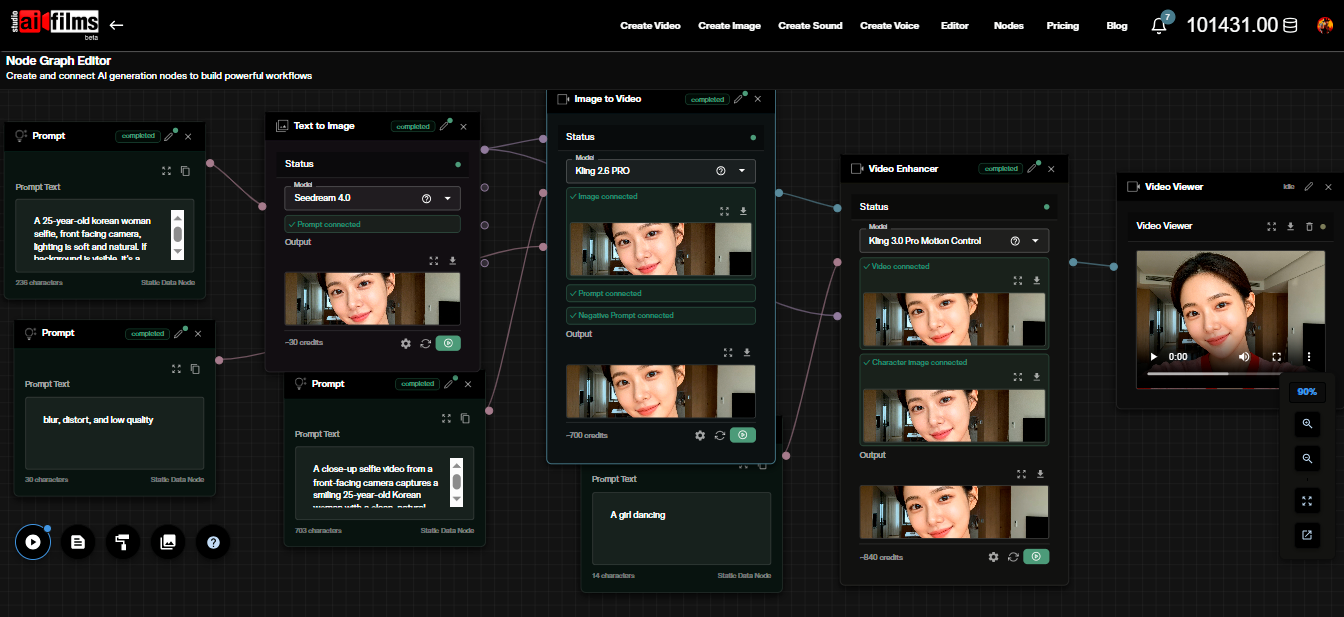
For filmmakers who are building their AI production capabilities now, the Gulf states represent an emerging set of competition opportunities and production incentives that did not exist two years ago. The trajectory of both competition prizes and production rebates in the region suggests more opportunities, not fewer, over the next three years. The AI FILMS Studio video workspace provides the generation tools that these competitions reward, with access to the latest text-to-video and image-to-video models.
Sources
Variety | Gulf News | Arab News | Khaleej Times | Times of India | The National (UAE)
Continue Reading
Video & LipSync
- Video Generator
- Text to Video
- Image to Video
- Start-End Frame to Video
- Draw to Video
- Motion Control
- Video Enhancer
- Video Upscaler
- Video to Video LipSync
- Audio to Video LipSync
- Image to Video LipSync
- Video FaceSwap
- Seedance 2
- Vidu Q3 Pro
- Google Veo 3.1
- Kling 3.0 Pro
- LTX 2.3
- Happy Horse 1.1
- Kling 3.0 Motion
- ByteDance Upscaler
- InfiniteTalk
- InsightFace