
China Arrives at Cannes With AI Films and $16.5 Billion
中華民國駐外單位, Attribution, via Wikimedia Commons
Share this post:
China Arrives at Cannes With AI Films and $16.5 Billion
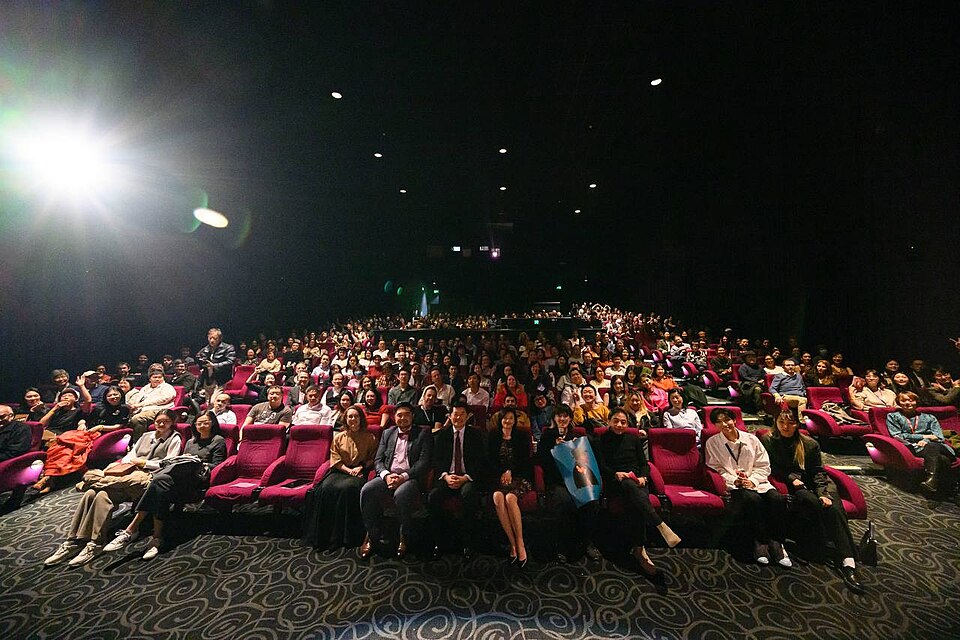
On May 14, 2026, China held its China Night event on the Cannes Marché du Film Beach, organized jointly by the China Film Administration, China Film Group Corporation, China Film Producers Association, and Wing Sight. It was the fifth consecutive year China has maintained a pavilion presence at the Cannes Film Market. This year the delegation brought robots, the country's first two AI animated films, and a set of market projections that frame the entire exercise as a strategic industry statement.
Magic Lab Robots
Wing Sight displayed three categories of Magic Lab robots on the Marché du Film Beach: robotic people, robotic puppies, and robotic pandas. The robots were not presented as production tools. They were designed to signal technological capability, a visual argument that China's entertainment sector is operating at the frontier of AI hardware and software simultaneously.
.jpg)
Abxbay, CC0, via Wikimedia Commons
Wing Sight's use of the Cannes platform for hardware demonstration is unusual. Film markets typically host software tools, production services, and distribution rights. Physical robotics on the beach is a departure that signals ambition beyond standard film industry positioning. The implication is that China's entertainment sector sees AI hardware and AI content as connected verticals, not separate industries.
The robot display drew visible attention from buyers and press attending the market, which served the delegation's communication purpose. China Night was one of the most visually distinctive pavilion presences at the 2026 Marché, and the robots were the reason.
China's First Two AIGC Films
Two films were presented as national firsts in the AI film category: The Reunion Journey, described as China's first AI animated feature film, and Legends of the South, described as China's first AIGC documentary. AIGC is the Chinese industry's shorthand for AI generated content productions.
Both films were featured as evidence of a fully operational production pipeline, not a research experiment. Presenting them at Cannes places them directly in front of international buyers and festival programmers.
The Reunion Journey represents a specific claim: that Chinese studios have produced a feature length AI animated film with enough visual quality to present at an international market. The film's Cannes presentation made it visible to distributors who would otherwise only encounter it through festival circuit screenings within China. Legends of the South is significant as a documentary category claim, demonstrating that AIGC production is not limited to animation but extends to nonfiction content.
The Numbers
The market data behind the Cannes presence makes the delegation's ambitions clear. China's box office reached $7.45 billion in 2025, a 22% year on year rise. The country now has 93,187 cinema screens, more than any other nation on Earth.
The AI content market within that infrastructure is already substantial. China's AI animated drama sector was worth $2.8 billion by the end of 2025. The AI generated micro drama industry is projected at $16.5 billion by the end of 2026. Analysts forecast a 100 billion yuan market for the AI film sector within five years.
"We Are Not Here Just to Present China"
Wing Sight founder Tina Jia articulated the industry argument directly. "AI empowers the whole industrial chain of Chinese filmmaking to reduce costs, improve efficiency and expand capacity", she told the gathering.
Her statement on the Cannes presence addressed the international dimension: "We are not here just to present China, but to create dialogue, foster partnerships, and open new pathways for Chinese content, brands, and ideas to engage globally".
Jia's framing positions Wing Sight as a bridge rather than a competitor. The Cannes presence is not a sales pitch for Chinese content displacing Western titles. It is an offer of coproduction, licensing, and IP collaboration built on the AI production infrastructure China has already built domestically. That framing addresses the competitive anxiety that Chinese AI film capabilities provoke among Western industry observers.
The $16.5 billion projection for micro dramas specifically is the number that puts China's AI content market in global context. Micro dramas, short form serialized productions often running under five minutes per episode, are the primary vehicle for AIGC production in China. The content type is largely unknown outside Asia, but its domestic commercial scale exceeds the annual box office of most national film industries.
The 100 billion yuan five-year forecast is an extrapolation from current growth rates. At 22% year on year box office growth in 2025 and a micro drama market already approaching $16.5 billion, the five-year forecast is not speculative. It is a straight-line projection from documented growth.

Photo by Jovan Vasiljević on Unsplash
No Union Constraints
The scale and pace of China's AI film adoption reflects a regulatory environment with no union framework equivalent to SAG-AFTRA's or the WGA's. The SAG-AFTRA 2026 agreement restricts synthetic performer use and requires consent and compensation for digital replicas in covered productions. Chinese micro drama and AIGC productions operate under no such structure.
That structural difference means the $16.5 billion projection is not a scenario being negotiated around consent rules. It is a production target for a market already running.
China's AI film production trajectory is documented in the Hengdian Studios transformation, where AI tools are integrated across thousands of micro drama productions annually. The Cannes presence is the international market face of that industrial capacity.
The Cannes Market as a Platform
China's five consecutive years at the Cannes Film Market have followed a consistent escalation. The first years established a presence. Subsequent years added programming and deal-making sessions. The 2026 edition adds hardware demonstrations, feature film premieres, and market statistics designed to shift the perception of Chinese AI content from a domestic phenomenon to a global commercial proposition.
The combination of Magic Lab robots on the beach and box office statistics in the briefing materials creates a specific argument: China has the infrastructure, the scale, and the technical capability to be the world's leading AI film producer, and Cannes is where it is choosing to say so publicly for the fifth consecutive year.
The international production community's response to that argument will depend partly on whether the AIGC films presented at the 2026 Marché generate actual acquisition interest. A $16.5 billion domestic micro drama market does not automatically translate to international distribution. But the companies and officials presenting at China Night in May 2026 are not addressing the domestic market. They are addressing the international buyers, festival programmers, and production executives who have been attending the same event in the same building for five years.
What Micro Drama Is
Micro drama is the Chinese short form serialized format driving the AI content market's growth. Individual episodes run between one and ten minutes. Series run from 12 to 100 episodes. Platforms distribute them on mobile devices, with most consumption happening on vertical screens.
The format has no Western equivalent at scale. The closest comparison is soap opera, but micro dramas are produced on compressed timelines with minimal traditional production infrastructure, which is exactly why AI tools have found rapid adoption in the category. A studio producing 50-episode micro drama series every two to three weeks needs tools that reduce the time cost of scripting, visual development, voice recording, and post-production to a fraction of conventional workflows.
The $16.5 Billion in Context
China's micro drama AI market projection of $16.5 billion by end of 2026 is denominated against a total Chinese domestic box office of $7.45 billion in 2025. The micro drama market, if it reaches projections, would be more than twice the size of China's theatrical box office in a single year.
The comparison illustrates why traditional film industry metrics do not capture the scale of Chinese AI content production. The market Wing Sight presented at Cannes is not a subset of theatrical production. It is a distinct and larger category that the theatrical box office number does not include.
Co-production and IP Discussion at China Night
Wing Sight's framing of the Cannes presence as an invitation for coproduction was reflected in the structure of the event. China Night included sessions between Chinese industry representatives and international buyers, with specific discussion of IP licensing and coproduction frameworks.
No specific coproduction deals were announced publicly from China Night 2026. But the event's explicit positioning as a coproduction platform means the conversations that happened there were structured around specific terms rather than general introductions. The follow-up to China Night will be visible in whatever coproduction announcements emerge from Chinese studios and their international partners in the second half of 2026.
Wing Sight's Previous Cannes Delegations
China Night 2026 was the fifth consecutive year Wing Sight organized China's Cannes presence. The earlier editions established pavilion presence and networking infrastructure. The 2026 edition was the first to include product demonstrations, specifically the Magic Lab robots, alongside the standard market presentations.
That escalation from networking to demonstration reflects a strategic decision: after four years of building relationships at the Marché, the delegation is now using Cannes as a venue to show capabilities, not just connections. The robots on the beach and the AIGC films in the briefing materials are both demonstrations of what the Chinese AI entertainment infrastructure can produce, addressed to the international buyers and programmers who have been attending China Night for five years.
What Micro Drama Is
Micro drama is the Chinese short form serialized format driving the AI content market's growth. Individual episodes run between one and ten minutes. Series run from 12 to 100 episodes. Platforms distribute them on mobile devices, with most consumption happening on vertical screens.
The format has no Western equivalent at scale. The closest comparison is soap opera, but micro dramas are produced on compressed timelines with minimal traditional production infrastructure, which is exactly why AI tools have found rapid adoption in the category. A studio producing 50-episode micro drama series every two to three weeks needs tools that reduce the time cost of scripting, visual development, and post-production to a fraction of conventional workflows.
How Chinese AI Films Are Financed
Chinese micro drama AI production operates under a preorder financing model. Streaming platforms purchase episode packages before production begins, with payment tied to delivery schedules rather than finished quality review. The preorder model compresses production timelines to match platform release schedules.
AI tools that reduce per-episode cost and production time fit naturally into that structure. A studio producing two series simultaneously at platform-demanded pace is generating 100 to 200 episodes per month. The infrastructure needed for that volume is the infrastructure the five SIFF platforms launched in Shanghai in June 2026 are designed to provide.
Wing Sight's Five Consecutive Years
China Night 2026 was the fifth consecutive year Wing Sight organized China's Cannes presence. Earlier editions established pavilion presence and networking infrastructure. The 2026 edition was the first to include product demonstrations, specifically the Magic Lab robots, alongside the standard market presentations.
That escalation from networking to demonstration reflects a strategic transition: after four years of building relationships at the Marché, the delegation is now using Cannes as a venue to show capabilities. The robots on the beach and the AIGC films in the briefing materials are demonstrations of what the Chinese AI entertainment infrastructure can produce, addressed to the international buyers who have been attending China Night for five years.
The SIFF Connection One Month Later
The Shanghai International Film Festival launched a new AI Technology Unit and five service platforms on June 12, 2026, less than a month after China Night at Cannes. The Cannes delegation represented the international market-facing dimension of Chinese AI film expansion. The SIFF infrastructure launched one month later is the domestic production infrastructure those films will flow through.
China's AI film strategy in 2026 operates simultaneously on two tracks: presenting finished content and market projections to international buyers at Cannes in May, while building the domestic production infrastructure at SIFF in June to sustain the content pipeline that serves those international buyers.
Filmmakers exploring AI video generation can work with the latest models at AI FILMS Studio.
Sources
The Hollywood Reporter | Variety | Screen Daily
Continue Reading
.jpg?w=3840)


Video & LipSync
- Video Generator
- Text to Video
- Image to Video
- Start-End Frame to Video
- Draw to Video
- Motion Control
- Video Enhancer
- Video Upscaler
- Video Extend
- Video to Video LipSync
- Audio to Video LipSync
- Image to Video LipSync
- Video FaceSwap
- Seedance 2.5
- WAN 3.0
- Seedance 2
- FLUX 3
- Minimax H3
- Vidu Q3 Pro
- Grok Imagine Video 1.5
- Gemini Omni
- Google Veo 3.1
- Kling 3.0 Pro
- Luma Ray 3.2
- LTX 2.3
- Happy Horse 1.1
- Kling 3.0 Motion
- ByteDance Upscaler
- InfiniteTalk
- InsightFace
Image & Edit
- AI Character
- AI Actor
- Art Generator
- Text to Image
- Image to Image
- LoRA Image to Image
- Draw to Edit
- Image LoRA Training
- Remove Background
- Image Enhancer
- MidJourney 8.0
- Krea 2
- OpenAI GPT Image 2.0
- Nano Banana Pro Ultra
- Nano Banana 2 Lite
- Nano Banana Pro
- Minimax Image
- Clarity Pro
- Z-Image Turbo LoRA
- Krea 2 Turbo LoRA
- Z-Image LoRA Trainer
- Qwen Image LoRA Trainer
- Background Erase Network 2 (BEN2)