

ByteDance Seed — Depth Anything 3 (DA3) multi view geometry and depth benchmarks
Share this post:
Depth Anything 3: Open Source Metric Depth for VFX
Depth Anything 3 (DA3) (ByteDance-Seed/Depth-Anything-3, ICLR 2026) upgrades open source depth estimation from single frame relative disparity into spatially consistent, multi view 3D geometry and camera pose recovery from arbitrary visual inputs. Whether you feed a single still frame, a multi camera set of production photos, or a moving handheld video clip, DA3 recovers dense metric depth maps, camera extrinsics, and clean 3D point clouds using a compact single transformer architecture without specialized multi branch overhead.
Studio availability. Try the public Hugging Face demo below; Depth Anything 3 is not part of a paid AI FILMS Studio plan (use WAN 3.0 or Kling 3 Motion Control in the video workspace for example instead).
Why Multi View Metric Depth Matters in Film Post Production
Single frame depth estimators like Depth Anything V1 and V2 excel on still images, but when run frame by frame on a moving camera shot, the scale fluctuates constantly. Atmospheric fog pumps in and out, synthetic shallow depth of field breathes awkwardly, and 3D camera projections tear apart.
Depth Anything 3 fixes temporal scale pumping for VFX and virtual production:
- Unified single transformer for single and multi view geometry. DA3 predicts aligned depth and ray maps jointly across multiple frames or camera angles, locking physical metric scale across the entire shot.
- Joint camera pose and 3D point cloud output. Alongside crisp 16 bit Z depth passes for compositors, DA3 recovers camera poses that drop straight into Blender, Unreal Engine, or Nuke for rapid matchmove and virtual set extension.
- Scalable model tiers from Small to Giant. Lightweight variants run rapidly on
6 GB – 8 GBconsumer GPUs for live depth previews, whileDA3-LARGEandDA3-GIANTdeliver sharp edge preservation around thin poles, foliage, and hair for theatrical VFX shots.
Try Depth Anything 3 Live in the Browser
Test Depth Anything 3 directly in the official Hugging Face Space below (depth-anything-depth-anything-3.hf.space) on stills or multi view frames.
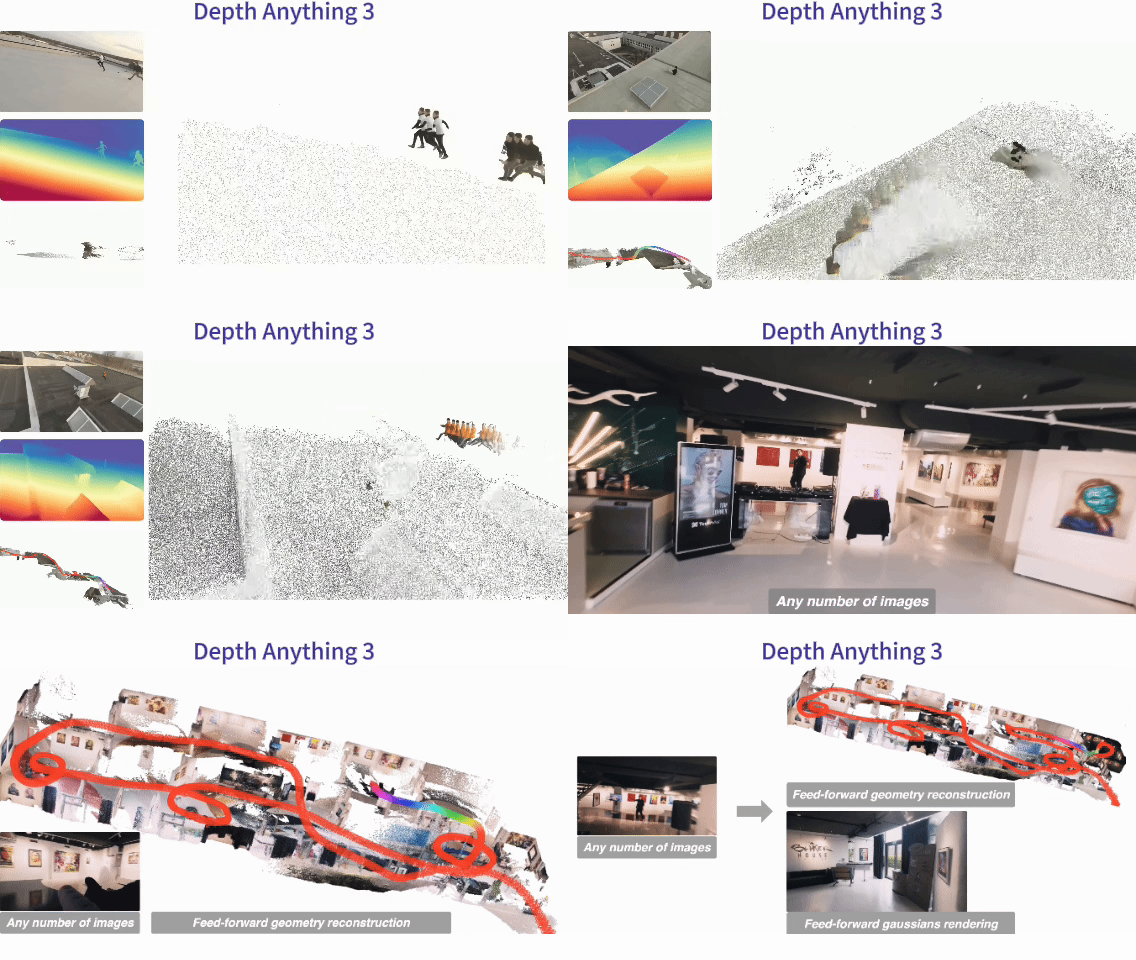
Multi view 3D reconstruction and metric depth stability in Depth Anything 3. Credit: ByteDance Seed.
Consistent multi frame depth allows compositors to add believable atmospheric mist, realistic anamorphic lens defocus, and 3D particle snow behind moving foreground actors without flickering depth planes.
Virtual production teams can also export DA3 point clouds directly into 3D Gaussian Splatting pipelines like **SplatAnything** or **World from Motion**.
Hardware and Model Tier Matrix
| Checkpoint | Target VRAM | Output Modalities | Best Filmmaking Use |
|---|---|---|---|
| DA3-BASE / SMALL | 6 GB – 8 GB VRAM |
Relative & metric depth + rays | Fast Z depth passes on laptops and indie edit bays |
| DA3-LARGE | 10 GB – 16 GB VRAM |
High precision multi view depth + camera poses | Theatrical Z defocus, atmospheric fog, matchmove prep |
| DA3-GIANT | 16 GB – 24 GB VRAM |
Maximum fine edge geometry + 3D point clouds | Hero VFX plates, 3DGS initialization, set extensions |
Local Setup with Python
git clone https://github.com/ByteDance-Seed/Depth-Anything-3.git
cd Depth-Anything-3
pip install -e .
import torch
from depth_anything_3.api import DepthAnything3

model = DepthAnything3.from_pretrained("depth-anything/DA3-LARGE").to("cuda")
prediction = model.inference(["frame_001.png", "frame_002.png", "frame_003.png"])

# Access temporally consistent metric depth maps and camera extrinsics
depth_maps = prediction.depth
camera_poses = prediction.extrinsics
Filmmaker Production Playbook
- Add realistic post production lens bokeh. Export 16 bit EXR Z depth maps from
DA3-LARGEand drive DaVinci Resolve's Depth Map or Nuke's ZDefocus node to turn flat wide angle footage into creamy shallow focus cinema frames. - Layer atmospheric haze and volumetric light. Multiply subtle warm or cool depth fog across background planes to separate foreground actors in busy practical locations.
- Combine with SAM 3 and TRELLIS.2. Use SAM 3 for clean foreground masks, DA3 for metric depth and camera tracking, and TRELLIS.2 LoRA to drop relightable 3D props into the tracked scene.
Related Reading
- SplatAnything & Pi4: Open Source 3D and 4D Scene AI
- GeoState & World from Motion: Open Source 4D Camera AI
- Meta SAM 3: Open Source Promptable Video Segmentation
- TRELLIS.2 LoRA: Open Source 3D PBR Asset Fine Tuning


Sources
Continue Reading


Video & LipSync
- Video Generator
- Text to Video
- Image to Video
- Start-End Frame to Video
- Draw to Video
- Motion Control
- Video Enhancer
- Video Upscaler
- Video Extend
- Video to Video LipSync
- Audio to Video LipSync
- Image to Video LipSync
- Video FaceSwap
- Seedance 2.5
- WAN 3.0
- Seedance 2
- FLUX 3
- Minimax H3
- Vidu Q3 Pro
- Grok Imagine Video 1.5
- Gemini Omni
- Google Veo 3.1
- Kling 3.0 Pro
- Luma Ray 3.2
- LTX 2.3
- Happy Horse 1.1
- Kling 3.0 Motion
- ByteDance Upscaler
- InfiniteTalk
- InsightFace
Image & Edit
- AI Character
- AI Actor
- Art Generator
- Text to Image
- Image to Image
- LoRA Image to Image
- Draw to Edit
- Image LoRA Training
- Remove Background
- Image Enhancer
- MidJourney 8.0
- Krea 2
- OpenAI GPT Image 2.0
- Nano Banana Pro Ultra
- Nano Banana 2 Lite
- Nano Banana Pro
- Minimax Image
- Clarity Pro
- Z-Image Turbo LoRA
- Krea 2 Turbo LoRA
- Z-Image LoRA Trainer
- Qwen Image LoRA Trainer
- Background Erase Network 2 (BEN2)