

Microsoft Research, TRELLIS.2-4B (MIT License)
Share this post:
TRELLIS.2 LoRA: Open Source 3D PBR Asset Fine Tuning
TRELLIS.2 (microsoft/TRELLIS.2-4B, MIT License) is Microsoft Research's 4 billion parameter flow matching 3D asset generator that turns a single 2D concept still into a textured, relightable 3D mesh with full Physically Based Rendering (PBR) maps, base color, roughness, metallic, and opacity, up to 1536^3 resolution. On November 12, 2026, Hugging Face released an official open source LoRA fine tuning pipeline for TRELLIS.2, enabling VFX studios and indie art departments to adapt the 4B sparse voxel transformer to custom film props, sci fi armor, vehicles, or stylized character geometry without retraining from scratch.
Studio availability. Try the public Hugging Face demo below; TRELLIS.2 is not part of a paid AI FILMS Studio plan (generate concept plates in the image workspace).
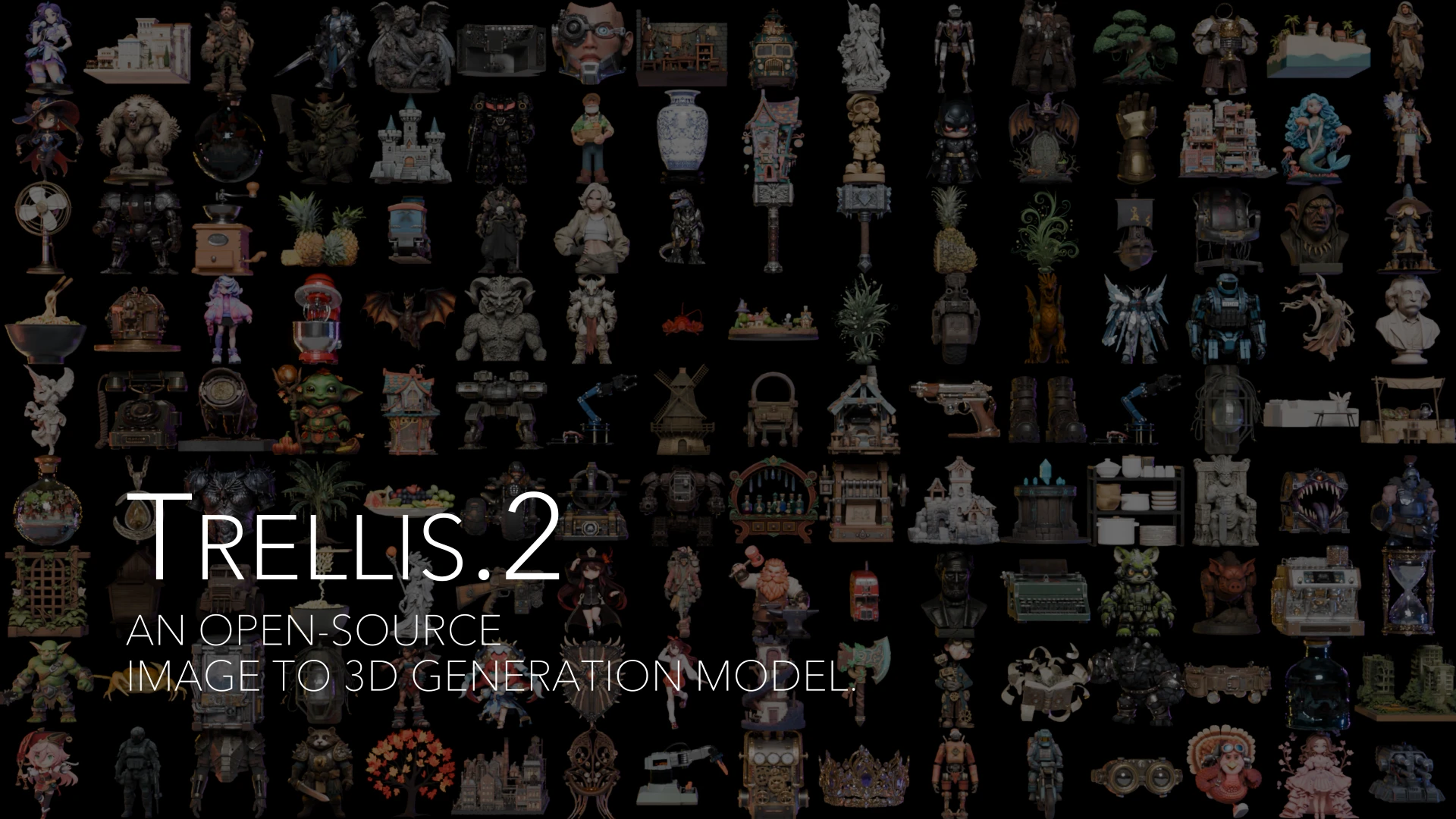
Why O-Voxel and Stage Targeted LoRA Matter for Film VFX
Earlier open 3D generators relied on signed distance fields (SDF) or marching cubes iso surfaces. Those representations sealed hollow cavities shut and melted open surfaces such as torn cloaks, foliage leaves, eyeglasses, and bicycle spokes into thick blobby meshes.
TRELLIS.2 and the November 2026 LoRA release remove both geometry and customization limits:
- Field free
O-Voxelsparse representation. Instead of forcing every prop into a watertight signed distance shell, TRELLIS.2 encodes assets as field free sparseO-Voxelscompressed by a Sparse 3D VAE (SC-VAE) with16xspatial downsampling. Open cloth, interior cockpits, thin wires, and transparent visors reconstruct cleanly up to1536^3effective resolution. - Full PBR material synthesis. Every generated
.glbor.usdasset carries separate albedo, roughness, metallic, and opacity channels so lighting artists can drop props straight into Blender, Unreal Engine, or Houdini and relight them under any HDRI dome. - Stage targeted LoRA fine tuning (November 2026). Hugging Face's PEFT recipe targets the sparse structure and shape flow DiT stages while freezing the visual conditioning and texture decoders. Small studio datasets (50 to 300 reference 3D meshes) train specialized geometric LoRAs in hours on a single high VRAM GPU or cloud job instead of multi node cluster runs.

TRELLIS.2 two stage flow matching architecture pairing Sparse 3D VAE compression with O-Voxel PBR decoding. Credit: Microsoft Research (MIT License).
Separating sparse structure generation from fine shape and PBR flow matching makes LoRA adaptation surgical.
Art teams can lock their film's exact architectural silhouette or costume proportions by training LoRA adapters strictly on the geometry flow DiT blocks while preserving TRELLIS.2's general PBR lighting priors.
Try TRELLIS.2 Live in the Browser
You can test TRELLIS.2 image to 3D PBR generation directly in Microsoft's official Hugging Face Space below (microsoft-trellis-2.hf.space).
Hardware, Resolution, and License Matrix
| Workflow Mode | Parameters | VRAM Needed | Output Resolution | License |
|---|---|---|---|---|
TRELLIS.2-4B Inference (512^3 – 1024^3) |
4B DiT + SC-VAE |
16 GB – 24 GB VRAM |
.glb / .usd with 2K–4K PBR maps |
MIT License (Commercial OK) |
TRELLIS.2-4B High Detail (1536^3) |
4B DiT + SC-VAE |
24 GB – 40 GB VRAM |
Hero prop mesh with open surfaces | MIT License (Commercial OK) |
| TRELLIS.2 LoRA Fine Tuning (PEFT) | 4B frozen + LoRA ranks (r=16–64) |
24 GB – 48 GB VRAM |
Custom domain LoRA adapter (.safetensors) |
MIT License (Commercial OK) |
Side by side fidelity checks show TRELLIS.2 resolving sharp bevels, translucent glass, metallic specular response, and complex thin structures where older SDF models fuse details together.
Because the weights and fine tuning scripts carry the **MIT license**, studios can ship custom LoRA props into commercial films, games, and LED volume virtual production walls without royalties.
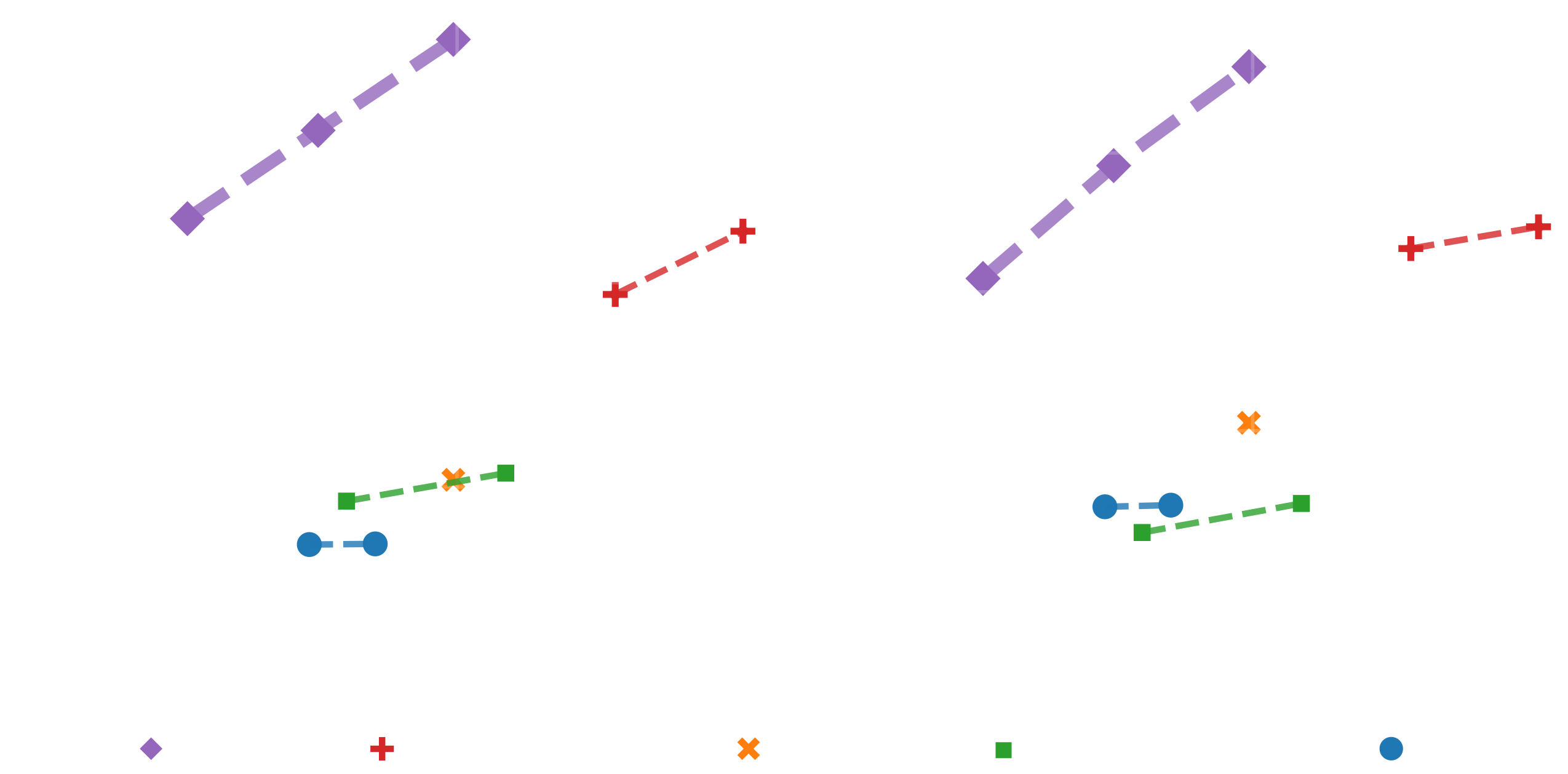
Geometric sharpness and PBR material fidelity comparison in TRELLIS.2-4B. Credit: Microsoft Research (MIT License).
Parameter Reference Table
| Parameter | Recommended Value | Effect on 3D Mesh & LoRA Training |
|---|---|---|
resolution |
1024 or 1536 |
Controls O-Voxel grid density; use 1024 for background set dressing and 1536 for hero close ups. |
lora_rank (r) |
16 to 32 |
Balances geometric style capacity against overfitting on small 50–150 asset film prop libraries. |
target_stage |
sparse_structure + shape_flow |
Focuses LoRA updates on silhouette and topology while keeping general PBR texture priors intact. |
texture_size |
2048 or 4096 |
Sets baked UV map size for base color, roughness, metallic, and opacity maps. |
cfg_strength |
5.0 – 7.5 |
Tightens adherence to the input concept illustration without clipping metallic reflections. |
Local Setup with Python and LoRA Inference
Install microsoft/TRELLIS.2, load the 4B checkpoint, and export a PBR textured .glb ready for Blender or Unreal Engine:
git clone https://github.com/microsoft/TRELLIS.2.git
cd TRELLIS.2
pip install -r requirements.txt
pip install peft diffusers huggingface_hub
import torch
from PIL import Image
from trellis2.pipelines import Trellis2ImageTo3DPipeline

pipe = Trellis2ImageTo3DPipeline.from_pretrained("microsoft/TRELLIS.2-4B")
pipe.cuda()

# Optional: attach a custom film prop LoRA trained with the Nov 2026 PEFT pipeline
# pipe.load_lora_weights("./loras/retro_scifi_props_r32.safetensors")

concept_still = Image.open("hero_prop_helmet_front.png").convert("RGBA")

outputs = pipe.run(
    concept_still,
    seed=108,
    sparse_structure_sampler_params={"steps": 12, "cfg_strength": 6.5},
    slat_sampler_params={"steps": 12, "cfg_strength": 5.0},
)

mesh = outputs["mesh"][0]
mesh.export_glb("hero_prop_helmet_pbr.glb", texture_size=2048)
Filmmaker Production Playbook
- Generate clean orthographic concept stills first. Render neutral lit, uncluttered prop stills in FLUX 2 or MiniMax-H3-Image before passing them to TRELLIS.2 so baked shadows do not pollute the albedo map.
- Train one show specific LoRA per art department pack. Export 80 to 150 existing kitbash meshes in your film's visual style, run the November 2026 Hugging Face LoRA script on the shape flow stage, and generate dozens of matching background props in minutes.
- Preview directly in OpenUSD and Unreal Engine. Export
.glbor convert to.usdzso virtual cinematography teams can block real camera lenses around your AI generated props before final video generation.
Related Reading
- SplatAnything & Pi4: Open Source 3D and 4D Scene AI
- WorldClaw & Hunyuan3D: Open Source 3D World Generation
- GeoState & World from Motion: Open Source 4D Camera Control
- MiniMax H3 Image: Open Weights 4K Multi Reference AI
Sources
Continue Reading


Video & LipSync
- Video Generator
- Text to Video
- Image to Video
- Start-End Frame to Video
- Draw to Video
- Motion Control
- Video Enhancer
- Video Upscaler
- Video Extend
- Video to Video LipSync
- Audio to Video LipSync
- Image to Video LipSync
- Video FaceSwap
- Seedance 2.5
- WAN 3.0
- Seedance 2
- FLUX 3
- Minimax H3
- Vidu Q3 Pro
- Grok Imagine Video 1.5
- Gemini Omni
- Google Veo 3.1
- Kling 3.0 Pro
- Luma Ray 3.2
- LTX 2.3
- Happy Horse 1.1
- Kling 3.0 Motion
- ByteDance Upscaler
- InfiniteTalk
- InsightFace
Image & Edit
- AI Character
- AI Actor
- Art Generator
- Text to Image
- Image to Image
- LoRA Image to Image
- Draw to Edit
- Image LoRA Training
- Remove Background
- Image Enhancer
- MidJourney 8.0
- Krea 2
- OpenAI GPT Image 2.0
- Nano Banana Pro Ultra
- Nano Banana 2 Lite
- Nano Banana Pro
- Minimax Image
- Clarity Pro
- Z-Image Turbo LoRA
- Krea 2 Turbo LoRA
- Z-Image LoRA Trainer
- Qwen Image LoRA Trainer
- Background Erase Network 2 (BEN2)