
FastWan-QAD: Ultrafast Open Source Video Generation by Hao AI Lab

Share this post:
FastWan-QAD: Ultrafast Open Source Video Generation by Hao AI Lab
FastWan-QAD generates a 5 second 480p video in approximately 3.4 seconds on a single RTX 4090, released under Apache 2.0 by Hao AI Lab at UC San Diego. The model distills Wan 2.1 down to 1.3 billion parameters at FP8 precision using quantization aware distillation, a training method that builds artifact compensation directly into the model rather than applying it as a post-processing step after compression.
Studio availability. FastWan-QAD is not available in AI FILMS Studio. This article covers a public research release. To generate video in the Studio, see the models listed on the text to video page.
What Quantization Aware Distillation Changes
Standard post training quantization compresses a model after training finishes, which degrades output quality because the model was never trained to compensate for the information lost during compression. Temporal flickering, spatial noise, and fine detail collapse are the typical failure modes in video models compressed this way. The model has learned to produce output at full precision, and then that precision is stripped away without any opportunity to adapt.
FastWan-QAD builds the compensation into the distillation objective itself. During training, the model learns not just to generate video but to generate video at 1.3 billion parameters and FP8 precision without visible degradation. By inference time, the artifacts that typically appear in models compressed with PTQ have already been absorbed into the learned weights. The result is output quality competitive with the full-size base model at 480p resolution.
The key difference is when the model encounters the precision constraints. A PTQ model sees them for the first time at inference, with no capacity to compensate. A QAD model has learned the compressed representation during training and knows how to generate within it. That is why the approach is called quantization "aware": the model is trained to be aware of the constraints it will operate under, not surprised by them at runtime.
The FastVideo Project
FastWan-QAD is part of the FastVideo project, Hao AI Lab's open source initiative for fast video generation inference on consumer hardware. The project's goal is to reduce the compute requirements for video generation to the point where interactive and near-real-time workflows become practical on single-GPU workstations, without requiring cloud compute or enterprise-grade hardware.
Hao AI Lab is a research group at UC San Diego working on efficient AI for vision and video tasks. The FastVideo project has produced multiple distilled models targeting different points on the speed and quality tradeoff, with FastWan-QAD representing the current speed benchmark for the Wan 2.1 model family at 480p resolution.
All FastVideo models are released under Apache 2.0, covering research and commercial use with no royalty requirements. The GitHub repository under hao-ai-lab/FastVideo includes inference scripts, installation instructions, and the full training methodology for researchers who want to reproduce or build on the results.
The Benchmark
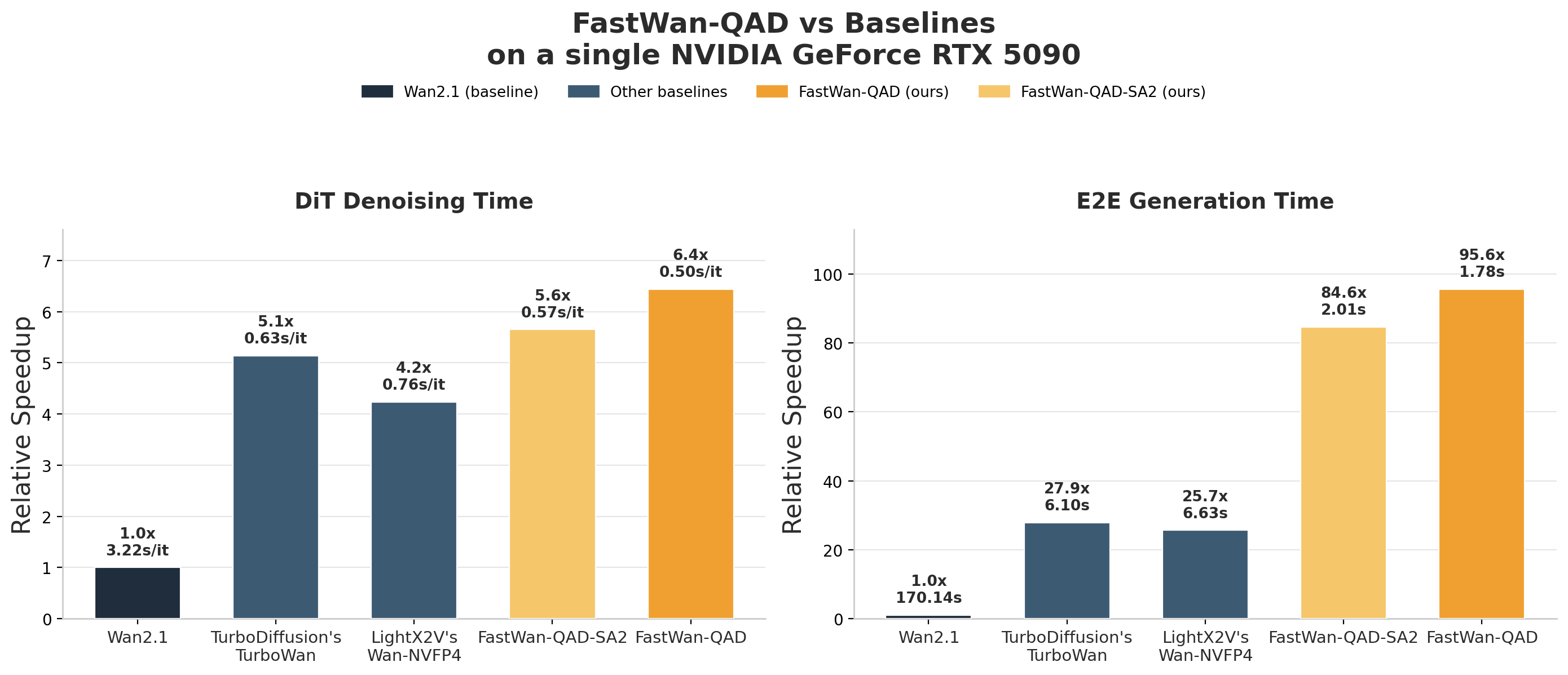
FastWan-QAD runs 3 denoising steps using SageAttention2++ as the attention backend. The official benchmark from the Hao AI Lab model card:
| Metric | Value |
|---|---|
| Resolution | 832×480 pixels |
| Duration | 5 seconds (81 frames at 16 fps) |
| Inference time | ~3.4 seconds |
| Test hardware | Single RTX 4090 |
| Parameters | 1.3 billion |
| Precision | FP8 |
| Denoising steps | 3 |
Compatible GPU architectures are Ampere and Ada, corresponding to the RTX 3000 and RTX 4000 series. The 3.4 second figure is the official benchmark on a single RTX 4090. No higher resolution benchmarks have been published alongside the initial release.
The 3 denoising steps is what separates this from the full Wan 2.1 model, which requires many more steps to converge on a high quality output. The distillation process trains the student model to arrive at a final result in far fewer steps by learning a compressed approximation of the full generation trajectory.
No official benchmark has been published for higher resolutions at time of writing. The 832×480 benchmark represents the documented capability. Users seeking 720p or 1080p output would need to run at those resolutions without a published latency reference point from Hao AI Lab.
SageAttention2++ and Hardware Requirements
SageAttention2++ is an optimized attention kernel that replaces the standard attention computation in the model's transformer layers. Attention is one of the primary compute bottlenecks in transformer inference: the cost scales quadratically with sequence length, meaning longer or higher-resolution generations become proportionally more expensive to compute. SageAttention2++ addresses this by implementing the attention calculation with hardware-specific optimizations that reduce memory bandwidth usage and improve arithmetic throughput on NVIDIA GPUs.
The combination of FP8 precision, the 3 step distillation schedule, and SageAttention2++ produces the 3.4 second figure. Each element contributes separately: FP8 halves the memory footprint compared to standard FP16, the 3 step schedule reduces the number of forward passes by roughly an order of magnitude compared to the base model, and SageAttention2++ reduces the per-step compute time.
Running FastWan-QAD requires an Ampere or Ada GPU. FP8 linear operations are supported across both architectures, with Ada GPUs offering dedicated hardware acceleration for FP8 tensor operations. Performance on Ampere GPUs is functional but will vary from the benchmark, which was measured on an Ada-based RTX 4090.
RTX 3000 series owners can run FastWan-QAD, but should expect meaningfully longer inference times than the published 3.4 second benchmark. An RTX 3080 or RTX 3090 will still be significantly faster than running the full Wan 2.1 model, because the parameter count reduction and the 3 step distillation schedule apply regardless of GPU generation. The Ada-specific FP8 acceleration is an additional gain on top of those reductions.
Example Outputs
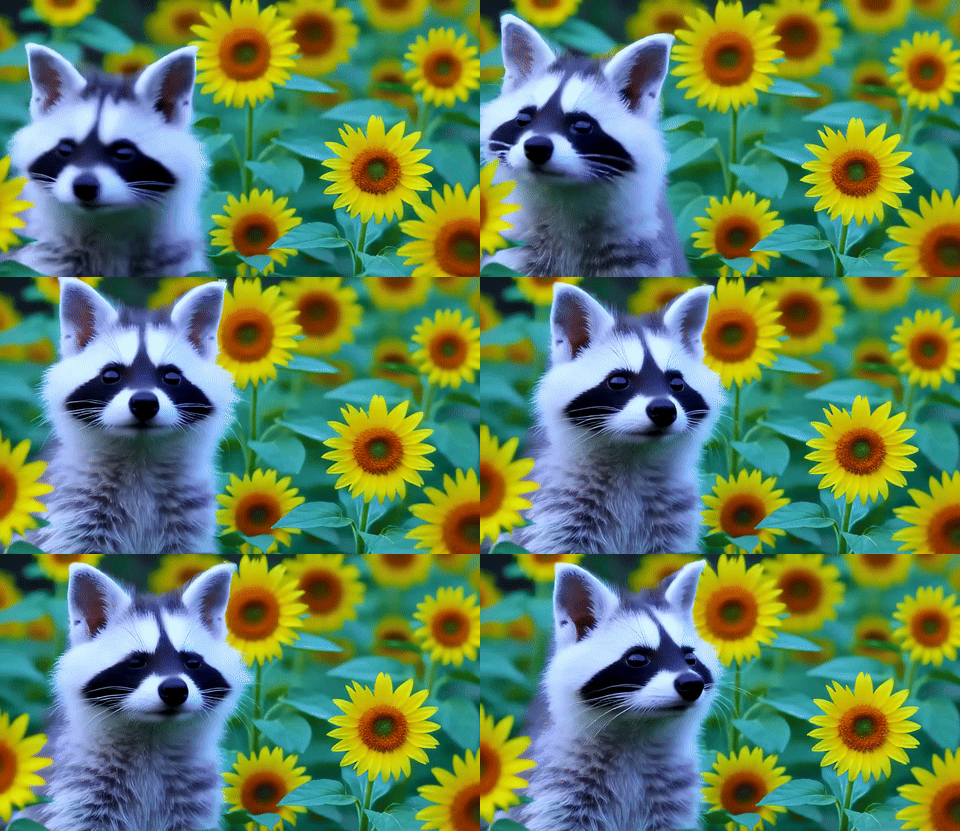
The following outputs are generated with the FastWan-QAD FP8 model:



How FastWan-QAD Compares to Other Distilled Video Models
The open source fast video generation landscape in mid-2026 includes several distilled models targeting different points on the speed and quality tradeoff. FastWan-QAD is distinguished by its 3 step schedule at 3.4 seconds for 5 second 480p clips, which represents the most aggressively optimized speed benchmark among the open source Wan 2.1 distillations available at publication.
Other models in the FastVideo ecosystem target higher resolutions or different speed points. The project is structured around Wan 2.1 as a base, with different distilled variants serving different use cases. FastWan-QAD is positioned as the speed extreme: minimum steps, maximum inference throughput, 480p resolution suited for iteration rather than delivery.
The relevant comparison for production workflows is not against other distilled models but against the full Wan 2.1 baseline. Full Wan 2.1 requires significantly more steps to converge on quality output and correspondingly more time on equivalent hardware. FastWan-QAD's 3.4 second benchmark represents roughly a 10 to 20 times speedup depending on the step count configuration of the base model, which translates directly into iteration cycles per hour for a filmmaker testing ideas.
Cloud-based video generation services charge per second of video generated or per compute unit consumed. A filmmaker who generates 100 test clips in a session at 5 seconds each is paying for 500 seconds of video across the generation queue. FastWan-QAD running locally eliminates that marginal cost entirely after the initial hardware investment, making high-iteration exploratory workflows economically viable that would be expensive to run through a cloud API.
Architecture and Use in Production
The model is built on Wan 2.1, distilled and quantized at 1.3 billion parameters using FP8 linear layers throughout. SageAttention2++ handles the attention computation, contributing to inference speed alongside the parameter reduction from distillation. The 3 step pipeline means the model converges on a final output with dramatically fewer denoising iterations than a full-step baseline requires.
The Apache 2.0 license covers both research and commercial production use with no royalty requirements. A production studio can integrate FastWan-QAD into a pipeline for prototype generation, previsualization, or concept validation without licensing overhead. The model generates 480p output, which is suited for storyboarding and concept work where speed of iteration matters more than final delivery resolution.
The FastVideo project is actively maintained and has produced multiple distilled models since its initial release. Hao AI Lab's GitHub repository documents the distillation methodology in the codebase, making the approach reproducible for research teams that want to adapt it to other base models or target different resolution and speed points than the current benchmarks cover.
The broader significance of FastWan-QAD is what it demonstrates about the gap between research-scale and consumer-scale video generation. The full Wan 2.1 model requires hardware that most individual creators do not own and cloud compute that adds cost per generation. A 1.3 billion parameter model running in under 4 seconds on an RTX 4090 changes the economics of iteration: a filmmaker can generate dozens of variations in the time a full-size model completes one.
That iteration speed matters most in the earliest stages of production, where direction is still being established. Rapid generation at 480p is well matched to storyboarding and concept validation workflows, where the goal is to test ideas quickly rather than deliver broadcast-ready output. The resolution limitation is a practical fit rather than a fundamental constraint for those use cases.
For broader context on the open source video generation landscape, MoVA and Lumos-Nexus take different architectural approaches to the quality and speed tradeoff. Hao AI Lab's FastWan-QAD targets the fastest end of the consumer GPU spectrum: a 5 second clip in under 4 seconds, at a parameter count that fits comfortably in single-GPU VRAM.
For a different speed optimization approach using consistency model distillation rather than quantization, NVIDIA's Causal rCM achieves 1 to 2 step inference on a Wan2.1 student model under Apache 2.0, and additionally open sources the full training recipe for teams that want to distill their own models rather than depend on a released checkpoint.
Filmmakers who want to generate AI video without a local GPU setup can use AI FILMS Studio to access text-to-video and image-to-video tools directly in the browser.
Sources
Hao AI Lab Blog: FastWan-QAD GitHub: hao-ai-lab/FastVideo HuggingFace: FastVideo/FastWan-QAD-FP8-1.3B arXiv: 2603.00040
Continue Reading
.jpg?w=3840)


Video & LipSync
- Video Generator
- Text to Video
- Image to Video
- Start-End Frame to Video
- Draw to Video
- Motion Control
- Video Enhancer
- Video Upscaler
- Video Extend
- Video to Video LipSync
- Audio to Video LipSync
- Image to Video LipSync
- Video FaceSwap
- Seedance 2.5
- WAN 3.0
- Seedance 2
- FLUX 3
- Minimax H3
- Vidu Q3 Pro
- Grok Imagine Video 1.5
- Gemini Omni
- Google Veo 3.1
- Kling 3.0 Pro
- Luma Ray 3.2
- LTX 2.3
- Happy Horse 1.1
- Kling 3.0 Motion
- ByteDance Upscaler
- InfiniteTalk
- InsightFace
Image & Edit
- AI Character
- AI Actor
- Art Generator
- Text to Image
- Image to Image
- LoRA Image to Image
- Draw to Edit
- Image LoRA Training
- Remove Background
- Image Enhancer
- MidJourney 8.0
- Krea 2
- OpenAI GPT Image 2.0
- Nano Banana Pro Ultra
- Nano Banana 2 Lite
- Nano Banana Pro
- Minimax Image
- Clarity Pro
- Z-Image Turbo LoRA
- Krea 2 Turbo LoRA
- Z-Image LoRA Trainer
- Qwen Image LoRA Trainer
- Background Erase Network 2 (BEN2)