
Guillermo Del Toro at Comic-Con: 'Absolutely No Goddamn AI' in the Pan's Labyrinth Restoration

Share this post:
Guillermo Del Toro at Comic-Con: 'Absolutely No Goddamn AI' in the Pan's Labyrinth Restoration
Guillermo del Toro confirmed at San Diego Comic-Con on July 24 that the 20th anniversary theatrical restoration of Pan's Labyrinth used no AI at any stage. "Absolutely no goddamn AI," he told the audience. They applauded.
The statement came during a panel promoting the October 9 theatrical release of Pan's Labyrinth in 4K 3D HDR, the first major rerelease of the 2006 film that won three Oscars for Cinematography, Art Direction, and Makeup.
Pan's Labyrinth at Twenty
Del Toro directed Pan's Labyrinth in Spanish in 2006, funding part of the production himself after studios passed on the project. Guillermo Navarro's cinematography won the Oscar for Best Cinematography at the 79th Academy Awards. Doug Jones, who attended the SDCC panel alongside del Toro, played both the Faun and the Pale Man in full practical prosthetics designed by DDT Efectos Especiales.
The film opened in limited US release in December 2006 before expanding the following year. Its commercial result was approximately $83 million worldwide against a budget of roughly $19 million. That return was built on word of mouth and critical consensus, not on visual effects spectacle.
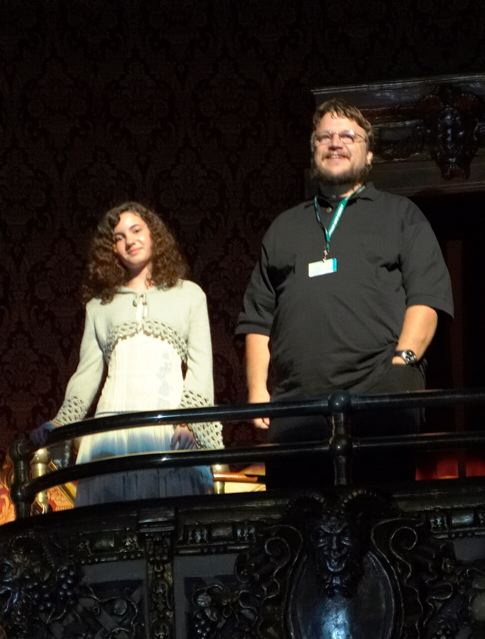
Jim Bachalo, CC BY-SA 2.0, via Wikimedia Commons
Pan's Labyrinth won three Cannes awards in 2006 and collected the same three categories as Oscars the following February. Its combination of political horror and fairy tale structure made it one of the most studied contemporary fantasy films of the decade. A 4K restoration is an act of preserving precisely the craft decisions that built each frame of that work.
The three Oscars were all in technical categories: Cinematography, Art Direction, and Makeup. That pattern of craft recognition is consistent with del Toro's current argument. The film's reputation is inseparable from the hands that made it.
The choice to fund the production independently after studio rejections is relevant to his current position. Del Toro made Pan's Labyrinth outside the logic of maximum efficiency. He prioritized the film over the business calculation. His argument against AI in art is, in part, an argument against applying commercial efficiency logic to creative decisions that require slower, more deliberate work.
The SDCC audience understood that history. Del Toro has been a fixture at Comic-Con for over two decades. His panels draw audiences who are familiar with the craft decisions behind his films and with the career trajectory that produced them. The applause that followed "absolutely no goddamn AI" came from people who knew what it cost to make Pan's Labyrinth the way it was made.
The Restoration and What Was Done by Hand
The October 9 rerelease presents Pan's Labyrinth in 4K resolution, with a 3D conversion and HDR color grade. Del Toro confirmed that no AI was used anywhere in that process. The remastering, the 3D depth mapping, and the HDR grade were all completed without AI tools.
A 3D conversion of a film originally shot in two dimensions requires depth decisions for every object in every shot. Each frame must be analyzed to understand how the original cinematographer built the visual space. Closer elements get separated from their backgrounds, and intermediate depth planes are assigned between them. That process is completed frame by frame. Pan's Labyrinth was shot on 35mm film with a visual language built entirely around physical space. The conversion team had to work with Navarro's choices to understand what the depth relationships were supposed to feel like before they could construct the 3D version.
Completing that conversion without AI tools is slow and expensive. It also builds professional knowledge in the people who do it. The specialist completing the conversion learns to read Navarro's choices, to understand why a shadow falls at a particular angle, and to recognize how the physical space of the labyrinth was constructed to imply a logic the audience feels without naming. That working knowledge is what del Toro is arguing must not be bypassed.
What Del Toro Said and Why He Said It
Del Toro did not frame the choice to avoid AI as a matter of quality or aesthetics. He explained the decision in different terms: "What we're protecting is the beauty and the redeeming power of art. If we cut a generation of people from learning their craft, you're cutting the rest of the history of that medium away from them."
That argument is not about what AI produces. It is about what the production process produces in the people who do it. Craft in filmmaking is transmitted through practice. Colorists, 3D conversion specialists, and sound remixers develop their knowledge through iterative decisions on real material. If AI tools complete that work instead, the knowledge those decisions generate does not accumulate in the practitioners working today.
The generational framing is precise. Del Toro is not arguing that current craftspeople will be harmed. He is arguing that the generation following them will not inherit the knowledge the current generation would otherwise transmit. A 3D conversion specialist who learned by doing the work teaches a different set of skills than one who spent a career supervising AI outputs. That difference compounds over decades.
Del Toro's argument applies to restoration work with particular force. Restoration is where the accumulated knowledge of earlier craft decisions is studied most closely. The teams completing this restoration by hand will leave with a more detailed understanding of how Pan's Labyrinth was built than those who supervised an automated version would carry away. That is what he is pointing to when he describes the chain being cut.
The argument also separates his position from the labor debates that have driven most of Hollywood's AI conversation in 2026. SAG-AFTRA, the DGA, and the WGA have focused on consent, compensation, and the unauthorized use of likenesses. Del Toro is making a different claim. He is not arguing that AI use harms the people who would otherwise do the work. He is arguing that it breaks the chain through which those people's knowledge reaches the practitioners who follow them. The labor argument and the craft transmission argument overlap but are not the same.
Del Toro's Position Across 2026
The SDCC statement is the third and most specific version of an argument del Toro has been developing across separate public appearances in 2026. In June, he warned at a BFI Fellowship dinner in Hollywood that the film industry was approaching cinema illiteracy, describing AI as "natural stupidity" in front of studio executives including Ted Sarandos and Pam Abdy. In May, he used the Cannes Classics presentation of the Pan's Labyrinth 4K restoration to deliver what Thierry Frémaux called the festival's first political statement against AI.
Both earlier statements addressed general cultural concerns. The BFI speech was a diagnosis of what cinema was becoming. The Cannes speech framed Pan's Labyrinth's resistance themes as a response to the current moment. Neither named a specific production decision and explained the reasoning behind it.
The Comic-Con confirmation does. It names one project, confirms one process, and explains the reasoning in terms of what that process teaches the people who complete it. The argument has moved from cultural warning to operational decision.
Del Toro has made this position in front of three different audiences in three months. The BFI dinner room held the executives with the most direct power over AI deployment in production. The Cannes Classics audience was a festival institution. The SDCC panel drew the audience that has followed his work most closely over the longest period. He said the same thing in each context, adjusting only the level of specificity.
That consistency is the argument. Del Toro is not making a different case to different rooms. He is making the same case with increasing precision as each appearance gives him a more concrete context to apply it to. By July, the context was the restoration itself: a named project, a confirmed process, and a specific explanation of why that process mattered beyond the film it produced.
Pan's Labyrinth opens in theaters on October 9, 2026. The rerelease gives it a theatrical scale it never had on its original limited US run. The choice to complete the restoration by hand is consistent with how the film was made in the first place. It was built by people who learned something in the process of building it.
Filmmakers working with AI tools can generate text-to-video and image-to-video at AI FILMS Studio.
Sources
Deadline | Variety | Hollywood Reporter
Continue Reading


Video & LipSync
- Video Generator
- Text to Video
- Image to Video
- Start-End Frame to Video
- Draw to Video
- Motion Control
- Video Enhancer
- Video Upscaler
- Video Extend
- Video to Video LipSync
- Audio to Video LipSync
- Image to Video LipSync
- Video FaceSwap
- Seedance 2.5
- WAN 3.0
- Seedance 2
- FLUX 3
- Minimax H3
- Vidu Q3 Pro
- Grok Imagine Video 1.5
- Gemini Omni
- Google Veo 3.1
- Kling 3.0 Pro
- Luma Ray 3.2
- LTX 2.3
- Happy Horse 1.1
- Kling 3.0 Motion
- ByteDance Upscaler
- InfiniteTalk
- InsightFace
Image & Edit
- AI Character
- AI Actor
- Art Generator
- Text to Image
- Image to Image
- LoRA Image to Image
- Draw to Edit
- Image LoRA Training
- Remove Background
- Image Enhancer
- MidJourney 8.0
- Krea 2
- OpenAI GPT Image 2.0
- Nano Banana Pro Ultra
- Nano Banana 2 Lite
- Nano Banana Pro
- Minimax Image
- Clarity Pro
- Z-Image Turbo LoRA
- Krea 2 Turbo LoRA
- Z-Image LoRA Trainer
- Qwen Image LoRA Trainer
- Background Erase Network 2 (BEN2)