
Guillermo del Toro at Cannes: 'Art Can't Be Done With a F---ing App'

Share this post:
Guillermo del Toro at Cannes: 'Art Can't Be Done With a F---ing App'
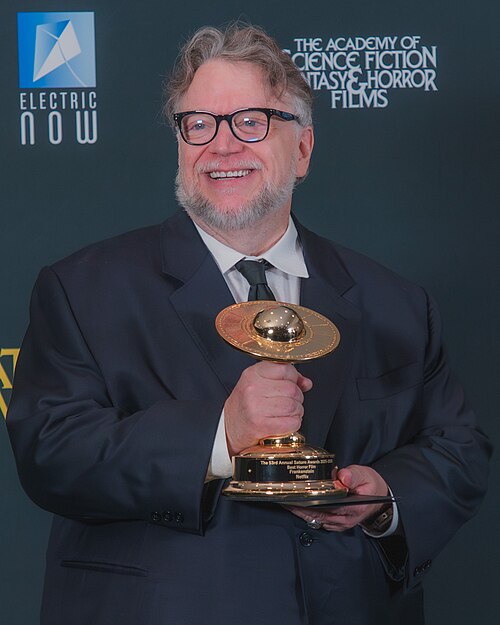
Guillermo del Toro appeared at Cannes Classics on May 13 to present the 4K restoration of "Pan's Labyrinth" on its 20th anniversary and delivered a speech that Festival General Delegate Thierry Frémaux called "the first political statement of the festival". Del Toro used the occasion to issue a direct attack on generative AI, framing the film's themes of resistance against fascism as a response to what he called the current cultural moment.
The speech arrived early in the festival schedule, before the competition films had built momentum. Frémaux's designation reflects how quickly the AI debate had become the defining story of the 2026 Cannes edition.
Del Toro appeared in person to introduce the restored version. The Cannes Classics sidebar is designed for exactly this kind of reunion: a major film, its director, and an anniversary screening. The political argument del Toro added to the ceremony transformed the occasion into something else.
Pan's Labyrinth had not screened at Cannes in any official capacity since its 2006 premiere. The 20th anniversary restoration gave Cannes Classics a clear occasion to bring del Toro back. The AI argument was not on the official program.
The Speech
Del Toro told the Cannes Classics audience: "We are, unfortunately, in times that make this movie more pertinent than ever, because they tell us everything is useless to resist, that art can be done with a f---ing app".
He did not limit his remarks to aesthetics. The speech drew a direct line between the film's resistance narrative and what he sees as the cultural threat posed by AI replacing human creative work. "If we can just leave a mark, if we can put our faith against our faith... there is hope", he said. He closed with a declaration: "Never, never, never give to fear".
The phrase "f---ing app" was deliberate. Del Toro is a filmmaker known for precise language in public statements. Using it at Cannes Classics, in the introduction to a beloved film's 4K restoration, was a choice of register. He was expressing contempt, not merely disagreement.
The speech reframed Pan's Labyrinth's central theme. The film follows a child who refuses to accept the world as defined by power. Ofelia's fantasy world is a form of resistance. Del Toro connected that resistance explicitly to 2026, drawing a line from the film's 1944 setting to the present cultural moment.
Frémaux was present for the speech and did not distance himself from its content afterward. His designation of it as the festival's first political statement is an act of institutional endorsement: Cannes accepted and amplified what del Toro said.
The speech was short. The argument was specific: art carries something a tool cannot generate; resistance is still available. The framing was political rather than aesthetic, which is unusual for an introduction to a restored film. Del Toro was not there to praise Pan's Labyrinth. He was there to make an argument, and the film was his evidence.
Pan's Labyrinth at Twenty
"Pan's Labyrinth" premiered at Cannes in 2006, where it won three awards. The film is set in Spain in the years after the Civil War and follows a young girl who retreats into a fantasy world of fauns and fairies while her stepfather, a fascist military officer, wages a brutal campaign against republican guerrillas. Del Toro wrote and directed it in Spanish, funding the film partly with his own money after studios passed on the project.
.jpg)
The film has since become one of the most studied works of contemporary fantasy cinema. Its pairing of political horror and fairy tale logic is considered a defining example of genre filmmaking used to process historical trauma. Cannes Classics selected it for a 4K digital restoration for the 20th anniversary, presented with del Toro in attendance to introduce the restored version.
The three Cannes awards the film won in 2006 were technical and craft honors: Best Cinematography, Best Production Design, and Best Makeup. That pattern of craft recognition is consistent with del Toro's current argument. The film's power lives in specific decisions made in specific departments by specific people. A 4K restoration is an act of preserving precisely those decisions.
The film was made in Spanish and partly financed by del Toro himself after studios passed on the project. Its commercial result was approximately $83 million worldwide against a budget of roughly $19 million. That outcome did not depend on visual effects spectacle. It depended on handmade imagery and a story told in a language that most international distributors consider a commercial liability.
Del Toro's choice to fund the film himself after studio rejections is relevant to his current position on AI. He made Pan's Labyrinth outside the logic of maximum efficiency. His argument against AI in art is, in part, an argument against that logic applied to creative work.
A 4K restoration is an assertion that this image, made this way, by this person, is worth preserving at its highest fidelity. The care of a restoration is the inverse of the scale economy that AI image generation represents. Del Toro introduced a restoration and made an argument against AI in the same breath. The two acts are consistent.
Frémaux's Response
Frémaux's designation of the speech as "the first political statement of the festival" carries weight. Cannes has historically drawn clear distinctions between artistic and political interventions, and Frémaux used this phrase to mark del Toro's remarks as the opening act in a broader debate the festival expected to define the 2026 edition.
His description also frames del Toro's position as coming from inside the industry, not from outside critics. Del Toro is a filmmaker with two Oscar wins, including Best Director for "The Shape of Water" in 2018. His credibility as a craftsman gives the statement a different register than a cultural commentator making the same argument. The contrast with his peers sharpened in June 2026 when Martin Scorsese joined Black Forest Labs as an advisor, describing FLUX storyboarding as "creatively freeing".
Cannes has a long tradition of filmmakers using the festival platform to make political arguments. Del Toro's speech belongs to that tradition, except that it was made in the Cannes Classics sidebar rather than at the main competition stage. Frémaux's endorsement elevated it above a sidebar moment.
The contrast between del Toro and Scorsese is not a rivalry. Both are filmmakers whose artistic credibility is beyond institutional dispute. That they arrived at opposite conclusions on AI engagement in the same period defines the range of the debate at the highest level of the industry.
Frémaux himself has floated the idea of an organic label for films made without AI. His designation of del Toro's speech as the festival's first political statement is consistent with that editorial position. The festival is not neutral on this question.
A Consistent Position
Del Toro told NPR in January 2026 that he would "rather die" than use generative AI in his work. The Cannes speech is consistent with that position, but it extends it. Where the NPR interview was a personal statement about his own practice, the Cannes speech was directed outward: at the industry, at the audience, and at the technology's advocates.
His argument is not technical. He does not dispute that AI can generate images or write text. His argument is that the act of making art carries meaning that the tool cannot supply, and that accepting the substitution represents a form of cultural surrender he frames in explicitly political terms.
The escalation in register from January to May is deliberate. The NPR interview drew a personal line about his own practice. The Cannes speech drew a collective one, directed at the industry and its audience.
Del Toro's argument has been consistent across decades. In interviews going back to his early career, he has described filmmaking as an act of personal witness: a director placing something of themselves into every frame. That position is not compatible with a tool that generates images from prompts.
The consistency is also strategic. Del Toro does not modulate his position based on the audience or the commercial context. He says the same thing to NPR, to Cannes, and to rooms full of studio executives. That consistency is what gives the argument its institutional weight.
His position does not engage the labor debate directly. Del Toro is not primarily arguing that AI will take jobs, though it may. He is arguing that AI changes what art is and what it does to audiences. The labor argument and the cultural argument overlap but are not the same thing.
The three public statements from January through June 2026 each escalated in audience and authority. NPR was personal. Cannes was institutional. The BFI dinner in June placed the argument directly in front of the executives whose companies are building what he argues against.
Del Toro brought those themes to Hollywood directly. At a BFI Fellowship dinner on June 15, 2026, in a room that included Leonardo DiCaprio and Jon Favreau, he warned of cinema illiteracy and called AI 'natural stupidity'.
The Spectrum at Cannes
Del Toro's speech arrived at a festival where the AI debate is not abstract. The Cannes competition has banned generative AI from its Official Selection while the Marché du Film runs dedicated commercial AI programming. Frémaux's own proposal for organic labeling of films made without AI, floated on opening day, comes from the same impulse as del Toro's speech: a desire to preserve a category of work that AI has not touched.
At the same festival, Steven Soderbergh is presenting a John Lennon documentary that uses Meta AI for 10% of its runtime, explicitly defending his approach as transparent and responsible. On the commercial side, David Mamet's "Speed the Plow" adaptation was announced at the Marché using the New Hollywood AI platform for preproduction tools. The festival holds all three positions simultaneously: the ban, the disclosure, and the commercial adoption.
Del Toro's contribution to that spectrum is the most uncompromising. His Cannes Classics platform gave it the weight of ceremony and of a great film's anniversary. Whether the argument lands with the industry will take longer to measure than the week in which he made it.
Days later at the same festival, Seth Rogen made the same argument focused specifically on screenwriting, telling reporters that writers who use AI to write their scripts "shouldn't be a writer".
The split between the official AI ban in the competition and the commercial AI programming at the Marché reflects how the Cannes institution has decided to hold the contradiction. The festival does not require consistency between its curatorial standards and its commercial programming. Del Toro's speech was consistent with the former and uncomfortable with the latter.
Soderbergh's position is the one most difficult to argue against from either direction. He used AI for 10% of a documentary, disclosed it in the film itself, and defended disclosure as an ethical obligation. That approach is harder to characterize as cultural surrender than mass adoption without disclosure.
Seth Rogen and del Toro were making structurally similar arguments from different disciplines. Rogen was addressing screenwriting. Del Toro was addressing visual art. Both drew a line between the person doing the work and the work itself, arguing that the authenticity of one is what makes the value of the other.
Del Toro's contribution to the Cannes AI debate is also notable for what it does not say. He does not argue for regulation, industry bans, or institutional enforcement. He argues that the people in the industry should choose. The political frame he uses is about collective human agency, not policy.
Two months after Cannes, del Toro confirmed at San Diego Comic-Con that the Pan's Labyrinth 4K 3D restoration used absolutely no AI, adding a generational argument. If AI tools complete restoration work instead of human practitioners, the craft knowledge required to do that work will not be transmitted to the generation that follows.
Filmmakers working with AI video generation tools can generate text-to-video and image-to-video at the AI FILMS Studio video workspace.

Sources
Deadline | Variety | The Wrap | Washington Post
Continue Reading
.jpg?w=3840)


Video & LipSync
- Video Generator
- Text to Video
- Image to Video
- Start-End Frame to Video
- Draw to Video
- Motion Control
- Video Enhancer
- Video Upscaler
- Video Extend
- Video to Video LipSync
- Audio to Video LipSync
- Image to Video LipSync
- Video FaceSwap
- Seedance 2.5
- WAN 3.0
- Seedance 2
- FLUX 3
- Minimax H3
- Vidu Q3 Pro
- Grok Imagine Video 1.5
- Gemini Omni
- Google Veo 3.1
- Kling 3.0 Pro
- Luma Ray 3.2
- LTX 2.3
- Happy Horse 1.1
- Kling 3.0 Motion
- ByteDance Upscaler
- InfiniteTalk
- InsightFace
Image & Edit
- AI Character
- AI Actor
- Art Generator
- Text to Image
- Image to Image
- LoRA Image to Image
- Draw to Edit
- Image LoRA Training
- Remove Background
- Image Enhancer
- MidJourney 8.0
- Krea 2
- OpenAI GPT Image 2.0
- Nano Banana Pro Ultra
- Nano Banana 2 Lite
- Nano Banana Pro
- Minimax Image
- Clarity Pro
- Z-Image Turbo LoRA
- Krea 2 Turbo LoRA
- Z-Image LoRA Trainer
- Qwen Image LoRA Trainer
- Background Erase Network 2 (BEN2)