
HiDream-O1-Image: 8B Open Source Image Model With No VAE
Share this post:
HiDream-O1-Image: 8B Open Source Image Model With No VAE
HiDream-ai released HiDream-O1-Image on May 8, 2026 under an MIT license, making a unified 8 billion parameter image model freely available for commercial use. A second checkpoint, HiDream-O1-Image-Dev-2604, followed on May 14 with an added reasoning driven prompt agent that rewrites and expands input prompts before generation.
The technical report was published on arXiv on May 10 (paper 2605.11061), covering architecture and benchmark results in full.
Three Capabilities, One Model
HiDream-O1-Image handles three tasks from a single set of weights: text to image generation, instruction based image editing, and subject driven personalization. All three share the same model checkpoint, with no switching between separate systems. Maximum output resolution is 2,048 x 2,048 pixels.
Subject driven personalization generates consistent visual representations of a specific subject across multiple images. Instruction based editing modifies an existing image based on a text description without regenerating the full scene from scratch.
The Architecture: No VAE
Most diffusion models work in latent space. An image is compressed into a smaller representation by a Variational Autoencoder before generation, then decoded back to pixels at the end. HiDream-O1-Image removes that step entirely.
The model uses the Pixel-level Unified Transformer (UiT) architecture, processing raw pixel values directly from input to output. HiDream-ai describes this as "natively unified" because text to image generation, editing, and personalization all share the same pixel space representation without separate encoder or decoder components.
Text to image output samples from HiDream-O1-Image. Courtesy HiDream AI.
The pixel native output also changes what counts as a generation artifact. In VAE based systems, some visual quality issues trace to the compression step rather than the generation step itself. HiDream-O1-Image makes the generation process the sole source of the output, which means optimization during training and inference is not split across two separate objectives.
Working entirely in pixel space also makes the model's behavior more interpretable for art directors reviewing outputs. When a color or texture in the generated image does not match the intent, the cause is in the generation, not in a reconstruction step the user cannot inspect or adjust.
Benchmark Results
The arXiv paper reports the following scores:
| Benchmark | Score | What it measures |
|---|---|---|
| GenEval | 0.90 | Compositional generation accuracy |
| DPG-Bench | 89.83 | Dense prompt following |
| HPSv3 | 10.37 | Human aesthetic preference |
HiDream-O1-Image debuted at position 8 on the Artificial Analysis Text to Image Arena leaderboard, the highest ranked open weights model on the chart at launch. Independent evaluation found it outperforms FLUX variants up to seven times larger in parameter count on the same tests.
HPSv3 scores human aesthetic preference, collected through pairwise human judgments of image quality across style, composition, and fidelity to the prompt. A score of 10.37 places the model in the range of commercial closed models evaluated on the same leaderboard. DPG-Bench at 89.83 measures dense prompt following, meaning the model's ability to render long, detailed prompts that specify many attributes simultaneously. For production use where prompts describe complex scenes in the style of production script directions, DPG-Bench performance is the benchmark most directly relevant to output quality.
Subject driven personalization and instruction based editing share the same checkpoint, which means both modes benefit from the same pixel space representation. A production pipeline does not need separate models for generation and editing, removing a dependency management problem that arises when unified tasks are split across specialized tools.
The editing mode's ability to modify an existing image without rebuilding the full scene addresses one of the core friction points in iterative concept development. The spatial layout, lighting conditions, and background details established in the first generation pass can be carried forward while only the specified attribute changes.
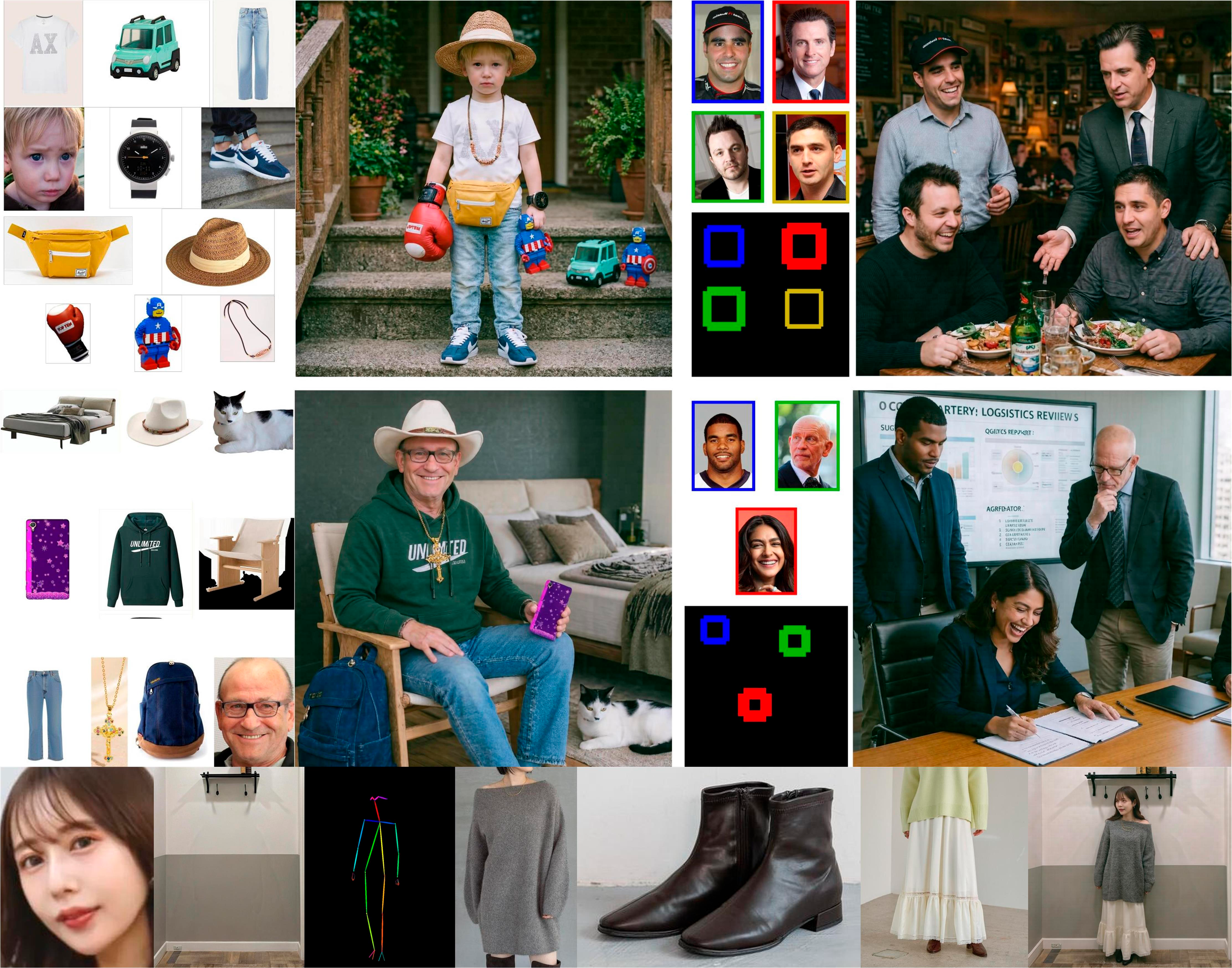
Subject personalization and instruction based editing outputs from HiDream-O1-Image. Courtesy HiDream AI.
Applications for Film Production
Subject driven personalization directly addresses one of the harder problems in AI image generation for filmmaking: keeping a character or object visually consistent across multiple frames, reference sheets, or storyboard panels. Standard text to image models regenerate independently each run, producing different interpretations of the same subject.
Instruction based editing lets a production designer or art director describe a change to an existing concept image and apply it without rebuilding the scene from scratch. The 2,048 x 2,048 maximum output resolution makes results suitable for print quality concept art and large format storyboard panels.
The absence of a VAE compression pass means faces and fine architectural detail are not subject to the encode decode round trip that introduces softness in conventional diffusion output. That is relevant for character design work where face consistency and fine detail retention matter across multiple generations.
The model is released under MIT license, which permits commercial use without restriction. HiDream-ai states this explicitly in the GitHub repository and HuggingFace model card.
Instruction Editing in a Production Design Workflow
Instruction based editing modifies an existing image based on a text description without rebuilding the scene. A practical application during development: a set design concept image that needs iterative changes, each representing a different material or lighting treatment for the same spatial layout. Instead of regenerating the full scene from a revised text prompt each time, which produces a different scene composition on every run, instruction editing applies the change to the existing image while preserving everything the art director has not specified for change.
In practice this means a scene with an established camera angle, background architecture, and furniture arrangement can be iterated in the same session by describing only what changes: "make the walls concrete instead of brick," "change the lighting from noon to dusk," "replace the chairs with benches." Each edit produces a version of the same scene, not a new scene that incidentally includes the requested change.
Storyboard and Pitch Deck Continuity
Subject driven personalization has a specific production application that extends beyond generating individual images in isolation. A storyboard for a feature pitch typically requires 40 to 80 panels depicting the same characters across different environments, angles, and lighting conditions. Standard text to image models generate each panel independently, which means the character's face, hair, clothing, and proportions vary slightly from panel to panel. Subject personalization anchors the visual identity of a character across the full board, producing a pitch deck where the protagonist looks like the same person in every frame.
The same mechanism applies to costume design across episodes of an animated or AI assisted series. A character's visual consistency across multiple production phases, from concept art to reference sheet to in-scene visualization, depends on the model holding specific visual attributes across separate generation runs. HiDream-O1-Image's unified architecture handles all three modes in one checkpoint, which means the workflow does not require switching between tools for different tasks in the same pipeline.
Color Accuracy Without VAE Reconstruction
The absence of VAE compression has a practical consequence for production design work that benchmark scores do not capture. VAE encoding and decoding introduces a small but measurable color shift during the reconstruction step. Skin tones, fabric colors, and surface materials can emerge from the decode pass at a slightly different hue than what the generation process computed. For production design references that need to communicate exact color specifications to a crew, that shift introduces ambiguity.
Working in pixel space eliminates the reconstruction step entirely. The model's output is the final pixel value, without a compression and decompression pass that can alter it. For a costume designer establishing a character's color palette across multiple reference frames, or an art director generating set design variations at a specific paint color, that fidelity matters in a way it does not for standard content generation tasks.
For filmmakers who prefer a browser based workspace without local model setup, AI FILMS Studio provides access to the latest image generation models in the cloud.
Deployment and Local Setup
HiDream-O1-Image requires approximately 20 GB of GPU VRAM to run the full 8B checkpoint at inference. The model runs on a single A100 80GB or H100 80GB GPU. For teams without access to high-memory GPUs on premises, the HuggingFace Spaces demo provides a fully managed alternative for evaluation and low-volume use.
The Dev variant, HiDream-O1-Image-Dev-2604, adds a reasoning driven prompt agent that rewrites and expands the input prompt before generation, which increases coherence on compositionally complex prompts but also adds latency. For production teams with tighter latency requirements, the base checkpoint without the prompt agent is the more practical starting point.
The HuggingFace Space at HiDream-ai/HiDream-O1-Image provides a live browser based demo for testing text to image generation, subject personalization, and instruction editing without local installation.
The Space runs on Zero GPU, which means requests may queue during peak usage. For production testing where latency and throughput matter, local deployment is the appropriate path.
The MIT license covers all three capabilities from a single checkpoint: generation, editing, and personalization. There are no separate licenses for different model modes, and no distinction between research and commercial use.
The license applies uniformly to the checkpoint, the HuggingFace model card, the GitHub code, and all derivative works that include the model.
What the GenEval 0.90 Score Means
GenEval measures compositional generation accuracy. A score of 0.90 means the model correctly renders attribute binding, object counting, spatial relationships, and color attribution in nine out of ten test cases.
Attribute binding refers to correctly assigning "red" to "apple" and not to "chair" in a prompt that names both objects with different colors. Spatial relationships test whether "to the left of" and "above" produce the correct arrangement of objects in the output.
For storyboard and concept art generation, these capabilities translate directly. A director working from a script with specific blocking needs the model to interpret spatial language accurately.
A production designer generating multiple reference images of the same object with varied material treatments ("the chair in brushed aluminum," "the chair in matte black ceramic") needs reliable attribute binding to avoid iterations that require manual correction.
For comparison with other recent open source approaches, the Dype model applies training free upscaling to existing diffusion models rather than rebuilding the generation architecture from scratch. Flux 2 remains the most widely used open source image baseline, though HiDream-O1-Image matches or exceeds it on standard benchmarks at 8 billion parameters. Another June 2026 open source model, FreeStyle, takes a different approach to image reference. It mines community LoRA weights to enable dual reference generation from a style image and a content image without additional training.
In June 2026, Krea released Krea 2 Raw and Turbo, a 12B Diffusion Transformer with a community license that permits free commercial use for studios under 50 seats and native 2K generation in approximately 2 seconds.
Two newer papers address the resolution problem from the decode side. NVIDIA's PiD decoder replaces VAE decoding with pixel diffusion, converting 512×512 latents to 2048×2048 in 210 ms on GB200. The L2P framework from NJU and Tencent transfers entire latent diffusion model checkpoints into pixel space, enabling native 4K generation and 8K zero shot extrapolation without retraining from scratch.
A July 2026 addition to the pixel space category is PRX Pixel from Photoroom, a 7B model released under Apache 2.0 that also eliminates VAE compression and uses a Qwen3-VL multilingual text encoder. It does not include the editing and personalization modes that HiDream-O1-Image provides, but its full training code is published alongside the weights, making it useful as a research baseline for teams building custom pixel space systems.
Also in July 2026, Microsoft Research released Mage-Flow, a 4B flow matching model that generates and edits images at native resolution without resize cropping artifacts. It covers both text-to-image and instruction based editing across six weight variants under an MIT license.
Sources
GitHub: HiDream-ai/HiDream-O1-Image HuggingFace model: HiDream-ai/HiDream-O1-Image HuggingFace Dev: HiDream-ai/HiDream-O1-Image-Dev HuggingFace demo: HiDream-ai/HiDream-O1-Image Space arXiv: HiDream-O1-Image: A Natively Unified Image Generative Foundation Model with Pixel-level Unified Transformer
Continue Reading
.jpg?w=3840)


Video & LipSync
- Video Generator
- Text to Video
- Image to Video
- Start-End Frame to Video
- Draw to Video
- Motion Control
- Video Enhancer
- Video Upscaler
- Video Extend
- Video to Video LipSync
- Audio to Video LipSync
- Image to Video LipSync
- Video FaceSwap
- Seedance 2.5
- WAN 3.0
- Seedance 2
- FLUX 3
- Minimax H3
- Vidu Q3 Pro
- Grok Imagine Video 1.5
- Gemini Omni
- Google Veo 3.1
- Kling 3.0 Pro
- Luma Ray 3.2
- LTX 2.3
- Happy Horse 1.1
- Kling 3.0 Motion
- ByteDance Upscaler
- InfiniteTalk
- InsightFace
Image & Edit
- AI Character
- AI Actor
- Art Generator
- Text to Image
- Image to Image
- LoRA Image to Image
- Draw to Edit
- Image LoRA Training
- Remove Background
- Image Enhancer
- MidJourney 8.0
- Krea 2
- OpenAI GPT Image 2.0
- Nano Banana Pro Ultra
- Nano Banana 2 Lite
- Nano Banana Pro
- Minimax Image
- Clarity Pro
- Z-Image Turbo LoRA
- Krea 2 Turbo LoRA
- Z-Image LoRA Trainer
- Qwen Image LoRA Trainer
- Background Erase Network 2 (BEN2)