
Cannes 2026: The Filmmakers Who Are Learning to Embrace AI
.jpg?w=3840&q=90)
Share this post:
Cannes 2026: The Filmmakers Who Are Learning to Embrace AI
At Cannes 2026, Mathieu Kassovitz put a number to the argument: "A project that might have cost $50-60 million is now closer to $25 million using AI". The La Haine director was one of several filmmakers who stopped treating AI use as something to hide and started discussing it in practical, financial terms.
The Hollywood Reporter described Cannes 2026 as the festival where filmmakers began "learning to love AI". The Wrap called the shift "more curiosity, less fear". Both framings pointed to the same change: the industry's default posture at a major festival moved from denial to disclosure.
A Different Calculation
The cost argument is the one filmmakers reached for most often when asked to justify their AI use. Kassovitz's figures represent the clearest public statement from a named director comparing budget ranges on the same type of project with and without AI tools.
.jpg)
Abxbay, CC0, via Wikimedia Commons
Producers working on Doug Liman's *Bitcoin: Killing Satoshi* offered a comparable claim from the production side. The film's AI methodology, replacing every location and background with generated environments, brought a project the team estimated would cost $300 million down to $70 million. [The production arrived at Cannes with a complete cast and 30 weeks of AI post underway](/blog/doug-liman-bitcoin-killing-satoshi-cannes-ai-production).
The Kassovitz calculation requires some context. The $50-60 million baseline he cited reflects the cost of a mid budget European action film with practical locations, physical sets, and the full technical infrastructure that kind of production requires. His $25 million AI estimate covers a production where generated environments replace the majority of location and set costs, and where AI tools compress post production timelines.
The comparison is not universal. Films where the physical environment is central to the story cannot replicate the savings. A film like La Haine, which depends on the specific architecture and texture of a French banlieue, would not benefit from AI location replacement in the same way. The savings Kassovitz described apply most directly to genre productions where the environment is a backdrop rather than a character.
Casey Affleck on the Stage
Casey Affleck, who stars in Bitcoin: Killing Satoshi, described the filming experience directly. "It was much more like acting in a Broadway play than in a giant event film", he told The Wrap. "The entire focus on set was on performances".
Affleck's Broadway analogy is worth taking seriously as a production observation. Conventional large scale productions create two distinct working environments: a technical environment where crew manages logistics, and a performance environment where actors work. On a standard action production, actors wait while the technical environment is prepared and adjusted. The performance happens inside a technical machine.
The Bitcoin production removed much of that machine from the set. Without practical locations requiring weather holds, lighting adjustments, and logistics for hundreds of crew members, the set became smaller, quieter, and more focused on what the actors were doing. Affleck's account suggests it suited the kind of character driven work his role required.
Soderbergh and the Lennon Documentary
Steven Soderbergh's documentary on John Lennon drew some of the festival's most pointed AI controversy. The film used Meta AI tools to create what Soderbergh described as "surrealistic" imagery, accounting for roughly 10 percent of its visuals. The Cannes screening made it one of the first documentaries from a director of Soderbergh's stature to use AI generation openly and without apology.
The full account of how Soderbergh built the documentary's AI visual approach is covered separately. His presence at Cannes, alongside the Bitcoin production, contributed to what Variety described as the moment AI "came out of the closet" at the festival.
Soderbergh's position on the Lennon film was explicit about what AI did and what it did not do. That specificity, rather than a blanket disclosure or denial, appears to be the approach earning industry credibility at this stage.
Resistance and Acceptance
Not every filmmaker at Cannes arrived at the same position. Jury member Demi Moore described fighting AI as "a battle that we will lose", while Cannes director Thierry Fremaux stated that the festival stands "on the side of the artists". Tilda Swinton, in a masterclass the same week, argued that [formulaic AI output cannot compete with adventurous, unpredictable cinema](/blog/tilda-swinton-cannes-ai-filmmaking-2026).
.jpg)
Mike is Michi, CC BY-SA 4.0, via Wikimedia Commons
Tom Tykwer, Nora Fingscheidt, and three German directors took the position a step further, launching German Dogma 25, a formal set of ten rules that bars internet access from the creative process and, with it, AI tools. The range of reactions illustrated a festival having a serious conversation about AI without having reached consensus.
The broader story of Cannes 2026 as the moment AI disclosure became the norm covers those multiple threads. What Kassovitz, Affleck, and Soderbergh represent is the specific subset of filmmakers who went beyond acknowledging AI's presence and described its actual effects on production cost and creative process.
The International Dimension
The Cannes 2026 conversation about AI production was not limited to Hollywood films or American directors. Several international productions arrived at the festival using AI tools to address budget constraints that differ from American production economics in important ways. For a mid budget South Korean or Indian production, the cost differential AI creates can be the difference between theatrical distribution and direct-to-streaming.
Kling AI's formal filmmaker initiative launch at the festival included directors from South Korea, China, and the United Kingdom presenting verified production data. South Korean director Eekjun Yang and a team of seven completed a science fiction feature for between $700,000 and $2 million, a project a conventional production of comparable scope would require 150 to 300 crew members and $150 to $300 million to realize. Those presentations, delivered on the Palais des Festivals Main Stage, placed AI production data from non-American directors at the center of the conversation rather than its margins.
What Disclosure Actually Costs
The shift from denial to disclosure that The Hollywood Reporter and The Wrap both identified carries a practical cost that filmmakers are learning to manage. Studios and distributors that financed productions before AI disclosure became common are reassessing their contracts. A film delivered with AI generated backgrounds may face questions about whether it complies with a production agreement that specified practical locations.
The pressure moves in multiple directions. Distributors want transparency for marketing and audience expectation management. Insurance underwriters for productions involving AI generated content are creating their own provenance documentation requirements. The filmmakers at Cannes who spoke openly about their AI use were navigating a moment when the industry's disclosure norms are forming in real time.
How the Narrative Shifted From 2024 to 2026
At Cannes 2024, AI was discussed primarily in defensive terms. Directors asked about AI use in their films often gave answers that minimized or denied involvement. Cannes 2025 saw more open conversation in festival sidebar events but limited main stage discussion. The 2026 shift to open disclosure on main stages and in press junkets represents a cumulative change over three festival cycles, not a sudden reversal.
Part of the shift came from practical necessity. By mid-2026, enough films with AI generated content had entered production that concealment became harder to maintain. Visual effects supervisors, editors, and colorists working on AI assisted productions had begun discussing the tools in trade press and at industry events. Directors who had not disclosed AI use were finding that their crews had already done so in other contexts. Open disclosure became the lower-risk posture.
Kassovitz's Film and What He Was Actually Describing
Mathieu Kassovitz has not produced a major theatrical release since The Crimson Rivers sequels in the mid-2000s. His Cannes 2026 comments came in the context of discussions about a new project he described as in development using AI tools. He was not describing a completed film but a production model he was evaluating.
That context matters for interpreting the $25 million figure. It is a cost estimate for a planned production, not a verified final budget from a completed one. The comparison to $50-60 million for a conventional version of the same type of film is credible in broad terms, but it has not been tested by an actual production. Kassovitz's authority on this subject is his experience as a mid budget European director, not a data set of AI productions he has delivered.
The distinction between a verified budget and an estimate was not highlighted in most trade coverage of his comments. His figures circulated as evidence of AI's cost reduction potential, which they are, but at one degree of remove from proof. The productions that provided verified cost data at Cannes 2026, Bitcoin: Killing Satoshi and Wei Li's Born of the Tide, carry more weight as evidence precisely because they represent work already completed.
Who Was in the Room at Cannes
The Cannes 2026 conversations about AI happened across multiple venues: the main festival programming, the Marché du Film, the NEXT section focused on technology and innovation, and the Cannes Docs market. The filmmakers discussing AI openly were distributed unevenly across those venues.
Directors like Soderbergh and Kassovitz appeared in mainstream press coverage because of their profiles. The Marché du Film and NEXT section conversations included less prominent filmmakers whose AI adoption was further along but attracted less coverage. That imbalance means the public record of Cannes 2026's AI discussions overrepresents established directors and underrepresents the mid career and emerging filmmakers for whom AI tools have been most transformative economically.
The Budget Numbers in Context
The cost claims at Cannes 2026 circulated widely without the context that would let the industry evaluate them. Kassovitz's $25 million figure for an AI assisted mid budget production is plausible for a film where location costs are the largest variable. But the comparison is not to the same film made conventionally. It is to a film whose visual language has been redesigned to accommodate AI generation rather than a direct substitution of one production method for another.
The Bitcoin production's $70 million budget covers a full cast, traditional on-set direction, and 30 weeks of AI post. The AI portion of that budget, generating backgrounds and environments, is a subset of total costs. Comparing $70 million to the $300 million estimated for a conventional production of equivalent scope is accurate, but it describes a production model, not a tool price. The savings come from eliminating practical locations entirely, a creative and logistical decision that precedes any choice of AI tool.
Cannes 2026 as a Turning Point
The Hollywood Reporter's assessment that Cannes 2026 marked the moment filmmakers began "learning to love AI" reflects something real, but the phrase understates the range of positions on display. The festival hosted filmmakers who were enthusiastic, filmmakers who were cautious, and filmmakers who launched formal manifestos against AI. What changed was not consensus but visibility.
In 2024, most filmmakers using AI tools did not discuss it publicly. In 2025, disclosure began to emerge at festivals in sidebar conversations. At Cannes 2026, AI use was discussed in main stage panels, press interviews, and formal announcements. The change is not in the tools or the adoption rates. It is in whether the industry treats AI as something to admit or something to describe.
The Marche du Film as the AI Deal Room
The Cannes Marche du Film is where the business activity at the festival actually happens. Rights deals, distribution agreements, and co-production negotiations occur in the Palais basement and the surrounding hotels, not in the main theatre. In 2026, AI production capabilities became a significant variable in those conversations for the first time.
Buyers and distributors at the Marche were asking questions about AI production methods during acquisition discussions, not in panel format. The relevant questions were about rights provenance, whether AI training data use could create downstream licensing liability, and what the deliverables from an AI assisted post production pipeline look like. Those concerns are more concrete than the philosophical debate happening in press coverage of the main festival.
What the Cannes AI Conversation Omitted
The filmmaker discussions at Cannes 2026 focused on directors who were already using AI tools and were prepared to speak about them in public. They did not represent the full range of industry positions on AI adoption. Directors working in documentary, animation, and low-budget independent film were largely absent from the main stage conversations, even though those sectors have seen significant AI adoption.
The international production context also received limited coverage in English-language trade press. The cost reduction arguments Kassovitz and the Bitcoin team described apply most directly to mid budget English-language productions. The economics of AI adoption for Francophone productions, German co-productions, or South Korean features involve different subsidy structures, different labor frameworks, and different distribution economics. The Cannes conversation addressed those contexts only in the Marche.
The absence of working-class crew voices from the main stage AI discussions was another gap. Directors, producers, and studio executives spoke publicly about AI. The cinematographers, editors, location managers, and visual effects workers whose jobs most directly change under AI production models were not the ones being interviewed. That asymmetry is not unique to Cannes 2026, but it shapes the record the festival produced.
Whether the 2027 festival produces a more representative range of voices on AI will depend in part on whether the tools' effects on crew employment become a visible crisis before then.
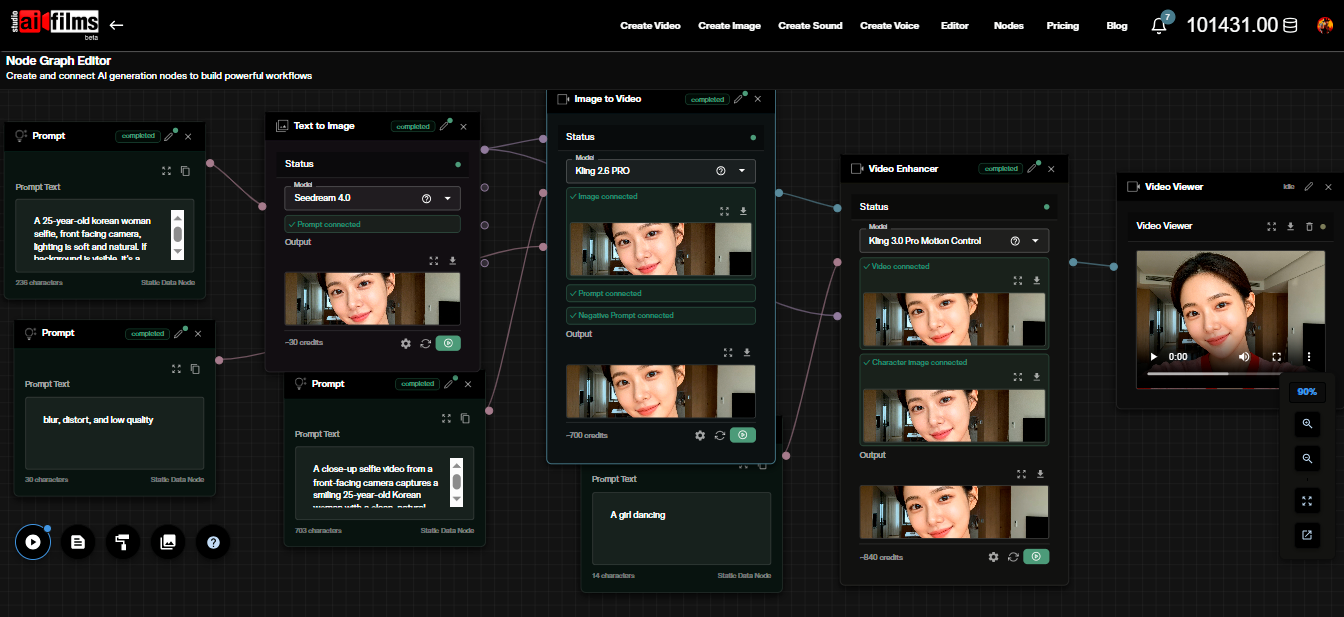
Filmmakers ready to test the tools these directors described can access text-to-video and image generation through the AI FILMS Studio video workspace.
Sources
The Hollywood Reporter | Variety | The Wrap | Deadline | Screen Daily
Continue Reading
.jpg?w=3840)


Video & LipSync
- Video Generator
- Text to Video
- Image to Video
- Start-End Frame to Video
- Draw to Video
- Motion Control
- Video Enhancer
- Video Upscaler
- Video Extend
- Video to Video LipSync
- Audio to Video LipSync
- Image to Video LipSync
- Video FaceSwap
- Seedance 2.5
- WAN 3.0
- Seedance 2
- FLUX 3
- Minimax H3
- Vidu Q3 Pro
- Grok Imagine Video 1.5
- Gemini Omni
- Google Veo 3.1
- Kling 3.0 Pro
- Luma Ray 3.2
- LTX 2.3
- Happy Horse 1.1
- Kling 3.0 Motion
- ByteDance Upscaler
- InfiniteTalk
- InsightFace
Image & Edit
- AI Character
- AI Actor
- Art Generator
- Text to Image
- Image to Image
- LoRA Image to Image
- Draw to Edit
- Image LoRA Training
- Remove Background
- Image Enhancer
- MidJourney 8.0
- Krea 2
- OpenAI GPT Image 2.0
- Nano Banana Pro Ultra
- Nano Banana 2 Lite
- Nano Banana Pro
- Minimax Image
- Clarity Pro
- Z-Image Turbo LoRA
- Krea 2 Turbo LoRA
- Z-Image LoRA Trainer
- Qwen Image LoRA Trainer
- Background Erase Network 2 (BEN2)