
Jia Zhang-ke at Cannes: "With AI, You Lose the Collective Soul of Filmmaking"
%20(1).jpg?w=3840&q=90)
Share this post:
Jia Zhang-ke at Cannes: "With AI, You Lose the Collective Soul of Filmmaking"
Jia Zhang-ke presented "Torino Shadow" in the official selection at the 79th Cannes Film Festival, a 32 minute short that meditates on cinema through shadow puppetry and the parallel architectures of Turin and Taishan. In a Variety interview at Cannes, he gave the clearest statement yet from a major Asian director on what AI removes from filmmaking, arguing that the technology reduces collaboration to its smallest possible form.
%20(1).jpg)
Georges Biard, CC BY-SA 4.0, via Wikimedia Commons
Jia Zhang-ke won the Venice Golden Lion for "Still Life" in 2006 and built his career on close observation of China's collective experience, from the mass displacement of the Three Gorges Dam era to the industrial decay of Datong. He arrived at Cannes 2026 not as a theorist of AI limitations, but as a filmmaker who had already tested the technology directly before forming his position.
"Just You and the Engineer"
"With AI, it is just you and the engineer", Jia told Variety. "Two people, with all the imaginative limits that entails".
For Jia, that pairing is the problem. Traditional filmmaking at its best is a convergence of many contributors at a single moment: a director, a cinematographer, actors, crew, and the specific conditions of a real place and time. Jia draws on Austrian writer Stefan Zweig's concept of "starry hours" to describe those rare junctures when collective human effort produces something no individual could have reached alone. AI assisted work, he argues, removes the conditions that make those moments possible.
Stefan Zweig and the "Starry Hours" Argument
Stefan Zweig's "Sternstunden der Menschheit", translated as "Stellar Moments" or "Decisive Moments in History", described pivotal historical junctures when the right people converged at the right time to produce something irreversible. Jia borrows the framework and applies it to filmmaking: the collision of specific human presences, in a specific place, under specific conditions, produces work that could not have been planned or simulated.
The argument is not primarily about quality. It is about conditions of possibility. AI assisted production, reduced to a director and an engineer, eliminates the human surfaces that friction and unexpected collaboration require. A cinematographer's instinctive reading of available light, an actor's physical discovery in the moment, a location detail that rewrites how a scene functions: these are the surfaces AI removes while leaving the director's intention intact.
What AI Can Do Well
Jia sees genuine potential in what AI can produce that conventional production cannot. "Using AI we can discover 100 kinds of plants or flowers that don't exist on Earth", he told Variety, pointing to impossible visualization as the technology's real creative opening.
Earlier in 2026, he experimented directly. He used Seedance 2.0 to produce a short that placed two AI generated versions of himself on screen simultaneously, debating questions of authorship and creative control. That AI short treated the technology as a medium worth understanding through practice. His Cannes argument draws on that firsthand experience, not on abstract objection.
What the Experiment Confirmed
Jia's Seedance 2.0 short gave his Cannes position something most filmmaker statements about AI lack: ground truth from working with the technology. He did not arrive at the "just you and the engineer" position by observing other people's results. He arrived at it by producing his own.
The specific form of his experiment, placing two versions of himself in dialogue, is itself a reflection on the limits he describes. The film raises authorship as its subject while using AI as its method. That structure is only available to a filmmaker who has already thought carefully about what the technology does and does not preserve from the traditional process. It also demonstrates that Jia's argument is a precise account of what the tool costs, not a rejection of AI as a tool.
"Torino Shadow"
"Torino Shadow" is filmed conventionally, with no AI in its production pipeline. Jia made it about cinema itself rather than through the lens of AI as a tool.
The 32 minute short is built around shadow puppetry, a form of storytelling with deep roots in Chinese culture, and traces what Turin and Taishan share architecturally and historically. The film explores how cinema creates collective memory that no single person owns. Jia won the Venice Golden Lion for "Still Life" in 2006 and built his reputation on close observation of Chinese collective experience. "Torino Shadow" continues that project in short form.
Shadow Puppetry as Deliberate Counterargument
Choosing shadow puppetry for a film about cinema's collective soul is not incidental. Shadow puppetry is among the oldest performance forms in both Chinese and Mediterranean traditions, predating cinema by centuries. It is entirely handmade, entirely dependent on the physical presence of a performer, and produces work that varies with each performance in ways that cannot be reproduced identically.
Jia's use of the form in a film presented at Cannes during the same week the festival banned generative AI from competition reads as a deliberate argument made in visual terms. The film does not need to state its position verbally because the choice of medium states it. A shadow puppet is the opposite of a generated image.
The Turin-Taishan Parallel
Turin and Taishan are the film's geographic and architectural poles. Turin, in northern Italy, is an industrial city shaped by Fiat's postwar expansion and the social structures that factory production created. Taishan, in China's Pearl River Delta, underwent a parallel transformation through emigration and the remittance economy that defined its overseas Chinese architecture in the early twentieth century.
Both cities carry histories of collective labor in their physical fabric. Both have undergone deindustrialization and the resulting disruption of the communities that built them. The architectural parallel Jia finds between them is a version of the same argument he makes about cinema: collective human effort leaves traces that outlast the individuals who produced it.
The Cannes Official Selection placement for "Torino Shadow" signals the festival's assessment that the film belongs alongside the main competition works rather than in a sidebar. Official Selection designations at Cannes determine how a film is covered by trade press and how it circulates internationally in the months after the festival. A 32 minute short receiving that designation is less common than a feature, which adds to the film's visibility when it moves toward distribution.
.jpg)
Georges Biard, CC BY-SA 4.0, via Wikimedia Commons
The Argument and the Award
Jia's position landed the same week Cannes officially banned generative AI from its competition and Tilda Swinton presented the Palme d'Or to Cristian Mungiu's "Fjord", declaring that films "really messy and about the human experience" left cinema safe from AI. The closing ceremony became a statement on collective versus algorithmic filmmaking.
Screen Daily listed "AI moves in" as one of the seven defining talking points of the 2026 Cannes edition. At the Marché du Film, running in parallel to the competition, more than 20 tech focused sessions dominated the final four days. Jia's distinction between AI's potential for impossible imagery and its incapacity for genuine collaboration sits at the center of that split.
The Role of Place in Jia's Filmmaking
Jia's body of work is inseparable from the specific Chinese landscapes and social formations it documents. "Platform" (2000) follows a theater troupe through Shanxi Province as China's economy transforms. "Unknown Pleasures" (2002) is set in Datong as its industrial base collapses. "Still Life" (2006) is shot in towns being inundated by the Three Gorges reservoir. Place is not background in Jia's films. It is structure.
The Turin-Taishan parallel in "Torino Shadow" extends that methodology to a transnational scale. Rather than documenting a single Chinese place, the film searches for architectural kinship across national and cultural boundaries. Shadow puppetry was the art form available in both traditions before cinema existed. The film uses a form that predates cinema to ask questions about what cinema, now under pressure from AI, actually is.
What the Cannes AI Ban Established
Cannes' April 2026 ruling barred generative AI from functioning as a creator in films submitted for Official Competition. The rule covered scripting, performance synthesis, and primary visual generation while permitting technical AI in post production. That distinction between creative origination and technical processing became the framework other festivals and industry bodies referenced when developing their own positions.
Jia's presence in the Official Selection with a film made entirely without AI, paired with his Variety interview during the same week, placed his argument in direct dialogue with the festival's own rule. He was not speaking abstractly about AI and creativity. He was speaking from within a festival that had just committed to a specific position, in a language that the rule itself validated.
The Cannes Marché and the Split Week
While Jia was making his case against AI's incapacity for collective creativity in the press areas, the Marché du Film was hosting more than 20 AI focused sessions for buyers and sellers. Screen Daily's characterization of "AI moves in" as one of the seven defining themes of the 2026 edition captures the week's essential tension.
The Marché serves commercial production, not prestige competition. Its sessions addressed how AI tools fit into the economics of international coproduction, distribution, and financing rather than what those tools mean for the art form. That institutional split, between the artistic program and the commercial market running simultaneously, was the context Jia's statement landed in.
The Filmmaker's Investment Before Taking a Position
Jia's willingness to engage the technology on his own terms before speaking publicly about it sets his statement apart from most Hollywood AI commentary. Directors and actors frequently opine on AI without having used it in production. Jia produced a short film with Seedance 2.0 and then drew conclusions from that experience.
That sequence matters because it grounds the "just you and the engineer" observation in practice. The limit Jia names is a report from inside the process, not a theoretical concern about what AI might fail to preserve.
Jia and the Chinese Director Generation
Jia belongs to the sixth generation of Chinese directors, the generation that came of age after the Cultural Revolution and produced work shaped by China's economic opening and its social consequences. Directors like Zhang Yuan, Wang Xiaoshuai, and Lou Ye developed alongside Jia during the 1990s and early 2000s, each working with small budgets and limited institutional support and producing films whose specificity came from close attention to places and communities undergoing rapid transformation.
That generation built its artistic identity around the irreplaceable specificity of documentary engagement with real people and real places. The AI debate, for directors whose creative foundation is that form of attention, is a debate about what cinema is for in a way that it is not for directors whose tradition is more studio based.
What the 79th Cannes Edition Chose
The 79th Cannes Film Festival selected Jia's film and banned AI from its competition in the same year. That combination is not coincidental. The programming and rule changes at a festival of Cannes' institutional weight reflect considered positions rather than ad hoc decisions. Selecting "Torino Shadow", a film built around a pre-cinematic art form and presented by a director who has spoken clearly about what AI removes from filmmaking, is part of the same institutional argument as the AI ban itself.
The festival's choices across a single edition communicate its values. What gets into the Official Selection alongside what gets excluded from competition are both statements. The 79th edition made both kinds of statement about AI in cinema during the same week.
How Jia's Position Fits the Cannes 2026 Debate
At Cannes 2026, the AI debate divided broadly into two positions: those who argued the technology threatened the conditions that make cinema possible, and those who argued it expanded what cinema could produce. Jia's statement occupies an unusual place because it holds both views at once.
He has made AI film. He sees what the technology can do with impossible visuals. And he has concluded that its irreducible limitation is structural: it collapses the collaborative surface that his best work has depended on. That is a more precise objection than a blanket rejection, and it is grounded in practice rather than principle.
The distinction also clarifies what the technology might be useful for within a director like Jia's practice. The impossible visuals he cited, plants and flowers that do not exist on Earth, are exactly the kind of visualization that serves a filmmaker whose work begins with the question of what cannot be seen through conventional documentation. AI as a tool for visualizing the impossible, rather than as a replacement for the collective conditions that make cinema meaningful, is the specific opening he names.
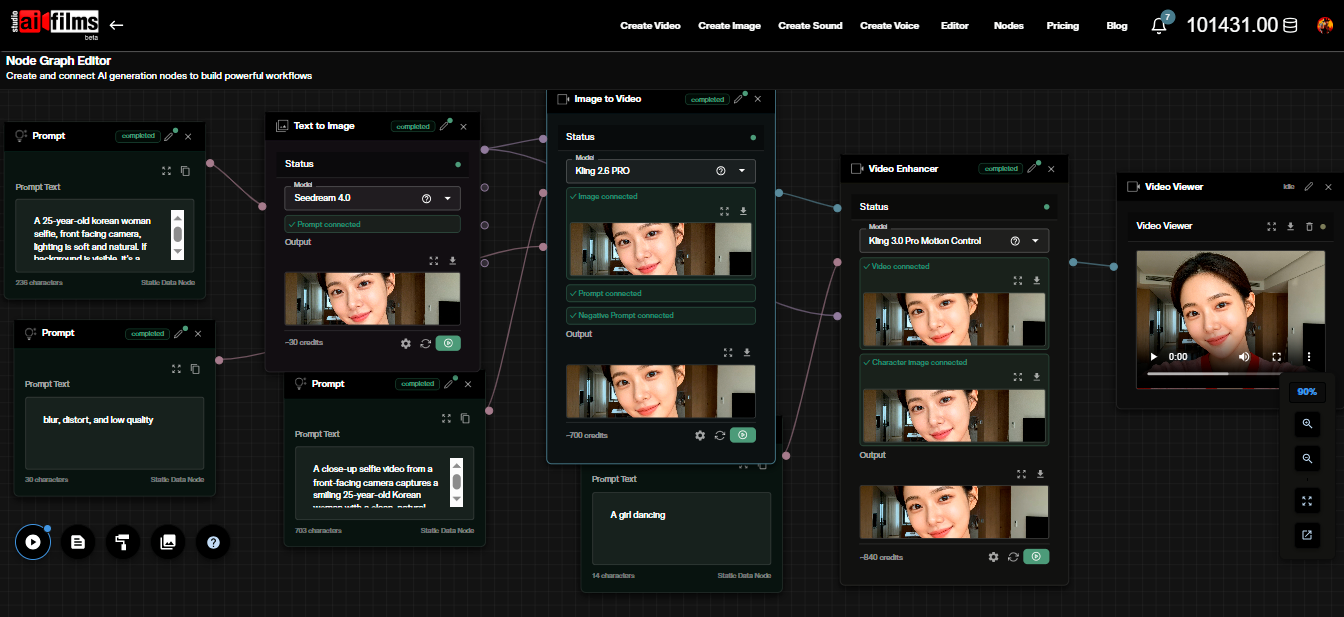
Filmmakers building work that depends on collective contribution can find the AI video tools increasingly used on professional sets in the AI FILMS Studio video workspace.
Sources
Variety | The Wrap | Screen Daily | The Hollywood Reporter | IndieWire
Continue Reading
.jpg?w=3840)


Video & LipSync
- Video Generator
- Text to Video
- Image to Video
- Start-End Frame to Video
- Draw to Video
- Motion Control
- Video Enhancer
- Video Upscaler
- Video to Video LipSync
- Audio to Video LipSync
- Image to Video LipSync
- Video FaceSwap
- Seedance 2.5
- WAN 3.0
- Seedance 2
- FLUX 3
- Minimax H3
- Vidu Q3 Pro
- Grok Imagine Video 1.5
- Gemini Omni
- Google Veo 3.1
- Kling 3.0 Pro
- Luma Ray 3.2
- LTX 2.3
- Happy Horse 1.1
- Kling 3.0 Motion
- ByteDance Upscaler
- InfiniteTalk
- InsightFace
Image & Edit
- AI Character
- AI Actor
- Art Generator
- Text to Image
- Image to Image
- LoRA Image to Image
- Draw to Edit
- Image LoRA Training
- Remove Background
- Image Enhancer
- MidJourney 8.0
- Krea 2
- OpenAI GPT Image 2.0
- Nano Banana Pro Ultra
- Nano Banana 2 Lite
- Nano Banana Pro
- Minimax Image
- Clarity Pro
- Z-Image Turbo LoRA
- Krea 2 Turbo LoRA
- Z-Image LoRA Trainer
- Qwen Image LoRA Trainer
- Background Erase Network 2 (BEN2)