
Locarno 79: 'The Counter-Algorithm Is a Human Being Who Gives a Damn'

Share this post:
Locarno 79: "The Counter-Algorithm Is a Human Being Who Gives a Damn"
The 79th Locarno Film Festival opens August 5, 2026, carrying a proposition: the human programmer is the counter algorithm. While streaming platforms use behavioral data to determine what audiences should see next, a film festival's artistic director makes curatorial decisions that no dataset can replicate. That argument, stated explicitly in Locarno's StepIn think tank materials obtained by Variety, is the festival's formal response to the question of what human film culture is for in the age of AI recommendation systems.
The festival runs August 5 to 15 in Locarno, Switzerland. The 79th edition presents 233 total works, including 51 features, 81 shorts, and 1 series. The main screening venue is the Piazza Grande, an open air lakeside cinema that functions as the festival's signature image: thousands of spectators watching films under the night sky with the Alps visible in the distance.
"Power, People, Data and the Future of Film"
Locarno's StepIn think tank, a film industry forum that runs alongside the main competition, has organized its 2026 edition around the theme "Power, People, Data and the Future of Film." The forum brings together filmmakers, distributors, platform executives, and critics to discuss where the film industry is heading. The counter algorithm framing is StepIn's governing concept for 2026.
StepIn operates as a designated space for the industry to think out loud about structural questions it cannot resolve inside the market. Its 2026 theme places data directly at the center of that inquiry, not as a tool to be adopted or rejected but as the defining condition of the current film market. The choice to name data in the theme title, alongside power and people, is a precise editorial decision about what the industry's real dispute is.
The phrase comes directly from festival materials shared with Variety: "The counter algorithm is a human being who gives a damn." It is both a description of what a film programmer does and a claim about what that work is worth. Algorithms optimize for engagement metrics derived from past behavior. A programmer selects films based on judgment, aesthetic values, and a belief that audiences can be introduced to work they did not already know they wanted.
Artistic Director Giona A. Nazzaro told The Hollywood Reporter that the 2026 program is intended to be "adventurous" specifically as a counterpoint to algorithmic recommendation culture. His premise is that recommendation systems narrow audiences toward what they have already demonstrated they will watch. A festival committed to adventurous programming is the structural alternative.
233 Works, One Open Air Screen
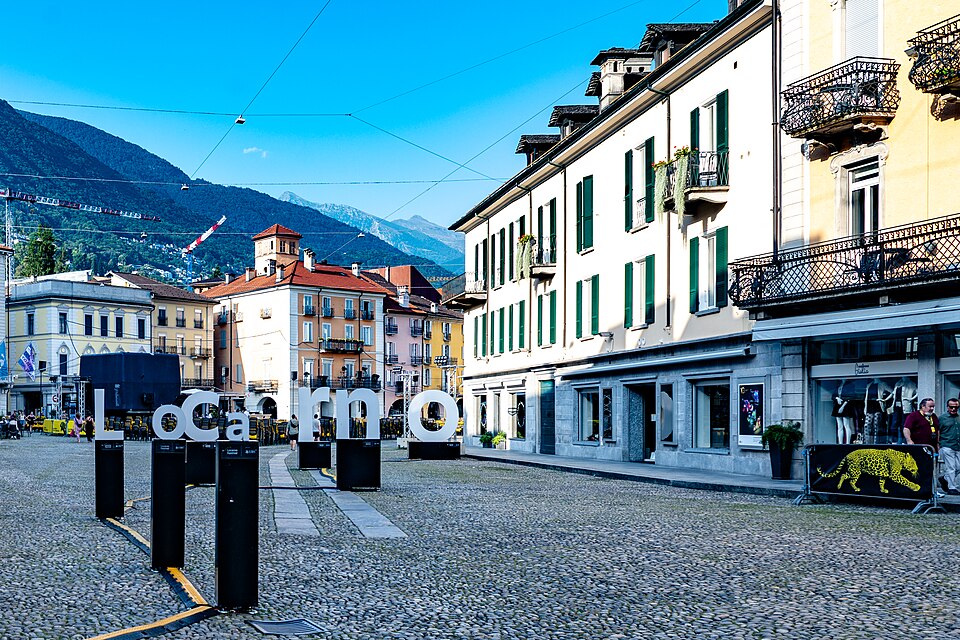
DavidPMaynard, CC BY-SA 4.0, via Wikimedia Commons
The Piazza Grande is the festival's most visible asset: a large open air cinema in the historic center of Locarno, with the lake and mountains as backdrop. Screening there is one of the most physically distinctive experiences available to a filmmaker. The venue's scale and setting are part of what Locarno offers that a streaming platform cannot approximate.
The 233 total works in the 79th program span international competition, retrospective, and special events. The 51 features include the main competition, which determines the Golden Leopard, and sidebar sections. The 81 shorts represent a significant commitment to short film as a distinct form, not simply a proving ground for feature directors.
The international competition selection includes Hong Sang Soo (South Korea), Denis Côté (Canada), Albert Serra (Spain), Lê Bảo (Singapore/Vietnam), Ann Oren, Florin Serban, and León & Cociña. This lineup is consistent with Locarno's longstanding preference for formally ambitious international work over commercially positioned prestige cinema. None of these filmmakers has a studio infrastructure behind them. Each arrives based on the artistic director's judgment, which is precisely the point the festival is making.
Tributes at the 79th edition go to James Gray and Darren Aronofsky. Both directors represent a generation of filmmakers who built careers on personal vision within, and sometimes against, American studio infrastructure. Their presence at a festival arguing for human curation over algorithmic programming is contextually appropriate.
Gray's films, including "We Own the Night," "The Immigrant," and "Ad Astra," have never performed at the commercial scale their studio releases required. Several were considered disappointments at the box office. They have all grown in critical estimation over time. An algorithm optimizing for opening weekend revenue would have identified Gray's track record as a risk factor. A programmer arguing for human judgment over behavioral data would cite the same films as evidence that the algorithm would have been wrong.
Aronofsky described his AI project's improvement from January to April 2026 as "mind blowing" at Cannes. His presence as a Locarno tribute subject alongside that statement situates him at the center of the 2026 debate: a filmmaker whose career was built on the kind of uncompromising personal vision Locarno celebrates, now publicly engaging with the AI tools that complicate the counter algorithm argument. Both can be true of the same filmmaker in the same year. Locarno 79's tribute program placed that tension in the main program without resolving it.
Human Curation as Counter Programming
Nazzaro's argument is not that recommendation algorithms are bad at their function. They are good at their function, which is returning content similar to what a user has previously engaged with. His argument is that this function is insufficient for cinema's cultural role.
A festival can show a film from a debut director in a language spoken by few people in the audience, by a filmmaker who has no commercial profile in any territory where tickets will be sold. That decision is a bet on artistic judgment over demonstrated market preference. An algorithm cannot make that bet because algorithms do not make bets; they reflect the aggregate behavior of past users.
The economic pressure on festivals to behave more like platforms is real. Streaming coproduction finance and output deals with festivals have given platforms greater influence over programming decisions. Locarno's counter algorithm argument is partly a defense of the festival's own curatorial independence from that pressure. Naming the programmer as the answer to the algorithm is a statement about what the festival refuses to let go of.
The counter algorithm framing also addresses what festivals offer to filmmakers directly. A Locarno selection creates a global moment for a film that streaming distribution might never generate. A film placed in an algorithm's recommendation queue competes silently against every other piece of content on the platform. A film screening in the Piazza Grande in front of thousands of people has an audience, a context, and a press response that exists nowhere else in the world. The economic logic of the two distribution channels is entirely different.
The Hollywood Blacklist Retrospective
The 79th edition's retrospective focuses on the Hollywood blacklist, the period between 1947 and 1960 when approximately 300 writers, directors, and actors were refused employment in the American film industry based on alleged Communist sympathies. Many worked under pseudonyms or had their credits removed entirely.
No press coverage of the 2026 Locarno program has noted what the programming choices placed next to each other. The festival is simultaneously running a think tank on AI's relationship to human authorship and a retrospective on a historical episode in which human authors were stripped of credit for their work based on political association.
The parallel is not exact. The blacklist stripped credit for ideological reasons; AI authorship debates involve questions of whether human credit is warranted at all when machine tools generate content. But both are crises about who gets named as the author of creative work, and under what conditions that naming can be challenged or removed. Locarno placed both conversations in the same program. Whether intentionally or not, the juxtaposition is coherent.
The blacklist retrospective also serves the counter algorithm argument in a less obvious way. The writers who survived the blacklist often did so through informal networks, underground screenings, and the advocacy of individuals who valued their work independent of its commercial or political profile. That is a description of what film festival culture has historically provided to work that the mainstream market cannot accommodate. The Piazza Grande is the institutional version of that function at scale.
The retrospective's selection is also a statement about film history's relationship to institutional validation. Blacklisted filmmakers whose credits were stripped are now the subject of a tribute at one of Europe's most historically significant festivals. The work survived the system that tried to suppress it because individual advocates kept it alive. The counter algorithm argument is that the same function, individual humans making judgments that institutional systems cannot replicate, is what keeps cinema vital in 2026 as it did in 1947.
Whether the parallel between the blacklist era and the current AI authorship debate is the programming team's intention is not documented in any Locarno communication. The juxtaposition is the result regardless of intent. Locarno 79 opened with a think tank on AI and data, ran a competition of formally ambitious international films that no algorithm would have selected, and screened a retrospective on what happens when authorship is stripped from artists by external systems. That is the full program of the 79th edition.
Locarno Among the Major European Festivals
Cannes 2026 banned generative AI from its official competition, instituting the first categorical prohibition at a major film festival. The decision created an explicit line between AI-generated work and Palme d'Or eligibility.
Locarno has taken a philosophically different approach. There is no AI ban in the 79th program. The festival's position is expressed through its curatorial philosophy, not through eligibility rules. Identifying the programmer as "the counter algorithm" is a statement about human value, not a restriction on what tools filmmakers may use.
Venice 2026 has similarly not announced categorical AI restrictions, relying on Artistic Director Alberto Barbera's individual film evaluation rather than rule-based exclusions. The three major European festivals opening in close succession, Locarno in August, Venice in late August, and the fall festival circuit that follows, now represent three distinct positions on how film institutions should relate to AI tools: prohibit, evaluate individually, or name human curation as the philosophical response.
The Reply AI Film Festival running concurrently at Venice shows the parallel track that exists for specifically AI-focused work. AI generated films have dedicated festivals designed to receive them. The question the major festivals are answering with their positioning is which films belong in the main competition, not whether AI films exist as a category.
Locarno's counter algorithm framing sidesteps the eligibility debate entirely. It does not say AI films are welcome or unwelcome. It says the programmer's judgment is the institution's value proposition, and that judgment applies to all films regardless of how they were made. That position is coherent and replicable. Any festival can say it. What Locarno 79 demonstrates is whether saying it produces a program worth attending. 233 works, 1,000+ industry professionals at Locarno Pro, and a full Piazza Grande across ten August nights are the evidence that it does.
What Locarno Pro 2026 Reported
Locarno Pro, the industry program that runs alongside the competition from August 6 to 11, drew more than 1,000 professionals to sessions on AI, algorithms, and independent film distribution. The opening StepIn think tank panel asked the room who was full of hope after researcher Stephen Follows presented data on how algorithm driven acquisition is narrowing the arthouse market. Two hands went up.
That response came from a room that had just heard what the counter algorithm argument looks like when translated from curatorial philosophy into commercial evidence. The StepIn data described the same dynamic Nazzaro named before the festival opened: recommendation systems optimize for prior behavior, and the films worth distributing to independent cinema audiences are precisely the films that prior behavior cannot predict.
Andrea Occhipinti of Lucky Red stated the position directly at the panel: "We don't use algorithms to choose a film that we want to distribute or produce." He cited Pawel Pawlikowski's "Ida" and Barry Jenkins's "Moonlight" as specific examples of films that data driven acquisition models would have passed on. Both films won Academy Awards.
The Locarno Investment Community, which ran alongside Locarno Pro from August 6 to 9, drew venture capital interest as an alternative to contracted streaming finance. The VC presence at Locarno is itself a measure of how far the traditional streaming acquisition model has shifted: investors are attending the festival to explore what fills the gap that platform spending left behind.
Olivia Wilde addressed a related dimension at the festival: "They bribe you to not take theatrical. We have to fight for it." The phrase "bribe" describes the financial incentive streaming platforms use to steer films away from theatrical windows. The Locarno Pro audience for that remark consisted of the professionals deciding whether to accept those terms.
Where the Festival Stands After 79 Editions
The counter algorithm position Nazzaro stated before the festival opened carried through both the competition program and the Locarno Pro sessions. The curatorial argument is that human judgment selects films that engagement data cannot predict. The Locarno Pro data is that the industry professionals operating on that argument held their nerve at the sessions but did not, for the most part, report feeling hopeful about the structural environment in which that argument is being made.
The 79th edition ran August 5 to 15. The Golden Leopard and Locarno Pro conclusions both belong to the same festival. The artistic program demonstrated that adventurous curation can fill a Piazza Grande. The industry program demonstrated that the professionals who depend on that curation for their livelihoods are assessing a difficult market with clear eyes.
Neither conclusion negates the other. Locarno 79 ran as a working festival with a serious competition, 1,000+ industry attendees, and a StepIn think tank that produced a documented result. The counter algorithm is still a human being who gives a damn. What Locarno Pro 2026 established is what that person is looking at when they give that damn.
Locarno in the Broader 2026 Festival Circuit
The 79th Locarno Film Festival ran from August 5 to 15, placing it at the center of the European festival summer. Venice follows in late August. The fall festival circuit begins in September. The positions each festival takes on AI and algorithmic curation in 2026 collectively define the institutional posture of major film events toward generative technology.
Locarno's position is now documented through two channels: the curatorial philosophy Nazzaro stated before the festival, and the Locarno Pro industry data generated during it. The 233 titles selected for the competition represent the former. The two raised hands in a room of 1,000 represent the latter.
Both are real data points about where cinema stands in August 2026. The festival ran. The competition selected. The industry professionals attended and reported their state of mind. Locarno 79 produced evidence on both the artistic and the commercial dimensions of the counter algorithm argument in the same two weeks.
The Piazza Grande remains the festival's clearest image of what human curation produces at scale: thousands of people, under the night sky, watching films that no recommendation algorithm selected for them. The 79th edition added documented industry data to that image. The StepIn panel results and the two raised hands belong to the same festival as the Golden Leopard and the 51 competition films.
The filmmakers in the 79th competition, including Hong Sang Soo, Denis Côté, Albert Serra, and Lê Bảo, represent the specific category of work that exists because programmers like Nazzaro make bets that platform data cannot support. Côté's work is formally rigorous and commercially marginal. Serra's films have never generated streaming numbers that would justify a platform investment. None of that disqualifies them from the Piazza Grande. The Locarno selection is the proof of concept for the counter algorithm argument, repeated across 51 films.
What changes between the 78th and 79th edition is not the curatorial philosophy. It is the industry context in which that philosophy operates. Locarno Pro 2026 documented that context with more specificity than any previous edition. The one or two year timeline Markus Duffner named is the period in which the structural shifts will reach every part of the independent market. The 79th program ran exactly at the moment that timeline began.
The 233 titles in the 79th program were selected by a programmer operating on exactly the principle the counter algorithm phrase describes. Each selection is evidence of the argument in practice, not only in statement. Nazzaro's curatorial record spans multiple editions and consistently demonstrates that festival scale human curation produces a program that platform recommendation models would not generate. That record is now running alongside Locarno Pro data that documents the industry conditions in which it operates. The 79th program asked and answered one question: given a market in which nearly no one reports feeling hopeful, what does adventurous curation look like? The answer is 233 films, 51 in competition, a Piazza Grande audience, and a Golden Leopard awarded to a work no algorithm would have predicted.
Independent filmmakers developing projects for festival submission can generate video, test visual concepts, and produce proof-of-concept footage through AI FILMS Studio's video workspace.
Sources
Variety | The Hollywood Reporter | Screendaily | Deadline | The Film Stage
Continue Reading
.jpg?w=3840)


Video & LipSync
- Video Generator
- Text to Video
- Image to Video
- Start-End Frame to Video
- Draw to Video
- Motion Control
- Video Enhancer
- Video Upscaler
- Video to Video LipSync
- Audio to Video LipSync
- Image to Video LipSync
- Video FaceSwap
- Seedance 2.5
- WAN 3.0
- Seedance 2
- FLUX 3
- Minimax H3
- Vidu Q3 Pro
- Grok Imagine Video 1.5
- Gemini Omni
- Google Veo 3.1
- Kling 3.0 Pro
- Luma Ray 3.2
- LTX 2.3
- Happy Horse 1.1
- Kling 3.0 Motion
- ByteDance Upscaler
- InfiniteTalk
- InsightFace
Image & Edit
- AI Character
- AI Actor
- Art Generator
- Text to Image
- Image to Image
- LoRA Image to Image
- Draw to Edit
- Image LoRA Training
- Remove Background
- Image Enhancer
- MidJourney 8.0
- Krea 2
- OpenAI GPT Image 2.0
- Nano Banana Pro Ultra
- Nano Banana 2 Lite
- Nano Banana Pro
- Minimax Image
- Clarity Pro
- Z-Image Turbo LoRA
- Krea 2 Turbo LoRA
- Z-Image LoRA Trainer
- Qwen Image LoRA Trainer
- Background Erase Network 2 (BEN2)