

Kandinsky Lab (MIT License)
Share this post:
Kandinsky ImageSR 2.0: Open Source 1 Step Image Upscaler
Kandinsky Lab released Kandinsky ImageSR 2.0 on November 24, 2026 as a complete Diffusers bundle for one step image super resolution. A single set of transformer weights serves both 2x and 4x upscaling, taking 1K and 2K plates up to 4K or 8K with tiled blending. You can test Kandinsky ImageSR 2.0 free in the embedded browser demo below with zero login.
Studio availability. Try the public Hugging Face demo below; Kandinsky ImageSR 2.0 is not part of a paid AI FILMS Studio plan (use SeedVR Image Upscaler in the image workspace for example instead).
Try Kandinsky ImageSR 2.0 Live
Upload a film still, storyboard frame, or concept render into the official Kandinsky Lab Space below. Pick a 2x or 4x scale factor and adjust the creativity slider to inspect restored detail directly in your browser.
Architecture and Technical Design
Kandinsky ImageSR 2.0 builds on the Kandinsky 5 transformer included in Diffusers 0.41 and newer. Instead of loading a multi billion parameter text encoder at inference time, the release uses prebaked zero text conditioning. Small per timestep Safetensors tables replace the entire text tower and all 50 cross attention layers.
Dropping the text encoder cuts memory overhead and removes prompt variance from plate restoration. The pipeline pairs the transformer with the Apache 2.0 VAE from black-forest-labs/FLUX.1-schnell, keeping high frequency edges sharp across skin, foliage, and architectural lines.
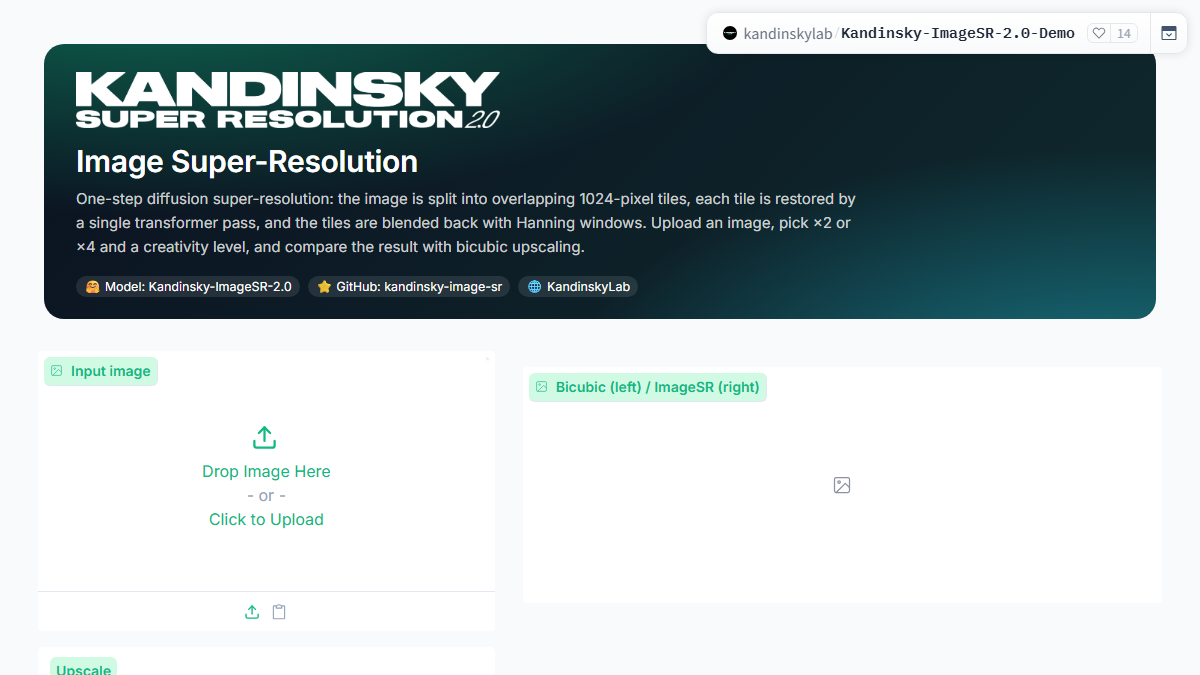
Interactive Space interface by Kandinsky Lab (MIT)
The pipeline splits large target frames into overlapping 1024 pixel output tiles and restores each tile in a single denoising step. Boundary aware Hanning windows blend overlapping edges so tile seams do not appear across smooth skies or studio backdrops.
Inputs smaller than a full tile are replicate padded before inference and cropped back to the exact requested dimensions. Because the transformer runs one evaluation per tile, scaling latency tracks the tile grid count predictably.
Hardware, Latency, and License Matrix
Kandinsky Lab published median single call benchmarks on an NVIDIA H100 80GB SXM GPU using bfloat16, PyTorch 2.13.0, CUDA 12.9, and tile_batch_size=1. Every measurement reflects the median of 5 full pipe(...) calls after 2 warm up runs.
| Input Resolution | Scale | Output Resolution | Tile Grid | Median Time (H100 80GB) |
|---|---|---|---|---|
| 1024 x 1024 (1K) | 2x | 2048 x 2048 (2K) | 3 x 3 | 2.78 s |
| 1024 x 1024 (1K) | 4x | 4096 x 4096 (4K) | 5 x 5 | 7.80 s |
| 2048 x 2048 (2K) | 2x | 4096 x 4096 (4K) | 5 x 5 | 7.84 s |
| 2048 x 2048 (2K) | 4x | 8192 x 8192 (8K) | 11 x 11 | 37.5 s |
| 4096 x 4096 (4K) | 2x | 8192 x 8192 (8K) | 11 x 11 | 37.7 s |
| Attribute | Specification |
|---|---|
| Release date | November 24, 2026 |
| Transformer & pipeline license | MIT License (commercial use permitted) |
| Bundled VAE license | Apache 2.0 (FLUX.1-schnell VAE) |
| Precision | torch.bfloat16 on CUDA GPUs |
| Denoising steps | 1 step per 1024 pixel tile |
| Text encoder VRAM | 0 GB (replaced by per timestep tables) |
Parameter Reference
Kandinsky ImageSR 2.0 exposes a calibrated creativity scale from 0 to 8 alongside raw one_step_t presets. Arbitrary raw one_step_t numbers outside the 18 calibrated values in the model config are rejected because each timestep maps to a prebaked conditioning table.
| Parameter | Valid Values | Default | Filmmaker Effect |
|---|---|---|---|
upscale_factor |
2 or 4 |
4 |
Selects 2x or 4x output scale using the same weights |
one_step_t (2x) |
0.07 to 0.30 (calibrated presets) |
0.15 |
Controls how strongly the step hallucinates fine texture |
one_step_t (4x) |
0.17 to 0.38 (calibrated presets) |
0.244 |
Balances faithful restoration against crisp synthesis |
creativity |
Integer 0 to 8 |
4 |
Maps directly to the 18 calibrated timestep tables |
tile_batch_size |
Integer >= 1 | 1 |
Raises batch throughput on high VRAM workstations |
Local Python and CLI Setup
Install PyTorch for your CUDA driver first, then install the official kandinsky-image-sr package from GitHub. The pipeline downloads weights automatically through from_pretrained.
pip install torch --index-url https://download.pytorch.org/whl/cu128
pip install git+https://github.com/kandinskylab/kandinsky-image-sr.git
Run a 4x upscale in Python with bfloat16 precision.
import torch
from kandinsky_image_sr import KandinskyImageSRPipeline

pipe = KandinskyImageSRPipeline.from_pretrained(
    "kandinskylab/Kandinsky-ImageSR-2.0",
    dtype=torch.bfloat16,
).to("cuda")

result = pipe(
    "input.png",
    upscale_factor=4,
    one_step_t=0.244,
)
result.images[0].save("output.png")
To reproduce the official benchmark script from a local clone, run the native backend CLI command.
CUDA_VISIBLE_DEVICES=0 python scripts/test.py --image photo.jpg --backend native
Filmmaker Production Playbook
Upscaling 1K Keyframes for 4K Image-to-Video Pipelines
Most open source image generators output 1024 x 1024 or 1280 x 720 stills quickly, while finishing departments need 4K plates for projection or compositing. Running Kandinsky ImageSR 2.0 at 4x with creativity=3 or 4 turns a 1K concept frame into a clean 4096 x 4096 master in under 8 seconds on an H100.
Matte Painting and Print Poster Finishing at 8K
Matte painters and poster designers often paint at 2K to keep brush response fast. Passing a 2048 x 2048 painting through 4x mode produces an 8192 x 8192 print ready plate across an 11 x 11 tile grid without visible grid seams. Keep creativity at 2 or 3 when preserving painted brushstrokes or small signage text.
Batch Keyframe Cleanup Without Prompt Engineering
Because zero text conditioning removes prompt inputs entirely, you can batch upscale hundreds of character turnarounds, prop sheets, or storyboard panels in one script. Output stays consistent across frames without writing per image captions.
Known Limitations and FAQ
Can I enter a custom prompt to guide texture restoration? No. Kandinsky Lab intentionally removed the text encoder and replaced all 50 cross attention layers with prebaked per timestep tables. This keeps memory low and prevents hallucinated objects from drifting away from the source frame.
Why did my custom one_step_t value raise an error?
The release only supports the default timestep values (0.15 for 2x and 0.244 for 4x) and the 18 calibrated creativity presets stored in the model config. Pass creativity between 0 and 8 instead of arbitrary floats.
Does Kandinsky ImageSR 2.0 handle video temporal consistency? No. This model processes individual still frames. For temporally stable video upscaling, pair it with Kandinsky 6.0 VSR 2.0.
Related Reading
- Kandinsky 6.0 VSR 2.0: Open Source 2 Step Video Upscaler
- DyPE: Training Free Method for 4K Image Generation
- Qwen-Image 2.1 Turbo: 8 Step Open Weights 2K Image AI
- AI Image Upscaler

Sources
Continue Reading


Video & LipSync
- Video Generator
- Text to Video
- Image to Video
- Start-End Frame to Video
- Draw to Video
- Motion Control
- Video Enhancer
- Video Upscaler
- Video Extend
- Video to Video LipSync
- Audio to Video LipSync
- Image to Video LipSync
- Video FaceSwap
- Seedance 2.5
- WAN 3.0
- Seedance 2
- FLUX 3
- Minimax H3
- Vidu Q3 Pro
- Grok Imagine Video 1.5
- Gemini Omni
- Google Veo 3.1
- Kling 3.0 Pro
- Luma Ray 3.2
- LTX 2.3
- Happy Horse 1.1
- Kling 3.0 Motion
- ByteDance Upscaler
- InfiniteTalk
- InsightFace
Image & Edit
- AI Character
- AI Actor
- Art Generator
- Text to Image
- Image to Image
- LoRA Image to Image
- Draw to Edit
- Image LoRA Training
- Remove Background
- Image Enhancer
- MidJourney 8.0
- Krea 2
- OpenAI GPT Image 2.0
- Nano Banana Pro Ultra
- Nano Banana 2 Lite
- Nano Banana Pro
- Minimax Image
- Clarity Pro
- Z-Image Turbo LoRA
- Krea 2 Turbo LoRA
- Z-Image LoRA Trainer
- Qwen Image LoRA Trainer
- Background Erase Network 2 (BEN2)