

Samuel Vitorino / HaloNeuro Research (Apache 2.0)
Share this post:
Sopro V2 Turbo: Open Source 120M CPU Voice Cloning
Samuel Vitorino released Sopro V2 Turbo (samuel-vitorino/sopro-v2-turbo) as a 120M parameter Apache 2.0 voice cloning model that runs faster than real time on a standard laptop CPU. It reaches 300 ms time to first audio in streaming mode across English, European Portuguese, French, and German from 5 to 20 seconds of reference speech. You can test Sopro V2 Turbo free in the embedded browser demo below with zero login.
Studio availability. Try the public Hugging Face demo below; Sopro V2 Turbo is not part of a paid AI FILMS Studio plan (use MiniMax Voice Clone in the voice workspace for example instead).
Try Sopro V2 Turbo Live
Upload a clean 5 to 20 second dialogue sample and enter a script line inside the CPU powered Hugging Face Space below. Because the demo runs on CPU, inference starts immediately without GPU queue delays.
Architecture and Technical Design
Sopro V2 Turbo compresses zero shot speaker cloning into a compact 120M parameter footprint trained on Emilia YODAS, LibriTTS-R, and FalAR. Instead of relying on a heavy autoregressive audio transformer that requires a dedicated 24 GB GPU, Sopro pairs a compact autoregressive backbone with a 2 step acoustic solver and a Vocos style vocoder.
The model ships with both offline and chunked streaming inference paths. On an Apple M3 laptop CPU, Sopro V2 Turbo achieves a 0.24 real time factor (RTF) offline and 0.21 RTF in streaming mode, producing audio roughly 4 to 5 times faster than playback speed without touching a GPU. On an NVIDIA H100, throughput reaches 0.07 RTF.
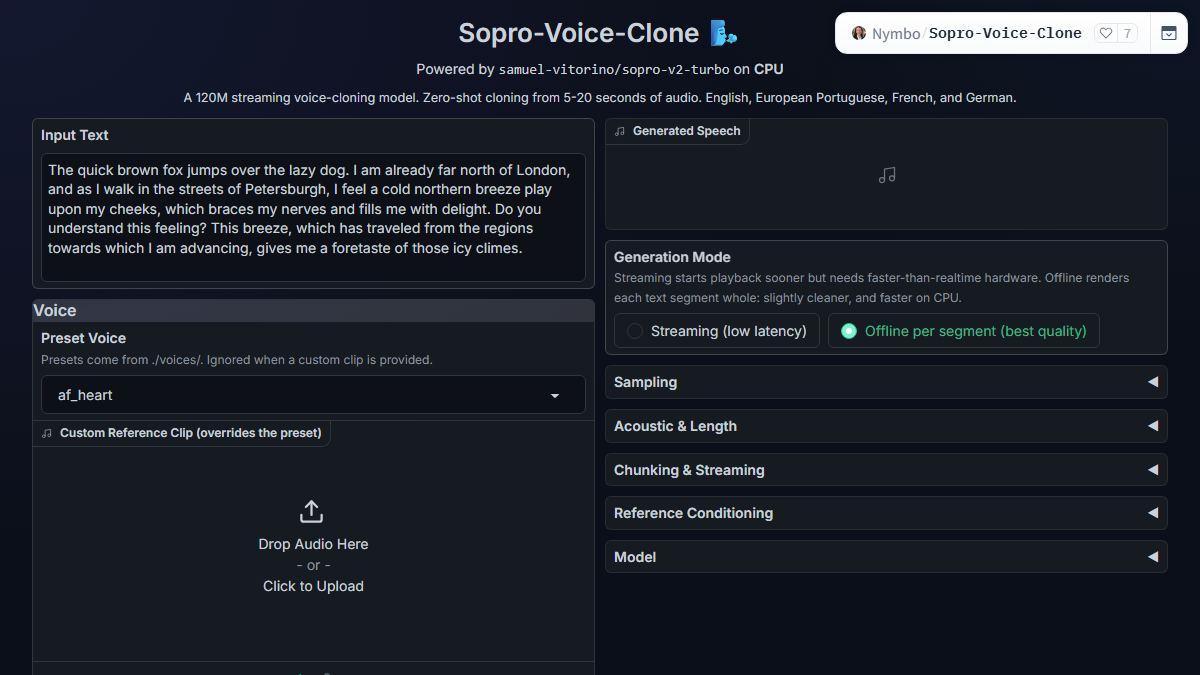
CPU voice cloning interface powered by Sopro V2 Turbo (Apache 2.0)
For low latency editorial tools and browser applications, the library exports a dependency isolated ONNX web package (`@soprotts/onnx-web`). Precalculating speaker embeddings with `prepare_reference` trims initial latency even further when generating long dialogue scenes line by line.
Optional `int8` quantization shrinks the autoregressive weights on CPU, allowing sound editors to generate temporary ADR and multilingual rough tracks on thin laptops in the field.
Hardware, Speed, and License Matrix
| Hardware Target | Mode | Measured Speed | Notes |
|---|---|---|---|
| Apple M3 CPU | Offline | 0.24 RTF |
Best acoustic fidelity, zero GPU needed |
| Apple M3 CPU | Streaming | 0.21 RTF (~300 ms TTFA) |
Chunked attention + causal vocoder |
| NVIDIA H100 GPU | Offline | 0.07 RTF |
High throughput batch dubbing |
| Browser (ONNX Web) | Client side | Quantized WebAssembly | Runs locally with zero server calls |
| Attribute | Specification |
|---|---|
| Release date | August 25, 2026 (95,600+ Hugging Face downloads) |
| Model size | 120M parameters |
| Supported languages | English (en), European Portuguese (pt), French (fr), German (de) |
| Reference audio length | 5 to 20 seconds of clean speech |
| License | Apache 2.0 (commercial use permitted) |
| Required package | sopro>=2.2.0 or @soprotts/onnx-web>=0.3.0 |
Parameter Reference
| CLI / API Parameter | Valid Values | Default | Filmmaker Effect |
|---|---|---|---|
--ref |
Path to WAV or MP3 (5 to 20 s) | Required | Supplies target speaker timbre and cadence |
--lang |
en, pt, fr, de |
Auto | Locks pronunciation on ambiguous names or short lines |
--stream |
Boolean flag | False |
Enables 300 ms streaming output via causal vocoder |
--int8 |
Boolean flag | False |
Uses int8 quantized weights on CPU for lower RAM |
--steps |
Integer | 2 |
Controls acoustic solver iterations |
--max-seconds |
Float | Default cap | Caps each auto split segment for long narrations |
Local Python and CLI Setup
Install the sopro package from PyPI or launch the local web server directly with uvx.
pip install -U sopro
soprotts serve
Generate a cloned voice line from the terminal on CPU.
soprotts "Sopro is a lightweight 120 million parameter voice model that runs on device." \
  --ref ref.wav \
  --lang en \
  --out out.wav
For multi line dialogue scripts in Python, precalculate the speaker reference once and reuse it across every cue.
import torch
from sopro import SoproTTS

tts = SoproTTS.from_pretrained("samuel-vitorino/sopro-v2-turbo", device="cpu")
ref = tts.prepare_reference(ref_audio_path="actor_ref.wav", stream=False)

wav = tts.synthesize(
    "We need to move the camera rig before the light drops.",
    ref=ref,
)
tts.save_wav("line_01.wav", wav)
Filmmaker Production Playbook
Offline Scratch Dialogue and Animatic Timing
Editors cutting animatics on laptops rarely have spare GPU memory while running NLE timelines. Because Sopro V2 Turbo runs at 0.24 RTF on CPU, you can synthesize temp narration and character dialogue offline on a plane or on set, then lock picture timing before booking voice actors.
Four Language International Previz
International productions spanning English, Portuguese, French, and German can generate matched reference dubs using one 10 second sample per cast member. Setting --lang explicitly prevents accent drift on short two word lines.
Clean Text Normalization Before Batch Renders
Sopro ships with a deliberately minimal text frontend. Before batching a screenplay CSV, convert numerals and symbols into spoken words (write twenty four instead of 24 and one plus two instead of 1 + 2) so every take reads cleanly on the first pass.
Known Limitations and FAQ
Should I use streaming mode or offline mode for film audio? Use offline mode for final temp tracks and dubbing. The author notes that the streaming path (chunked attention plus causal vocoder) is not bit exact with the offline path, so offline synthesis delivers cleaner fidelity.
How does Sopro V2 Turbo handle mixed language sentences? Code switching inside a single sentence (such as an English brand name inside a Portuguese line) is a known weak spot. Split mixed phrases or spell loanwords phonetically in the target language.
Does Sopro V2 Turbo add an audio watermark? No. The author omitted watermarking because open weights allow trivial removal. Always obtain written actor consent before cloning a real performer's voice for commercial production.
Related Reading
- Kitten TTS 2 Mini: Open Source 82M CPU Voice AI
- Breeze-TTS-2: Open Source Zero Shot Voice Cloning AI
- dots.tts: Voice Cloning at 54ms Streaming Latency
- AI FILMS Studio Voice Workspace

Sources
Continue Reading


Video & LipSync
- Video Generator
- Text to Video
- Image to Video
- Start-End Frame to Video
- Draw to Video
- Motion Control
- Video Enhancer
- Video Upscaler
- Video Extend
- Video to Video LipSync
- Audio to Video LipSync
- Image to Video LipSync
- Video FaceSwap
- Seedance 2.5
- WAN 3.0
- Seedance 2
- FLUX 3
- Minimax H3
- Vidu Q3 Pro
- Grok Imagine Video 1.5
- Gemini Omni
- Google Veo 3.1
- Kling 3.0 Pro
- Luma Ray 3.2
- LTX 2.3
- Happy Horse 1.1
- Kling 3.0 Motion
- ByteDance Upscaler
- InfiniteTalk
- InsightFace
Image & Edit
- AI Character
- AI Actor
- Art Generator
- Text to Image
- Image to Image
- LoRA Image to Image
- Draw to Edit
- Image LoRA Training
- Remove Background
- Image Enhancer
- MidJourney 8.0
- Krea 2
- OpenAI GPT Image 2.0
- Nano Banana Pro Ultra
- Nano Banana 2 Lite
- Nano Banana Pro
- Minimax Image
- Clarity Pro
- Z-Image Turbo LoRA
- Krea 2 Turbo LoRA
- Z-Image LoRA Trainer
- Qwen Image LoRA Trainer
- Background Erase Network 2 (BEN2)