

HeartMuLa / MuLa Labs (CC BY-NC 4.0)
Share this post:
MuLaCover: Open Source AI Music Cover and Remix Model
HeartMuLa and MuLa Labs released MuLaCover (HeartMuLa/MuLaCover) on September 16, 2026 as a controllable open weights model for full song covers and music remixes. It transforms reference audio or melody and chord MIDI into a new arrangement driven by custom lyrics and structured style tags. You can test MuLaCover free in the embedded browser demo below with zero login.
Studio availability. Try the public Hugging Face demo below; MuLaCover is not part of a paid AI FILMS Studio plan (use ACE-Step 1.5 Lyrics to Music in the music workspace for example instead).
Try MuLaCover Live
Upload a reference song, paste section tagged lyrics, and enter a one line style prompt inside the public Hugging Face Space below to generate a remixed cover directly in your browser.
Architecture and Technical Design
MuLaCover (arXiv:2610.26684) avoids copying reference waveforms frame by frame, which often traps audio-to-audio models inside the original timbre and instrumentation. Instead, its symbolic audio frontend transcribes reference music into a lead sheet of melody, harmony chords, and optional drum events using YourMT3 and five ChordNet checkpoints.
The model injects that symbolic lead sheet into a pretrained HeartMuLa text to song backbone through gated adaptive cross attention. A Qwen3-Embedding-0.6B text encoder processes structured style tags covering topic, genre, instrumentation, and mood, while HeartCodec-oss decodes generated tokens back into full length WAV audio.
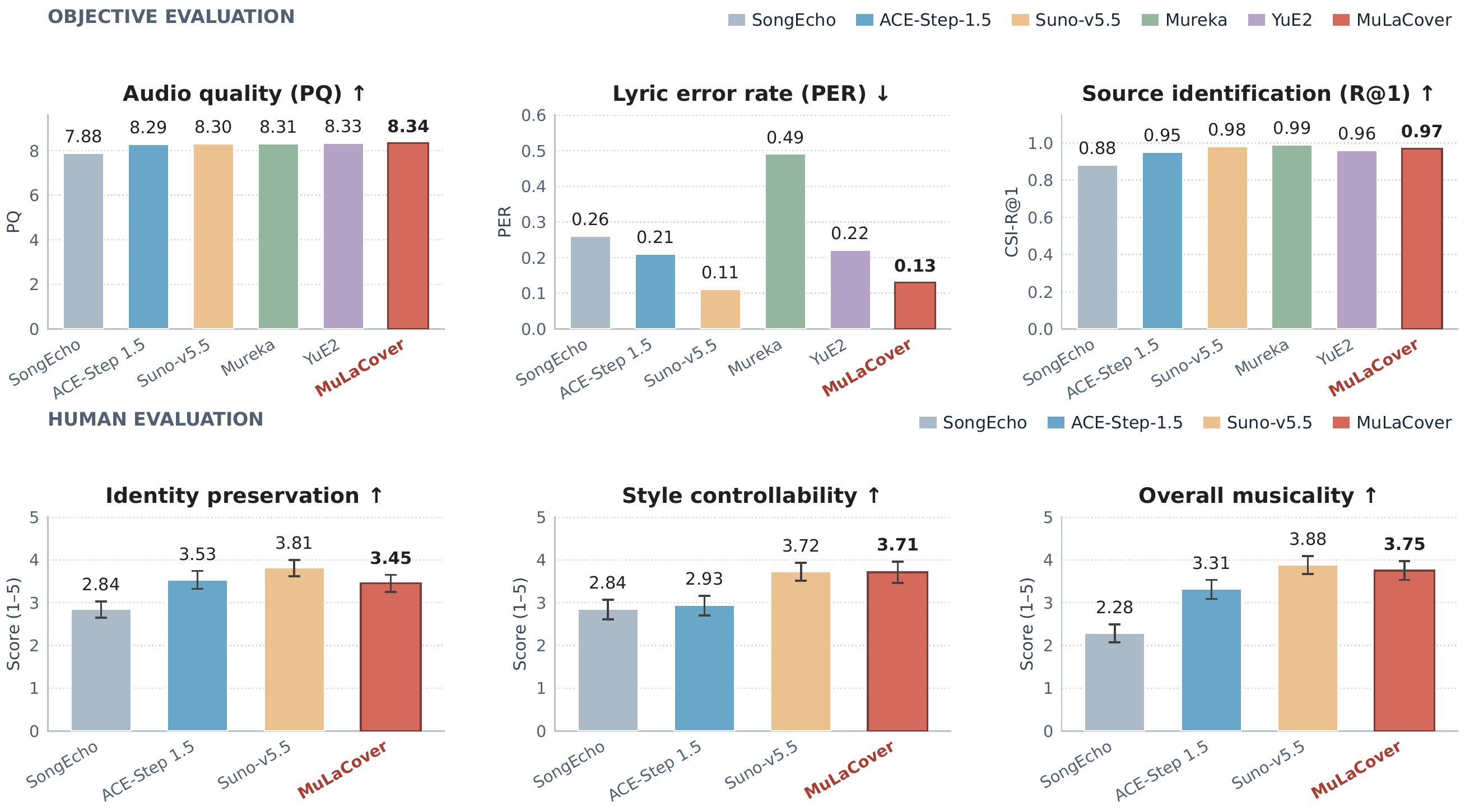
Full song cover evaluation chart by HeartMuLa / MuLa Labs
Because melody and chord harmony stay symbolic inside the conditioning layer, composers can reorchestrate a rough piano demo into cinematic strings or synthwave without losing the original motif. Partial conditioning also lets you drop drum tracks so the generator invents a new rhythmic pocket.
In the paper's full song benchmark across six objective systems and a 22 participant human study across four systems, MuLaCover outperformed baselines on tonal adherence and style transfer balance.
Local inference supports lazy loading by default (`lazy_load=True`). Rather than holding the transcription stack, style encoder, MuLaCover transformer, and HeartCodec in VRAM at once, the pipeline swaps components onto CUDA stage by stage.
If you export MIDI files directly from a DAW such as Logic Pro or Ableton Live, you can skip the YourMT3 and ChordNet transcription checkpoints completely and run the lighter MIDI conditioning path.
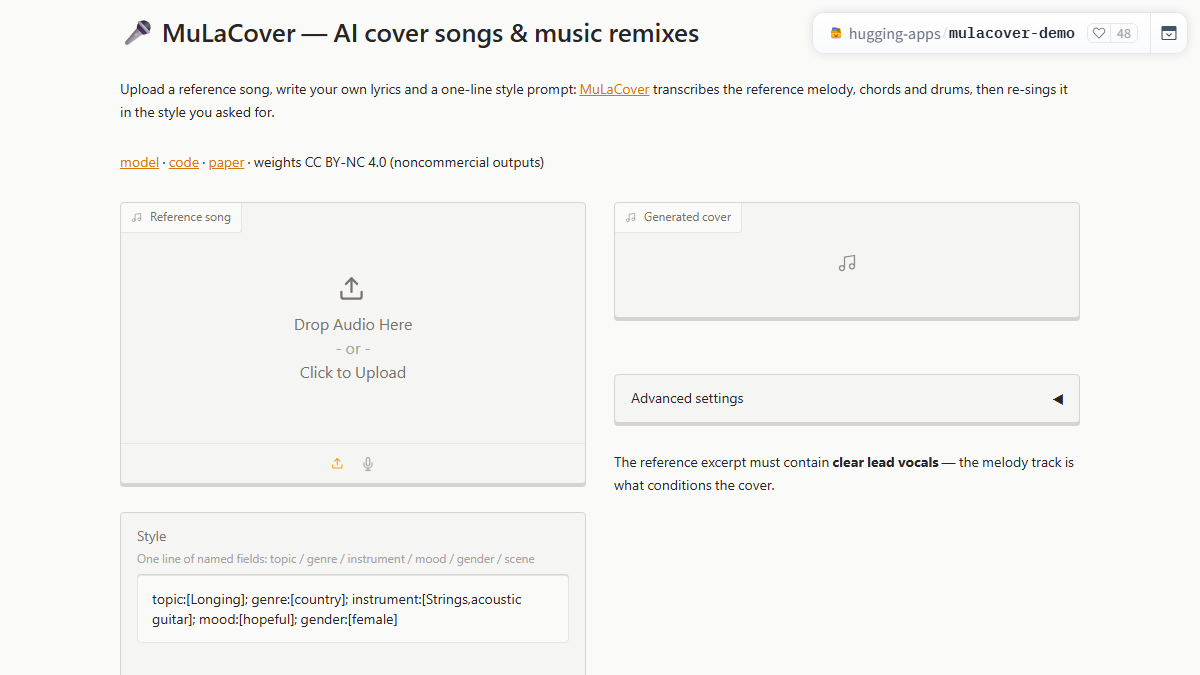
Interactive Hugging Face Space demo for HeartMuLa/MuLaCover
Hardware, Components, and License Matrix
| Component | Checkpoint / Package | Required For |
|---|---|---|
| Core cover model | HeartMuLa/MuLaCover (5 Safetensors shards) |
All MIDI and audio runs |
| Audio codec | HeartMuLa/HeartCodec-oss-20260123 |
All MIDI and audio runs |
| Style encoder | Qwen/Qwen3-Embedding-0.6B |
All MIDI and audio runs |
| Symbolic transcriptor | YourMT3 + 5 ChordNet checkpoints | Reference audio input only |
| Attribute | Specification |
|---|---|
| Release date | September 16, 2026 (arXiv:2610.26684) |
| Code license | Apache 2.0 |
| Weights & output license | CC BY-NC 4.0 + MODEL_LICENSE (noncommercial only) |
| Verified environment | Ubuntu 24.04, Python 3.10, PyTorch 2.10.0, CUDA 13.0 |
| Conditioning modes | Reference audio (MP3/WAV) or Melody + Chord (+ optional Drum) MIDI |
| Memory optimization | lazy_load=True enabled by default |
Parameter Reference
| Parameter | Valid Values / Format | Default | Filmmaker Effect |
|---|---|---|---|
--melody_midi / --chord_midi |
Beat aligned .mid files |
Optional | Supplies exact motif and harmony directly from a DAW |
--ref_audio |
.mp3 or .wav |
Optional | Auto transcribes melody and chords into symbolic files |
--drum_midi |
.mid file |
Optional | Locks percussion groove or omits it for free rearrangement |
--lyrics |
UTF-8 file with [Intro], [Verse], [Chorus], [Bridge], [Outro] |
Required | Guides vocal phrasing and song structure |
--tags |
topic:[...]; genre:[...]; instrument:[...]; mood:[...] |
Required | Sets instrumentation, genre, and emotional tone |
temperature / topk / cfg_scale |
1.0 / 250 / 1.5 |
1.0 / 250 / 1.5 |
Balances stylistic boldness against tight motif adherence |
Local CLI and Python Setup
Install the mulacover package with audio extras on Linux with Python 3.10 and CUDA, then download the model checkpoints.
git clone https://github.com/HeartMuLa/MuLaCover.git
cd MuLaCover
python -m pip install -e '.[audio]'

hf download HeartMuLa/MuLaCover --local-dir ckpt/MuLaCover
hf download Qwen/Qwen3-Embedding-0.6B --local-dir ckpt/Qwen3-Embedding-0.6B
hf download HeartMuLa/HeartCodec-oss-20260123 --local-dir ckpt/HeartCodec-oss
Generate a remixed cover directly from a reference audio track.
env -u LD_LIBRARY_PATH CUDA_VISIBLE_DEVICES=0 mulacover \
  --model_path ./ckpt \
  --ref_audio reference.mp3 \
  --lyrics lyrics.txt \
  --tags "topic:[Longing]; genre:[cinematic]; instrument:[Strings,piano]; mood:[hopeful]" \
  --symbolic_save_dir ./transcribed \
  --save_path cover.wav \
  --device cuda:0 \
  --seed 42
For DAW driven MIDI workflows in Python, call MuLaCoverGenPipeline with lazy_load=True.
import torch
from mulacover import MuLaCoverGenPipeline

pipe = MuLaCoverGenPipeline.from_pretrained(
    "./ckpt",
    device=torch.device("cuda:0"),
    dtype={"mulacover": torch.bfloat16, "codec": torch.float32, "qwen": torch.float32, "transcriptor": torch.float32},
    lazy_load=True,
)
pipe(
    {"melody_midi": "melody.mid", "chord_midi": "chord.mid", "lyrics": "lyrics.txt", "tags": "tags.txt"},
    save_path="cover.wav",
    temperature=1.0,
    topk=250,
    cfg_scale=1.5,
)
Filmmaker Production Playbook
Rapid Theme Variations for Temp Scores
Film composers often write one core piano motif and need three emotional variations for a director's cut review. Exporting the motif and chord progression as MIDI into MuLaCover lets you audition an acoustic folk cue, a tense string underscore, and a stripped down vocal reprise from the exact same harmonic skeleton.
Saving Transcribed MIDI for DAW Polish
Passing --symbolic_save_dir writes the extracted melody and chord MIDI tracks to disk during reference audio runs. You can inspect those MIDI files in a DAW, fix any stray transcribed notes, and rerun MuLaCover via the cleaner MIDI path.
Strict Tag Formatting for Predictable Instrumentation
MuLaCover expects a single line tag string using semicolons and square brackets (topic:[...]; genre:[...]; instrument:[...]; mood:[...]). Following that exact schema produces much tighter instrumentation shifts than freeform prose prompts.
Known Limitations and FAQ
Can I release MuLaCover outputs in a commercial film?
No without written authorization. While the inference codebase is Apache 2.0, both the official HeartMuLa/MuLaCover weights and generated audio outputs are restricted to noncommercial use under CC BY-NC 4.0 and MODEL_LICENSE. Use MuLaCover for research and internal temp scoring, or switch to a commercially cleared music generator for final release.
Does MIDI tempo metadata control the output BPM? MIDI timing is read in beats. Tempo metadata is preserved when exporting MIDI files, but it is not treated as an independent generation condition inside the model.
Why did cuBLAS fail on an AWS Deep Learning AMI?
On cloud Linux images where LD_LIBRARY_PATH points to a mismatched system CUDA toolkit, prefix your command with env -u LD_LIBRARY_PATH so PyTorch loads the CUDA libraries shipped inside its wheel.
Related Reading
- HeartMuLa: Open Source Apache Music Foundation Model
- ACE-Step 1.5: Open Source Music Generation Model
- StepAudio 3 Music: Open Source 48kHz Film Score AI
- AI FILMS Studio Music Workspace

Sources
Continue Reading


Video & LipSync
- Video Generator
- Text to Video
- Image to Video
- Start-End Frame to Video
- Draw to Video
- Motion Control
- Video Enhancer
- Video Upscaler
- Video Extend
- Video to Video LipSync
- Audio to Video LipSync
- Image to Video LipSync
- Video FaceSwap
- Seedance 2.5
- WAN 3.0
- Seedance 2
- FLUX 3
- Minimax H3
- Vidu Q3 Pro
- Grok Imagine Video 1.5
- Gemini Omni
- Google Veo 3.1
- Kling 3.0 Pro
- Luma Ray 3.2
- LTX 2.3
- Happy Horse 1.1
- Kling 3.0 Motion
- ByteDance Upscaler
- InfiniteTalk
- InsightFace
Image & Edit
- AI Character
- AI Actor
- Art Generator
- Text to Image
- Image to Image
- LoRA Image to Image
- Draw to Edit
- Image LoRA Training
- Remove Background
- Image Enhancer
- MidJourney 8.0
- Krea 2
- OpenAI GPT Image 2.0
- Nano Banana Pro Ultra
- Nano Banana 2 Lite
- Nano Banana Pro
- Minimax Image
- Clarity Pro
- Z-Image Turbo LoRA
- Krea 2 Turbo LoRA
- Z-Image LoRA Trainer
- Qwen Image LoRA Trainer
- Background Erase Network 2 (BEN2)