
Mage-Flow (Microsoft Research): Native Resolution Image Generation and Editing

Share this post:
Mage-Flow (Microsoft Research): Native Resolution Image Generation and Editing
Microsoft Research has released Mage-Flow, a 4B parameter flow matching diffusion transformer that generates and edits images at native resolution without the resize cropping artifacts that affect most existing image generation models. The model ships under an MIT license with six downloadable weight variants covering text-to-image and instruction based editing workflows. The weights are available on HuggingFace in SafeTensors format, compatible with the Diffusers library.
Studio availability. Mage-Flow is not available in AI FILMS Studio. This article covers a public research release. To generate images in the Studio, see the models listed on the text to image page.
The release is accompanied by a technical paper on arXiv (submitted July 25, 2026) detailing the NR-MMDiT architecture and the training methodology for both the base models and the RL aligned variants. The paper includes quantitative benchmarks against existing fixed resolution generation models and qualitative comparisons across a range of aspect ratios and prompt styles.
The native resolution approach is the defining technical contribution. Most image generation models internally resize inputs and outputs to fixed training resolutions, typically 512x512 or 1024x1024. When those models generate images in widescreen aspect ratios common in film production, 2.39:1 cinemascope or 1.85:1 standard theatrical flat, they introduce geometric distortion and cropping artifacts that require post-processing correction. Mage-Flow eliminates that step by operating directly at the target resolution throughout the generation process.
What Native Resolution Means in Practice
The problem with fixed resolution generation is concrete. A cinematographer or production designer who wants concept art at a 2.39:1 aspect ratio for a cinemascope production cannot run a standard 1024x1024 model and simply crop the result. The model was trained on square images and its spatial understanding encodes square compositional logic. Characters occupy different frame positions, depth cues behave differently, and the spatial weight of objects in the frame shifts when the model generates at a ratio it was not trained on.
Mage-Flow addresses this at the architecture level rather than through post-processing. The model uses a native resolution multi modal diffusion transformer, called NR-MMDiT in the paper, that processes the spatial dimensions of the input without remapping them to a fixed grid. The generation process preserves the aspect ratio geometry throughout, which means the compositional logic and spatial relationships in the output reflect the actual frame shape the user specified.
For concept art workflows, this distinction matters at every stage of pre production. When a production designer or director of photography generates reference images for a specific lens and aspect ratio, the spatial relationships in those images need to correspond to how the actual frame will be composed. A tool that distorts the geometry defeats the purpose of the concept art.
The native resolution capability also removes a post-processing step from the workflow. Teams that currently generate at 1024x1024 and then crop or recompose for widescreen formats can generate directly at the target frame shape. That is one fewer manual intervention in a concept art iteration cycle that may require dozens of generations per scene.
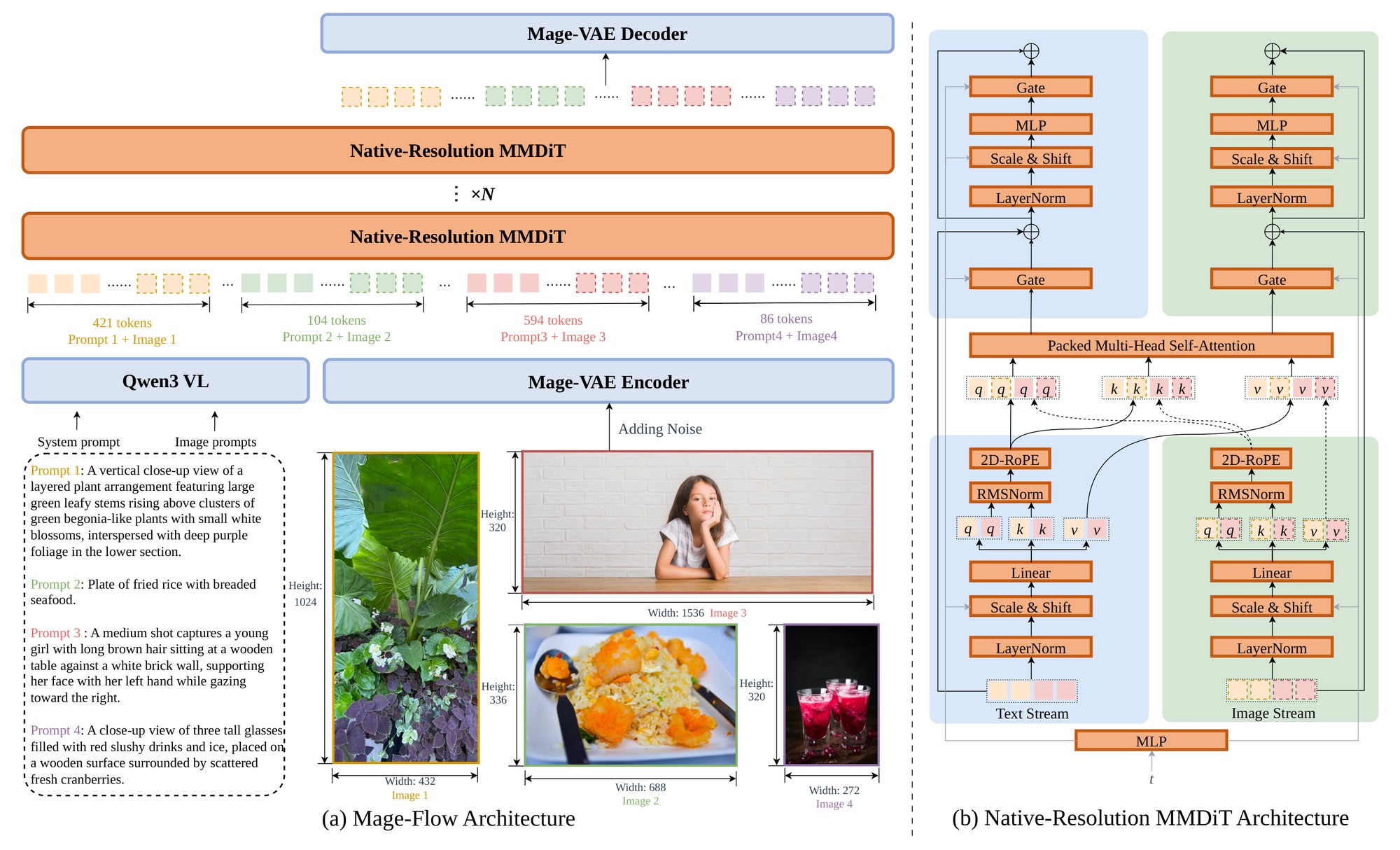
Native Resolution MMDiT architecture. Microsoft Research / Mage-Flow
The Six Model Variants
Mage-Flow ships as six distinct weight variants organized into two task categories. The text-to-image category includes a 30-step base model, a 20-step RL aligned variant trained with reinforcement learning from human feedback, and a 4-step turbo model optimized for fast iteration. The instruction based editing category mirrors the same structure: a 30-step base editing model, a 20-step RL aligned editing variant, and a 4-step turbo editing model.
The turbo variants at 4 steps trade some output quality for generation speed. For rapid concept exploration, where a production designer or art director needs to evaluate dozens of variations quickly, the 4-step model offers a meaningful speed advantage. Once a direction is selected, the team can switch to the 30-step or 20-step base models for higher quality output.
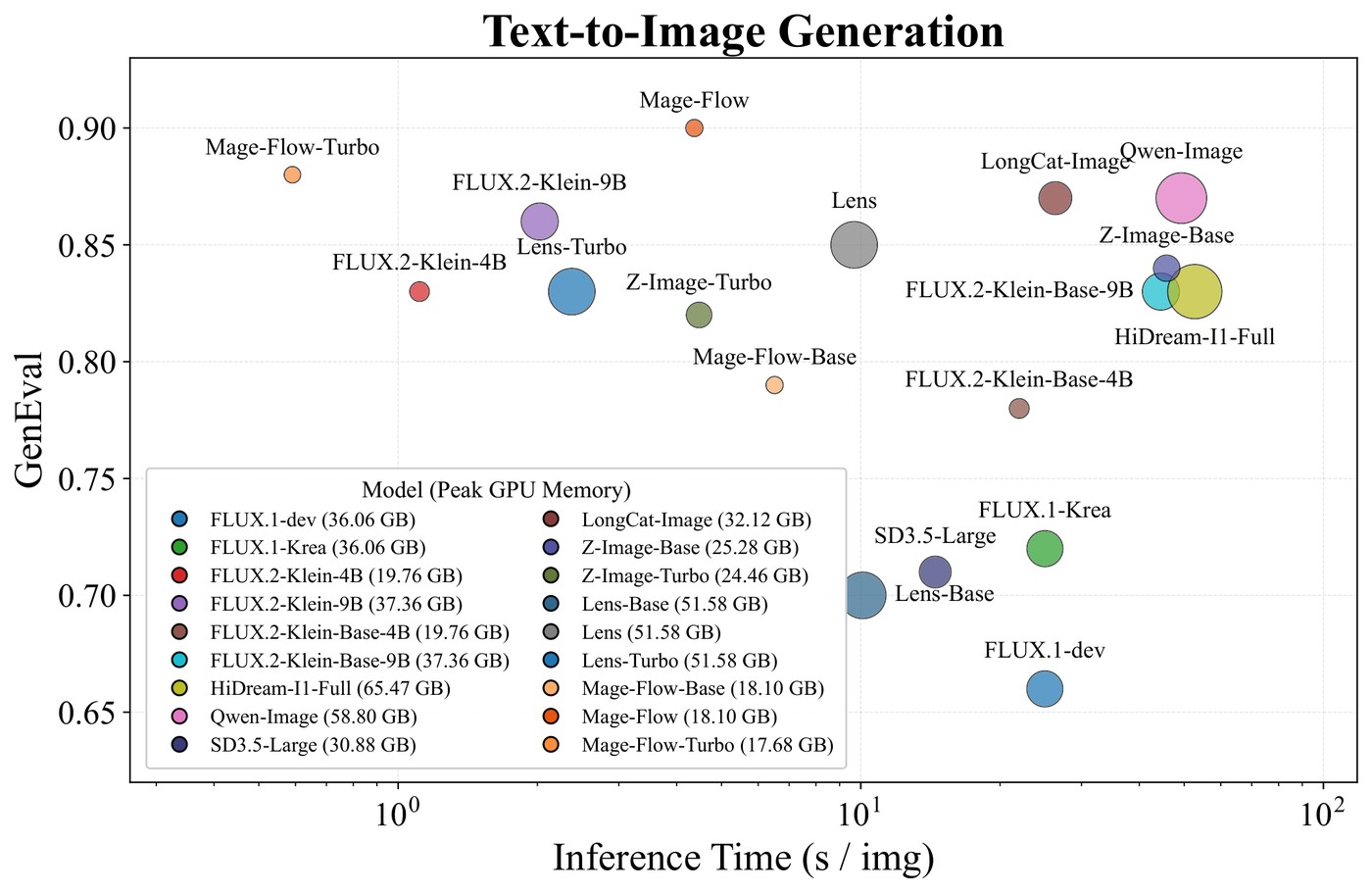
Generation speed across the full Mage-Flow model family. Microsoft Research / Mage-Flow
The RL aligned variants occupy the middle position in each task category. Reinforcement learning from human feedback trains the model to produce outputs that score well on human preference metrics rather than purely on reconstruction accuracy. For pre production use cases where the image will be reviewed by a director or producer with aesthetic preferences rather than purely technical criteria, the RL aligned variants typically produce outputs that require less manual curation to find a presentation-ready result.
The separation between base and RL aligned variants also gives production teams control over the output style. Base models tend to produce more diverse outputs across a batch. RL aligned models tend to produce outputs that cluster more consistently around preferred visual conventions. For teams iterating quickly through concepts, base models give a wider range of starting points. For teams that have already locked a visual direction and need reliable execution within it, the RL aligned models reduce the noise in the output set.
All six variants are MIT licensed, meaning they can be used in commercial production pipelines without restriction. The weights are available in SafeTensors format, which is the standard for secure model distribution in the Diffusers ecosystem. Teams running local generation infrastructure can integrate Mage-Flow weights directly into their existing Diffusers-based pipelines without additional format conversion.
Text-to-Image Generation
The text-to-image capability is the primary entry point for most production workflows. Mage-Flow accepts a text prompt and a target resolution, then generates an image that preserves the geometry of the specified aspect ratio throughout the diffusion process. The model was trained on a broad range of photographic and illustrative styles, which means it can operate across the range of concept art visual languages that production teams use, from photorealistic location reference to painterly atmosphere concept to hard-edge technical illustration.
The model's training data breadth is reflected in its ability to follow prompts that specify visual style alongside subject matter. A production designer generating reference for a period drama can specify the visual aesthetic, the lighting quality, the color palette, and the compositional approach in a single prompt without needing separate control mechanisms for each attribute. The model integrates those specifications within the generation process rather than requiring additional post-processing passes.
The native resolution capability extends to portrait and vertical orientations as well as widescreen. For productions that are producing content across multiple distribution formats, including streaming thumbnails, social media formats alongside theatrical aspect ratios, a generation model that can work at any specified resolution without remapping simplifies the multi format content pipeline. The same model handles a 9:16 vertical cut and a 2.39:1 scope frame without any architectural adjustment.
For concept art specifically, the model's output can serve as a starting point for further development in traditional tools. The native resolution geometry means that proportions carry over correctly when art directors trace or paint over the AI generated reference, rather than having to correct for aspect ratio distortion in subsequent manual work.

Text-to-image results across multiple aspect ratios. Microsoft Research / Mage-Flow
Instruction Based Editing
The second task category is instruction based editing, where the model receives an existing image alongside a text instruction describing the change to make. This is structurally different from text-to-image generation. The model works with existing imagery and applies targeted modifications in response to natural language rather than generating from scratch.
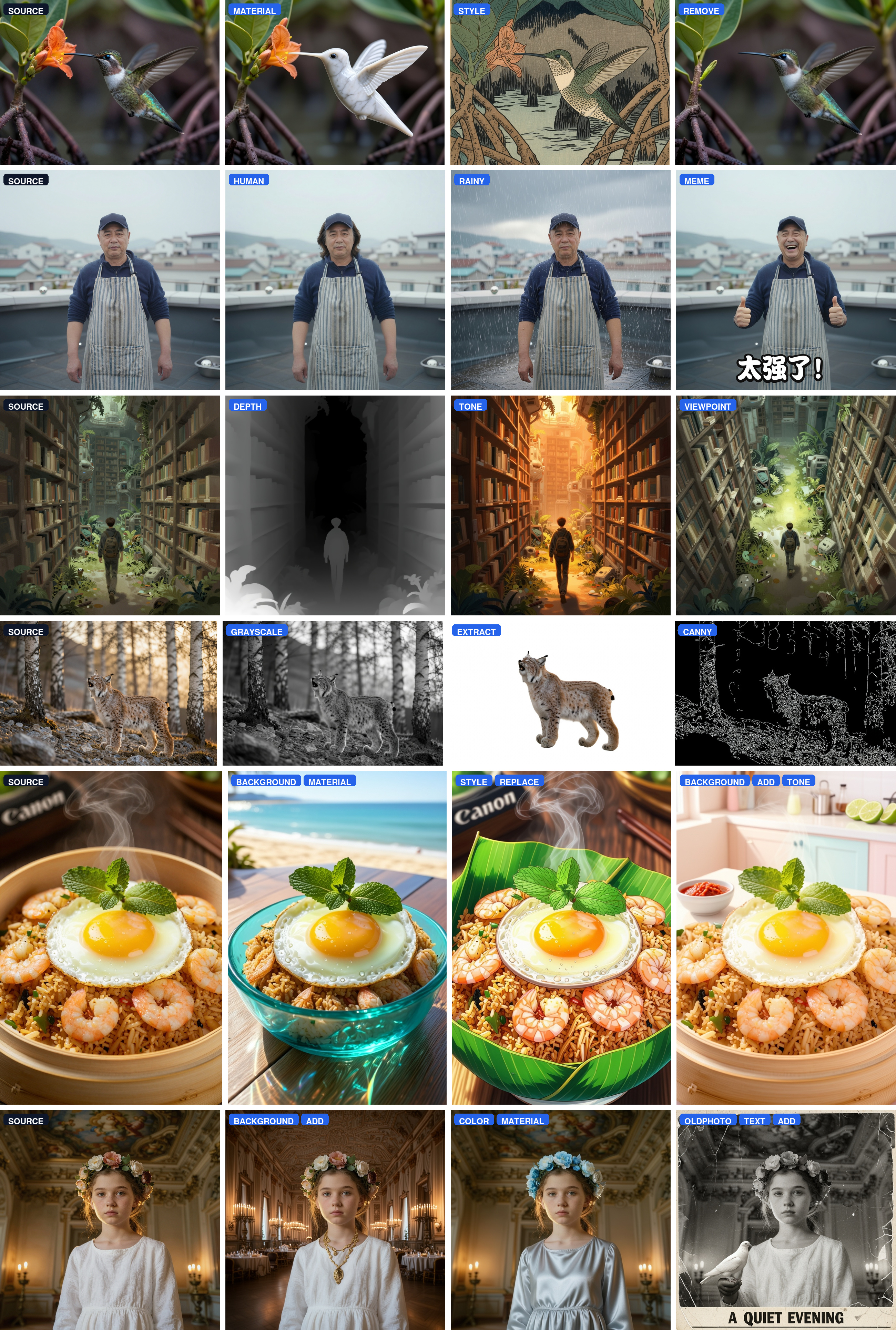
Instruction based editing showcase. Microsoft Research / Mage-Flow
For pre production and storyboard workflows, instruction based editing addresses a common iteration problem. A director or production designer may have a concept image that is close to the target but needs specific changes: alter the lighting from day to dusk, remove a background element that conflicts with the production's visual language, change the costume color to match a palette decision made after the initial concept was generated.
The editing variants handle these adjustments without requiring the user to regenerate from scratch. The model understands the instruction as a targeted modification and attempts to preserve the elements of the original image that the instruction does not address. That preserves the iterative work invested in reaching a close approximation and applies the adjustment on top of it rather than discarding the prior output.
The in-context editing approach also makes the model useful for style consistent iteration. A sequence of location concepts for the same fictional environment can be kept visually consistent by using the editing variants to make targeted changes to an approved base image rather than generating each variant independently from text. The spatial coherence of the native resolution generation carries through to the editing process, maintaining the geometric logic of the original frame across a family of related outputs.
How the Architecture Works
Mage-Flow is a flow matching model built on a multi modal diffusion transformer backbone. Flow matching is an alternative to the denoising diffusion approach used in earlier stable diffusion models. Where denoising diffusion iteratively removes noise from a random initialization over many steps, flow matching learns a direct mapping between a noise distribution and the target data distribution through continuous normalizing flows. The practical effect is that flow matching models can achieve comparable or better quality at lower step counts than equivalent denoising models.
The NR-MMDiT architecture extends the standard multi modal diffusion transformer to accept variable resolution inputs without remapping to a fixed grid. The model encodes position information in a way that is resolution aware rather than grid constrained. That encoding is what allows the model to maintain correct spatial relationships across different aspect ratios rather than stretching or cropping the positional signal to fit a fixed template.
The RL alignment applied to two of the six variants uses human preference data to fine-tune the model's output distribution toward images that human reviewers score as higher quality. For production pre visualization, where the standard for a good output is whether a director would want to look at it rather than whether it scores well on a technical reconstruction metric, the RL aligned variants typically produce results that require less manual selection from a batch of generations.
The flow matching approach also gives Mage-Flow an inference speed advantage over equivalent denoising diffusion models at the same quality level. The 30-step Mage-Flow base model generates at quality comparable to denoising models requiring 50 to 100 steps in testing reported in the paper. For teams running generation on local GPU hardware, that step count reduction translates directly to generation time. A team generating 20 concept variants per scene during active pre production sees a proportional reduction in the time from prompt to output.
Filmmaking Use Cases
The model's most direct application in film production is concept art generation for pre production. Production designers, art directors, and directors use concept art to establish the visual language of a project before principal photography begins. AI concept art generation reduces the time and cost of reaching an approved visual reference, allowing more iteration within a fixed pre production budget.
Mage-Flow's native resolution generation is specifically useful for projects with defined aspect ratios. Scope productions at 2.39:1 have significantly wider frames than standard theatrical flat at 1.85:1, and both differ substantially from the 16:9 television standard. A model that generates correctly at the production's target aspect ratio reduces the ambiguity in concept art reviews. The director and production designer are looking at images that reflect the actual frame geometry rather than approximations that require mental adjustment.
The instruction based editing capability extends the model's use into revision workflows. After a concept art direction is established through text-to-image generation, the editing variants allow art departments to apply targeted changes in response to feedback without full regeneration. That workflow mirrors the revision cycle in traditional concept art, where an artist receives notes and modifies an existing drawing rather than starting over.
For storyboard work and visual development, the combination of text-to-image and editing in a single model family means that teams can move from initial concept to revised reference without switching tools. Maintaining a consistent underlying model across both generation and editing tasks improves the coherence of the edited output. The editing model was trained in the same representational space as the generation model, which means modifications applied by the editing variants preserve the visual characteristics of generation-phase images more reliably than editing applied by a separate model trained on different data. The six-variant structure lets them manage the tradeoff between generation speed and output quality at each stage of the process. Rapid exploration uses the 4-step turbo models. Presentation-ready output uses the 30-step base or RL aligned models. AI FILMS Studio provides access to AI image generation tools for production concept work without requiring local model deployment.
For teams that want to run Mage-Flow locally, the Diffusers-compatible SafeTensors weights can integrate into existing generation infrastructure. The MIT license means there are no usage restrictions for commercial productions. A team generating concept art for a studio feature can use Mage-Flow weights without additional licensing considerations beyond the MIT terms. That is a meaningful distinction from models with non-commercial or restricted commercial licenses that require separate agreements for professional production use.
The combination of native resolution generation, six specialized variants across two task categories, an MIT license, and Diffusers compatibility positions Mage-Flow as a production viable tool for pre production visual development workflows. The architectural contribution, operating at native resolution throughout the diffusion process, addresses a geometric fidelity problem that has been a persistent limitation of fixed resolution generation models in professional production contexts.
Microsoft Research's release of the weights under MIT license accelerates the timeline for independent production teams to adopt native resolution generation. Research models with restricted commercial licenses require legal review before they can enter a professional production pipeline. Mage-Flow removes that friction, which typically separates research capability from production deployment by six months to a year in teams without dedicated legal counsel. The weights are available now, and the license permits immediate commercial use.
The 4B parameter scale also puts Mage-Flow within reach of consumer GPU hardware. Teams running local inference on a single high-end GPU can run the model without the compute infrastructure typically associated with frontier-scale models. That accessibility matters for independent productions without cloud inference budgets. A production team with a single workstation can run the turbo variants for rapid iteration and the base models for final output without additional infrastructure cost. Explore more AI image generation tools for filmmaking and see how image generation integrates into broader AI production pipelines.
Sources
arXiv: Mage-Flow: Unified Native Resolution Image Generation and Editing with Flow Matching GitHub: microsoft/Mage Hugging Face: microsoft/Mage-Flow
Continue Reading


Video & LipSync
- Video Generator
- Text to Video
- Image to Video
- Start-End Frame to Video
- Draw to Video
- Motion Control
- Video Enhancer
- Video Upscaler
- Video Extend
- Video to Video LipSync
- Audio to Video LipSync
- Image to Video LipSync
- Video FaceSwap
- Seedance 2.5
- WAN 3.0
- Seedance 2
- FLUX 3
- Minimax H3
- Vidu Q3 Pro
- Grok Imagine Video 1.5
- Gemini Omni
- Google Veo 3.1
- Kling 3.0 Pro
- Luma Ray 3.2
- LTX 2.3
- Happy Horse 1.1
- Kling 3.0 Motion
- ByteDance Upscaler
- InfiniteTalk
- InsightFace
Image & Edit
- AI Character
- AI Actor
- Art Generator
- Text to Image
- Image to Image
- LoRA Image to Image
- Draw to Edit
- Image LoRA Training
- Remove Background
- Image Enhancer
- MidJourney 8.0
- Krea 2
- OpenAI GPT Image 2.0
- Nano Banana Pro Ultra
- Nano Banana 2 Lite
- Nano Banana Pro
- Minimax Image
- Clarity Pro
- Z-Image Turbo LoRA
- Krea 2 Turbo LoRA
- Z-Image LoRA Trainer
- Qwen Image LoRA Trainer
- Background Erase Network 2 (BEN2)