
MIND Benchmark Tests Memory and Action in World Models
Share this post:
MIND Benchmark Tests Memory and Action in World Models
A research team from Central South University, the National University of Singapore, the Hong Kong University of Science and Technology (Guangzhou), and Nanyang Technological University has released MIND. It is the first open domain benchmark for evaluating memory consistency and action control in world models, released under the MIT license and free for commercial use.
What Is MIND
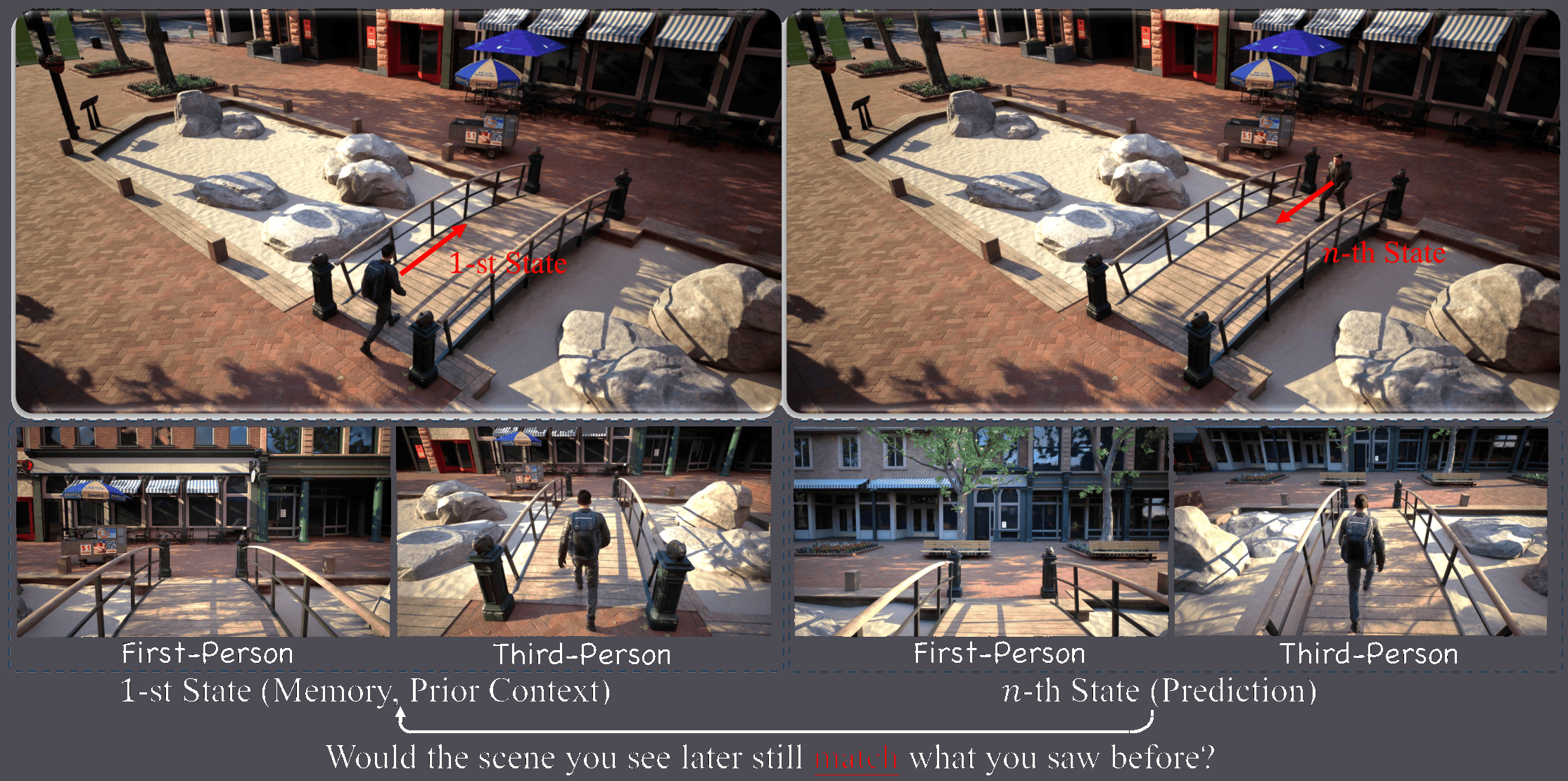
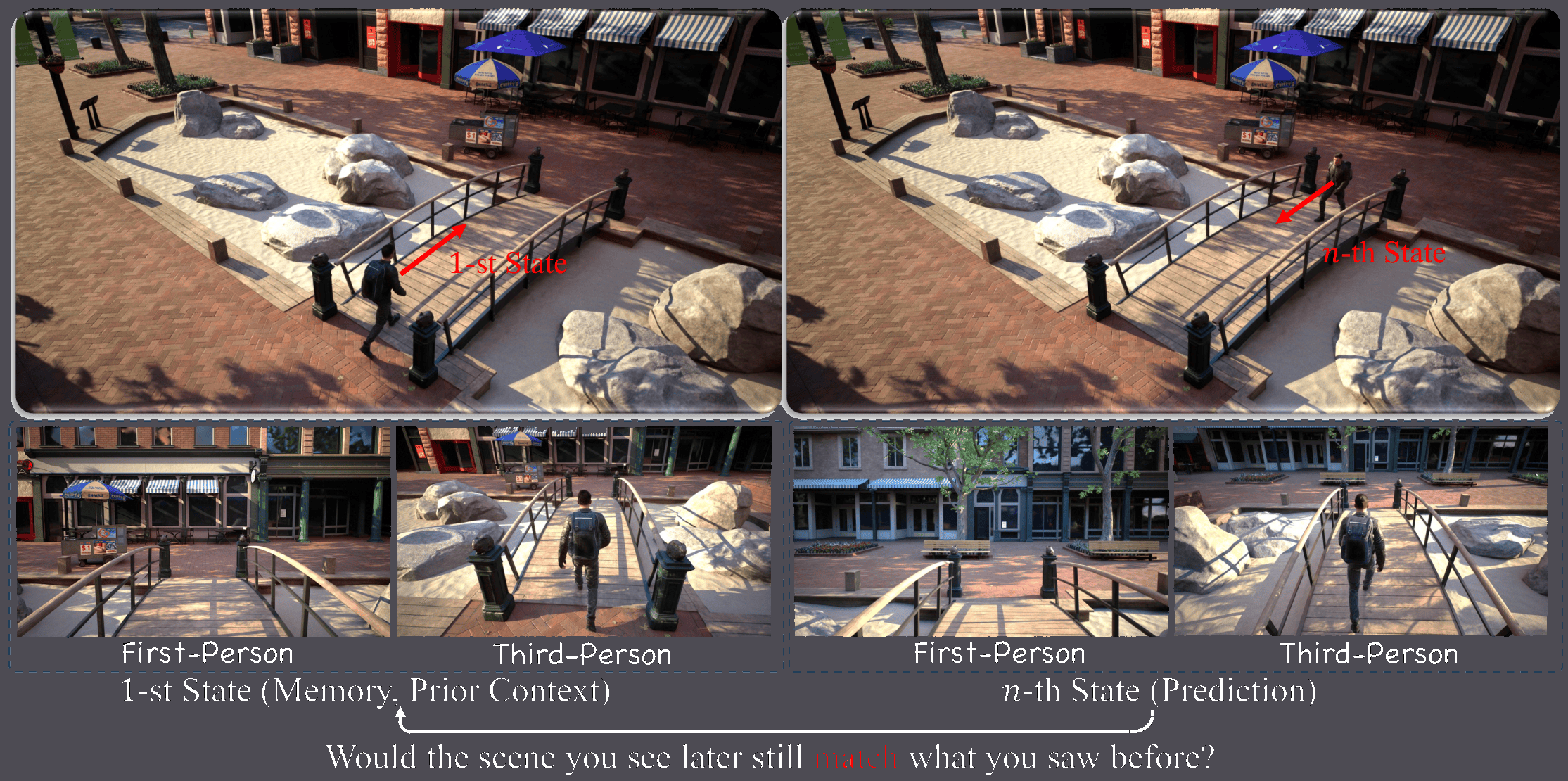
MIND stands for Memory consIstency and action coNtrol in worlD models. The benchmark targets a specific and persistent problem in AI video generation: current world models can produce visually convincing environments but fail to maintain a consistent memory of earlier events in a sequence and cannot reliably respond to action inputs.
The dataset contains 250 high quality videos recorded at 1080p and 24 frames per second. These divide into 200 clips sharing a common action space (100 first person, 100 third person) and 50 clips across varied action spaces. Eight distinct environments cover a range of visual styles, from realistic urban scenes and industrial settings to stylized fantasy and historical locations.
Open Source and Free for Commercial Use
MIND is released under the MIT license. This means researchers, developers, and commercial entities can use, modify, and distribute the benchmark dataset and code without restriction. There are no subscription fees, geographic limits, or usage caps.
The repository is hosted at github.com/CSU-JPG/MIND and includes the full dataset, evaluation code, and the accompanying paper on arXiv (2602.08025). The MIT license is one of the most permissive in open source software, distinguishing MIND from proprietary benchmarks that restrict commercial applications or require institutional agreements.
The MIND-World Baseline
Alongside the benchmark, the team introduces MIND-World, a novel interactive video-to-world baseline model. This system processes video input and generates interactive world representations that a user can navigate or manipulate. It serves as a reference implementation for researchers measuring performance against the MIND evaluation criteria.
MIND-World demonstrates the video-to-world paradigm. Rather than generating video from text prompts, the system takes existing footage as input and constructs a controllable world. This distinction has direct implications for filmmakers. A video-to-world model can ingest existing footage (shot on set, AI generated, or archival) and extend it into an interactive environment for further exploration or shot planning.
Six Challenges Identified in Current World Models
The benchmark measures two core capabilities across all evaluated models. Memory consistency tests whether a world model remembers what it generated in earlier frames when producing new ones. Long sequences amplify the challenge: a model that drifts from its initial scene composition after 30 seconds has poor long context memory. Action control tests whether the model accurately responds to specified actions. If a character is told to turn left, does the scene correctly reflect that movement? Does the correct speed change occur when the action specifies slower movement?
The research identifies six specific challenges where current systems fall short:
- Open domain generalization. Models trained on specific visual styles often fail on environments outside their training distribution.
- Action space generalization. A model calibrated for one character's movement speed struggles when speed parameters change.
- Precise action control. Exact quantitative control over camera angle and movement remains unreliable.
- Long context memory maintenance. Sequences extending beyond a few minutes show significant consistency degradation.
- Scene consistency in repeated generations. Regenerating a scene from the same conditions produces different results, breaking determinism.
- Third person perspective modeling. Models trained primarily on first person footage generalize poorly to third person camera setups.
Benchmark Dataset in Action
The MIND videos span eight environments with intentional diversity. The challenge scenarios test the hardest conditions: high-speed action sequences, heavily stylized art styles, rapid camera rotations, and long duration coherence requirements. The benchmark structure separates standard evaluation (consistent action spaces across clips) from challenge evaluation (varied action spaces and more demanding conditions).
This two-tier design lets researchers identify whether models fail at the fundamental task or only under stress conditions. A model that performs well in standard evaluation but collapses under challenge conditions reveals specific architectural limitations, rather than general capability gaps.
What This Reveals for AI Filmmaking
World models are the technical foundation beneath tools that generate interactive environments. For filmmakers, the capabilities under development include exploring virtual sets before principal photography, generating consistent background plates, and previz of complex sequences without physical production costs.
The six challenges MIND identifies map directly onto production requirements. Long context memory determines whether a virtual environment stays consistent across a two-minute shot. Third person perspective modeling determines whether a world model can simulate traditional cinematographic camera positions. Precise action control determines whether a director can specify a camera move with professional precision rather than approximate results.
Earlier world model releases including HunyuanWorld Mirror and Lingbot World demonstrate different approaches to environment generation. InSpatio-World pushes further, anchoring a persistent world state to a reference video so that spatial roaming and temporal reversal remain consistent across the full exploration. What has been missing is a shared evaluation standard that enables direct comparison between systems on the same criteria. MIND supplies that standard, and does so under a license that lets any production team, research lab, or developer adopt it without commercial restriction. MosaicMem, released in March 2026, directly targets the memory consistency and camera accuracy gaps MIND documents, using a patch based spatial memory system to sustain coherent scenes across 2 minute rollouts.
Filmmakers looking to generate environments and prototype scenes today can access video generation tools through AI FILMS Studio. As world models improve against benchmarks like MIND, those capabilities will translate directly into more consistent and controllable virtual production workflows.
The research team includes Yixuan Ye, Xuanyu Lu, Yuxin Jiang, Yuchao Gu, Rui Zhao, Qiwei Liang, Jiachun Pan, Fengda Zhang, Weijia Wu, and Alex Jinpeng Wang. The project was created in February 2026 and is under active development, with additional dataset components pending release.
Motion Staging: Performing the Shot Before Rendering It
There is a practical workflow that world models make possible, and most filmmakers working with AI video have not tried it yet. It goes by two names: Motion Staging, or World Model Puppeteering.
The problem it solves is control. Text prompts interpret instructions, and complex simultaneous actions compound interpretation errors. Asking a model to "pan left while the character falls from the ledge" forces it to infer timing, speed, and spatial relationships from language. The results are approximate at best.
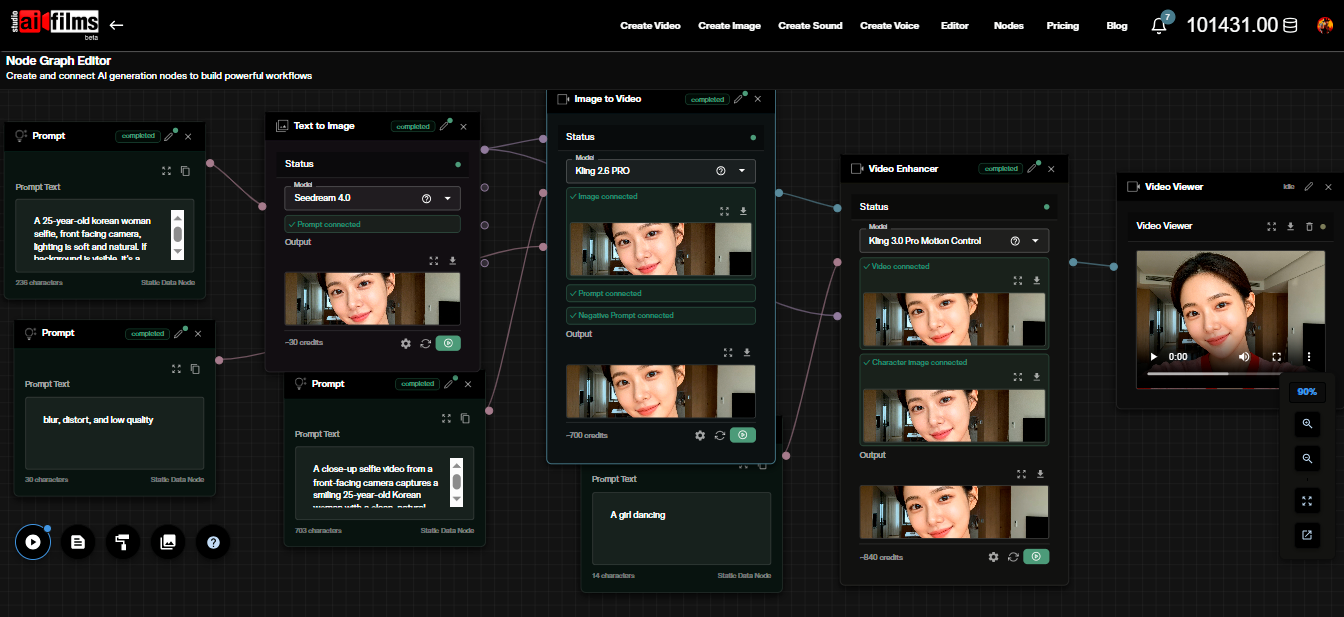
Motion Staging bypasses that entirely. Instead of prompting, you perform the shot. You open an interactive world model, physically execute the camera move and the character action in real time inside the low fidelity simulation, and record the output. The world model captures your exact inputs: the pan timing, the fall arc, the frame composition at each moment. That recording becomes your animatic.
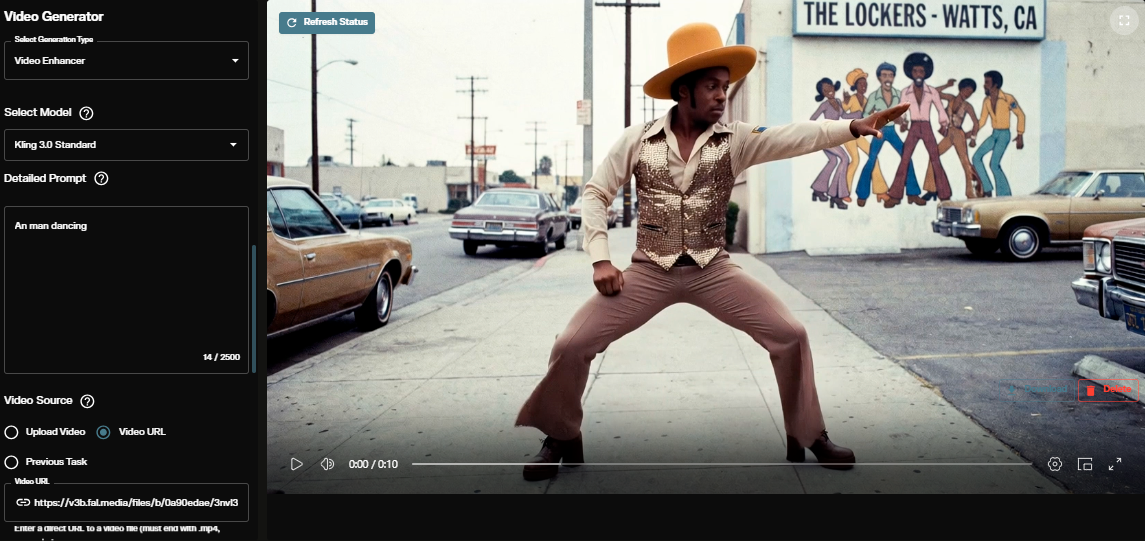
The second step is to run that recording through a video-to-video model. Vid2Vid takes the low fidelity base and skins it with cinematic visuals, translating the geometry and motion into finished imagery. An upscaler brings the resolution up to production quality.
The final result is a shot you directed physically, not one you hoped a prompt would interpret correctly. You controlled it. The AI dressed it.
This is precisely what makes MIND-World relevant beyond academic benchmarking. The benchmark videos shown throughout this article were captured from world model sessions using this same logic. Precise camera timing and character movement were recorded first. Then video-to-video rendering was applied on top. As models score higher against MIND's action control metrics, the correspondence between what you perform and what the final video delivers gets tighter. Better benchmarks drive better tools, and better tools give filmmakers genuine directorial control over AI video for the first time.
Sources
MIND: Benchmarking Memory Consistency and Action Control in World Models Yixuan Ye et al., Central South University and collaborating institutions Published: February 2026 arXiv:2602.08025
MIND GitHub Repository https://github.com/CSU-JPG/MIND
MIND Project Page https://csu-jpg.github.io/MIND.github.io/
Continue Reading


Video & LipSync
- Video Generator
- Text to Video
- Image to Video
- Start-End Frame to Video
- Draw to Video
- Motion Control
- Video Enhancer
- Video Upscaler
- Video Extend
- Video to Video LipSync
- Audio to Video LipSync
- Image to Video LipSync
- Video FaceSwap
- Seedance 2.5
- WAN 3.0
- Seedance 2
- FLUX 3
- Minimax H3
- Vidu Q3 Pro
- Grok Imagine Video 1.5
- Gemini Omni
- Google Veo 3.1
- Kling 3.0 Pro
- Luma Ray 3.2
- LTX 2.3
- Happy Horse 1.1
- Kling 3.0 Motion
- ByteDance Upscaler
- InfiniteTalk
- InsightFace
Image & Edit
- AI Character
- AI Actor
- Art Generator
- Text to Image
- Image to Image
- LoRA Image to Image
- Draw to Edit
- Image LoRA Training
- Remove Background
- Image Enhancer
- MidJourney 8.0
- Krea 2
- OpenAI GPT Image 2.0
- Nano Banana Pro Ultra
- Nano Banana 2 Lite
- Nano Banana Pro
- Minimax Image
- Clarity Pro
- Z-Image Turbo LoRA
- Krea 2 Turbo LoRA
- Z-Image LoRA Trainer
- Qwen Image LoRA Trainer
- Background Erase Network 2 (BEN2)