
PBS Documentary 'Declarations' Uses AI to Animate Portraits of Forgotten Black Revolutionary War Figures

Share this post:
PBS Documentary "Declarations" Uses AI to Animate Portraits of Forgotten Black Revolutionary War Figures
PBS premiered "Declarations: Black Americans and the Revolutionary War" on June 29, 2026, a one hour documentary that uses generative AI to animate hand painted oil portraits of four Black historical figures whose contributions to the Revolutionary War have received little mainstream documentation.
The film aired at 10pm ET as part of PBS's multiyear "America @ 250" slate, a programming initiative tied to the United States' 250th anniversary. It was produced by VPM, Virginia's public media station, and directed by Stacey L. Holman, with Maya Tepler serving as co-writer and producer.
Four Figures, Four Gaps in the Historical Record
The documentary centers on four individuals: James Lafayette, Harry Washington, Elizabeth Freeman, and Abraham Peyton Skipwith. Each played a documented role in the Revolutionary War era. None of them appear in the standard American history curriculum taught in most schools.
James Lafayette was a formerly enslaved man who served as a double agent, feeding false intelligence to the British while gathering real intelligence for the Continental Army. His work contributed directly to the British defeat at Yorktown in 1781. Elizabeth Freeman, born into slavery and known during her lifetime as "Mum Bet," became the first enslaved person in Massachusetts to win her freedom in court, suing a prominent patriot under the new state constitution in 1781.
Harry Washington and Abraham Peyton Skipwith represent two additional trajectories through the war period. Both were held in slavery, both navigated the war's competing promises of freedom, and both left records that the documentary argues belong in any honest account of who built and contested the founding era.
The visual record of the Revolutionary War era reflects who the era considered worth documenting. For most of the four figures in "Declarations," no verified contemporary likeness has survived.
| Figure | Historical Role | Known For |
|---|---|---|
| James Lafayette | Continental Army spy | Double agent at Yorktown (1781); petitioned Virginia legislature for freedom (1786) |
| Elizabeth Freeman | Legal plaintiff | First enslaved person to win freedom under Massachusetts constitution (1781) |
| Harry Washington | Black Loyalist | Evacuated to Nova Scotia (1783); later relocated to Sierra Leone |
| Abraham Peyton Skipwith | Formerly enslaved figure | Documented in Revolutionary era records; trajectory through the war period |
James Lafayette's story carries a specific recorded injustice: he was promised freedom in exchange for his service but was returned to slavery after the British surrender at Yorktown. He had to petition the Virginia General Assembly in 1786, nearly five years after the war ended, and the Marquis de Lafayette himself intervened to support the petition. Virginia legislators granted his freedom that year.
Elizabeth Freeman's legal case, Brom and Bett v. Ashley, set a precedent that effectively ended legal slavery in Massachusetts. Her lawyer Theodore Sedgwick argued that the new Massachusetts constitution's declaration that "all men are born free and equal" made slavery unconstitutional. The judge agreed. A watercolor portrait of Freeman painted around 1811 by Susan Ridley Sedgwick is one of the few confirmed likenesses from this group, now held at the Massachusetts Historical Society.
Artist First, AI Second
Before any generative AI tools were introduced, the production commissioned artist Hudson Campbell to create hand painted oil portraits of each of the four figures. Campbell worked with historical advisors to develop the portraits as informed representations rather than invented likenesses, grounding the visual choices in period dress, posture conventions, and available contextual documentation.
The advisors brought scholarly knowledge of 18th century material culture and the specific historical records that do exist for each figure. That research shaped what Campbell painted. The portraits are documented creative works by a named human artist, not the output of a generative model given a name and a prompt.
Only after Campbell completed the paintings did the production apply AI animation tools to introduce movement, expression, and the visual qualities of life that static portraits cannot carry. The AI animated what a human had already designed and painted, adding dimension to finished artworks rather than generating figures from scratch.
The production's decision to hire a named artist rather than use a generative model to create the portraits also leaves a clear attribution trail. Hudson Campbell's name is attached to the work. The historical advisors are credited. The AI animation is disclosed with a visible frame. At every stage, the creative and scholarly decision-making is traceable to specific people, not to a model operating on a prompt.
The tradition of formal portraiture as a record of identity is itself a product of access. Families and individuals with resources commissioned painted or photographed likenesses; those without left no visual trace. The four figures in "Declarations" fall into that second category, which is part of what the documentary argues the AI animation corrects.
Hudson Campbell's hand painted portraits give each figure a face grounded in historical research. The AI animation gives that face movement. The combination produces something no archive currently holds: a visual representation of people who shaped American history but were denied documentation of their existence.
.jpg)
Lafayette Ltd, Public domain, via Wikimedia Commons
The Rough Black Frame
Every sequence in "Declarations" that uses AI animated footage is marked by a rough black frame around the image, visible throughout the shot. The frame is part of the finished film, not an artifact of post-production. It functions as a real time signal to viewers that what they are watching is AI animation, distinguishable from historical photographs, archival footage, or conventional documentary imagery.
The technique makes the film's use of AI transparent at the moment of viewing without requiring a title card, voiceover explanation, or separate disclosure sequence. Viewers do not need to read supplementary materials or wait for an end credit to know which footage is AI generated. The frame communicates it while the image is on screen.
The Human Provenance standard for AI disclosure in film has articulated why in-frame disclosure matters for maintaining audience trust in documentary contexts. "Declarations" gives that principle a specific visual form: a low-technology, editorially embedded solution that works within the grammar of documentary presentation rather than interrupting it.
What the Disclosure Mechanism Solves
The rough black frame addresses a specific problem in AI documentary filmmaking that technical solutions alone do not solve: audiences cannot distinguish AI animated imagery from other documentary visual techniques without explicit markers. Motion graphics, archival restoration, and stylized re-enactments all appear in documentary films. AI animated portraits look like another production choice unless the film tells you otherwise.
"Declarations" commits to telling you otherwise, in the frame, every time. The black border is not subtle. It is deliberately rough and visible, a choice that prioritizes legibility over aesthetics. The filmmakers accepted a visual trade-off in favor of the audience's right to know what they are seeing.
Documentary filmmakers and legal scholars have been debating what AI disclosure obligations should look like in practice. The "Declarations" rough frame is not a regulatory response or a guild-negotiated standard. It is an editorial decision made before any external standard existed, which is what makes it a useful model for productions that cannot wait for the industry to produce official guidelines.
A Four Stage Transparency Workflow
The production's approach to AI integration has four components that can be separated and evaluated: historical research with qualified advisors, commissioned original art by a named human artist, AI animation of finished artworks, and visual disclosure to the audience at the moment of viewing.
Each stage has a clear owner and a clear purpose. The advisors are accountable for the historical grounding. Hudson Campbell is accountable for the visual interpretation. The AI tools are accountable only for the animation, not the creative or historical decisions. The rough black frame is accountable for the audience's ability to evaluate what they are watching.
That workflow structure is different from AI documentary applications where the generative model is doing more of the creative work earlier in the process. In "Declarations," the AI is the last tool applied, and its contribution is bounded by everything that came before it.
Part of America's 250th Anniversary Slate
PBS's "America @ 250" programming initiative is a multiyear series of productions addressing the United States' 250th anniversary, which falls in 2026. The initiative was designed to expand the American historical record in broadcast documentary beyond the most frequently covered figures and events of the founding era.
VPM's involvement reflects Virginia's direct historical connection to the story. The Battle of Yorktown, where James Lafayette's intelligence work helped bring about the British surrender in October 1781, took place in Virginia. VPM is the public media station for the Richmond, Norfolk, and Roanoke markets.
The "America @ 250" framing also places the documentary in a specific political conversation. As the United States approaches the 250th anniversary of the Declaration of Independence, public institutions, museums, and broadcasters have faced renewed scrutiny over which histories receive national investment. Choosing to produce a documentary about four Black figures from the founding era, aired on PBS in prime time, is itself a position in that conversation.
The choice to use AI animation as the visual tool for this particular story carries a secondary argument: that AI can serve historical inclusion rather than historical erasure. The technology is being used to document people the 18th century chose not to document, which positions it differently than most AI in history debates that center on fabrication or manipulation risks.
The "America @ 250" slate gave the production institutional backing and a national broadcast platform that a smaller independently produced documentary might not reach. That scale matters for the argument the filmmakers are making: these are stories they believe every American should have access to, not a niche historical audience.
Audience Reactions at the New York Premiere
The documentary held a New York premiere ahead of its June 29 broadcast. Director Holman described the audience response in press interviews afterward. "Everyone had the same question. Why did I not learn about this in school?" she said.
Maya Tepler noted a consistent emotional response from viewers leaving the screening. Audience members told her: "I was not aware of Black people having this kind of agency in the 1700s."
Holman's stated purpose for the project reaches beyond the historical gap. "This film is an opportunity to bring to light more hidden figures in history, stories that are important to the building of this nation," she said. She added: "There is so much we can learn about agency, endurance and most importantly hope, that viewers can apply to their lives today."
The premiere's audience responses suggest the documentary is reaching viewers who had no prior knowledge of these specific figures. That gap in awareness is not a failure of individual learning but a structural feature of how American history has been taught. A nationally broadcast PBS documentary with AI animated portraits of the subjects in question changes who can encounter these stories without going to a library or archive.
Transparency as a Production Decision, Not a Policy Response
The rough black frame in "Declarations" was not mandated by a regulator, required by a broadcaster's AI policy, or negotiated in a guild contract. It was a voluntary editorial choice made before any external standard for AI documentary disclosure existed in U.S. broadcast television.
That timing matters. The film demonstrates that a production team committed to transparency can implement a meaningful disclosure standard without waiting for the industry to develop one. The decision is credited to the filmmakers, not to a framework imposed on them.
Other documentary productions working with AI animated or AI generated content face the same question the "Declarations" team answered before any official guidance arrived: how does the audience know? The rough black frame answers that question in the simplest possible way. It requires no text overlay, no supplementary disclaimer, and no audience awareness of AI disclosure conventions. The frame is self-explanatory to anyone watching.
The wider value of "Declarations" for the documentary community is that it provides a tested production model. The film aired on PBS, reached a national audience, and received no reported complaints about misleading viewers. The voluntary disclosure mechanism worked in the sense that it was both present and apparently sufficient for the broadcast context it was designed for.
The production is now a data point available to any documentary filmmaker, broadcaster, or regulator trying to answer the question of what AI disclosure in a finished film should look like. The rough black frame approach does not require significant budget, specialized software, or post-production expertise beyond what a documentary production already uses. It is a design choice, available immediately, that costs nothing beyond the decision to make it.
What the Documentary Argues About AI
The filmmakers' description of the AI animation as a way to "give historical subjects agency" is the documentary's core conceptual claim about the technology. The four figures in "Declarations" were historically active agents who shaped events around them. The absence of their likenesses from the visual record is a product of who the era considered worth depicting, not a product of their historical significance.
The AI animated portraits reintroduce them into the visual vocabulary of American documentary history. That reintroduction is made with care: historical advisors, a commissioned artist, and a disclosure frame that tells viewers exactly what they are looking at. The result is an argument that AI can serve documentary truthfulness rather than undermine it, when the production's decisions are structured to keep the human creative and scholarly work in charge.
The argument "Declarations" makes about AI's role in historical documentation will be tested against whatever audience the broadcast reaches. Reactions at the New York premiere were consistent in one direction: surprise that these stories had not been taught, followed by a desire to know more. That response, whatever its scale, is the outcome the filmmakers built the production to produce.
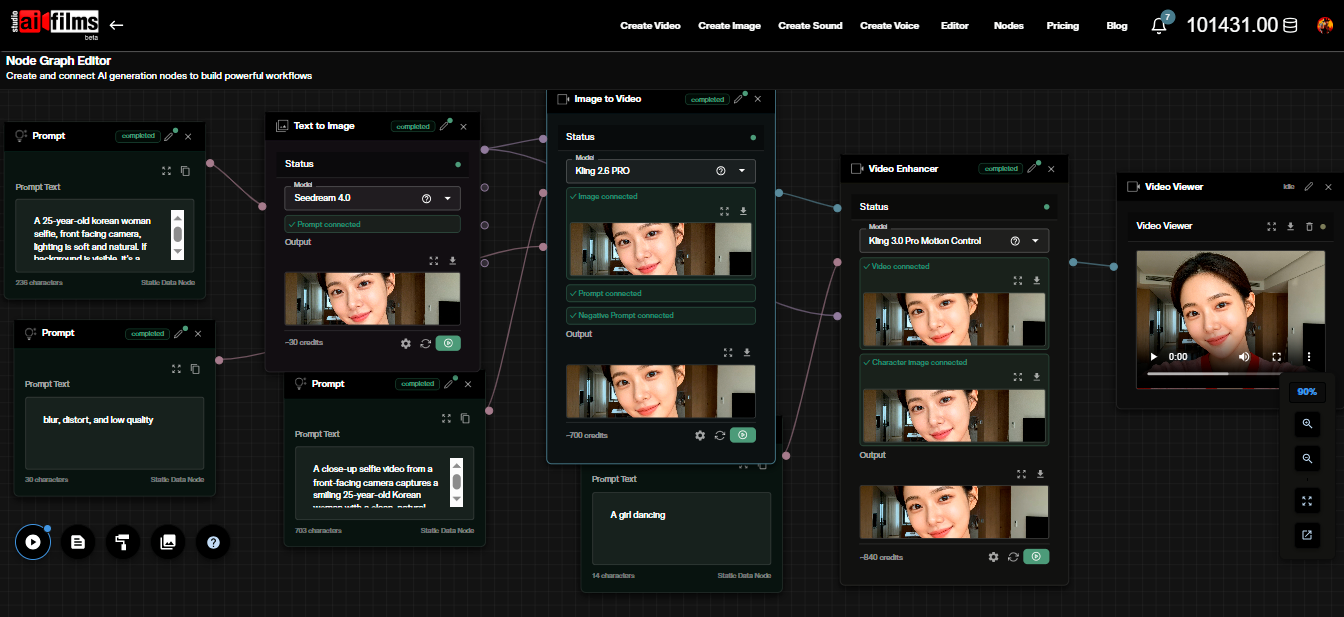
Filmmakers exploring AI tools for documentary and archival visual work can test and prototype approaches in the AI FILMS Studio video workspace before committing to a full production workflow.
Sources
Deadline | Forbes | PBS | KPBS Public Media | VPM | EURweb | Black PR Wire
Continue Reading
.jpg?w=3840)


.jpg)
Video & LipSync
- Video Generator
- Text to Video
- Image to Video
- Start-End Frame to Video
- Draw to Video
- Motion Control
- Video Enhancer
- Video Upscaler
- Video Extend
- Video to Video LipSync
- Audio to Video LipSync
- Image to Video LipSync
- Video FaceSwap
- Seedance 2.5
- WAN 3.0
- Seedance 2
- FLUX 3
- Minimax H3
- Vidu Q3 Pro
- Grok Imagine Video 1.5
- Gemini Omni
- Google Veo 3.1
- Kling 3.0 Pro
- Luma Ray 3.2
- LTX 2.3
- Happy Horse 1.1
- Kling 3.0 Motion
- ByteDance Upscaler
- InfiniteTalk
- InsightFace
Image & Edit
- AI Character
- AI Actor
- Art Generator
- Text to Image
- Image to Image
- LoRA Image to Image
- Draw to Edit
- Image LoRA Training
- Remove Background
- Image Enhancer
- MidJourney 8.0
- Krea 2
- OpenAI GPT Image 2.0
- Nano Banana Pro Ultra
- Nano Banana 2 Lite
- Nano Banana Pro
- Minimax Image
- Clarity Pro
- Z-Image Turbo LoRA
- Krea 2 Turbo LoRA
- Z-Image LoRA Trainer
- Qwen Image LoRA Trainer
- Background Erase Network 2 (BEN2)