
Reese Witherspoon Confronts Backlash to Her AI Advocacy
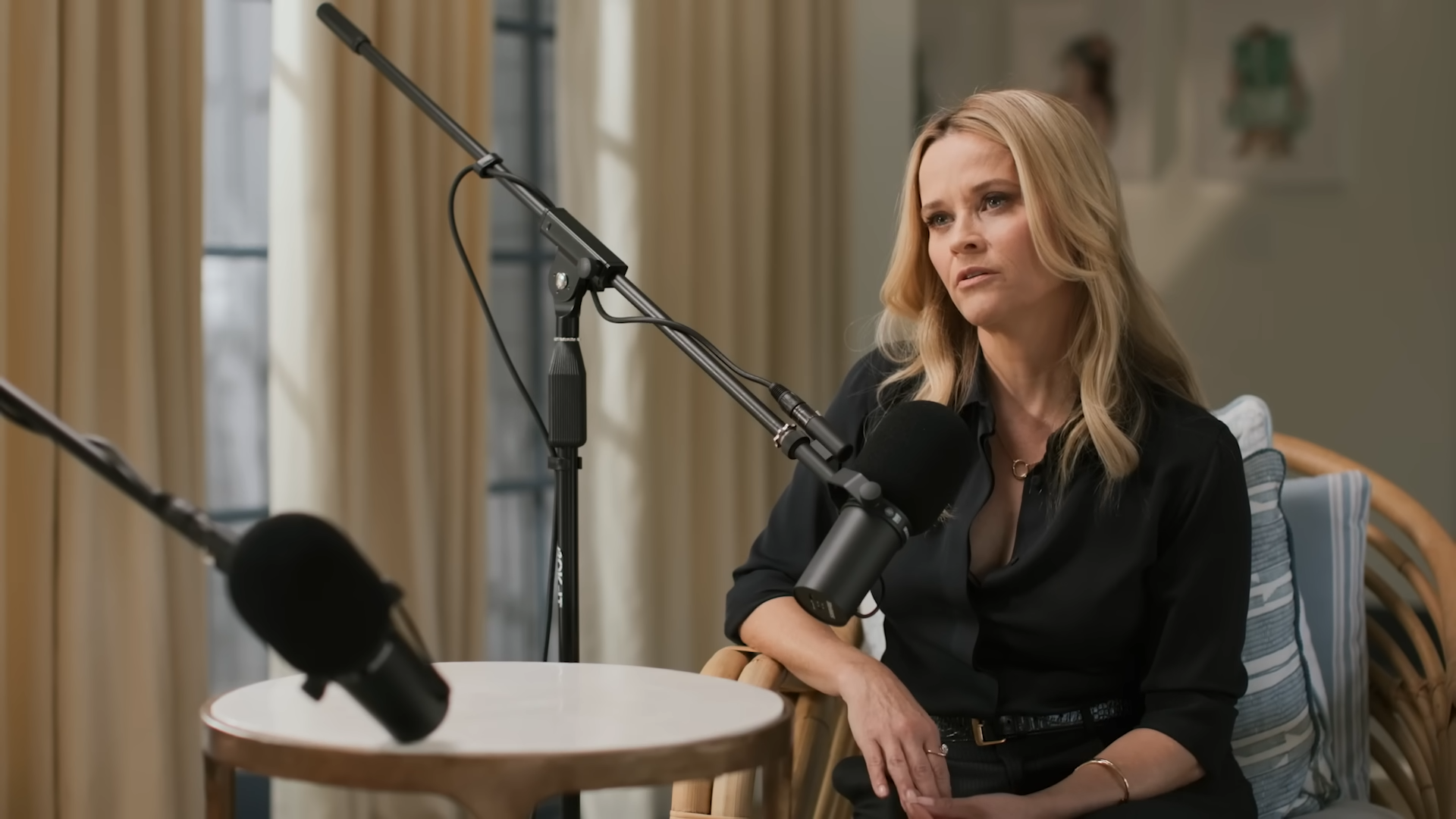
Still frame from The Interview by Lulu Garcia-Navarro, via The New York Times YouTube channel
Share this post:
Reese Witherspoon Confronts Backlash to Her AI Advocacy
On April 16, 2026, Reese Witherspoon posted an Instagram reel urging women to learn and adopt artificial intelligence tools, calling the current moment "the AI revolution." The video drew immediate pushback from industry workers, labor advocates, and environmental critics, forcing a public response from Witherspoon just days later.
The "Left Behind" Argument
Witherspoon's April reel was an extension of a position she first articulated publicly in September 2025. In a Glamour cover story, she called AI "the future of filmmaking" and urged women to participate before they were sidelined. She cited tools like Perplexity and Vetted AI and framed adoption as a matter of career survival. You can read the full context of her September 2025 position in our earlier coverage.
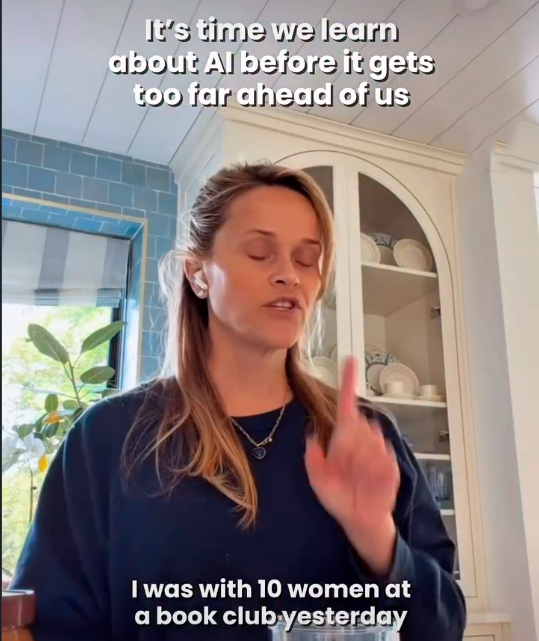
Witherspoon, R. (@reesewitherspoon). (2026, April 15). "It's time we learn about AI..." Instagram Reel.
The April reel sharpened that argument around a specific data point: women use AI at a rate 25% lower than men. Witherspoon framed this gap as a threat, saying women would be "left behind" if they did not act now.
Industry Backlash
The response was swift and came from multiple directions. Writers and actors pointed to unresolved labor disputes over AI's use of their work without consent or compensation. Critics noted that Witherspoon's framing ignored the ongoing fight over digital likenesses. California's digital replica law, signed in early 2026, had given performers new protections, but enforcement remained contested.
Environmental advocates objected to the reel's framing of AI as unambiguously positive, citing the energy consumption of large language models and data centers. Labor critics added that encouraging workers to "adopt" AI before robust protections are in place asks employees to accept the terms of their own displacement.
.jpg)
Eva Rinaldi, CC BY-SA 2.0, via Wikimedia Commons
Fast Company's coverage focused on the feminist angle specifically, noting that framing AI adoption as a women's issue drew criticism from the same labor and environmental groups that Witherspoon might otherwise expect as allies. Separately, YouTube's deepfake detection tool, rolled out to major talent agencies in April 2026, underscored how seriously the industry is treating AI risks to performers' identities. Days later, XR (Extreme Reach) launched the first formal payment system for AI performers in advertising, giving studios a mechanism to comply with the 2025 SAG-AFTRA Commercials Contract when using Digital Replicas or Synthetic Performers.
What Labor Groups Were Actually Asking
The criticism from writers and actors was not a rejection of AI tools as such. SAG-AFTRA had been negotiating expanded AI protections for synthetic performers since late 2025. WGA had just secured a four year deal that included new AI licensing requirements. Labor groups were asking for consent frameworks, compensation provisions, and disclosure requirements. None of those protections address whether individual workers choose to learn AI tools on their own time.
Witherspoon's framing bypassed that structure. Her argument was about individual adoption and personal career survival, not collective bargaining. Critics pointed out that encouraging workers to adopt AI before protections are in place implicitly accepts the industry's terms. The environmental criticism operated on a different axis: the energy cost of the large language models she cited runs into gigawatt hours annually.
Financial Ties
TheWrap and Fast Company both reported on Witherspoon's financial connection to Candle Media, a production company backed by Blackstone with significant investment in AI infrastructure. Critics argued the connection created a conflict of interest. Witherspoon was encouraging worker adoption of technology in which her financial partners have a direct stake. Witherspoon did not address this angle in her public response.
Candle Media was created in 2021 by Blackstone partners Kevin Mayer and Tom Staggs, who acquired Hello Sunshine from Witherspoon for $900 million in a deal that left her as a minority equity holder. The firm has made AI infrastructure a stated priority. Witherspoon's public advocacy for AI adoption therefore draws attention to an investment position that directly benefits from a workforce willing to use AI products.
The connection is not unique to Witherspoon in Hollywood. Several celebrity advocates for AI have financial ties to companies that build or sell the tools they are encouraging others to adopt. What made Witherspoon's situation more acute was the combination of a direct equity stake, a public platform with millions of followers, and a message targeted at workers rather than investors.
Her Response
On April 20-21, Witherspoon posted to her Instagram Stories to address the criticism directly. She stated she is not paid to promote AI and that "computers should not replace humanity." She acknowledged valid concerns around AGI, job displacement, and environmental impact. The response marked a shift in tone from the advocacy framing of the original reel toward one that recognized the complexity of the debate.
By late April 2026, the episode had become a reference point in a broader industry conversation about what celebrity AI advocacy actually means. The Hollywood Reporter's analysis noted that Witherspoon's response was more carefully worded than the original reel, suggesting an awareness that the audience for her message included industry workers with grievances as well as the professional women she was targeting.
Witherspoon's continued role as a producer and media company owner places her on both sides of the labor question in ways that individual actors are not. Her September 2025 position in Glamour was the starting point. Her April 2026 reel sharpened it. Her April 20-21 response complicated it again.
The Pattern Among Celebrity AI Advocates
Witherspoon was not alone. Days later, Sandra Bullock made a similar call for Hollywood to lean into AI at the CNBC Changemakers Summit alongside Warner Bros. CEO Pam Abdy. Will Smith, Scarlett Johansson, and Tyler Perry have all navigated public AI positions in the same period. The pattern across these statements is consistent: celebrities frame AI as inevitable, engagement as self-protective, and resistance as futile. The labor context in each case receives little or no acknowledgment.
The gap between celebrity advocacy and labor organizing around AI reflects a structural difference in exposure to risk. For a performer with Witherspoon's level of financial diversification, AI represents an investment opportunity and a production efficiency. For a working actor whose income depends on residuals and digital replica protections, the same tools represent a different set of calculations. Both frames are legitimate. The public conversation has largely collapsed them into one.
Hello Sunshine and the Broader Business Context
Hello Sunshine, the company Witherspoon founded in 2016, built its reputation on women-centered storytelling across film and television. The company's sale to Blackstone for $900 million in 2021 was among the largest acquisitions of an independent production company in recent industry history. Witherspoon retained a minority equity stake and continued as a public face of the brand.
Candle Media, the Blackstone vehicle that acquired Hello Sunshine, also purchased other production companies including Moonbug Entertainment, the creator of Cocomelon. The firm has been explicit about its interest in AI as a cost reduction mechanism across its content portfolio. Moonbug's animated content, in particular, is a category where AI generation is actively being evaluated as a production method by multiple studios.
The financial structure means that Witherspoon's advocacy for AI adoption speaks directly to the commercial interests of the company that purchased her business. Whether she coordinates her public statements with Candle Media's communications strategy is not public information. But the alignment of her advocacy with her financial position was the specific conflict critics flagged, and it is the one she chose not to address in her April 20-21 response.
The April 2026 Timing
The reel went up on April 16, three weeks after the WGA ratified its four year deal on March 28 and one week after SAG-AFTRA and the AMPTP began negotiating the terms of their own contract renewal. Witherspoon was not commenting on those negotiations directly. But the timing meant her message about individual AI adoption reached an audience actively engaged in collective negotiations about AI's terms.
Guild communications departments track public statements by studio-adjacent figures during active negotiations. The Witherspoon reel was not a negotiating position, but it functioned as a public statement about AI's value and inevitability at a moment when both sides were arguing about the specific terms of that value. The context shaped how it was received by members who were following their guild's negotiating updates alongside their industry feeds.
The Response from Guild Members Specifically
SAG-AFTRA members watching the April 16 reel were not only hearing Witherspoon's general argument about women and AI. They were hearing a studio-adjacent executive advocate for AI adoption weeks after their guild's tentative agreement with the AMPTP became public. The timing was not accidental, but it created a particular interpretive context: advice about AI adoption from someone on the studio side of a labor negotiation.
Several SAG-AFTRA members who responded publicly noted that the reel said nothing about the specific terms of the AI protections their guild had just negotiated. It did not acknowledge the consent and compensation provisions that differentiate the 2026 deal from 2023. It treated AI as a personal productivity tool rather than as the subject of active collective bargaining. That omission, rather than the advocacy itself, was what labor advocates found most revealing.
The Data Behind the 25 Percent Gap
The Pew Research Center study Witherspoon cited tracked AI tool use by gender across professional and personal contexts. The 25% gap showed up most consistently in professional tool adoption: women were using AI writing assistants, code helpers, and productivity tools at lower rates than men. The gap was smaller among younger workers and larger in industries where men hold the majority of senior roles.
Witherspoon's call to close the gap treats it as a behavioral problem with an individual solution. Critics from the labor and academic community pointed to a different framing: the gap reflects rational caution about tools that have been introduced into workplaces without adequate consent or compensation frameworks. Closing it by encouraging adoption before protections are in place accelerates displacement without changing who benefits.
The specific tools Witherspoon cited in her September 2025 Glamour interview, Perplexity and Vetted AI, are consumer and professional productivity tools rather than entertainment or production tools. Their relevance to Hollywood workers was not obvious, and critics noted she was framing a message about information workers for an audience of performers and crew.
What the Response Revealed About Witherspoon's Position
Her April 20-21 Instagram Stories response walked back the advocacy framing without repudiating the underlying argument. She acknowledged AGI risk, job displacement, and environmental concerns. She did not acknowledge the financial conflict critics identified. The response was careful enough to suggest it was drafted with communications input, but not careful enough to address the specific objection that attracted the most critical attention.
The Hollywood Reporter described the original reel as "well-intentioned but poorly timed." The episode illustrates a recurring pattern in Hollywood's AI debate: advocates with financial stakes in AI adoption speaking to audiences whose relationship to the tools is primarily one of risk exposure. Closing that gap requires engaging with the labor and compensation arguments, not just the career opportunity framing.
The Glamour Cover Story as the Origin Point
Witherspoon's September 2025 Glamour interview was the first public instance of her AI advocacy framed as career advice rather than general commentary. She named specific tools, described a specific threat (being left behind), and spoke directly to working professional women as her intended audience. The April 2026 reel repeated that structure with the additional data point from Pew Research.
The Glamour cover story generated relatively little industry pushback when it appeared. The April reel generated substantial pushback in part because the intervening months had sharpened the industry's awareness of AI's labor implications. The WGA deal ratified in March 2026 and the ongoing SAG-AFTRA negotiations gave the same message a different context. The message had not changed. The audience's frame of reference had.
How Candle Media's Portfolio Amplifies the Conflict
The conflict of interest critics identified is not a claim about Witherspoon's personal beliefs. It is a structural observation about how her financial position relates to the message she delivered. Candle Media, which owns Hello Sunshine, holds a portfolio that benefits from lower production costs and broader AI adoption across the content industry. Witherspoon's public message to workers encourages the behavior that benefits her financial partners.
That structure is common in Hollywood. Executives with equity in production companies regularly advocate publicly for production approaches that serve their financial interests. What made Witherspoon's situation different was the framing: she positioned her advocacy as advice to workers about their own career survival rather than as a perspective from the production company side of the labor equation. That framing collapsed a distinction that labor advocates consider important.
The conflict did not prevent Witherspoon from continuing her advocacy work. Her April 20-21 response acknowledged worker concerns without withdrawing the underlying argument. The episode ended with her public position somewhat complicated but her financial position unchanged. That outcome is itself a data point about how conflicts of interest operate in Hollywood's AI debate. The critics who raised the financial connection got coverage but did not change the behavior they were critiquing.
That dynamic is characteristic of how financial conflicts of interest resolve in public debates: the disclosure becomes part of the record, the original position continues, and the audience decides what weight to give the conflict.
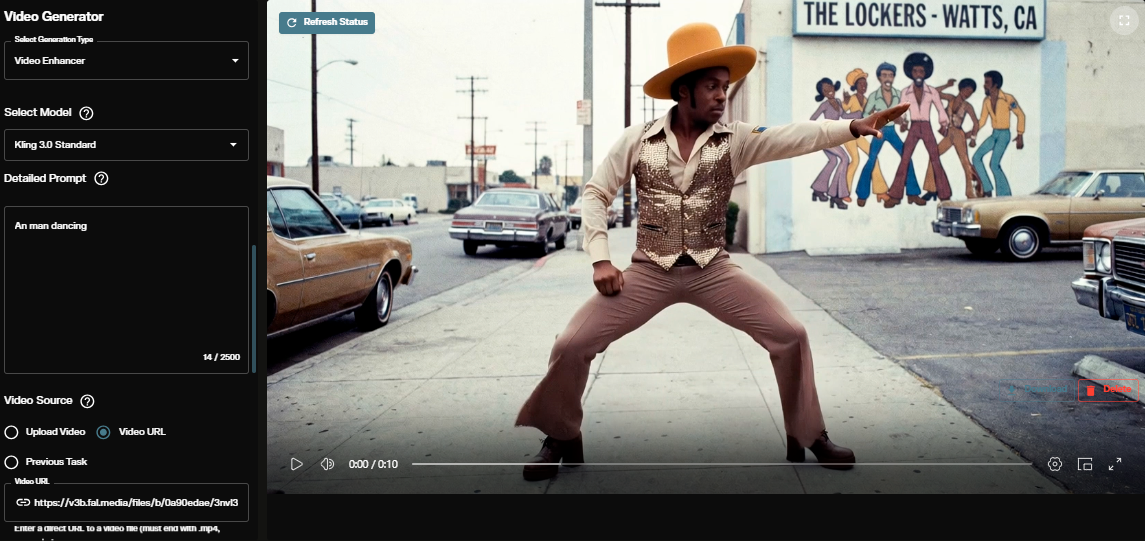
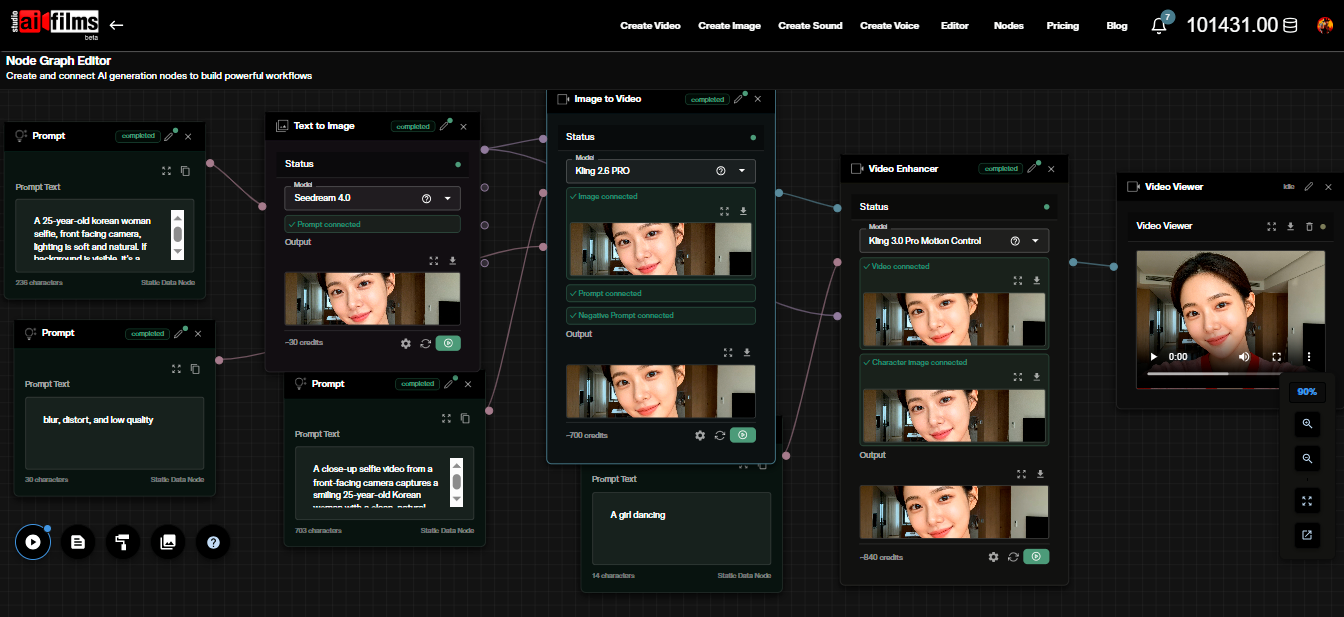
Explore the tools at the center of this conversation in the AI FILMS Studio video workspace, where you can generate video with the latest AI models.
Sources
The Hollywood Reporter | Variety | People | Rolling Stone | Fast Company | TheWrap | Glamour
Continue Reading


Video & LipSync
- Video Generator
- Text to Video
- Image to Video
- Start-End Frame to Video
- Draw to Video
- Motion Control
- Video Enhancer
- Video Upscaler
- Video Extend
- Video to Video LipSync
- Audio to Video LipSync
- Image to Video LipSync
- Video FaceSwap
- Seedance 2.5
- WAN 3.0
- Seedance 2
- FLUX 3
- Minimax H3
- Vidu Q3 Pro
- Grok Imagine Video 1.5
- Gemini Omni
- Google Veo 3.1
- Kling 3.0 Pro
- Luma Ray 3.2
- LTX 2.3
- Happy Horse 1.1
- Kling 3.0 Motion
- ByteDance Upscaler
- InfiniteTalk
- InsightFace
Image & Edit
- AI Character
- AI Actor
- Art Generator
- Text to Image
- Image to Image
- LoRA Image to Image
- Draw to Edit
- Image LoRA Training
- Remove Background
- Image Enhancer
- MidJourney 8.0
- Krea 2
- OpenAI GPT Image 2.0
- Nano Banana Pro Ultra
- Nano Banana 2 Lite
- Nano Banana Pro
- Minimax Image
- Clarity Pro
- Z-Image Turbo LoRA
- Krea 2 Turbo LoRA
- Z-Image LoRA Trainer
- Qwen Image LoRA Trainer
- Background Erase Network 2 (BEN2)