

AI FILMS architecture diagram from kopper/RelayVSR README & arXiv:2609.37850 (Apache 2.0)
Share this post:
RelayVSR: Open Source AI Video Super Resolution
Diffusion video upscalers recover rich fabric weave, foliage, and film grain that classic bicubic or GAN upscalers smear away, but running a multi billion parameter diffusion transformer on every single frame is painfully slow and prone to texture flicker. RelayVSR (kopper/RelayVSR, arXiv:2609.37850), released under the Apache 2.0 license in October 2026, splits streaming 4x video super resolution into two cooperative stages. A Wan 2.2 TI2V 5B reference generator restores sparse keyframes at 4x, and a lightweight Flash VSR network relays those sharp textures smoothly across every frame in between.
Studio availability. Try the public Hugging Face demo below; RelayVSR is not part of a paid AI FILMS Studio plan (use SeedVR2 Video Upscaler in the video workspace for example instead).
Try RelayVSR Live
Upload a compressed 480p or 720p AI generated clip into the Upsampler Hugging Face Space below to test RelayVSR's 4x diffusion restoration and inspect frame to frame texture stability directly in your browser.
Architecture and Technical Design
RelayVSR separates semantic hallucination from temporal propagation across two modular checkpoints. First, wan.safetensors (adapted from Wan 2.2 TI2V 5B with embedded restoration prompt conditioning) synthesizes high frequency 4x detail on sparse anchor keyframes. Next, flash.safetensors runs a compact streaming VSR decoder over the intermediate low resolution frames, warping and relaying the restored keyframe detail cleanly across motion boundaries.
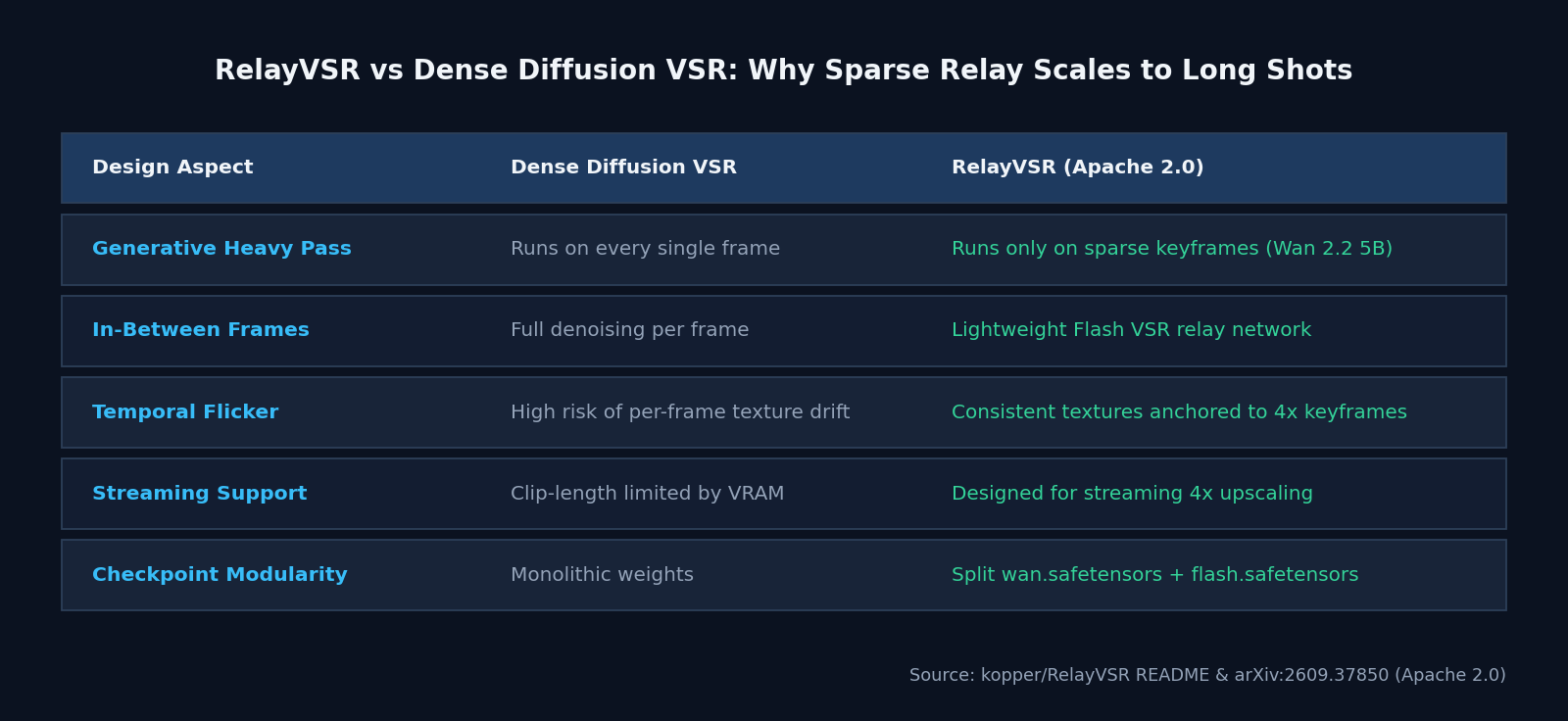
AI FILMS comparison diagram from kopper/RelayVSR & arXiv:2609.37850 (Apache 2.0)
Because the heavy Wan 2.2 diffusion pass executes only on sparse reference frames instead of every single frame in a 240 frame shot, RelayVSR slashes compute cost while removing the buzzing, frame to frame grain shimmer that plagues dense per frame diffusion upscalers.
Its streaming architecture also lets finishing artists upscale longer editorial takes without hitting out of memory crashes caused by holding an entire 4K latent volume in VRAM at once.
Hardware, VRAM, and License Matrix
| Checkpoint File | Role in Pipeline | Upstream Lineage | License | Typical VRAM (BF16) |
|---|---|---|---|---|
wan.safetensors |
Sparse 4x keyframe reference generator (includes prompt embeddings) | Adapted from Wan-AI/Wan2.2-TI2V-5B |
Apache 2.0 | ~16 to 24 GB |
flash.safetensors |
Lightweight streaming VSR relay network | RelayVSR (kopperx/RelayVSR) |
Apache 2.0 | ~6 to 10 GB |
Inference Code (kopperx/RelayVSR) |
Streaming 4x VSR runner | Original research code | Apache 2.0 | CUDA GPU (PyTorch) |
Both checkpoints and the inference codebase carry the permissive Apache 2.0 license, matching the upstream Wan 2.2 TI2V 5B license. Post houses and independent filmmakers can run RelayVSR locally for commercial finishing and archival restoration without royalty fees.
Parameter Reference
| Parameter | Recommended Setting | Finishing Impact |
|---|---|---|
| Scale factor | 4x native |
Upscales 480p drafts straight to 1920p / 4K mastering targets |
| Keyframe stride | Sparse reference interval | Tighter strides handle rapid camera whips; wider strides maximize speed |
| Precision | bfloat16 |
Keeps Wan 2.2 5B keyframe restoration fast and numerically stable |
| Input prep | Mildly denoised clean clip | Avoid sharpening halos before feeding clips into diffusion VSR |
| Streaming chunking | Enabled for long shots | Prevents VRAM spikes on 10+ second editorial takes |
Local Python and CLI Setup
Clone the kopperx/RelayVSR repository and download both wan.safetensors and flash.safetensors from Hugging Face.
git clone https://github.com/kopperx/RelayVSR.git
cd RelayVSR
pip install -r requirements.txt

hf download kopper/RelayVSR \
  wan.safetensors flash.safetensors \
  --local-dir ./checkpoints/RelayVSR
# Run streaming 4x video super resolution on a 480p draft plate
python inference.py \
  --input ./drafts/shot_012_480p.mp4 \
  --output ./masters/shot_012_4x.mp4 \
  --wan_ckpt ./checkpoints/RelayVSR/wan.safetensors \
  --flash_ckpt ./checkpoints/RelayVSR/flash.safetensors \
  --dtype bf16
Consult the exact CLI flag names in the latest kopperx/RelayVSR README after cloning, as the streaming inference wrapper receives regular memory optimizations.
Filmmaker Production Playbook
- Pair fast 480p/720p video generators with a 4x finishing pass. Models like FastH3-Omni and 4 step local video generators produce rough blocking fastest at 480p. Locking your edit at low resolution and passing only the approved cut through RelayVSR saves hours of wasted high resolution rendering.
- Stabilize fine skin, brick, and foliage textures. Single frame image upscalers cause leaves, brick walls, and woven jackets to boil from frame to frame. RelayVSR's sparse Wan keyframe + Flash relay design anchors high frequency texture consistently across camera pans.
- Avoid double compression before upscaling. Export your source AI clips as ProRes or high bitrate CRF 14 MP4 before running RelayVSR so the Wan 2.2 reference generator does not amplify macroblock artifacts into false surface detail.
- Upscale directly in the cloud for fast client turnarounds. When you need 4K video upscaling without managing local 24 GB VRAM pipelines, run SeedVR2 Video Upscaler, Topaz Video Upscaler, or Real-ESRGAN Video Upscaler on our video upscaler page inside the video workspace.
Related Reading
- SeedVR2 & Real-ESRGAN: Open Source Video Upscaling AI
- SparkVSR: Open Source Interactive Video Super-Resolution
- FlashVSR: Open Source Real-Time 4K Video Upscaler AI
- SVI360 & UltraVSR: Open Source 360 Video & 4K Upscaling
Sources
Continue Reading


Video & LipSync
- Video Generator
- Text to Video
- Image to Video
- Start-End Frame to Video
- Draw to Video
- Motion Control
- Video Enhancer
- Video Upscaler
- Video Extend
- Video to Video LipSync
- Audio to Video LipSync
- Image to Video LipSync
- Video FaceSwap
- Seedance 2.5
- WAN 3.0
- Seedance 2
- FLUX 3
- Minimax H3
- Vidu Q3 Pro
- Grok Imagine Video 1.5
- Gemini Omni
- Google Veo 3.1
- Kling 3.0 Pro
- Luma Ray 3.2
- LTX 2.3
- Happy Horse 1.1
- Kling 3.0 Motion
- ByteDance Upscaler
- InfiniteTalk
- InsightFace
Image & Edit
- AI Character
- AI Actor
- Art Generator
- Text to Image
- Image to Image
- LoRA Image to Image
- Draw to Edit
- Image LoRA Training
- Remove Background
- Image Enhancer
- MidJourney 8.0
- Krea 2
- OpenAI GPT Image 2.0
- Nano Banana Pro Ultra
- Nano Banana 2 Lite
- Nano Banana Pro
- Minimax Image
- Clarity Pro
- Z-Image Turbo LoRA
- Krea 2 Turbo LoRA
- Z-Image LoRA Trainer
- Qwen Image LoRA Trainer
- Background Erase Network 2 (BEN2)