

Audio8-TTS-Realistic-Air release banner by Edge0 AI (Apache 2.0)
Share this post:
Audio8-TTS Realistic Air: Open Source 23 Language Voice
Multilingual voice cloning models often demand 4B to 8B parameters and heavy Python stacks just to render scratch dialogue. Audio8-TTS-Realistic-Air, released by Edge0 AI under the Apache 2.0 license with native llama.cpp GGUF support added on November 16, 2026, delivers natural prosody and 44.1 kHz speech across 23 languages in a compact 0.6B DualAR architecture. With nearly 25,000 Hugging Face downloads, it gives editors and sound designers local zero shot ADR and international dubbing on consumer laptops or single GPUs.
Studio availability. Try the public Hugging Face demo below; Audio8-TTS-Realistic-Air is not part of a paid AI FILMS Studio plan (use ElevenLabs Eleven V3 Text to Speech in the voice workspace for example instead).
Try Audio8-TTS Realistic Air Live
Generate speech or test zero shot voice cloning directly inside the official Edge0 Playground below. Upload a clean reference clip with a matching transcript to steer cadence and speaker timbre across 23 supported languages.
Architecture and Technical Design
Audio8-TTS-Realistic-Air uses a DualAR architecture containing 601,159,424 main model parameters (excluding the bundled 44.1 kHz neural audio codec). A 24 layer Slow AR transformer (width 896, 14 attention heads, 2 KV heads) predicts one semantic token per audio frame. A 4 layer Fast AR decoder then predicts all 10 acoustic codebooks (4,096 entries per codebook) at roughly 21.5 frames per second, conditioned on the slow hidden state.
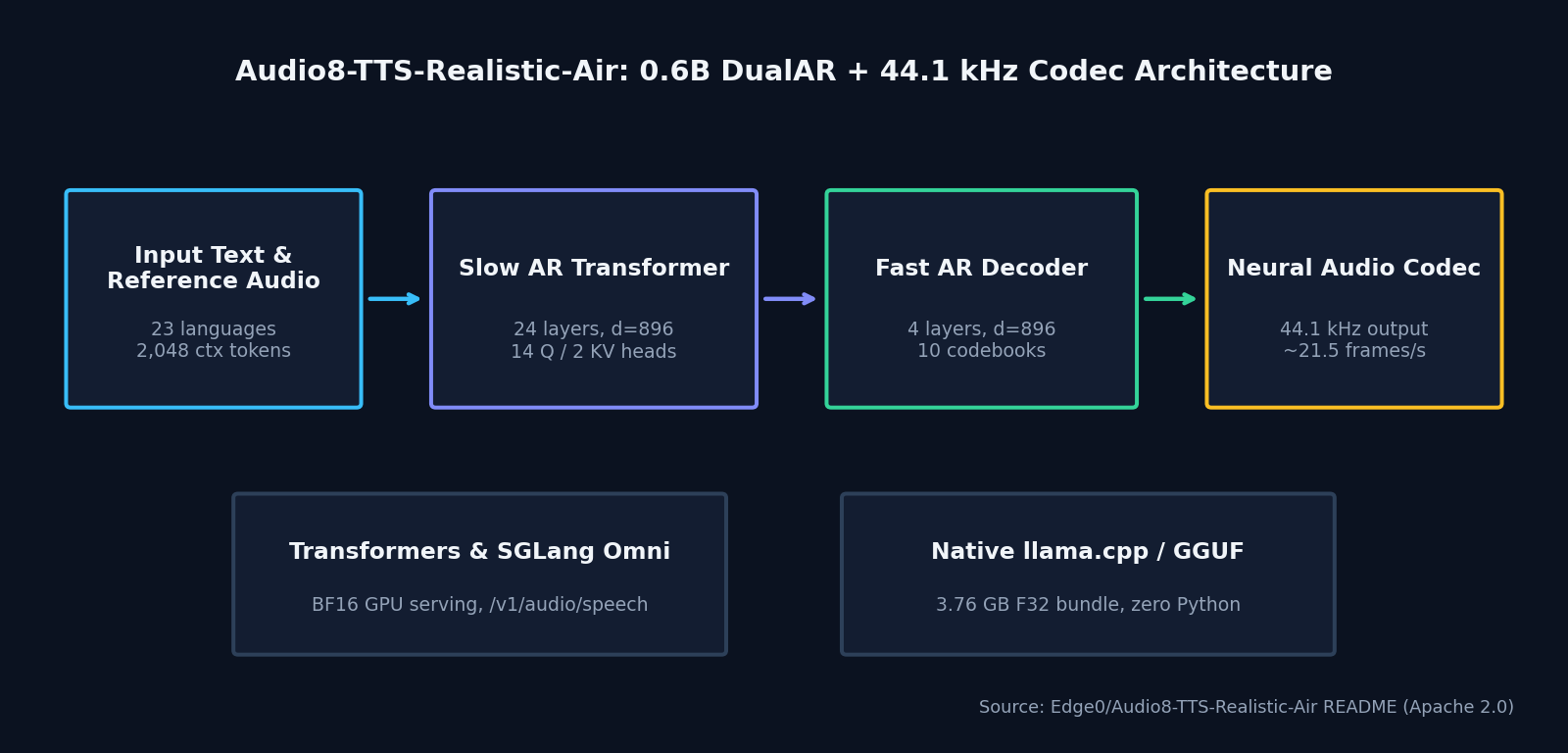
AI FILMS architecture diagram from Edge0/Audio8-TTS-Realistic-Air README (Apache 2.0)
Compared to the earlier 11 language Preview release, Realistic Air adds 12 languages: Arabic, Finnish, Hindi, Indonesian, Malay, Norwegian, Portuguese, Russian, Swedish, Thai, Turkish, and Vietnamese. The bundled 44.1 kHz codec handles both reference audio encoding and waveform decoding, eliminating separate vocoder downloads.
On November 16, 2026, Edge0 shipped a native C++ llama.cpp integration using a shared 3.76 GB F32 payload bundle. That runtime supports local CLI synthesis, voice cloning, HTTP serving, and incremental streaming with zero Python or PyTorch overhead.
In published benchmarks, the 0.6B checkpoint reaches 1.25% error on Seed-TTS English and Chinese (speaker similarity 0.704), 4.86% error across 9 core CV3 languages (beating Qwen3-TTS 1.7B at 7.73% and MOSS-TTS v1.5 8.5B at 6.11%), and 5.89% across the 24 language MiniMax evaluation set (SIM 0.754).
Hardware, VRAM, and License Matrix
| Deployment Runtime | Precision / Bundle | Approx. Memory | Streaming Support | License | Best Filmmaker Use |
|---|---|---|---|---|---|
Transformers (AutoModel) |
BF16 (CUDA) / FP32 (CPU) | ~2.5 to 4 GB VRAM | Batch / file export | Apache 2.0 | Python scripting and batch temp ADR |
Native llama.cpp CLI / HTTP |
Shared F32 bundle (3.76 GB) |
~4 to 5 GB RAM | Incremental streaming | Apache 2.0 | Offline edit bay laptops without Python |
| SGLang Omni Adapter | BF16 with paged attention | ~4 to 6 GB VRAM | OpenAI compatible API | Apache 2.0 | High throughput studio dubbing servers |
Because the weights, codec, llama.cpp converter, and SGLang Omni adapter are released under Apache 2.0, independent productions and post houses can embed Audio8-TTS into commercial dubbing and previsualization pipelines freely.
Parameter Reference
| Parameter | Default / Recommended | Effect on Dialogue Output |
|---|---|---|
max_new_tokens |
1024 (context max 2048) |
Caps utterance duration; ~21.5 codec frames per second |
temperature |
0.8 |
Controls vocal expressiveness and pitch variation |
top_p |
0.95 |
Balances natural cadence against pronunciation stability |
top_k |
50 |
Keeps codebook token sampling within clean phonetic bounds |
reference_audio |
Clean mono WAV | 5 to 12 seconds of dry speech works best for timbre lock |
reference_text |
Exact verbatim transcript | Must match every spoken word in the reference recording |
Local Python and CLI Setup
Install the PyTorch and Transformers dependencies (transformers>=4.57.0,<5), then run zero shot voice cloning locally in Python.
pip install "torch>=2.5.0" "torchaudio>=2.5.0" \
  "transformers>=4.57.0,<5" "soundfile>=0.12" "safetensors>=0.4"
import soundfile as sf
import torch
from transformers import AutoModel, AutoProcessor

model_id = "Edge0/Audio8-TTS-Realistic-Air"
device = "cuda" if torch.cuda.is_available() else "cpu"
dtype = torch.bfloat16 if device == "cuda" else torch.float32

processor = AutoProcessor.from_pretrained(model_id, trust_remote_code=True)
model = AutoModel.from_pretrained(
    model_id, trust_remote_code=True, dtype=dtype
).eval().to(device)

inputs = processor(
    text=["Cut to the exterior wide shot. The rain hits the windshield as the engine stalls."],
    reference_audio=["director_ref.wav"],
    reference_text=["The exact verbatim transcript of your reference clip."],
    return_tensors="pt",
)
inputs = {k: v.to(device) for k, v in inputs.items()}

with torch.inference_mode():
    output = model.generate(
        **inputs,
        max_new_tokens=1024,
        temperature=0.8,
        top_p=0.95,
        top_k=50,
        do_sample=True,
        return_dict_in_generate=True,
    )
    waveforms, lengths = model.decode_audio(output.codes)

audio = waveforms[0, : int(lengths[0])].float().cpu().numpy()
sf.write("temp_adr_line.wav", audio, model.config.codec_sample_rate)
For native C++ llama.cpp deployment without Python, download only the llama-cpp/ directory (3.76 GB total) and point the patched runtime's --audio8-model-dir flag at that folder.
hf download Edge0/Audio8-TTS-Realistic-Air \
  --include "llama-cpp/**" --local-dir model/Audio8-TTS-Realistic-Air
Filmmaker Production Playbook
1. Cut temp ADR lines during offline editorial. Editors frequently rewrite lines during rough cut screenings before actors return to the ADR booth. Using the 3.76 GB llama.cpp build, an assistant editor can synthesize 44.1 kHz scratch lines in the actor's cadence on a local workstation and drop them straight onto the timeline.
2. Pitch international festival cuts across 23 languages. Because Realistic Air preserves speaker similarity (0.754 SIM on MiniMax 24 language tests) at 0.6B scale, producers can generate localized trailer voiceovers in Spanish, French, Japanese, Korean, Arabic, or Hindi from one clean English reference take.
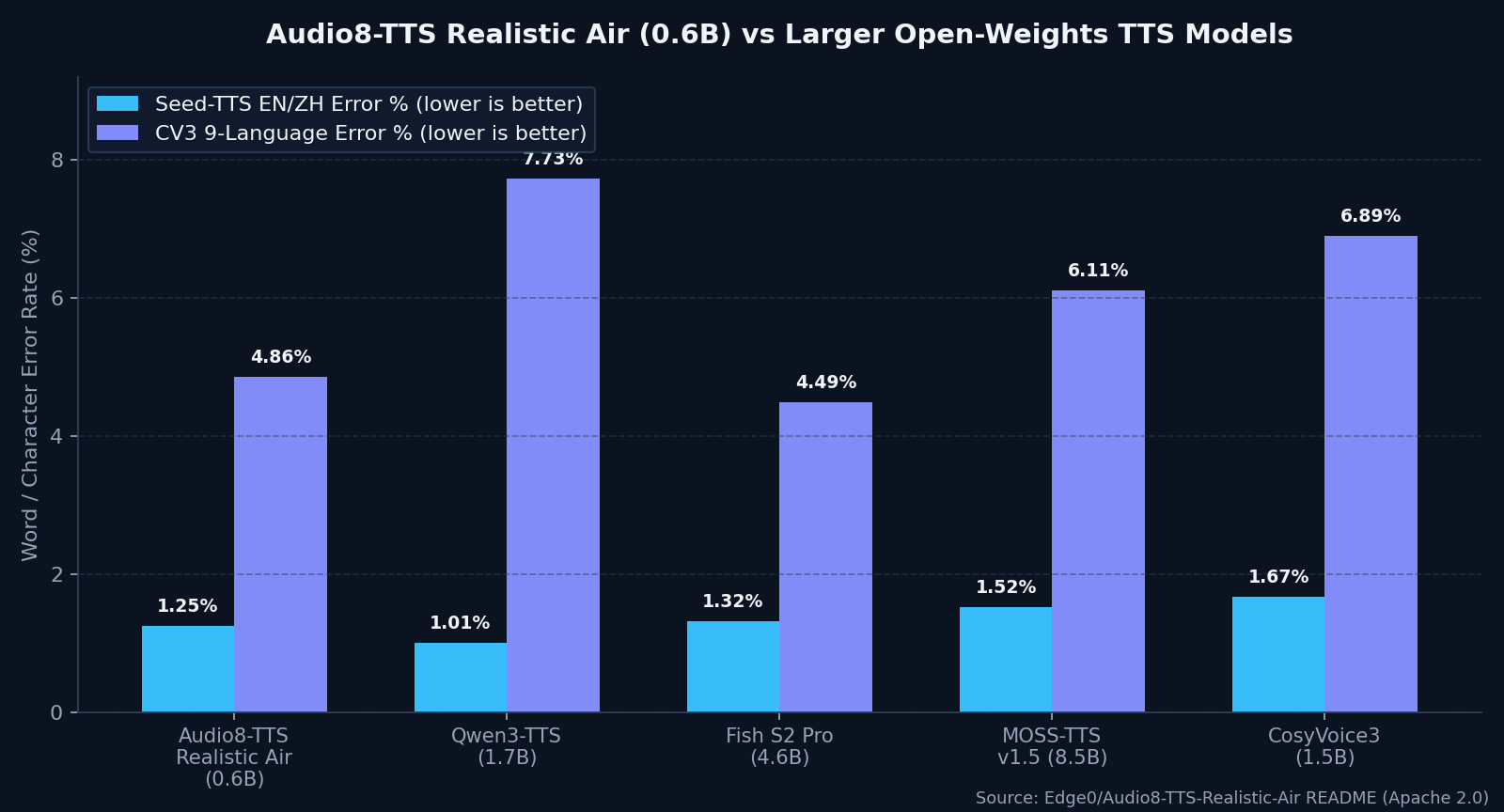
AI FILMS benchmark chart from Edge0/Audio8-TTS-Realistic-Air README (Apache 2.0)
- Pair with local dialogue cleanup before cloning. Reference clips recorded on set carry room tone and camera fan hum that leak into zero shot clones. Clean your reference take first with an open source voice isolator so the 44.1 kHz codec locks onto the actor's voice alone.
- Use cloud voice generation for rapid multi take casting. When you want studio grade voiceovers without local installs, generate directly with ElevenLabs Eleven V3 Text to Speech or MiniMax Voice Clone inside the voice workspace, and check our text to video page to pair narration with generated visuals.
Related Reading
- MOSS-TTS v1.5: Open Source 48 kHz Voice Cloning AI
- Fun-CosyVoice 3.0: Open Source Multilingual Voice AI
- Drama 3: Open Weights Multi Speaker Dialogue TTS
- Open Source Voice Cloning for Film: Qwen3, F5 & Kokoro


Sources
Continue Reading


Video & LipSync
- Video Generator
- Text to Video
- Image to Video
- Start-End Frame to Video
- Draw to Video
- Motion Control
- Video Enhancer
- Video Upscaler
- Video Extend
- Video to Video LipSync
- Audio to Video LipSync
- Image to Video LipSync
- Video FaceSwap
- Seedance 2.5
- WAN 3.0
- Seedance 2
- FLUX 3
- Minimax H3
- Vidu Q3 Pro
- Grok Imagine Video 1.5
- Gemini Omni
- Google Veo 3.1
- Kling 3.0 Pro
- Luma Ray 3.2
- LTX 2.3
- Happy Horse 1.1
- Kling 3.0 Motion
- ByteDance Upscaler
- InfiniteTalk
- InsightFace
Image & Edit
- AI Character
- AI Actor
- Art Generator
- Text to Image
- Image to Image
- LoRA Image to Image
- Draw to Edit
- Image LoRA Training
- Remove Background
- Image Enhancer
- MidJourney 8.0
- Krea 2
- OpenAI GPT Image 2.0
- Nano Banana Pro Ultra
- Nano Banana 2 Lite
- Nano Banana Pro
- Minimax Image
- Clarity Pro
- Z-Image Turbo LoRA
- Krea 2 Turbo LoRA
- Z-Image LoRA Trainer
- Qwen Image LoRA Trainer
- Background Erase Network 2 (BEN2)