

VoxDance Lab (VoxMel inference flow diagram, Apache 2.0)
Share this post:
VoxMel 0.3B: Open Source Wavelet Speech Synthesis
Most modern zero shot voice cloning models depend on a learned neural audio codec, which introduces quantization artifacts and metallic high frequency shimmer into cloned dialogue. VoxMel 0.3B (arXiv:2611.20254), released by VoxDance Lab in November 2026 under the Apache 2.0 license, removes the learned acoustic tokenizer entirely by applying a fixed, invertible two axis Haar wavelet transform directly to continuous Mel spectrograms for English and Mandarin voice cloning. You can test VoxMel 0.3B free in the embedded browser demo below with zero login.
Studio availability. Try the public Hugging Face demo below; VoxMel 0.3B is not part of a paid AI FILMS Studio plan (use ElevenLabs Eleven V3 Text to Speech in the voice workspace for example instead).
Try VoxMel 0.3B Live
Upload a short voice recording and its exact transcript inside the public Hugging Face Space below to test wavelet factorized zero shot voice cloning in your browser.
Architecture and Technical Design
VoxMel replaces discrete audio tokenizers with a purely mathematical two axis Haar wavelet transform that splits every training Mel spectrogram cleanly into three invertible components, specifically a low resolution Coarse-Mel contour plus one temporal residual and one frequency residual.
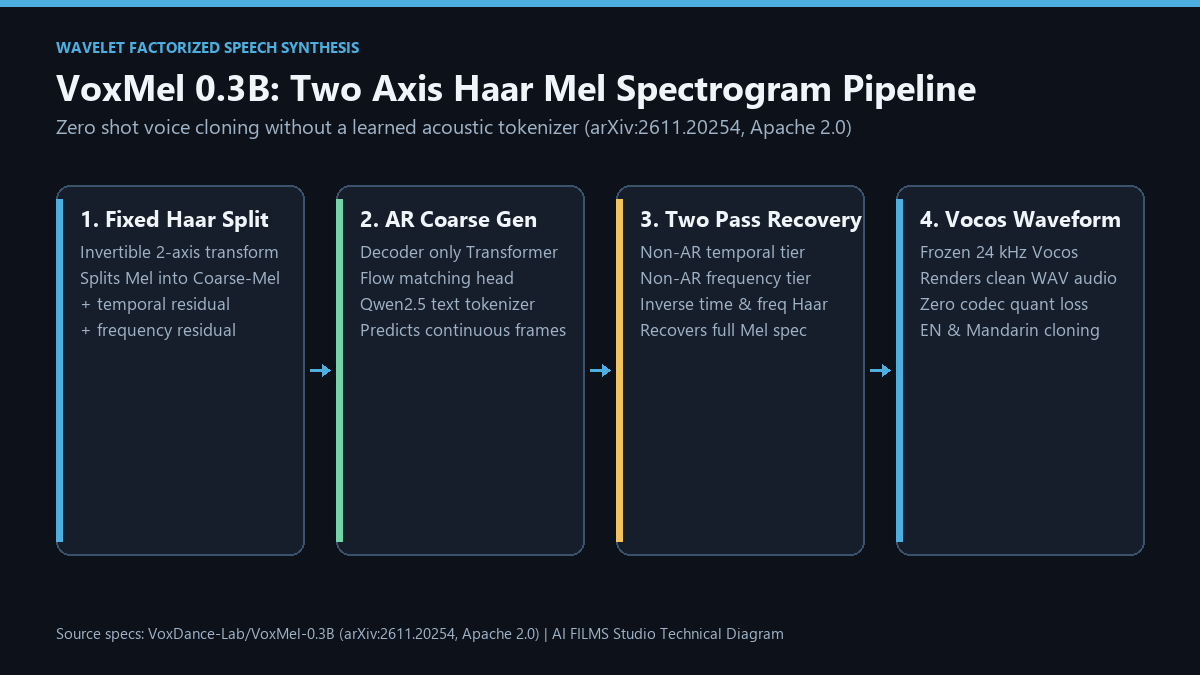
VoxMel wavelet factorized pipeline based on VoxDance-Lab/VoxMel-0.3B (arXiv:2611.20254)
Text enters through the Qwen2.5 tokenizer. A decoder only Transformer paired with a continuous flow matching head then generates Coarse-Mel frames autoregressively one step at a time, conditioned on the prompt text and reference audio.
Once the coarse contour finishes, two fast non autoregressive tiers predict the temporal residual and frequency residual in parallel. Applying the inverse time axis and frequency axis Haar transforms recovers the full Mel spectrogram, which a frozen 24 kHz Vocos vocoder renders into clean PCM audio.
Because the Haar decomposition is mathematically lossless and operates directly on continuous Mel features, VoxMel avoids codebook collapse and keeps parameter counts remarkably lean.
VoxDance Lab released two matching checkpoints under Apache 2.0, VoxMel-0.3B (300M parameters) for fast workstation synthesis and VoxMel-0.6B (600M parameters) for higher prosody fidelity. Both share the exact same voxcore Python interface and require the external 24 kHz Vocos vocoder and Qwen2.5 tokenizer.
Current evaluation focuses on short form English and Mandarin dialogue, making VoxMel well suited to sentence level ADR pickups and localized character lines.
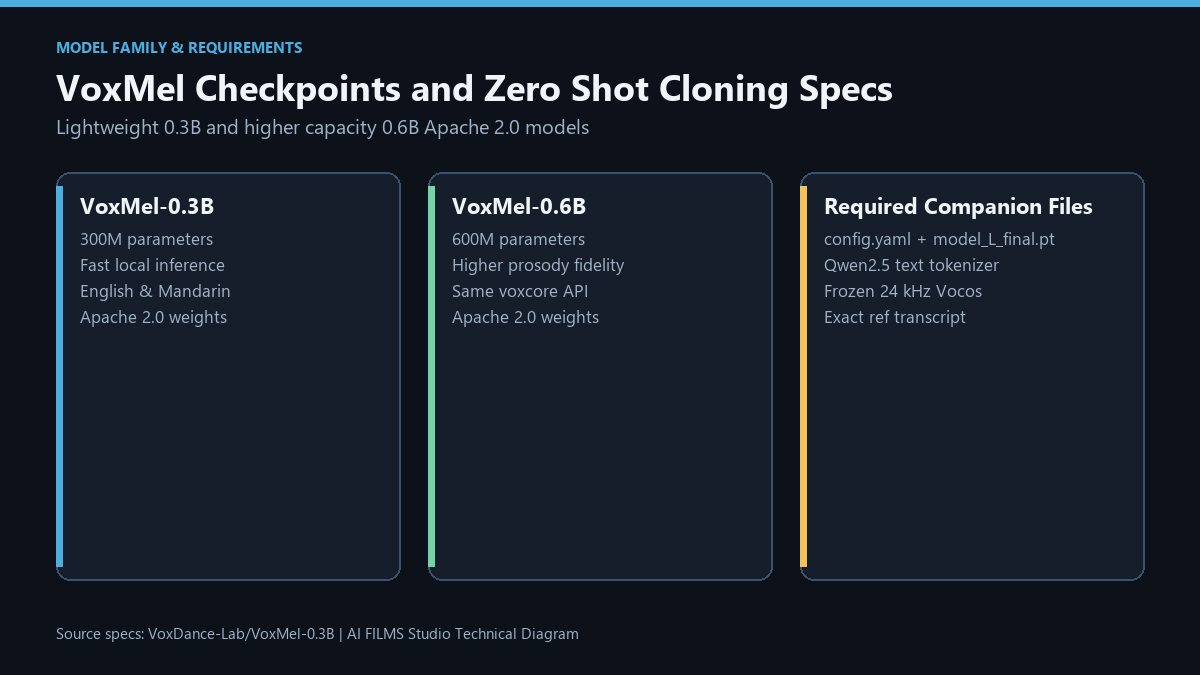
VoxMel checkpoint family and companion file requirements from VoxDance-Lab/VoxMel
Hardware, VRAM, and License Matrix
| Checkpoint | Parameters | Languages | Vocoder / Sample Rate | Typical GPU VRAM | License |
|---|---|---|---|---|---|
VoxDance-Lab/VoxMel-0.3B |
300M | English & Mandarin | Frozen Vocos (24 kHz) | ~2 to 4 GB GPU | Apache 2.0 |
VoxDance-Lab/VoxMel-0.6B |
600M | English & Mandarin | Frozen Vocos (24 kHz) | ~4 to 6 GB GPU | Apache 2.0 |
charactr/vocos-mel-24khz |
Companion vocoder | Language agnostic | 24 kHz Mel to WAV | Shared (~0.3 GB) | MIT / upstream terms |
Both VoxMel code and weights are released under the Apache 2.0 license, enabling commercial integration in independent animation pipelines and custom audio tools.
Parameter Reference
| Parameter | Recommended Setting | Cloning Effect |
|---|---|---|
prompt_wav_path |
Clean 3 to 10 s reference WAV | Supplies speaker timbre, pitch range, and vocal texture |
prompt_text |
Verbatim transcript of prompt_wav_path |
Aligns text tokens to acoustic frames; mismatches degrade clarity |
seed |
Integer (for example 42) |
Fixes flow matching noise sampling for reproducible takes |
device |
"auto" (CUDA or CPU) |
Automatically targets GPU acceleration when available |
Local Python and CLI Setup
Clone the VoxMel repository in Python 3.10 to 3.12, install the voxcore package, and place the VoxMel-0.3B checkpoint (model_L_final.pt + config.yaml) and vocos-mel-24khz weights in local directories.
git clone https://github.com/VoxDance-Lab/VoxMel.git
cd VoxMel
pip install -e .

huggingface-cli download VoxDance-Lab/VoxMel-0.3B --local-dir ./weights/voxmel-0.3b
huggingface-cli download charactr/vocos-mel-24khz --local-dir ./weights/vocos-mel-24khz
Synthesize zero shot cloned dialogue in Python with exact reference transcript alignment.
import soundfile as sf
from voxcore import VoxMel

model = VoxMel.from_pretrained(
    "./weights/voxmel-0.3b",
    tokenizer_path="examples/voxmel/qwen_tokenizer",
    vocos_path="./weights/vocos-mel-24khz",
    device="auto",
)

waveform = model.generate(
    "Stay below the ridge until the flare clears the canyon.",
    prompt_wav_path="lead_actor_dry_ref.wav",
    prompt_text="Replace this with the exact words spoken in the reference recording.",
    seed=42,
)
sf.write("adr_pickup_01.wav", waveform, model.sample_rate)
Keep individual generations to short form dialogue lines (one to two sentences per pass) so phrasing and intonation stay natural.
Filmmaker Production Playbook
1. Clean ADR pickup tests on modest GPUs. At 300M parameters, VoxMel 0.3B runs comfortably on 4 GB to 8 GB workstation GPUs while preserving natural sibilance and vocal breathiness that discrete codec models often smear.
2. Bilingual English and Mandarin line checks. Productions working across international co production teams can clone a cast member's reference tone across both English and Mandarin script revisions using one Apache 2.0 checkpoint.
3. Transcript accuracy first. Always double check that prompt_text matches every word and contraction spoken in prompt_wav_path, and strip background music from the reference clip before cloning.
4. Cloud voice and video alignment. When connecting cloned dialogue into hosted lip-sync or cinematic video generation without maintaining local vocoders, use MiniMax Voice Clone or ElevenLabs Eleven V3 Text to Speech in the AI FILMS Studio voice workspace and bring scenes to life on the AI Text-to-Video Generator page.
Related Reading
- Breeze-TTS-2: Open Source Zero Shot Voice Cloning AI
- Kitten TTS 2 Mini: Open Source 82M CPU Voice AI
- IndexTTS-2.5 & 2.0: Open Source Duration & Emotion TTS
- Fun-CosyVoice 3.0: Open Source Multilingual Voice AI
- Animate dialogue scenes on the AI Text-to-Video Generator page
Sources
Continue Reading


Video & LipSync
- Video Generator
- Text to Video
- Image to Video
- Start-End Frame to Video
- Draw to Video
- Motion Control
- Video Enhancer
- Video Upscaler
- Video Extend
- Video to Video LipSync
- Audio to Video LipSync
- Image to Video LipSync
- Video FaceSwap
- Seedance 2.5
- WAN 3.0
- Seedance 2
- FLUX 3
- Minimax H3
- Vidu Q3 Pro
- Grok Imagine Video 1.5
- Gemini Omni
- Google Veo 3.1
- Kling 3.0 Pro
- Luma Ray 3.2
- LTX 2.3
- Happy Horse 1.1
- Kling 3.0 Motion
- ByteDance Upscaler
- InfiniteTalk
- InsightFace
Image & Edit
- AI Character
- AI Actor
- Art Generator
- Text to Image
- Image to Image
- LoRA Image to Image
- Draw to Edit
- Image LoRA Training
- Remove Background
- Image Enhancer
- MidJourney 8.0
- Krea 2
- OpenAI GPT Image 2.0
- Nano Banana Pro Ultra
- Nano Banana 2 Lite
- Nano Banana Pro
- Minimax Image
- Clarity Pro
- Z-Image Turbo LoRA
- Krea 2 Turbo LoRA
- Z-Image LoRA Trainer
- Qwen Image LoRA Trainer
- Background Erase Network 2 (BEN2)