

AI FILMS Studio technical overview based on BreezeBlue/Breeze-TTS-2
Share this post:
Breeze-TTS-2: Open Source Zero Shot Voice Cloning AI
Temp voiceover tracks and animated dialogue prototypes often sound flat because standard text-to-speech engines cannot separate speaker identity from acting direction. Breeze-TTS-2, released by BreezeBlue on August 25, 2026, ranked #1 among open weight models on the Artificial Analysis TTS Elo leaderboard by combining Voice Clone, Voice Design, and Voice Direction inside one bilingual English and Chinese architecture with under 40 ms time to first audio. You can test Breeze-TTS-2 free in the embedded browser demo below with zero login.
Studio availability. Try the public Hugging Face demo below; Breeze-TTS-2 is not part of a paid AI FILMS Studio plan (use MiniMax Voice Clone in the voice workspace for example instead).
Try Breeze-TTS-2 Live
Upload a clean reference voice clip or type a natural language persona description in the public Hugging Face Space below to test Breeze-TTS-2 directly in your browser.
Architecture and Technical Design
Breeze-TTS-2 pairs an instruction following acoustic backbone with a multi codebook depth decoder and a streaming audio tokenizer based on Qwen3-TTS. It outputs mono 24 kHz signed 16 bit PCM audio and supports inline non verbal cues directly inside dialogue scripts, including (laugh), (cough), (clears throat), and (sigh) in English plus bracketed equivalents in Chinese.
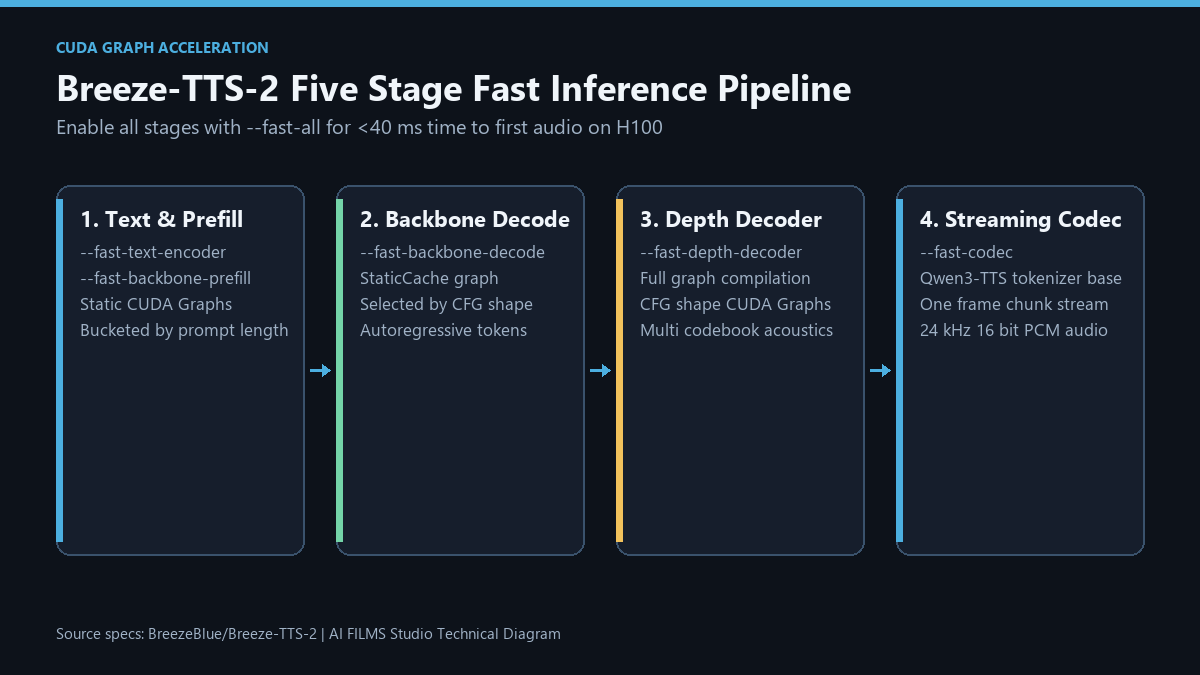
Breeze-TTS-2 five stage CUDA Graph pipeline based on BreezeBlue/Breeze-TTS-2
Directors can steer performances across three distinct operating modes. Voice Clone locks onto a clean reference clip and its exact transcript to mirror timbre and rhythm. Voice Design invents a fresh cast voice strictly from prose descriptions with zero audio sample.
Voice Direction combines both worlds, preserving a reference actor's timbre while applying natural language acting notes such as "Speak slowly with a restrained, serious tone" at --cfg-scale 4.
For low latency servers, passing --fast-all compiles static CUDA Graphs across all five runtime stages (text encoder, backbone prefill, backbone decode with StaticCache, depth decoder, and single frame streaming codec).
With the warmed up fast path on an NVIDIA H100, Breeze-TTS-2 achieves under 40 ms time to first audio and a 0.32 real time factor, generating speech at roughly 3.1x real time.
Local workstations without datacenter GPUs can stay on the default eager streaming path, which trims GPU memory down to approximately 7.7 GiB so a standard 12 GB NVIDIA card runs clean ADR experiments locally.
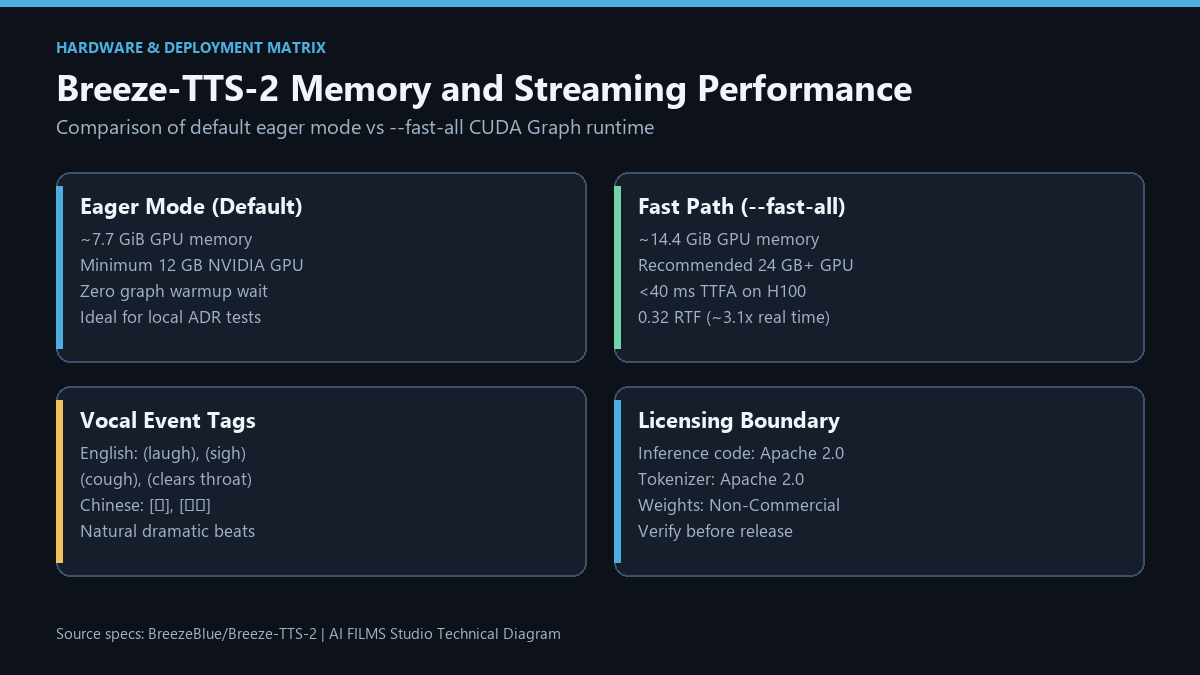
Memory, latency, and license breakdown from breezeblue-ai/breeze-tts
Hardware, VRAM, and License Matrix
| Runtime Profile | Peak GPU Memory | Recommended GPU | Performance (H100) | Code License | Weights License |
|---|---|---|---|---|---|
| Eager Streaming (Default) | ~7.7 GiB | 12 GB NVIDIA CUDA GPU | Zero graph warmup delay | Apache 2.0 | BreezeBlue Research & Non Commercial |
Fast Path (--fast-all) |
~14.4 GiB | 24 GB+ NVIDIA CUDA GPU | < 40 ms TTFA, 0.32 RTF (~3.1x real time) |
Apache 2.0 | BreezeBlue Research & Non Commercial |
Streaming HTTP API (breeze_infer.api) |
7.7 to 14.4 GiB | Linux + Python 3.10+ | 24 kHz mono 16 bit PCM stream | Apache 2.0 | BreezeBlue Research & Non Commercial |
Pay close attention to the split license. While the PyTorch inference code and Qwen3-TTS audio tokenizer carry the Apache 2.0 license, the Breeze-TTS-2 weights and self hosted outputs are restricted to research and non commercial use only. Obtain proper commercial clearance before releasing monetized films.
Parameter Reference
| Flag / Parameter | Recommended Value | Dialogue Impact |
|---|---|---|
--ref-audio + --ref-text |
Clean mono WAV + exact transcript | Anchors speaker identity for Voice Clone and Voice Direction |
--instruction |
Natural language acting note | Steers pacing, emotion, and persona (match language to target text) |
--cfg-scale |
4 for Voice Design & Direction |
Strengthens adherence to acting instructions and tone notes |
| Inline vocal events | (sigh), (laugh), (cough), (clears throat) |
Injects natural human breath and dramatic pauses into English lines |
--fast-all |
Optional CLI/API switch | Enables CUDA Graphs across all five inference stages |
Local Python and CLI Setup
Clone the official Apache 2.0 inference repository on Linux (Python 3.10+ with CUDA) and download the Breeze-TTS-2 checkpoint from Hugging Face.
git clone https://github.com/breezeblue-ai/breeze-tts.git
cd breeze-tts
python -m pip install -r requirements.txt

huggingface-cli download BreezeBlue/Breeze-TTS-2 --local-dir ../breeze-tts-2
Run Voice Direction from the command line to preserve a reference actor's timbre while delivering an emotional acting note and inline cue.
python infer.py ../breeze-tts-2 \
  --ref-audio actor_ref.wav \
  --ref-text "This is the exact transcript of the reference audio." \
  --text "(clears throat) We need to discuss what happened last night." \
  --instruction "Speak slowly with a restrained, serious tone." \
  --cfg-scale 4 \
  --output outputs/scene_04_take_01.wav
To serve real time streaming dialogue to an editing script or animatic tool, start the local HTTP server with python -m breeze_infer.api ../breeze-tts-2 --host 0.0.0.0 --port 7860 and POST requests to /v1/audio/speech.
Filmmaker Production Playbook
1. Directable animatic scratch tracks. Editors cutting animatics can rewrite line readings on the fly with --instruction notes ("whisper urgently", "tired and hesitant") rather than regenerating random seeds until an emotion lands by accident.
2. Natural dramatic beats via inline tags. Inserting (sigh) or (clears throat) directly inside script lines breaks up synthetic cadence and gives lip sync models realistic breathing cues between sentences.
3. Reference audio hygiene. Always record or trim reference clips from clean, dry dialogue with zero room echo and verify that --ref-text matches every spoken word verbatim so timbre locking stays stable.
4. Commercial voice cloning and dubbing in the cloud. Because self hosted Breeze-TTS-2 weights are limited to non commercial research, studios preparing commercial releases can use MiniMax Voice Clone or ElevenLabs Eleven V3 Text to Speech inside the AI FILMS Studio voice workspace alongside hosted text-to-video generation.
Related Reading
- Drama 3: Open Weight Multi Speaker Dialogue TTS
- Ming-3.0-tts: Open Source Voice Design & Cloning
- IndexTTS-2.5 & 2.0: Open Source Duration & Emotion TTS
- Fun-CosyVoice 3.0: Open Source Multilingual Voice AI
- Pair dialogue with hosted video on the AI Text-to-Video Generator page
Sources
Continue Reading


Video & LipSync
- Video Generator
- Text to Video
- Image to Video
- Start-End Frame to Video
- Draw to Video
- Motion Control
- Video Enhancer
- Video Upscaler
- Video Extend
- Video to Video LipSync
- Audio to Video LipSync
- Image to Video LipSync
- Video FaceSwap
- Seedance 2.5
- WAN 3.0
- Seedance 2
- FLUX 3
- Minimax H3
- Vidu Q3 Pro
- Grok Imagine Video 1.5
- Gemini Omni
- Google Veo 3.1
- Kling 3.0 Pro
- Luma Ray 3.2
- LTX 2.3
- Happy Horse 1.1
- Kling 3.0 Motion
- ByteDance Upscaler
- InfiniteTalk
- InsightFace
Image & Edit
- AI Character
- AI Actor
- Art Generator
- Text to Image
- Image to Image
- LoRA Image to Image
- Draw to Edit
- Image LoRA Training
- Remove Background
- Image Enhancer
- MidJourney 8.0
- Krea 2
- OpenAI GPT Image 2.0
- Nano Banana Pro Ultra
- Nano Banana 2 Lite
- Nano Banana Pro
- Minimax Image
- Clarity Pro
- Z-Image Turbo LoRA
- Krea 2 Turbo LoRA
- Z-Image LoRA Trainer
- Qwen Image LoRA Trainer
- Background Erase Network 2 (BEN2)