

Yuze He et al. (HairDeck stylized hair cards teaser, Apache 2.0)
Share this post:
HairDeck: Open Source 3D Character Hair Cards AI
Grooming stylized 3D character hair by hand takes days of placing individual polygon strips, unwrapping UVs, painting color gradients, and rigging physics joints. HairDeck (arXiv:2610.40599), released in October 2026 by researchers from Tsinghua University, Carnegie Mellon University, and The Chinese University of Hong Kong under the Apache 2.0 license, turns a single character image into animation ready 3D hair cards with per card UVs, colors, and spring bone chains ready for GLB and VRM 0.x export. You can test HairDeck free in the embedded browser demo below with zero login.
Studio availability. Try the public Hugging Face demo below; HairDeck is not part of a paid AI FILMS Studio plan (use FLUX.2 Pro Text to Image in the image workspace for example instead).
Try HairDeck Live
Upload a stylized character portrait inside the public Hugging Face Space below to generate 3D hair card geometry and inspect the animated head turn preview in your browser.
Architecture and Technical Design
Instead of sculpting hair as one solid watertight blob that cannot sway during character animation, HairDeck models hair as a structured deck of individual parametric cards aligned to a canonical head frame. The image pipeline chains four dedicated diffusion and decoder models to produce production ready assets in one run.
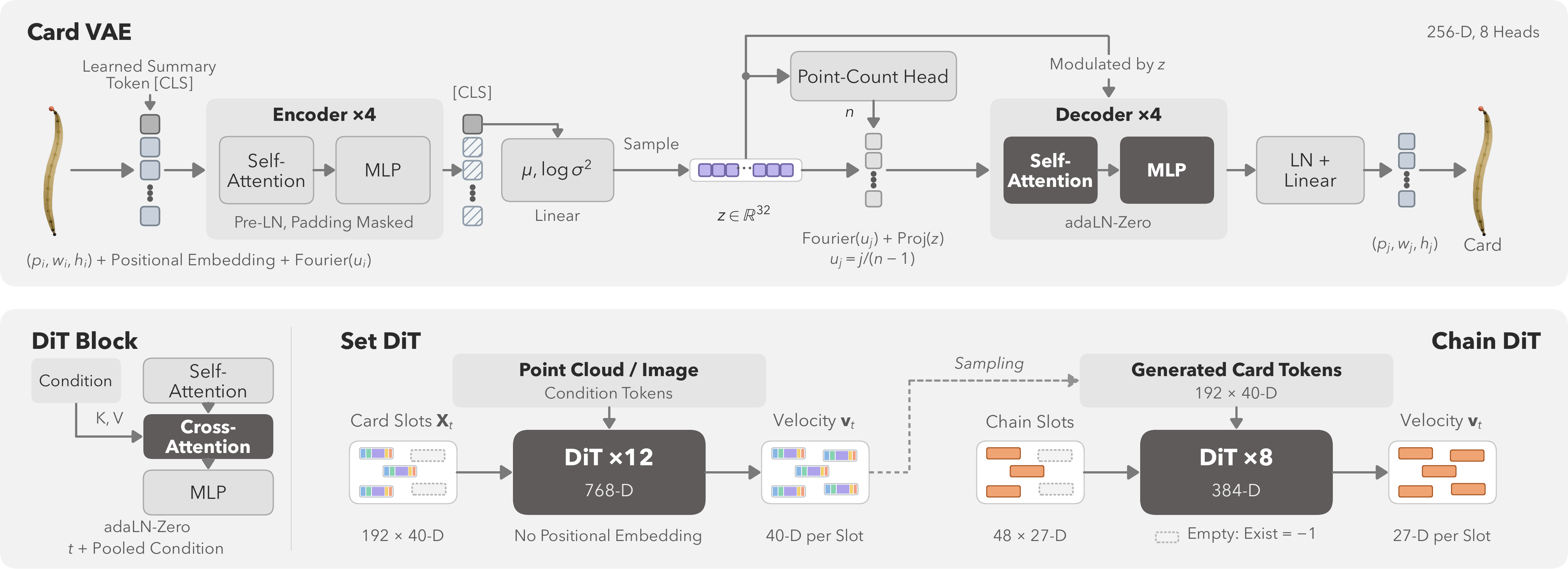
HairDeck multi model architecture by Yuze He et al. (Apache 2.0)
First, Image DiT extracts visual features using DINOv3 ViT-L/16 alongside SAM 3 and BiRefNet-matting to generate latent hair card tokens. Next, Card VAE decodes every token into clean quad strip geometry with aligned per card UVs.
Finally, Color DiT predicts vertex and strand color gradients along each card from the source portrait, while Chain DiT synthesizes hierarchical spring bone chains anchored to the skull.
The repository also ships a fifth checkpoint, Point cloud DiT (conditioned on Dora-VAE 1.1 features), for artists converting 3D hair scans or sculpts into lightweight game and real time animation hair cards.
Automatic spring bone generation separates HairDeck from static 3D asset tools. Because Chain DiT predicts physical bone hierarchies aligned to bangs, side locks, and ponytails, exported VRM 0.x avatars react naturally to head turns, wind, and camera motion immediately inside Unity, Unreal Engine, or Blender.
The included export module attaches the generated hair cards directly onto the supplied VRoid Studio template head frame and renders a quick head turn verification clip via ffmpeg.
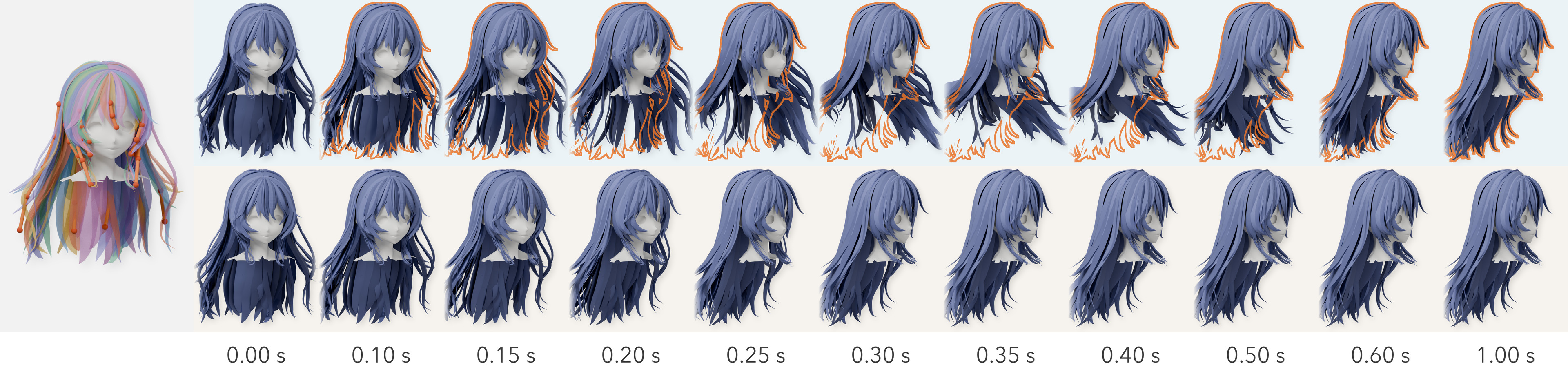
Generated spring bone physics chains on stylized hair cards by Yuze He et al. (Apache 2.0)
Hardware, VRAM, and License Matrix
| Released Model | Role in Pipeline | Checkpoint Path | Supporting Encoders | License |
|---|---|---|---|---|
| Image DiT | Generates hair card tokens from one portrait | ckpt/image_model/model.safetensors |
DINOv3 ViT-L/16, SAM 3, BiRefNet | Apache 2.0 |
| Card VAE | Decodes card latents into UV mapped meshes | ckpt/card_vae/model.safetensors |
Canonical head frame stats | Apache 2.0 |
| Color DiT | Predicts color gradients along each card | ckpt/color_model/model.safetensors |
Source portrait features | Apache 2.0 |
| Chain DiT | Generates animated spring bone chains | ckpt/chain_model/model.safetensors |
Head frame card latents | Apache 2.0 |
| Point cloud DiT | Generates hair cards from 3D point clouds | ckpt/pointcloud_model/model.safetensors |
Dora-VAE 1.1 | Apache 2.0 |
All five HairDeck checkpoints carry the Apache 2.0 license. Supporting encoders (DINOv3, SAM 3, BiRefNet-matting, and Dora-VAE) download separately from their upstream repositories under their own terms.
Parameter Reference
| CLI Argument / Module | Recommended Setting | Production Effect |
|---|---|---|
HAIRDECK_ROOT |
Local workspace directory | Stores downloaded checkpoints, normalization stats, and avatar templates |
scripts/image_to_hair.py --n |
4 (default variations) |
Samples multiple hair card layouts so artists pick the cleanest silhouette |
hairdeck.vrm.export <dir> <seed> |
Seed index (e.g. 0) |
Attaches hair cards to the avatar head, writes .vrm, and renders a head turn clip |
| Export formats | .glb hair mesh + .vrm 0.x avatar |
Imports cleanly into Blender, Unity, Unreal Engine, and virtual production rigs |
Local Python and CLI Setup
HairDeck runs on Linux with Python 3.12 and a CUDA GPU. Accept the upstream SAM 3 and DINOv3 licenses on Hugging Face, clone the repository, download the checkpoint bundle, and run inference on any character portrait.
git clone https://github.com/hyz317/HairDeck.git
cd HairDeck

export HAIRDECK_ROOT=/path/to/workspace
python scripts/setup/download_weights.py
Generate four hair card variations from a single portrait and export seed 0 as a rigged VRM avatar with an animated head turn preview.
python scripts/image_to_hair.py character_portrait.png \
  --out results/my_character \
  --n 4

python -m hairdeck.vrm.export results/my_character/character 0
Make sure ffmpeg is installed on your PATH so the export command can write the head turn MP4 preview alongside the GLB and VRM files.
Filmmaker Production Playbook
1. Rapid crowd and background character casting. Animated films and virtual production stages often require dozens of distinct stylized characters. Feeding generated concept portraits into HairDeck produces lightweight, physics ready hair meshes in minutes instead of manual sculpting passes.
2. Clean UV strips for custom shaders. Because Card VAE outputs per card UVs rather than fused photogrammetry triangles, lookdev artists can swap alpha textures, anisotropic highlights, and toon ramps cleanly without retopologizing the scalp.
3. Multi seed art direction. Always run --n 4 on hero characters to compare parting lines and volume distribution, then export only the winning seed into your VRM or Unreal Engine character rig.
4. Designing consistent character sheets first. Build clean front facing character concepts with consistent wardrobe and lighting on AI FILMS Studio's character generator page before bringing portraits into 3D grooming pipelines.
Related Reading
- FlowHMR: Open Source 3D Human Motion Capture
- TRELLIS.2 LoRA: Open Source 3D PBR Asset Fine Tuning
- Hi3D v1.0: Open Source High Resolution 3D Refinement
- Meta SAM 3: Open Source Promptable Video Segmentation
- Design production character concepts on the AI Character Generator page
Sources
Continue Reading


Video & LipSync
- Video Generator
- Text to Video
- Image to Video
- Start-End Frame to Video
- Draw to Video
- Motion Control
- Video Enhancer
- Video Upscaler
- Video Extend
- Video to Video LipSync
- Audio to Video LipSync
- Image to Video LipSync
- Video FaceSwap
- Seedance 2.5
- WAN 3.0
- Seedance 2
- FLUX 3
- Minimax H3
- Vidu Q3 Pro
- Grok Imagine Video 1.5
- Gemini Omni
- Google Veo 3.1
- Kling 3.0 Pro
- Luma Ray 3.2
- LTX 2.3
- Happy Horse 1.1
- Kling 3.0 Motion
- ByteDance Upscaler
- InfiniteTalk
- InsightFace
Image & Edit
- AI Character
- AI Actor
- Art Generator
- Text to Image
- Image to Image
- LoRA Image to Image
- Draw to Edit
- Image LoRA Training
- Remove Background
- Image Enhancer
- MidJourney 8.0
- Krea 2
- OpenAI GPT Image 2.0
- Nano Banana Pro Ultra
- Nano Banana 2 Lite
- Nano Banana Pro
- Minimax Image
- Clarity Pro
- Z-Image Turbo LoRA
- Krea 2 Turbo LoRA
- Z-Image LoRA Trainer
- Qwen Image LoRA Trainer
- Background Erase Network 2 (BEN2)