

inclusionAI (Ant Group), Ming-3.0-tts (MIT License)
Share this post:
Ming-3.0-tts: Open Source Voice Design & Cloning
Ming-3.0-tts (inclusionAI/Ming-3.0-tts, released October 19, 2026, MIT License) is Ant Group's open source multilingual speech family available in two distinct checkpoints: Ming-3.0-tts-0.5B (a lightweight dense model on a Qwen2.5-0.5B backbone) and Ming-3.0-tts-tiny (a 7.9B total / 1.3B active Mixture of Experts model on a Ling V3 backbone). Across 7 languages plus regional dialects, Ming-3.0-tts combines zero shot voice cloning, natural language voice design, and inline paralinguistic performance tags ([laughter], [sigh], [breath]) while running in under 2 GB to 4 GB of VRAM on consumer GPUs.
Studio availability. Try the public Hugging Face demo below; Ming-3.0-tts is not part of a paid AI FILMS Studio plan (use the AI Voice Generator or voice workspace).
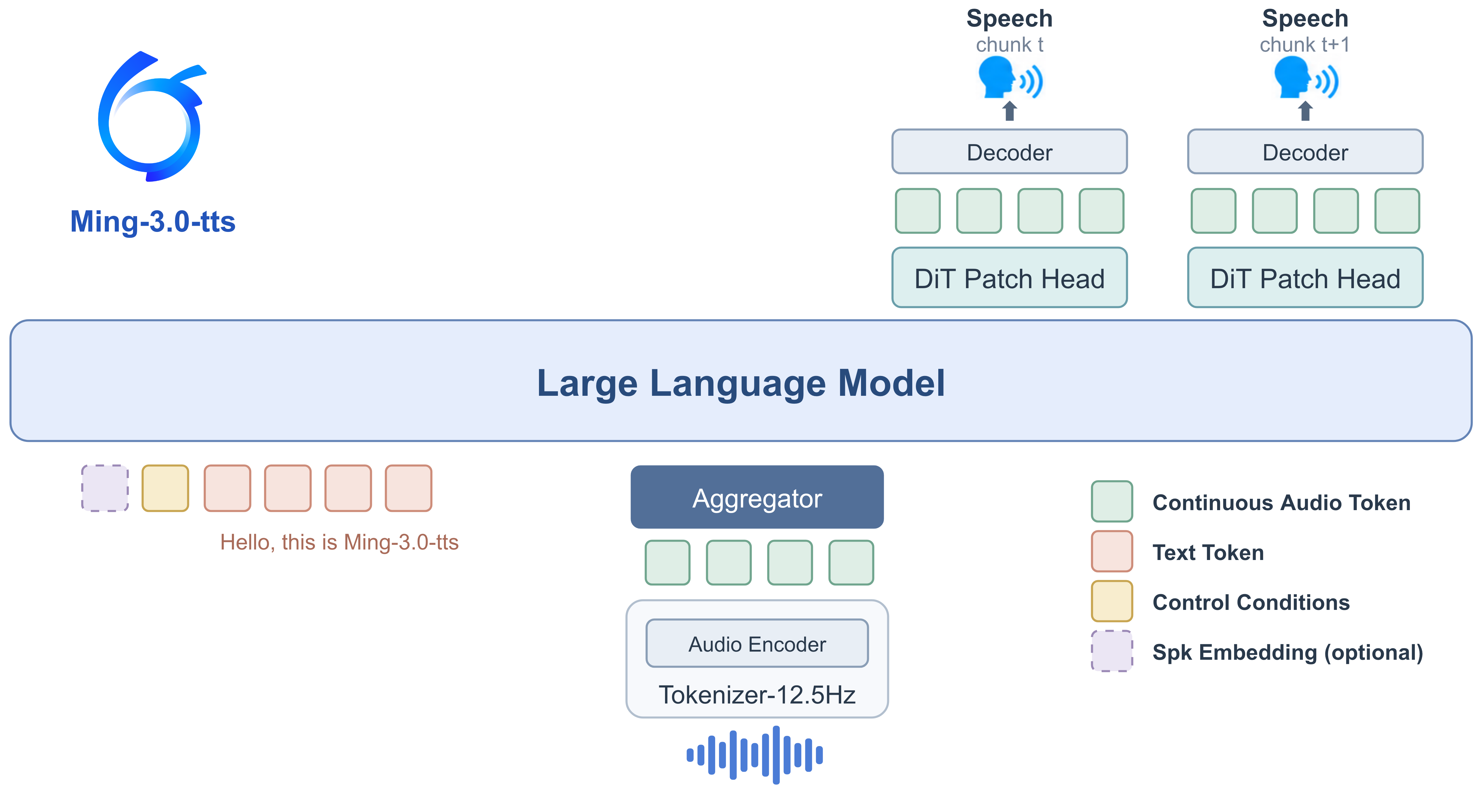
Why Filmmakers Need Inline Paralinguistic Control
Most open TTS models read screenplay dialogue like an audiobook narrator. If a character needs to pause, inhale sharply before a confession, or laugh mid sentence, sound editors usually have to splice separate Foley breath clips onto dry voice tracks.
Ming-3.0-tts puts acting direction directly inside the script text:
- Inline paralinguistic tags. Directors can place expressive markers such as
[laughter],[sigh],[breath], and emotional delivery cues directly inside dialogue lines so vocal timbre shifts naturally across the breath without audible edit splices. - Natural language voice design without reference audio. Need a "raspy 60 year old dockworker speaking slowly with dry sarcasm" for an animatic scratch track? Describe the age, pitch, pacing, and mood in plain text and Ming-3.0-tts synthesizes a reusable vocal persona from scratch.
- Zero shot voice cloning across 7 languages. Feed a clean 5 to 10 second reference clip to lock a cast member's vocal identity across English, Chinese, German, Spanish, French, Korean, and Japanese, plus regional dialects like Cantonese and Sichuanese.
- MIT license with tiny local footprint. The
0.5Bdense model runs smoothly on 2 GB – 4 GB VRAM laptops or Apple Silicon MLX setups, while the7.9BMoE (1.3Bactive) model delivers deeper dramatic prosody in roughly 12 GB VRAM with INT8 quantization.
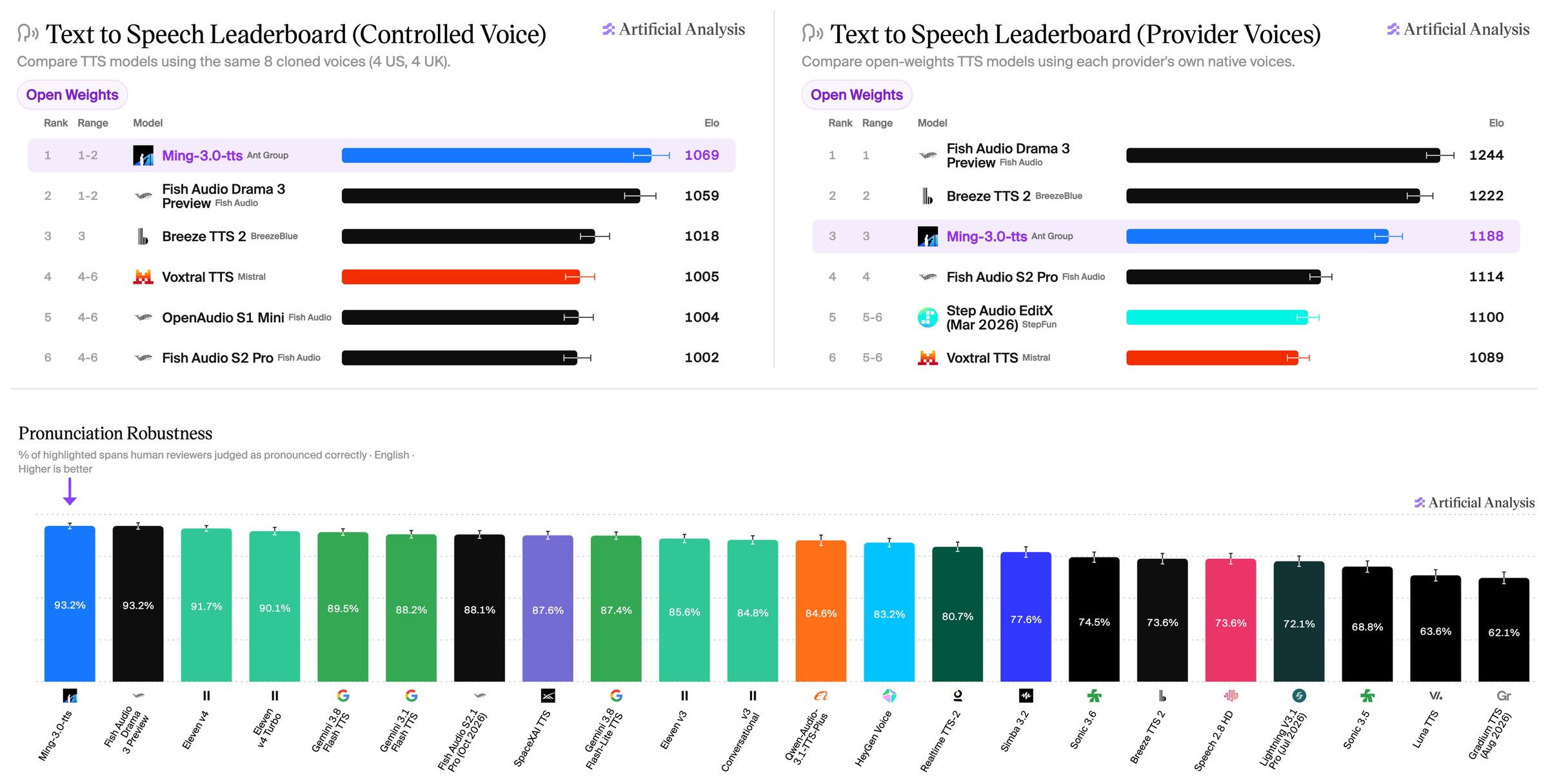
Ming-3.0-tts placement on late 2026 open weights speech and controlled voice leaderboards. Credit: inclusionAI (MIT License).
On late 2026 controlled voice benchmarks, Ming-3.0-tts ranks at the top of open weights speech models despite activating only `0.5B` to `1.3B` parameters per token.
That efficiency allows editors to audition five emotional reads of a single screenplay line in seconds on a standard editing laptop.
Try Ming-3.0-tts Live in the Browser
You can test Ming-3.0-tts-0.5B directly in the embedded Hugging Face Space below (mrfakename-ming-3-0-tts-0-5b.hf.space) without local setup.
Hardware, Variant, and License Matrix
| Model Variant | Backbone & Parameters | VRAM Needed | Languages & Features | License |
|---|---|---|---|---|
Ming-3.0-tts-0.5B |
Dense Qwen2.5-0.5B (0.5B) |
2 GB – 4 GB VRAM (FP16 / 8-bit MLX) |
7 languages + dialects, zero shot clone, voice design, inline tags | MIT License |
Ming-3.0-tts-tiny |
Ling V3 MoE (7.9B total / 1.3B active) |
12 GB+ VRAM (INT8 ConvRot) / 18 GB BF16 |
Richer dramatic prosody, long form monologue stability, zero shot clone | MIT License |
Controlled synthesis evaluations confirm strong adherence to emotion instructions, speaking speed adjustments, and paralinguistic insertions without degrading speaker similarity.
Exported WAV dialogue stems plug directly into lip sync engines such as **LongCat-Video-Avatar 1.6** or AI FILMS Studio's Lip Sync tools.
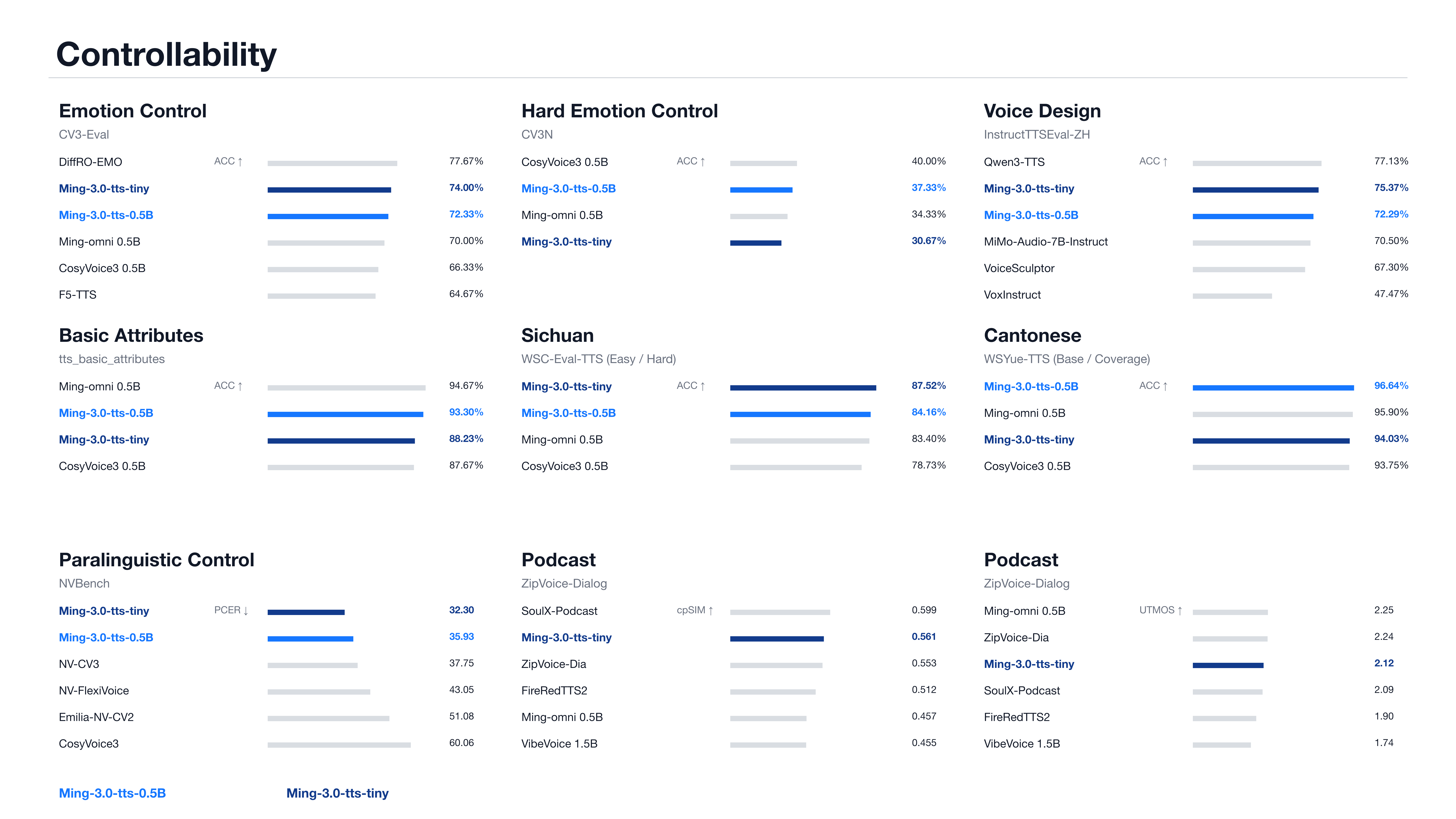
Controlled emotion, voice design, and paralinguistic benchmark breakdown across Ming-3.0-tts variants. Credit: inclusionAI (MIT License).
Parameter Reference Table
| Parameter | Recommended Value | Effect on Dialogue Delivery |
|---|---|---|
model_id |
inclusionAI/Ming-3.0-tts-0.5B or Ming-3.0-tts-tiny |
Choose 0.5B for fast scratch dialogue and tiny (MoE) for dramatic hero performances. |
voice_prompt |
Plain text persona description | Designs a brand new character voice when no reference WAV is supplied. |
ref_audio |
5–10s clean mono WAV (24 kHz+) |
Locks actor timbre for zero shot voice cloning and cross lingual dubbing. |
temperature |
0.6 – 0.8 |
Lower for steady documentary narration; higher for expressive theatrical variation. |
inline_tags |
[laughter], [sigh], [breath] |
Triggers non verbal vocal beats inline without breaking speaker identity. |
Local Setup with Python
Install inclusionAI/Ming-3.0-tts and generate emotionally directed dialogue locally:
git clone https://github.com/inclusionAI/Ming-3.0-tts.git
cd Ming-3.0-tts
pip install -r requirements.txt

huggingface-cli download inclusionAI/Ming-3.0-tts-0.5B --local-dir ./weights/Ming-3.0-tts-0.5B
import soundfile as sf
from ming_tts import MingTTSPipeline

tts = MingTTSPipeline.from_pretrained("./weights/Ming-3.0-tts-0.5B", device="cuda")

wav, sr = tts.synthesize(
    text=(
        "[sigh] You told the crew we had twelve hours before the storm hit. "
        "[breath] Look at the radar now, we have twenty minutes."
    ),
    voice_prompt="Calm, weathered female ship captain in her 40s, low pitch, tense pacing",
    temperature=0.7,
)

sf.write("scene_12_captain_line04.wav", wav, sr)
Filmmaker Production Playbook
- Cast animatics with text based voice design before hiring ADR talent. Generate distinct, consistent character voices for every role in your script so editors can test comedic timing and scene rhythm during storyboarding.
- Use
Ming-3.0-tts-tiny(MoE) for multi sentence monologues. The 7.9B MoE checkpoint holds breath cadence and emotional arc much better across 30 to 60 second speeches than compact 0.5B dense models. - Always secure performer consent before cloning real actor voices. Even though the model weights are MIT licensed, cloning a living performer's voice for commercial distribution requires explicit written release agreements.
Related Reading
- ZONOS3-Mini & Tiny-Voca: Open Source Voice Cloning TTS
- Hunyuan AuK: Open Source Speech & Dialogue Editing AI
- LongCat-Video-Avatar 1.6: Open Source 10+ Min Lip Sync
- Dots TTS: Open Source Streaming Voice Cloning Compare Ming-3.0-tts against Alibaba Tongyi Lab's 0.5B Apache 2.0 streaming model in Fun-CosyVoice 3.0 multilingual voice cloning.


Sources
Continue Reading


Video & LipSync
- Video Generator
- Text to Video
- Image to Video
- Start-End Frame to Video
- Draw to Video
- Motion Control
- Video Enhancer
- Video Upscaler
- Video Extend
- Video to Video LipSync
- Audio to Video LipSync
- Image to Video LipSync
- Video FaceSwap
- Seedance 2.5
- WAN 3.0
- Seedance 2
- FLUX 3
- Minimax H3
- Vidu Q3 Pro
- Grok Imagine Video 1.5
- Gemini Omni
- Google Veo 3.1
- Kling 3.0 Pro
- Luma Ray 3.2
- LTX 2.3
- Happy Horse 1.1
- Kling 3.0 Motion
- ByteDance Upscaler
- InfiniteTalk
- InsightFace
Image & Edit
- AI Character
- AI Actor
- Art Generator
- Text to Image
- Image to Image
- LoRA Image to Image
- Draw to Edit
- Image LoRA Training
- Remove Background
- Image Enhancer
- MidJourney 8.0
- Krea 2
- OpenAI GPT Image 2.0
- Nano Banana Pro Ultra
- Nano Banana 2 Lite
- Nano Banana Pro
- Minimax Image
- Clarity Pro
- Z-Image Turbo LoRA
- Krea 2 Turbo LoRA
- Z-Image LoRA Trainer
- Qwen Image LoRA Trainer
- Background Erase Network 2 (BEN2)