
Brian Grazer Confirms AI in Post Production on Netflix's Churchill at War
Share this post:
Brian Grazer Confirms AI in Post Production on Netflix's Churchill at War
Brian Grazer did not hide it. The Imagine Entertainment co-founder confirmed that AI generated Winston Churchill's voice throughout "Churchill at War", the four part Netflix docuseries he produced with Ron Howard. Grazer made the disclosure publicly, at a moment when most of Hollywood stays quiet about AI in production.
The Project
"Churchill at War" premiered on Netflix in December 2024. Director Malcolm Venville built the series around Churchill's wartime speeches, hundreds of which had existed only on paper and had never been recorded. Imagine Documentaries used AI to generate Churchill's voice from those unrecorded texts, making it possible to present primary source material that no archive could provide.
The series also incorporated digitally colorized and restored historical footage alongside the synthesized audio.
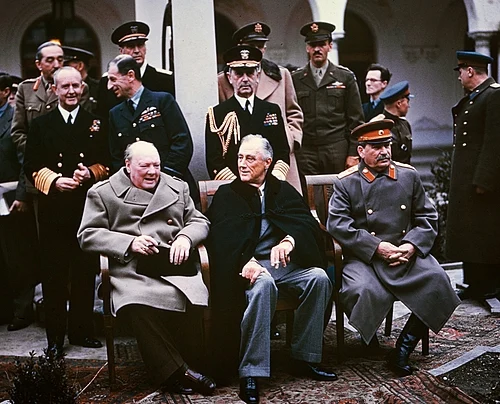
Yalta Conference, February 1945. Public Domain, U.S. National Archives.
The unrecorded speeches represent a specific gap in the historical archive that no conventional documentary technique can fill. Churchill gave hundreds of speeches during the Second World War. A small number were broadcast on radio and survive in recordings. The majority were delivered in Parliament, in private briefings, or in settings where recording equipment was not present.
Generating Churchill's voice from those texts using AI voice synthesis creates a kind of secondary archive: not primary sources, but documentary presentations of what the words sounded like in a voice that matches the archival recordings. The ethical question this raises about historical authenticity is distinct from the guild question about living performers. Churchill died in 1965. No consent framework applies.
Malcolm Venville's Directorial Role
Malcolm Venville directed "Churchill at War". Venville has worked primarily in commercial and music video direction, with select documentary and narrative work. His background in commercial production means he works efficiently with AI augmentation that changes the post production pipeline: commercial directors routinely supervise complex visual effects and audio work that requires similar decisions to those the Churchill voice synthesis involved.
The director's relationship with the AI voice work is the practical production question that Grazer's disclosure leaves open. Venville received the synthesized Churchill audio and integrated it into the editorial structure of a four part docuseries. How closely he supervised the synthesis output, how many iterations were required to reach acceptable results, and how the synthesized audio was presented to the editorial team are production details that Grazer's public disclosure does not address.
Grazer's Position
Grazer has been candid about AI's limits as much as its uses. "No one can point to where AI could produce soul, or life essence, or the best entertainment storytelling", he told The Ankler. That position separates his use of AI in post production from any replacement logic. The tool filled a gap the historical record left behind.
The "soul" formulation is one Grazer returns to regularly. It draws a line between what AI can replicate and what it cannot. Voice timbre, prosody, and regional accent are replicable from sufficient archival audio. The quality Grazer describes as "life essence" is not the kind of thing that can be extracted from recordings and synthesized. His use of AI for Churchill is precisely calibrated to operate on the replicable side of that line.
That calibration is also commercially strategic. A documentary that synthesized the voice of a living performer without their consent would face guild objections and legal exposure. Churchill as the subject allows Grazer to demonstrate AI's documentary potential without those complications.
.jpg)
David Shankbone, CC BY 3.0, via Wikimedia Commons
The Series Format and AI Voice Synthesis
"Churchill at War" is a four part docuseries, not a feature film. The series format extended the AI voice synthesis work across multiple episodes and hundreds of individual uses, not a single scene or sequence. That scale is important: the ethical and legal question about AI voice synthesis of historical figures becomes more significant when the technique is applied systematically across a long form production rather than as a one-time effect.
Grazer's disclosure covers the entire series. The acknowledgment that AI generated Churchill's voice throughout the production, rather than in specific identified segments, is a form of blanket disclosure that tells audiences everything they need to know about the production method without requiring the series to log each individual instance. That approach is the standard Grazer is proposing: name the technique and its scope, let audiences decide what weight to give the information.
Imagine and Obsidian
Imagine Entertainment formalized its AI investment in November 2025, announcing a partnership with Obsidian Studio, an AI production company. The deal positions Imagine to integrate AI tools across development and post production at scale, not on a project by project basis. The Churchill voice work preceded the Obsidian partnership, which means Imagine was already developing its AI production approach before the formal partnership was announced. The Obsidian deal represents a formalization and scaling of what Churchill demonstrated was possible.
Grazer has acknowledged using ChatGPT in his own development process. His partner Ron Howard has spoken publicly about AI tools as expanding what filmmakers can achieve rather than replacing human decision making. That pragmatic stance translated into Imagine's partnership with Obsidian Studio, a company that uses AI only after human storyboarding and only in ways the audience cannot detect.
Historical AI Voice Synthesis: The Pattern
Churchill is not the only historical figure whose voice has been reconstructed for documentary purposes using AI. The approach has been applied to other subjects whose archival audio is limited: historical lectures where only transcripts survive, film shoots where audio recording failed, and radio broadcasts whose recordings were destroyed during wartime.
The field of AI voice synthesis for historical figures requires a sufficient base of existing recordings to train the synthesis model. Churchill's wartime BBC broadcasts provide that base. The trained model then generates new audio from text that Churchill wrote but never spoke for a microphone.
The ethical questions around this technique are not settled. Historians have debated whether synthesized audio of historical figures creates a false sense of primary source authenticity. Documentary filmmakers have generally responded that clear disclosure of the synthesis technique, which Grazer provided, is the minimum standard. Whether that disclosure is sufficient is a question the documentary field has not resolved.
The Voice Synthesis Process
AI voice synthesis from archival audio requires a sufficient sample of existing recordings to train the synthesis model. Churchill's wartime BBC broadcasts provide a usable corpus: recordings from 1939 to 1945 that capture his speech pattern, prosody, and voice character across the period the docuseries covers. The synthesis model trained on those recordings then generates new audio from the text of speeches Churchill gave but never broadcast.
The resulting audio is not a recording of Churchill. It is a prediction of how Churchill would have sounded delivering those specific words, based on how he sounded delivering other words in the same period. That distinction matters for historical accuracy claims: the synthesis is a reconstruction, not a recording. Grazer's disclosure establishes this explicitly, preventing audiences from treating the generated audio as primary source material.
The Transparency Question
Hollywood's standard approach to AI involvement is to stay silent. A pattern documented across multiple productions, from "Secret Invasion" to "The Brutalist" to "Emilia Pérez", shows studios typically acknowledge AI use only after journalists ask directly, if at all. Grazer's willingness to name the tool and describe how it worked on a specific project is an exception to Hollywood's default of staying quiet about AI usage.
The context matters. AI generated voice for a historical figure who died in 1965 does not trigger the same guild objections as AI that replaces a living performer. Grazer chose a use case where disclosure carried no guild risk. But the openness itself sets a different standard than the industry norm.
.jpg)
isabelle VERONESE from ELBEUF, France, CC BY-SA 2.0, via Flickr
Steven Soderbergh applied the same transparency standard at Cannes 2026, using Meta AI for 10% of his John Lennon documentary and declaring that transparency about AI use is "rule number one". The two productions are different in subject and method but identical in their disclosure approach: name the tool, describe the use, let audiences decide what to make of it.
John Lennon, like Churchill, died decades before the documentary was made. Both cases test the ethics of AI synthesis for historical figures in a legal context where no guild protections apply. Both directors chose disclosure as their baseline standard without being required to do so.
What the Netflix Platform Means for Reach
"Churchill at War" premiering on Netflix rather than in theaters or on a broadcast network meant the AI voice synthesis reached a global audience without the country-by-country distribution negotiations that theatrical releases require. Netflix's direct-to-subscriber distribution removed the intermediary that might otherwise have required additional clearance or disclosure beyond what Grazer provided directly.
For historical documentaries with significant AI production components, streaming platforms represent the path of least resistance to wide distribution. Theatrical distributors have no established framework for how to present AI synthesized audio in marketing materials. Netflix's format requires no such framework: the disclosure happens at the production level and the film is presented as a finished work.
The Scale of the Churchill Audio Work
Four episodes of docuseries content about Churchill's wartime period would include dozens of individual speech excerpts, private communications, and wartime briefings read in Churchill's voice. The AI synthesis was not applied to a single sequence or a handful of lines. It was the production method for an entire dimension of the series.
That scale makes "Churchill at War" a more significant AI production precedent than projects where AI fills a small gap in available archival material. Grazer's disclosure covers a production decision that shaped the entire editorial approach of the series, not a single special effect.
The Bourdain Precedent
"Roadrunner: A Film About Anthony Bourdain" (2021) used AI to recreate the voice of Anthony Bourdain for three lines of narration. The director, Morgan Neville, acknowledged the technique after it was reported in press coverage. The disclosure came after publication rather than before, and Bourdain's estate objected. The contrast with Grazer's Churchill approach is instructive: Grazer disclosed proactively, on a subject who died six decades ago rather than four years ago, and in a context where the synthesis technique was fundamental to the film's premise rather than used to fill three lines.
The Bourdain case established that posthumous AI voice synthesis was possible and that audiences would encounter it without knowing unless someone disclosed it. Churchill is the same technique applied to a different set of ethical constraints. The century of elapsed time, the absence of living family with standing to object, and the historical rather than personal nature of the content make Churchill a more comfortable test case than Bourdain. Grazer's decision to use it there, and to disclose it fully, applies the lesson the Bourdain case left open.
What Obsidian Brings to Imagine's Pipeline
Obsidian Studio, Imagine's AI production partner, operates on a specific set of constraints that define its commercial position. It uses only licensed-content AI models, meaning every piece of training data in the models it deploys has cleared rights. It uses AI only after human storyboarding, meaning the creative direction is human-originated before AI generates visuals. And it uses AI only in ways the audience cannot detect, meaning the work product must pass as conventionally produced.
Those three constraints are commercially defensive but also commercially valuable. They allow Imagine to use AI without triggering the guild protections that govern AI use of performer likenesses, without the copyright exposure that attaches to models trained on unlicensed data, and without the audience backlash risk that attaches to visibly AI generated content. Obsidian gives Imagine an AI production pipeline that is designed to avoid every known category of legal and reputational risk.
The Broader Pattern
Hollywood insiders calling for a proactive AI strategy have argued that producers, not directors or performers, will drive how AI gets integrated into mainstream production. Grazer's "Churchill at War" decision supports that argument. The producer chose the use case, chose the tool, and made the call to disclose it.
The DGA opens formal contract talks with AMPTP on May 11, with mandatory AI disclosure among the union's stated demands. If the DGA secures that requirement, decisions like Grazer's will shift from exceptions to obligations. For filmmakers building AI into their own work outside the studio system, AI FILMS Studio provides video generation tools without the production company infrastructure.
Sources
The Wrap | Variety | The Hollywood Reporter | The Ankler
Continue Reading
.jpg?w=3840)


Video & LipSync
- Video Generator
- Text to Video
- Image to Video
- Start-End Frame to Video
- Draw to Video
- Motion Control
- Video Enhancer
- Video Upscaler
- Video Extend
- Video to Video LipSync
- Audio to Video LipSync
- Image to Video LipSync
- Video FaceSwap
- Seedance 2.5
- WAN 3.0
- Seedance 2
- FLUX 3
- Minimax H3
- Vidu Q3 Pro
- Grok Imagine Video 1.5
- Gemini Omni
- Google Veo 3.1
- Kling 3.0 Pro
- Luma Ray 3.2
- LTX 2.3
- Happy Horse 1.1
- Kling 3.0 Motion
- ByteDance Upscaler
- InfiniteTalk
- InsightFace
Image & Edit
- AI Character
- AI Actor
- Art Generator
- Text to Image
- Image to Image
- LoRA Image to Image
- Draw to Edit
- Image LoRA Training
- Remove Background
- Image Enhancer
- MidJourney 8.0
- Krea 2
- OpenAI GPT Image 2.0
- Nano Banana Pro Ultra
- Nano Banana 2 Lite
- Nano Banana Pro
- Minimax Image
- Clarity Pro
- Z-Image Turbo LoRA
- Krea 2 Turbo LoRA
- Z-Image LoRA Trainer
- Qwen Image LoRA Trainer
- Background Erase Network 2 (BEN2)