
Golden Globes Set AI Rules: Submissions Allowed, Performances Banned
Share this post:
Golden Globes Set AI Rules: Submissions Allowed, Performances Banned
The Golden Globe Awards released new eligibility guidelines on May 7, establishing that AI use in film and television does not automatically disqualify a work from consideration. The announcement came three days after the Academy announced a stricter ban on AI performances and scripts from the 99th Oscars, placing the two biggest awards bodies on different sides of the industry's most contested question.
What the Rules Say
The core principle, as stated by the organization: "The use of artificial intelligence (AI), including generative AI, does not automatically disqualify a work from consideration, provided that human creative direction, artistic judgment, and authorship remain primary throughout the production process".
For craft categories including direction, writing, composition, and animation, AI may serve a supporting or enhancing role. The Golden Globes stopped short of requiring a formal human authorship certification for screenplay submissions, unlike the Academy's Affidavit of Human Origin requirement.
Disclosure Is Mandatory for Every Submission
All Golden Globes submissions must include "a disclosure describing any generative AI used anywhere in the production of the completed work, including if any AI alteration was made to a credited performer's likeness or voice". This applies regardless of whether the AI use would otherwise affect eligibility.
The disclosure requirement brings the Globes in line with a broader industry shift toward transparency, even where the eligibility rules themselves are less restrictive than the Academy's.
.jpg)
AI Performances Remain Ineligible
Acting submissions must be "primarily derived from the work of the credited performer". Performances "substantially generated or created by artificial intelligence" are not eligible, and unauthorized use of a performer's digital likeness or voice replication is prohibited in any category.
This protection mirrors what actors secured in the SAG-AFTRA four year deal with studios, which established consent and compensation requirements for digital replica use. The Globes rules apply that same boundary at the awards level.
Where the Globes and the Oscars Diverge
Both the Globes and the Academy ban AI generated performances in acting categories. The gap lies in writing. The Academy requires that screenplays be "human authored" and asks producers to sign an Affidavit of Human Origin during submission. The Golden Globes impose no such requirement, only that human authorship be "primary" across creative categories.
In visual effects, sound, and editing, both organizations permit AI tools without restriction. The line each has drawn is between AI as a production instrument and AI as a credited creative author or performer. Gizmodo described the Globes rules as "way less strict than the Oscars", a characterization the respective rule texts support.
The Television Academy followed a similar but less strict path for the 78th Emmy Awards. Emmy's AI guidelines require disclosure only above a vague threshold, drawing criticism from writers who want a more specific framework. The Globes' universal disclosure requirement is, in that respect, more demanding than what the Television Academy mandated for the Emmy season beginning in 2026.
Submission Timeline for the 84th Ceremony
The rules apply to films and television released in 2026 competing for the 84th Golden Globes on January 10, 2027. Submissions open June 1, with a deadline of October 30, 2026. Nominations are announced December 7, 2026.
The Academy is backing its ban with a Digital Integrity Committee staffed by forensic AI specialists. The Globes have not announced an equivalent enforcement body, relying instead on the mandatory disclosure requirement to surface AI use for review.
What the Disclosure Requirement Actually Produces
The mandatory disclosure applies to every submission, not only those in categories where AI might otherwise trigger an eligibility question. A documentary using AI to generate reference imagery in post production must disclose. A drama using AI to clean audio must disclose. The universality of the requirement means the Globes will receive a disclosure record for the full submission pool, which no other major awards body currently collects on a blanket basis.
What the organization does with those disclosures is not specified in the published rules. There is no announced review process, no committee empowered to compare disclosures against the productions they describe, and no published penalty for inaccurate disclosure. The requirement creates a paper record; it does not create an enforcement mechanism.
The comparison to the Oscars' approach is instructive here. The Academy's Digital Integrity Committee is authorized to examine submissions and investigate eligibility questions in AI banned categories. The Globes have no announced equivalent. Both bodies ask for information about AI use. The Academy backs the request with investigation capacity; the Globes have not.
The value of the Globes' disclosure data may ultimately be aggregate rather than adjudicative. If studios and production companies report AI use consistently across the 2026 submission pool, the organization will have a full cycle picture of how widely AI tools were deployed in award-qualifying production. That picture does not exist anywhere in the industry today.
The disclosure requirement also extends to AI alterations of credited performer likenesses and voices, which goes further than a generic production tool declaration. A production that used AI to reduce an actor's apparent age on screen, modify a performer's voice pitch, or reconstruct a performance from archive footage must specifically disclose that use. The Globes are the first major awards body to require this level of performer specific AI reporting in submission documents.
The distinction between general production AI use and performer specific AI use matters because it maps directly onto the acting ban. If a production discloses AI alteration of a credited performer's voice or likeness, that disclosure is also evidence that the performance may have been AI assisted. The disclosure mechanism and the acting eligibility rule are designed to work together, even if the enforcement process for connecting them has not been publicly described.
The Three Major Awards Bodies in 2026
The Oscars, the Golden Globes, and the Emmy Awards all published new AI guidelines in the same calendar year, and all three ended up in different positions. The Academy banned AI generated performances and AI written scripts. The Globes permit AI use in all categories provided human authorship remains primary. The Television Academy permits AI use and requires disclosure only above a threshold that has not been defined.
The strictest approach is the Oscars' because it combines a categorical ban in two categories with a required certification and an enforcement committee. The most permissive approach is the Emmys' because neither the ban nor the disclosure obligation is absolute. The Globes sit between those positions: no categorical writing ban but a universal disclosure floor.
Every organization drew the same line in one category. AI generated performances in acting categories are ineligible under the Oscars, the Globes, and, implicitly, under the Emmy framework as well. The acting protection is where the awards community reached consensus. The writing question is where the divergence is sharpest.
The practical effect for producers submitting to all three bodies in the same eligibility year is that they face three separate disclosure regimes, each asking different questions and creating different records. A film competing for a screenplay award at the Globes is not required to produce an affidavit. The same film competing at the Oscars is. Studios submitting to both must manage the distinction, and the gap between what the two bodies require will become more visible as nominations are announced and press scrutiny increases.
What Comes Next for the 84th Ceremony
The 84th Golden Globe Awards will be held January 10, 2027. Nominations will be announced December 7, 2026, making the first full year of operation under the new disclosure rules visible before the ceremony itself. The disclosures submitted between June 1 and October 30, 2026, will be the industry's first comprehensive record of AI use in a single awards cycle.
Whether the Hollywood Foreign Press Association publishes aggregate data from those disclosures, or uses them only for internal eligibility review, has not been determined. The transparency argument behind the disclosure requirement implies that voters and audiences would benefit from knowing which productions used which AI tools. Whether that argument results in public reporting depends on decisions the organization has not made public.
The Globes' permissive stance on writing and production tool use may attract submissions from productions that used AI tools at scale and are uncertain about eligibility under the Academy's harder standard. For producers navigating the submission landscape in the second half of 2026, the Globes represent a path that does not require the categorical assurance the Oscars' affidavit demands.
The WGA, DGA, and SAG-AFTRA all negotiated AI restrictions through their current studio contracts. Those restrictions govern production. The Globes' rules govern awards eligibility. Neither framework explicitly defers to the other, meaning a production could comply fully with its guild contracts and still face disclosure obligations at submission that those contracts did not require.
The Globes' rules for the 84th ceremony are also the first set applied after the formation of the Creators Coalition on AI, whose 500 member group includes multiple Golden Globe nominees and winners. The coalition's stated position is that AI disclosure and consent frameworks should travel from production through distribution and into awards consideration. The Globes' blanket disclosure requirement is the closest any awards body has come to implementing that position.
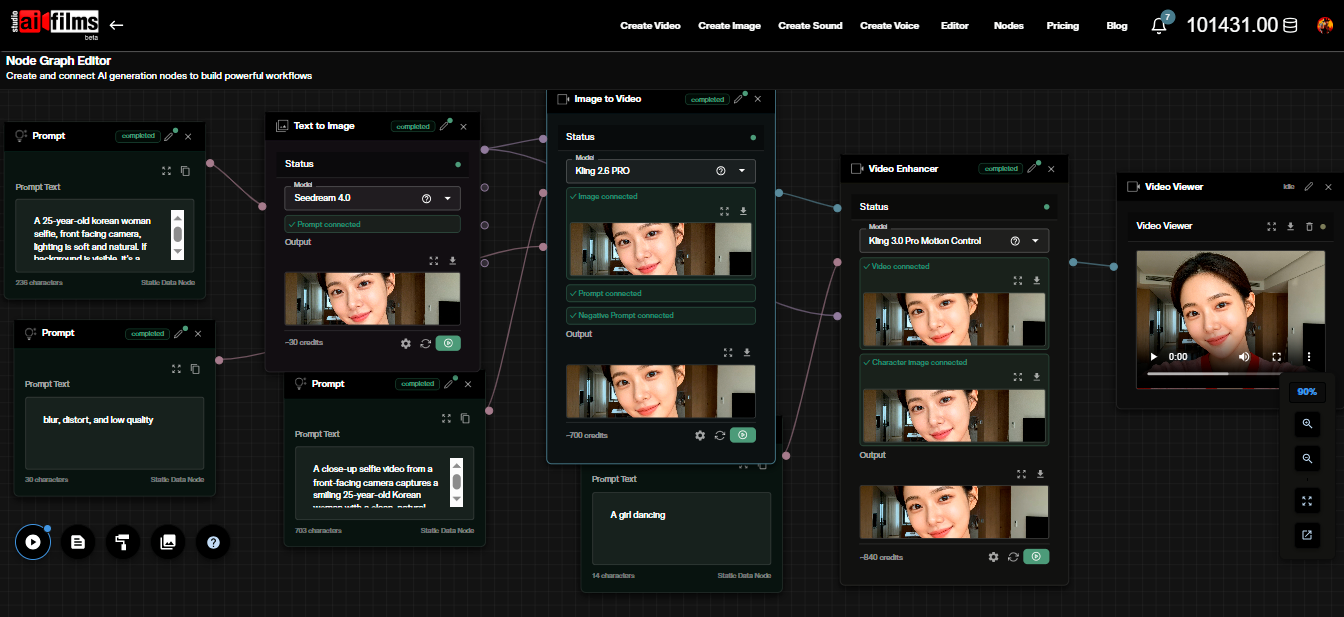
Independent filmmakers using AI video generation tools for projects that qualify for Golden Globes consideration, including short form work and limited series, can generate text-to-video and image-to-video material through AI FILMS Studio and would need to document that use in the Globes' disclosure form. The requirement applies to all qualifying productions, not only major studio films.
The 84th Golden Globe nominations on December 7, 2026, will be the first public signal of how voters applied the new eligibility framework. Whether productions that disclosed significant AI use receive nominations across multiple categories will begin to answer the industry's open question of whether awards bodies treat AI disclosure as neutral information or as a factor that shapes voting behavior.
That answer will arrive a month before the Academy announces its own nominations, setting up a rare comparative test of two different eligibility philosophies applied to the same pool of 2026 releases.
A third framework joined the comparison in July 2026 when BAFTA released its AI guidance for the 2027 Film Awards. Like the Globes, BAFTA imposes no categorical ban on AI production tools and requires no mandatory disclosure at entry. The three institutions now represent three distinct positions that the same pool of 2026 films must navigate simultaneously.
Sources
Variety | Deadline | The Wrap | IndieWire
Continue Reading
.jpg?w=3840)


Video & LipSync
- Video Generator
- Text to Video
- Image to Video
- Start-End Frame to Video
- Draw to Video
- Motion Control
- Video Enhancer
- Video Upscaler
- Video to Video LipSync
- Audio to Video LipSync
- Image to Video LipSync
- Video FaceSwap
- Seedance 2.5
- WAN 3.0
- Seedance 2
- FLUX 3
- Minimax H3
- Vidu Q3 Pro
- Grok Imagine Video 1.5
- Gemini Omni
- Google Veo 3.1
- Kling 3.0 Pro
- Luma Ray 3.2
- LTX 2.3
- Happy Horse 1.1
- Kling 3.0 Motion
- ByteDance Upscaler
- InfiniteTalk
- InsightFace
Image & Edit
- AI Character
- AI Actor
- Art Generator
- Text to Image
- Image to Image
- LoRA Image to Image
- Draw to Edit
- Image LoRA Training
- Remove Background
- Image Enhancer
- MidJourney 8.0
- Krea 2
- OpenAI GPT Image 2.0
- Nano Banana Pro Ultra
- Nano Banana 2 Lite
- Nano Banana Pro
- Minimax Image
- Clarity Pro
- Z-Image Turbo LoRA
- Krea 2 Turbo LoRA
- Z-Image LoRA Trainer
- Qwen Image LoRA Trainer
- Background Erase Network 2 (BEN2)