
Hirokazu Kore-eda Brings a Humanoid Drama to Cannes Competition
Share this post:
Hirokazu Kore-eda Brings a Humanoid Drama to Cannes Competition
Hirokazu Kore-eda's "Sheep in the Box" will world premiere in the Official Competition of the 79th Cannes Film Festival, which opens May 13, 2026. The film is a near future drama in which a bereaved couple takes in a state of the art humanoid as their son, placing artificial life at the center of a story otherwise in keeping with Kore-eda's focus on family and loss.
The Film
"Sheep in the Box" follows a grieving couple who accept a humanoid to fill the absence left by loss. The title comes from Antoine de Saint-Exupéry's "The Little Prince", in which the prince asks the narrator to draw him a sheep, and the narrator draws a box instead, with the sheep understood to be inside, invisible.
Kore-eda has described the project as science fiction in structure and intimate in subject. Haruka Ayase, one of Japan's most recognized dramatic actresses, stars alongside comedian and musician Daigo. Goodfellas handles international sales. Neon acquired distribution rights for the United States, United Kingdom, and Australia. Toho will release the film in Japan on May 29, 2026.
The Little Prince Reference and What It Means
Antoine de Saint-Exupéry's sheep in a box is a figure for imagination. The prince accepts the invisible sheep because the narrator describes it, not because he can see it. The bond between them exists through that shared act of projection.
Kore-eda's use of that image as his film's title sets up the central question directly. Is the humanoid the couple adopts really their son, or is the son the projection they bring to it? The box the narrator drew was empty. What the grieving couple sees inside the box they bring home may say more about grief than about the humanoid itself.
That reading places "Sheep in the Box" in a different register from robot films about machine consciousness. Kore-eda is asking what a grieving family needs the humanoid to be, and what that need costs them. The sentience question is secondary to the human psychology driving the adoption.
Goodfellas and the International Sales Landscape
Goodfellas handles international sales on "Sheep in the Box". The company is one of the primary international sales agents for prestige Asian cinema at Cannes, having represented films including "Drive My Car" and "Decision to Leave". Their involvement positions the film for arthouse theatrical distribution across Europe, Latin America, and Southeast Asia through the festival's market.
International sales for a Kore-eda competition film typically close quickly once the competition selection is announced. Buyers in secondary markets know the commercial profile of a Kore-eda film, which is predictable enough for programmers to make acquisition decisions before the premiere. The Neon deal for English language territories closed before the festival, leaving Goodfellas to close the remaining territories during the Marché.
Kore-eda at Cannes
Kore-eda won the Palme d'Or in 2018 for "Shoplifters", a film about a family surviving on the margins of Japanese society through petty crime. It became the second Japanese film in 21 years to win the prize.
He served on the Cannes jury in 2014 and has returned to competition multiple times, including with "Broker" in 2022 and "The Truth" in 2019, the latter a French language production with Catherine Deneuve and Juliette Binoche. "Sheep in the Box" is his second 2026 release, arriving months after "Monster", the film he made with Sakura Ando and Soya Kurokawa that opened to strong critical response earlier in the year.
International Co-Production Structure
"Sheep in the Box" is a French and Japanese co-production, continuing Kore-eda's practice of working with European partners on international projects. His 2019 film "The Truth" was a French production with Catherine Deneuve and Juliette Binoche. The 2022 "Broker" was a Korean-Japanese co-production. Working within international co-production frameworks gives Kore-eda access to European financing and distribution infrastructure that domestic Japanese productions cannot provide.
French-Japanese co-productions qualify for French cinema support mechanisms administered by the CNC (Centre National du Cinéma et de l'Image Animée), which contributes to development and production budgets. For a science fiction production with a humanoid character requiring visual effects work, French co-production support is a meaningful financial contribution. The Cannes competition slot, which Kore-eda secured with a film made partly under French co-production terms, closes the loop: the festival and the financing infrastructure that makes international productions viable are both French.
Kore-eda's 2026 Output
"Sheep in the Box" is not Kore-eda's first 2026 production. His earlier 2026 film, centered on a child navigating adult secrets, completed its Japanese theatrical run before the Cannes premiere. Releasing two features in one year is uncommon even for directors with established production infrastructure. The pace reflects Kore-eda's ability to develop projects simultaneously across different production contexts.
The two films together trace the range of his interests in 2026. One works entirely within the conventions of domestic Japanese drama. The other moves into speculative territory. Both share the question that has organized his work since the 1990s: what does family require to hold together when the conditions that typically define it are absent?
What Science Fiction Gives Kore-eda
Moving into science fiction gives Kore-eda access to the kind of narrative premise that would be impossible to arrive at through naturalistic domestic drama alone. The central question of "Sheep in the Box" cannot be asked through a film about a conventional adoption, because conventional adoption involves a human child whose capacity for relationship is not in question.
The humanoid is the thought experiment that makes the question clear. By placing a manufactured entity at the center of a family drama, Kore-eda can ask directly whether the bond the family forms with the humanoid is love, projection, therapy for grief, or all three simultaneously. A naturalistic film about the same grief would not be able to hold all of those possibilities open in the same way. Science fiction provides the premise that unlocks the question.
Kore-eda's Thematic Through Line
Kore-eda's career has returned to the same question from different angles: what makes a family? "Nobody Knows" depicted children abandoned by a mother who built a family outside marriage. "Like Father, Like Son" centered on a hospital baby swap that forced two sets of parents to reconsider what biological connection means to parenthood. "Shoplifters" and "Broker" both examined families assembled outside biological or legal ties.
"Sheep in the Box" moves that question into science fiction territory without abandoning it. A humanoid adopted as a son is the extreme version of the question Kore-eda has always been asking: does the bond precede the biology, or follow from it? The answer his films tend to give is that the bond is the real thing, and its origin is secondary.
The Cast: Haruka Ayase and Daigo
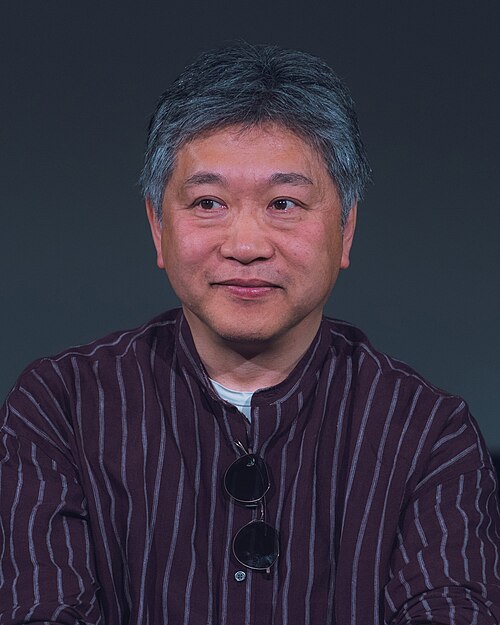
.jpg)
Yuan Hsien-Chieh / WikiPortraits, CC BY-SA 4.0, via Wikimedia Commons
Haruka Ayase has built her career across drama, romance, and action film in Japan. She is best known internationally for "Umimachi Diary", the 2015 Kore-eda film in which she played one of three sisters welcoming a half sibling into their home. That prior collaboration means Ayase is returning to a director who has worked with her in a film about family bonds formed outside traditional arrangements before.
Daigo is a pop musician and television personality with significant domestic visibility. Casting him alongside Ayase brings commercial recognition to a film that otherwise operates in art cinema territory. For a Toho release with a May 29 domestic opening, that combination matters.
The Humanoid as Cultural Mirror
Japanese cinema has returned to humanoid figures throughout its history, from Osamu Tezuka's Astro Boy through the robotic companions of 1970s science fiction to the androids in recent domestic productions. The cultural comfort with humanoid AI as a narrative subject is higher in Japan than in most Western film traditions.
Kore-eda's humanoid is not presented as threatening. The premise positions it as a candidate for love, not as a danger. That framing connects to a strand of Japanese cultural thinking about technology and emotion that tends toward integration rather than conflict. The grief the couple carries into the film is the engine of the story. The humanoid is the object onto which that grief is directed.
The question the film appears to be asking is not whether a humanoid can be a son. It is whether the parents can become parents again.
The Competition
The 79th Cannes competition lineup includes Asghar Farhadi, Pedro Almodóvar, Pawel Pawlikowski, and Ira Sachs, among others. The festival received 2,541 submissions from 141 countries for this edition. Park Chan-wook, director of "Oldboy", "The Handmaiden", and "Decision to Leave", serves as jury president.
2,541 submissions from 141 countries is a record for the festival. The growth in international submissions reflects both the broadening of global film production and the removal of barriers that digital production workflows have created for filmmakers in regions where physical production infrastructure was previously a limiting factor.
The 79th edition's auteur slate follows a competition trend visible since 2024, when filmmaker Greta Gerwig led the jury. Major studio productions have receded; independent directors with strong festival histories dominate the selection. Park Chan-wook's jury presidency connects Korean cinema's prestige arc to the competition that Kore-eda's "Shoplifters" won in 2018, two years before Bong Joon-ho's "Parasite" closed that decade's run of East Asian Palme d'Or contenders.
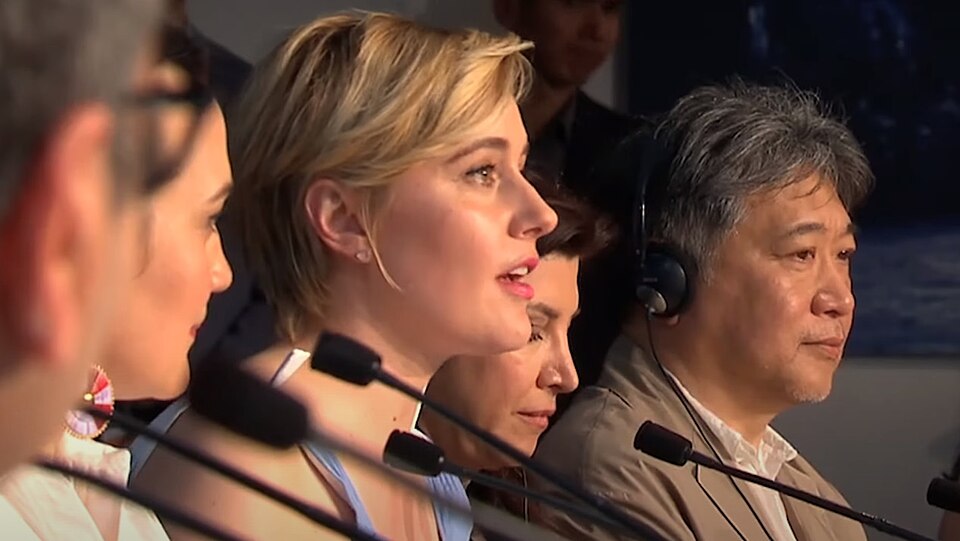
Canal22, CC BY 3.0, via Wikimedia Commons
AI on Screen in a Competition That Bans AI Production
The 79th Cannes competition officially bans generative AI from production. Films relying on generative models for scripts, performance synthesis, or primary visual content are ineligible for the Palme d'Or. The rule does not address films whose subject matter involves AI, only films whose production methods rely on it. That distinction allows "Sheep in the Box" to compete on exactly the subject the competition's rules most directly address. "Sheep in the Box" was produced through conventional means. The humanoid it depicts is a narrative subject, not a production method.
The distinction separates subject matter from production tools, and Cannes has been clear that the ban addresses the latter. The same competition that bars AI filmmaking tools selected a film whose central figure is a being designed to pass as human. Jia Zhangke took the opposite route at Filmart 2026, using Seedance 2.0 to produce a short about authorship. Kore-eda uses traditional production to ask related questions through fiction.
Kore-eda's choice to engage AI through subject matter rather than production tools is consistent with how established auteurs have typically engaged with the technology in 2025 and 2026. The AI acceptance moment at Cannes 2026 was largely a market phenomenon, with AI disclosure happening at the Marché du Film level rather than in the competition films themselves.
Park Chan-wook as Jury President
Park Chan-wook brings a specific viewing lens to Kore-eda's film. His own filmography includes "Oldboy" and "Sympathy for Lady Vengeance", both deeply concerned with what families do to each other across time, and "The Handmaiden", a period thriller in which power and intimacy are inseparable. His most recent feature, "Decision to Leave", is a detective story built entirely around the emotional logic of loss and projection.
A jury president who has spent his career examining how desire and grief reshape perception is reading "Sheep in the Box" with different attention than a jury president whose interests are elsewhere. Whether that alignment benefits or disadvantages the film in competition depends on how the full jury responds to a film whose argument is literary rather than visceral.
Neon's Distribution Strategy
Neon, the distributor behind "Anatomy of a Fall" and "Parasite" in North America, handled the acquisition before the Cannes selection was announced. The festival premiere will be the first public screening outside Japan.
Neon's track record with competition films that win major prizes is the relevant context. Their acquisitions of "Parasite" and "Anatomy of a Fall" both came before those films won the Palme d'Or. The Cannes premiere gives "Sheep in the Box" the same trajectory. If Park Chan-wook's jury awards it any major prize, Neon holds the distribution rights for three major English language markets.
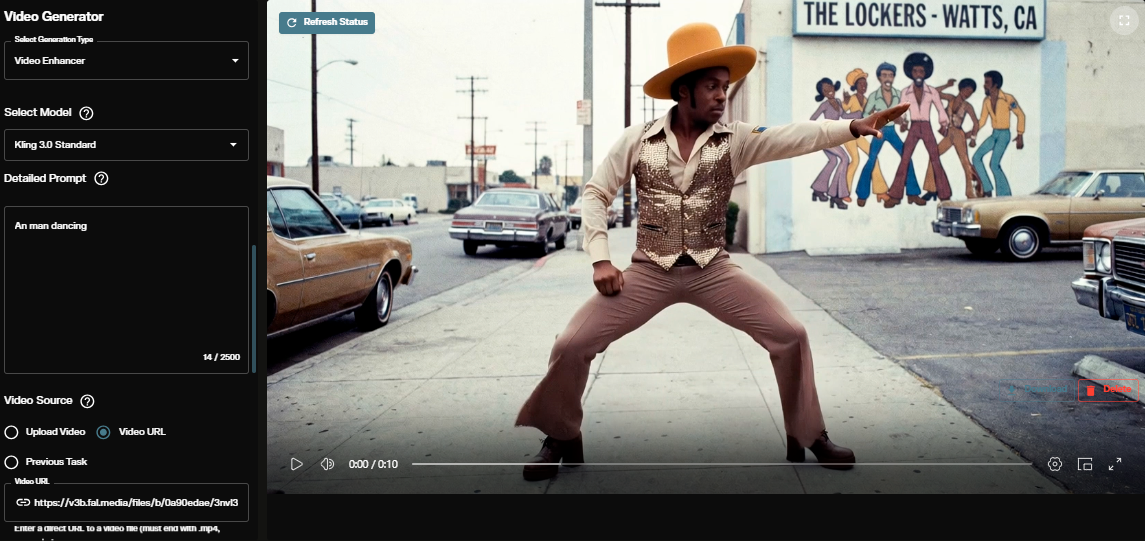
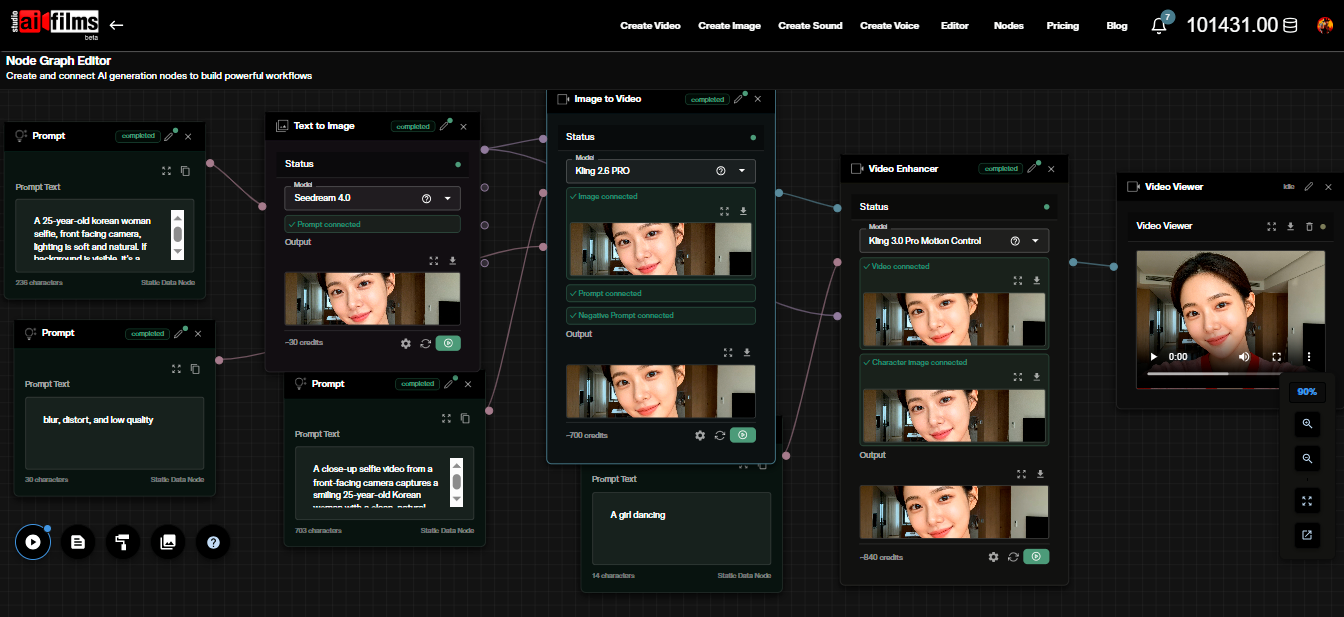
The Toho release date of May 29 puts the film in Japanese cinemas days after the festival closes. Audiences in Japan will see "Sheep in the Box" without yet knowing whether it won any prizes. Filmmakers exploring similar questions about AI and human identity can try AI video generation in the workspace to prototype their own approaches.
Sources
Variety | Deadline | The Hollywood Reporter | Screen Daily
Continue Reading
.jpg?w=3840)


Video & LipSync
- Video Generator
- Text to Video
- Image to Video
- Start-End Frame to Video
- Draw to Video
- Motion Control
- Video Enhancer
- Video Upscaler
- Video Extend
- Video to Video LipSync
- Audio to Video LipSync
- Image to Video LipSync
- Video FaceSwap
- Seedance 2.5
- WAN 3.0
- Seedance 2
- FLUX 3
- Minimax H3
- Vidu Q3 Pro
- Grok Imagine Video 1.5
- Gemini Omni
- Google Veo 3.1
- Kling 3.0 Pro
- Luma Ray 3.2
- LTX 2.3
- Happy Horse 1.1
- Kling 3.0 Motion
- ByteDance Upscaler
- InfiniteTalk
- InsightFace
Image & Edit
- AI Character
- AI Actor
- Art Generator
- Text to Image
- Image to Image
- LoRA Image to Image
- Draw to Edit
- Image LoRA Training
- Remove Background
- Image Enhancer
- MidJourney 8.0
- Krea 2
- OpenAI GPT Image 2.0
- Nano Banana Pro Ultra
- Nano Banana 2 Lite
- Nano Banana Pro
- Minimax Image
- Clarity Pro
- Z-Image Turbo LoRA
- Krea 2 Turbo LoRA
- Z-Image LoRA Trainer
- Qwen Image LoRA Trainer
- Background Erase Network 2 (BEN2)