
Cannes 2026: How AI "Came Out of the Closet" While Hollywood Stayed Home
.jpg?w=3840&q=90)
Share this post:
Cannes 2026: How AI "Came Out of the Closet" While Hollywood Stayed Home
Cannes 2026 became the first major film festival where filmmakers openly admitted using artificial intelligence in their productions. Variety published the defining summary on May 19: after years of secrecy and denial, AI had "come out of the closet" at the Marché du Film.
Why Hollywood's Biggest Names Stayed Home
Christopher Nolan and Steven Spielberg both declined invitations from the festival this year. Studios cited budget constraints and fear of negative French critical reception damaging box office performance. One anonymous sales agent told Variety: "The studios are scared of the French critics".
The withdrawal created a gap in the market that independent filmmakers moved into. The shift was visible in the competition as well: the official Cannes selection maintained a ban on AI generated works, making the market's openness to AI a sharper contrast than any previous year.
The budget constraint explanation is only partly economic. French critics at Cannes have been openly hostile to the kind of commercial spectacle that major studio productions represent. A film that opens Cannes and receives hostile reviews from the French press faces a specific commercial problem: those reviews travel internationally and can damage a film's positioning in markets where French critical opinion carries disproportionate weight, including Germany, Japan, and the Anglophone art house circuit. Studios performing cost-benefit analysis on a Cannes presence concluded that the risk was not worth the platform.
What the Absence Created
Hollywood's retreat from Cannes 2026 was not just an absence of marquee names. It was an absence of the commercial gravity that major studio productions create at the Marché du Film. When a Spielberg or Nolan film is in competition, it pulls buyers into the market, generates press that benefits other films, and establishes the stakes of the festival as a commercial event.
Without that pull, the market shifted. The space on the exhibition floor that would have been occupied by major studio presentations was filled by the companies that had been growing fastest in 2025 and 2026: AI platforms, AI integrated production companies, and independent financiers who had been watching AI lower the cost of certain production tasks. Over 100 AI companies had booths or presentations at the Marché, more than any previous year.
The French critical establishment's hostility to Hollywood spectacle did not disappear. It simply became less consequential because the spectacle was not there to evaluate. What French critics received instead was the independent and arthouse program the competition always prioritizes, alongside a market floor that looked more like a technology conference than a film sales event.
The Year Hollywood Stopped Pretending
Industry observers noted a qualitative shift in how Cannes 2026 conversations happened compared to prior years. In 2024 and 2025, AI discussions at Cannes were characterized by careful wording, frequent off-the-record requests, and producers describing AI use in terms that left room for denial. In 2026, those conversations changed register. Multiple producers who spoke to Variety and Deadline used their names.
The change is partly structural. The guild agreements in place by 2026 created a disclosure framework that reduced the reputational risk of admission. Saying you used an AI tool in post production is a different statement in 2026, when that use is governed by a consent agreement, than it was in 2023, when it was legally ambiguous and professionally radioactive.
The Films That Did Show Up
Steven Soderbergh premiered his documentary on John Lennon, which uses Meta AI tools for approximately 10 percent of its visuals. Doug Liman showcased Bitcoin: Killing Satoshi, a thriller built on 55 AI artists generating every location across 30 weeks of post production. Both directors discussed their AI use openly, without apology, a break from every previous Cannes.
Peter Jackson told reporters AI was "just a tool", framing it in the same terms filmmakers once used for digital cameras. Other prominent voices took a more reluctant position, with Demi Moore describing the fight against AI as a "battle we will lose". The range of reactions illustrated a festival at a crossroads.
The Two Tracks at One Festival
.jpg)
Mike is Michi, CC BY-SA 4.0, via Wikimedia Commons
Cannes 2026 operated on two parallel tracks that barely acknowledged each other. In the Palais des Festivals, the official competition jury evaluated films under a rule that barred AI generated work from eligibility. In the Marché du Film exhibition halls and conference rooms, AI companies occupied significant floor space and ran more than 45 dedicated AI sessions over the festival's 11 days.
The coexistence of a competition ban and a market embrace is not a contradiction in Cannes's institutional logic. The competition is about artistic prestige. The Marché is about commercial transactions. The festival has always kept these tracks separate. In 2026, the gap between them was the widest it has ever been.
The Meta Partnership at the Majestic Hotel
Meta's presence at Cannes 2026 operated through Meta House, a hospitality and screening venue at the Majestic Hotel on the Croisette. The space functioned as a meeting point for producers, distributors, and filmmakers interested in AI production tools, with demonstrations of Meta AI's video and audio generation capabilities running throughout the festival.
The Soderbergh documentary was Meta's primary content showcase. Having a film from a director of Soderbergh's standing as the flagship example of what Meta AI can do in production is significantly different from a demo environment. It provides a real production outcome rather than a proof of concept. For the international buyers and producers who passed through Meta House during the festival, the Soderbergh film was evidence that Meta AI tools work at a level a major director would accept.
The multiyear strategic partnership between Cannes and Meta extends beyond 2026. What that extension includes is not fully public, but the pattern suggests Meta House will be a fixture of the festival's market infrastructure for the foreseeable future.
Jordan Firstman and the New Cannes
The market's breakout story had nothing to do with AI. Jordan Firstman, a social media personality making his feature directorial debut, screened "Club Kid" to a six minute standing ovation at the Théâtre Claude Debussy. A24 acquired global rights for $17 million after a bidding war with Focus Features, Searchlight, Netflix, and Mubi.
"Club Kid" is not an AI production. Its trajectory, a first time director with no studio backing winning a major acquisition over every top platform, reflects what happened when traditional gatekeepers pulled back. The space they left was filled not by AI itself but by a new class of filmmaker who benefited from the absence.
The Market Numbers
Cannes 2026 drew 40,000 professionals and 16,000 market participants from 140 countries. The Marché du Film hosted more than 45 AI focused panels, and the "AI on the Lot" conference grew from 600 attendees in prior years to an expected 2,000 by June 2026.
Filmmakers at the festival put specific numbers to the cost shift, with Mathieu Kassovitz citing a reduction from $50-60 million to $25 million per project using AI tools.
The Cannes Film Festival signed a multiyear strategic partnership with Meta, which operated Meta House at the Majestic Hotel. The Soderbergh documentary was one direct product of that partnership. The World AI Film Festival, a separate event running alongside Cannes, drew 5,500 submissions from 80 countries in its second year. The animation market followed a month later: Annecy MIFA 2026 opened June 21 with AI workshops on its main program for the first time, making it the first animation industry market to move AI from the margins to the official agenda.
The Festival's Institutional Response to AI
Cannes 2026 produced no new regulatory or institutional framework for AI. The competition ban on AI generated work was implemented unilaterally by festival director Thierry Frémaux without an industry consultation process. The Meta House partnership was signed commercially without reference to the competition rules. The Human Provenance in Film initiative launched by a separate group during the festival had no formal relationship with the festival's official program.
The result is an institution operating three simultaneous positions on AI: banning it from competition, partnering commercially with a company building it, and hosting a voluntary disclosure initiative that it neither endorsed nor opposed. That combination is less contradictory than it appears. Cannes is simultaneously a prize competition, a commercial market, and a platform for industry discourse. Each operates with different rules and priorities. The incoherence across positions reflects the actual state of the industry in 2026, which has not yet consolidated around any single position.
What the Bleecker Street CEO Said
Kent Sanderson, CEO of Bleecker Street, offered the clearest statement of where the industry now stands: "You probably will be able to make something that looks like a Marvel movie in your basement".
Sanderson's framing captures what exhibitors and distributors have been discussing privately. The technology concern is not that AI films will be bad. It is that they might be good enough that audiences cannot distinguish them from high budget productions, and that if that happens at scale, the premium audiences pay for theatrical experience becomes harder to justify.
The filmmakers at Cannes 2026 who admitted AI use were not hiding a competitive advantage. They were reporting a production reality. Cannes 2026 is the first festival in the event's history where that admission became the norm rather than the exception. The debate reached its peak at the closing ceremony, where "Fjord" won the Palme d'Or as AI vendors packed the market floors below.
.jpg)
Abxbay, CC0, via Wikimedia Commons
What "AI on the Lot" Covered
The "AI on the Lot" conference ran as a dedicated event within the Cannes market framework. The 2026 edition, expected to draw 2,000 attendees, organized sessions around four primary areas: AI in visual development and pre-production, AI in post production and VFX, AI in distribution and audience targeting, and AI governance and disclosure standards.
The visual development track attracted the largest attendance from filmmakers. Producers and directors came to understand what the current generation of tools can do in pre-production contexts where AI is lowest risk: concepting environments, developing tone references, and generating visual pitches before physical production begins. The post production track attracted the most enterprise clients: studios and VFX houses evaluating AI for specific pipeline integration points rather than end-to-end production.
The Human Provenance in Film Initiative
On May 12, a voluntary standard called Human Provenance in Film launched at Cannes proposing disclosure labeling for AI use in theatrical distribution. The standard asks filmmakers and distributors to declare, at the point of theatrical submission, what percentage of a film's visuals, sound, and performance elements were AI generated.
The initiative did not attract major studio adoption during the festival. No US distributor or major theater chain signed onto it during the Cannes period. Its significance at this stage is definitional: establishing agreed categories for what counts as AI use in a production, since the threshold debate had been ongoing with no consensus measure.
What "Coming Out of the Closet" Meant
The Variety framing was specific. It did not mean that AI had become acceptable at Cannes. It meant that the pretense of non-use had ended. Directors who had been quietly using AI in production were no longer speaking around it or denying it when asked directly. Soderbergh said transparency was "rule number one". Liman described his production method without hedging.
The shift had been building since the SAG-AFTRA agreement in late 2023, which established a consent and disclosure framework that made AI use in productions at least theoretically trackable. The WGA deal had already established that AI tools could be used by writers with disclosure. By Cannes 2026, both frameworks were in place, the initial panic about AI had subsided, and directors with AI in their pipelines no longer saw concealment as worth the reputational cost of being caught denying it.
The Business Shift in Concrete Terms
The Marché du Film attendance for AI companies grew from roughly a dozen booths in 2023 to over 100 in 2026. That growth rate is faster than any other technology category the market has absorbed in the same period. The comparison to the streaming disruption of 2010-2015 is the one Marché organizers use most often, though the mechanism is different: streaming replaced distribution channels, while AI is replacing production methods. The streaming disruption took approximately a decade to consolidate. The AI disruption is consolidating in roughly half that time, in part because AI production tools are software products that can be distributed globally without physical infrastructure. That growth rate is faster than any other technology category the market has absorbed in the same period. The comparison to the streaming disruption of 2010–2015 is the one Marché organizers use most often, though the mechanism is different: streaming replaced distribution channels, while AI is replacing production methods.
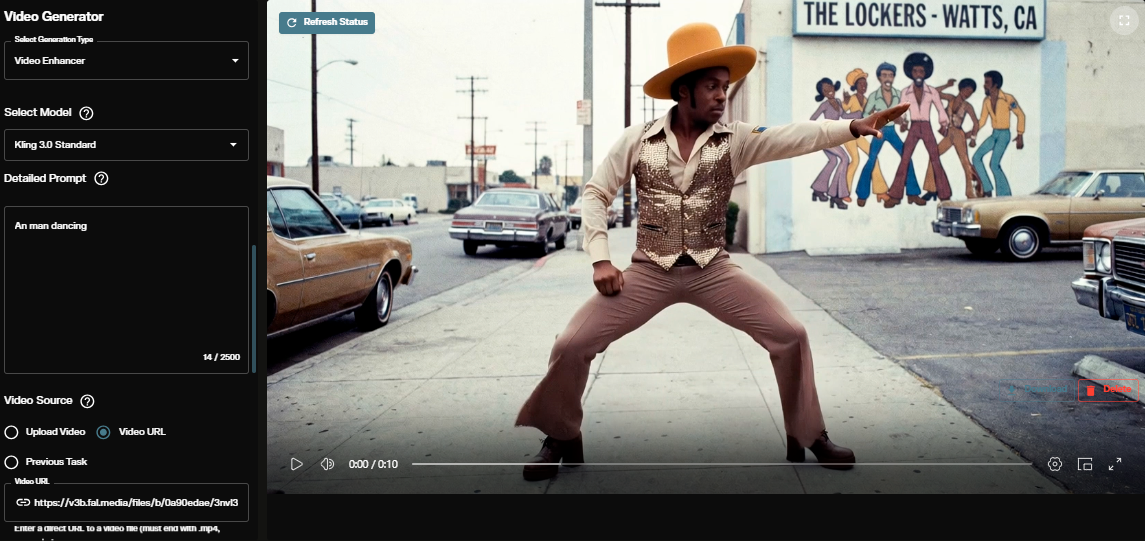
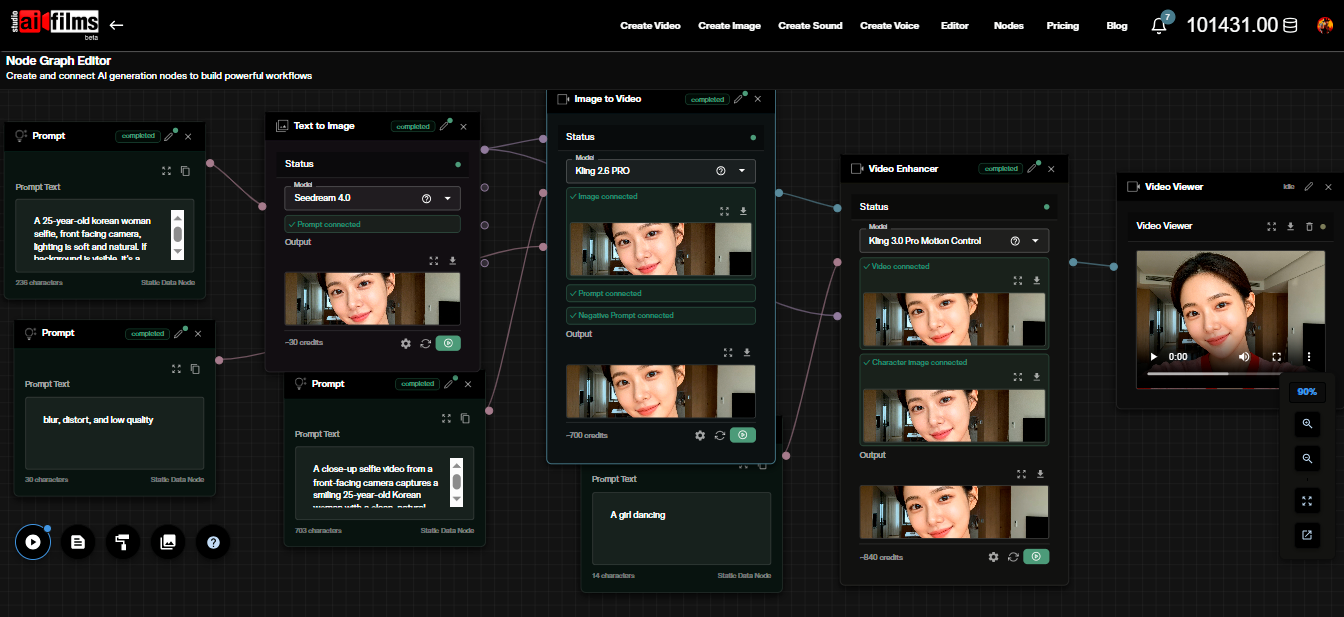
The business side of that shift was stark: over 100 AI companies flooded the Marché du Film as the competition banned their films from eligibility above. For filmmakers wanting to understand the production tools that made those conversations possible, the AI FILMS Studio video workspace is where the current generation of text-to-video and image-to-video models can be tested directly.
Filmmakers who want to test the tools these directors are using can start in the AI FILMS Studio video workspace.
Sources
Variety | Deadline | ABC News | The Wrap | Screen Daily
Continue Reading
.jpg?w=3840)


Video & LipSync
- Video Generator
- Text to Video
- Image to Video
- Start-End Frame to Video
- Draw to Video
- Motion Control
- Video Enhancer
- Video Upscaler
- Video Extend
- Video to Video LipSync
- Audio to Video LipSync
- Image to Video LipSync
- Video FaceSwap
- Seedance 2.5
- WAN 3.0
- Seedance 2
- FLUX 3
- Minimax H3
- Vidu Q3 Pro
- Grok Imagine Video 1.5
- Gemini Omni
- Google Veo 3.1
- Kling 3.0 Pro
- Luma Ray 3.2
- LTX 2.3
- Happy Horse 1.1
- Kling 3.0 Motion
- ByteDance Upscaler
- InfiniteTalk
- InsightFace
Image & Edit
- AI Character
- AI Actor
- Art Generator
- Text to Image
- Image to Image
- LoRA Image to Image
- Draw to Edit
- Image LoRA Training
- Remove Background
- Image Enhancer
- MidJourney 8.0
- Krea 2
- OpenAI GPT Image 2.0
- Nano Banana Pro Ultra
- Nano Banana 2 Lite
- Nano Banana Pro
- Minimax Image
- Clarity Pro
- Z-Image Turbo LoRA
- Krea 2 Turbo LoRA
- Z-Image LoRA Trainer
- Qwen Image LoRA Trainer
- Background Erase Network 2 (BEN2)