

Boyang Wang et al., CodecOPSD (arXiv:2611.31184)
Share this post:
CodecOPSD-H3-Ref2VA: Open Source Fast Reference Video
Researchers Boyang Wang, Kevin Blackburn-Matzen, Oindrila Saha, Matheus Gadelha, and Zezhou Cheng released CodecOPSD-H3-Ref2VA (HikariDawn/CodecOPSD-H3-Ref2VA, arXiv:2611.31184) on November 23, 2026. By pruning around 70% of redundant reference image and video tokens with a video codec and training a compact self distilled LoRA on top of MiniMax-H3 Ref2VA, the model accelerates multi reference video and audio denoising by 1.87x on average and up to 8.4x on heavy multi clip shots. You can test CodecOPSD-H3-Ref2VA free in the embedded browser demo below with zero login.
Studio availability. Try the public Hugging Face demo below; CodecOPSD-H3-Ref2VA is not part of a paid AI FILMS Studio plan (use MiniMax H3 Image to Video in the video workspace for example instead).
Try CodecOPSD-H3-Ref2VA Live
Upload character sheets, scene stills, or reference clips in prompt order (<Picture 1>, <Video 1>), write your shot prompt, and compare CodecOPSD against full token MiniMax-H3 directly in the Space below.
Architecture and Technical Design
All in one sequence generators such as MiniMax-H3 Ref2VA concatenate every reference image and reference video directly onto the transformer's input token sequence. Adding three reference videos and two character stills can push sequence length above 230,000 tokens, causing quadratic attention compute to balloon past 15 minutes per shot.
CodecOPSD (On Policy Codec Self Distillation) solves this bottleneck in two stages. First, a lightweight video codec analyzer scores spatio temporal redundancy across reference clips and drops static or low motion condition tokens before they reach the DiT. Second, a small student LoRA is trained via on policy self distillation against the full token teacher so the model learns to reconstruct crisp identity and motion from the surviving 10% to 30% of reference tokens.
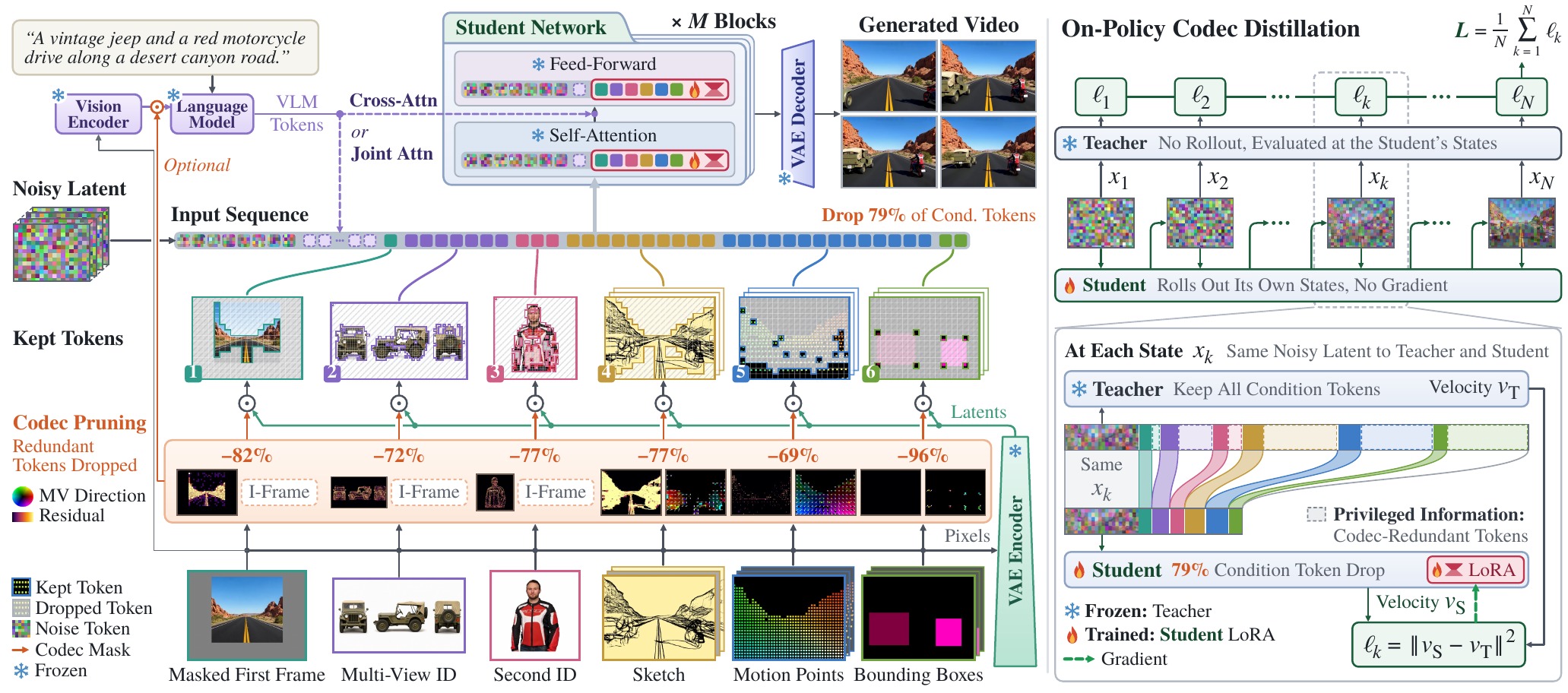
Method diagram by CodecOPSD authors (arXiv:2611.31184)
In the authors' published benchmark on a 768p, 243 frame dusk desert shot conditioned on two photos and three videos, pruning 90% of video tokens cut condition length from 232k to 24k tokens and dropped denoising time from 1,013 seconds to 121 seconds (an 8.4x speedup).
A companion LoRA, CodecOPSD-H3-Image, applies the same pruning strategy to multi reference still generation, dropping 65% of tokens for 2x to 7.6x faster renders across up to 16 input references.
To demonstrate multi shot narrative continuity, the research team assembled a five part 737 frame action short film (Robot versus Monster) using greybox animation plates, mech turnarounds, and particle effect stills.
Total reference tokens dropped by 68% (from 279,552 to 90,396), completing all five shots in 348 seconds on a single B200 GPU with synchronized audio and zero post editing.

Multi reference conditioning example by Boyang Wang et al.
Hardware, VRAM, and License Matrix
CodecOPSD-H3-Ref2VA is a LoRA adapter for MiniMax-H3 and follows the MiniMax H3 Community License Agreement.
| Workload Profile | Conditioning Inputs | Speedup vs Teacher | Target Hardware | License |
|---|---|---|---|---|
| ZeroGPU Space Demo | 1 to 3 references, 5s 480p | ~25s end to end | ZeroGPU xlarge | MiniMax H3 Community |
| Standard Multi Ref | 2 stills + 1 video (~70% pruned) | 1.87x average | 48 GB to 80 GB GPU | MiniMax H3 Community |
| Heavy Greybox Shot | 2 stills + 3 videos (90% pruned) | 6.8x to 8.4x | H200 / B200 (80 GB+) | MiniMax H3 Community |
| CodecOPSD-H3-Image | 6 to 16 reference stills | 2.0x to 7.6x | 24 GB to 80 GB GPU | MiniMax H3 Community |
Parameter Reference
| Parameter | Recommended Value | Technical Notes |
|---|---|---|
| Reference Tags | <Picture 1>, <Video 1> |
Match tag indices strictly to upload order |
| Token Pruning Ratio | ~70% default (90% extreme) |
Higher drop rates trade tiny background details for dramatic speedups |
| Base Checkpoint | MiniMaxAI/MiniMax-H3 Ref2VA |
Compatible with distilled 6 step Pika H3 Flex pipelines |
| Output Resolution | 480p (demo) / 768 x 1344 |
Scales across portrait and widescreen aspect ratios |
| Audio Output | Synchronized native audio | Preserved automatically through MiniMax-H3 Ref2VA |
Local Python and CLI Setup
Clone the official CodecOPSD repository and download the Ref2VA LoRA checkpoint from Hugging Face:
git clone https://github.com/Kiteretsu77/CodecOPSD
cd CodecOPSD
pip install -r requirements.txt
Download the CodecOPSD-H3-Ref2VA adapter weights using huggingface_hub:
from huggingface_hub import snapshot_download

snapshot_download(
    repo_id="HikariDawn/CodecOPSD-H3-Ref2VA",
    local_dir="checkpoints/CodecOPSD-H3-Ref2VA",
)
Then run inference following the repository's Ref2VA script by passing your character sheets, greybox animation clips, and target token keep ratio alongside the MiniMax-H3 base weights.
Filmmaker Production Playbook
Multi reference conditioning is the core workflow for narrative AI filmmaking because a single shot often needs front and back character turnarounds, a location plate, a VFX particle reference, and a rough 3D greybox animatic. Without token pruning, iterating on a five shot action sequence takes hours of GPU time.
CodecOPSD makes greybox to final render pipelines practical for small studios. Block your camera and staging in Blender or Unreal Engine as a fast greybox clip, attach character turnarounds and first/last keyframes, and let CodecOPSD discard redundant background frames from the greybox video while preserving motion timing. For cloud multi reference and start/end frame workflows without managing 80 GB GPUs, compare the models on the AI image-to-video page and start-end frame page.
Known Limitations and FAQ
Does CodecOPSD work with other video models besides MiniMax-H3?
The current weights target MiniMax-H3 Ref2VA and MiniMax-H3-Image. The authors list checkpoints for Qwen-Image 2.1, FLUX 3 Image Klein, and Cosmos 3 Nano as upcoming releases on the project repository.
When does aggressive 90% pruning hurt quality? Static environment stills and slowly panning greybox videos tolerate 70% to 90% pruning cleanly. If a reference clip contains rapid facial micro expressions or tiny text that changes every frame, lower the pruning ratio so key identity tokens stay intact.
Is CodecOPSD a standalone video model?
No. It is a compact LoRA adapter plus codec pruning preprocessor that requires the base MiniMaxAI/MiniMax-H3 weights locally.
Related Reading
- FreeVideo and MiniMax H3: Open Source Video AI on 8GB VRAM
- MiniMax-H3 FlashGen: Open Source 4 Step Video Audio
- MiniMax-H3 Character Swap: Open Source Video Recast
- pi-H3: Open Source 2-Step Audio Video Generation
- Try cloud generation on the AI image-to-video page.

Sources
Continue Reading


Video & LipSync
- Video Generator
- Text to Video
- Image to Video
- Start-End Frame to Video
- Draw to Video
- Motion Control
- Video Enhancer
- Video Upscaler
- Video Extend
- Video to Video LipSync
- Audio to Video LipSync
- Image to Video LipSync
- Video FaceSwap
- Seedance 2.5
- WAN 3.0
- Seedance 2
- FLUX 3
- Minimax H3
- Vidu Q3 Pro
- Grok Imagine Video 1.5
- Gemini Omni
- Google Veo 3.1
- Kling 3.0 Pro
- Luma Ray 3.2
- LTX 2.3
- Happy Horse 1.1
- Kling 3.0 Motion
- ByteDance Upscaler
- InfiniteTalk
- InsightFace
Image & Edit
- AI Character
- AI Actor
- Art Generator
- Text to Image
- Image to Image
- LoRA Image to Image
- Draw to Edit
- Image LoRA Training
- Remove Background
- Image Enhancer
- MidJourney 8.0
- Krea 2
- OpenAI GPT Image 2.0
- Nano Banana Pro Ultra
- Nano Banana 2 Lite
- Nano Banana Pro
- Minimax Image
- Clarity Pro
- Z-Image Turbo LoRA
- Krea 2 Turbo LoRA
- Z-Image LoRA Trainer
- Qwen Image LoRA Trainer
- Background Erase Network 2 (BEN2)